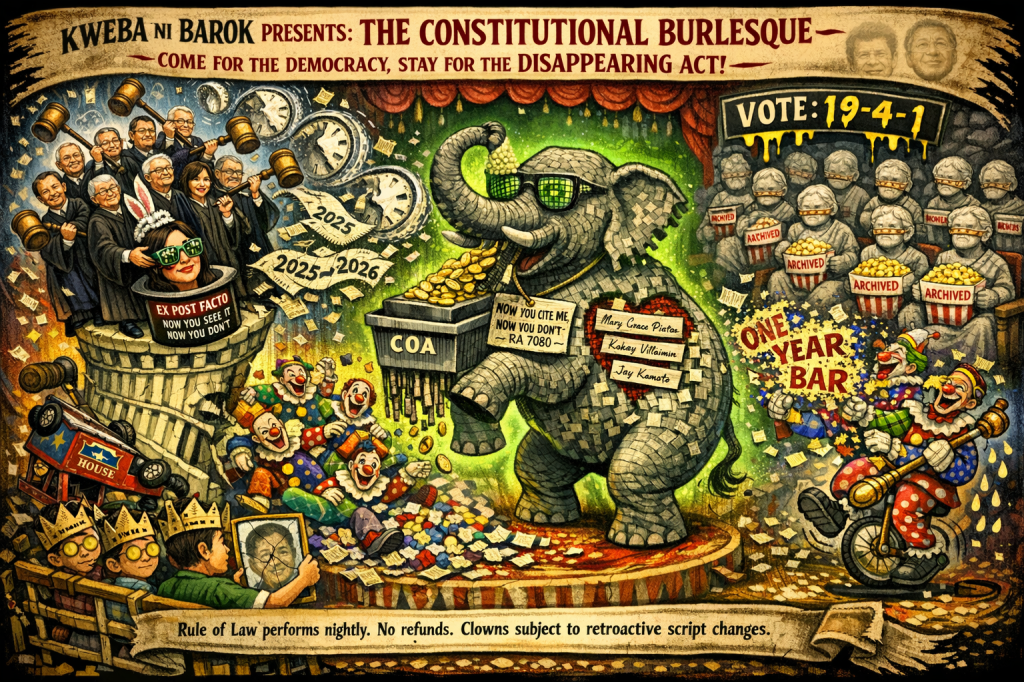
House Clowns, Senate Cowards, and an Ivory Tower Coup: A Constitutional Trial in Three Acts
By Louis ‘Barok‘ C. Biraogo — January 6, 2026
MGA ka-kweba, gather ’round this digital bonfire of vanities, where the flames lick at the feet of our so-called guardians of the Republic. It’s your humble scribe, Barok, back from the trenches of Manila’s legal labyrinth, armed with a quill dipped in acid and a heart full of constitutional fire. Today, we dissect the festering wound that is the impeachment and plunder saga of Vice President (VP) Sara Duterte—ignited anew by retired Justice Antonio Carpio’s pronouncements, like a phoenix rising from the ashes of procedural absurdity. This isn’t just a scandal; it’s a full-blown constitutional burlesque, where the actors trip over their robes while the audience—the Filipino people—pays the ticket price in eroded trust. Let us eviscerate this circus with the precision of a scalpel and the glee of a satirist, anchoring every thrust in the cold steel of law and fact.
1. Deconstructing the Circus
The Carpio Gambit
Uyy, Justice Carpio, thou art a constitutional Cassandra indeed—or perhaps a sly chess grandmaster, moving pawns while the board burns? In his interview with the Manila Standard, Carpio boldly asserts that a fresh impeachment complaint against VP Duterte can gallop forward, even as the House’s Motion for Reconsideration (MR) languishes in the Supreme Court’s inbox like an unread love letter from a jilted suitor. He hinges this on the Court’s retroactive application of new impeachment rules, which voided the 2025 complaint for breaching the one-year bar under Article XI, Section 3(5) of the 1987 Constitution: “No impeachment proceedings shall be initiated against the same official more than once within a period of one year.”
Valid? Legally, it’s a mixed bag of brilliance and bravado. Carpio’s “retroactivity” argument cleverly sidesteps the principle against ex post facto laws (Article III, Section 22 of the 1987 Constitution), which bars retroactive penalties that disadvantage the accused—here, the House’s bungled filings. But wait, irony alert: Ex post facto typically shields criminals, not congressional clowns. Carpio’s not wrong that the voiding resets the clock to February 6, 2026, allowing a new stab without awaiting MR resolution. Yet, is he a prophet warning of impunity, or a player in the anti-Duterte orchestra? His critique exposes the SC’s interpretative sleight-of-hand on “initiation”—shifting it from mere filing to committee referral—but it risks endorsing harassment, the very evil the bar was meant to prevent.
The Supreme Court’s ‘Kafkaesque’ Rule-Making
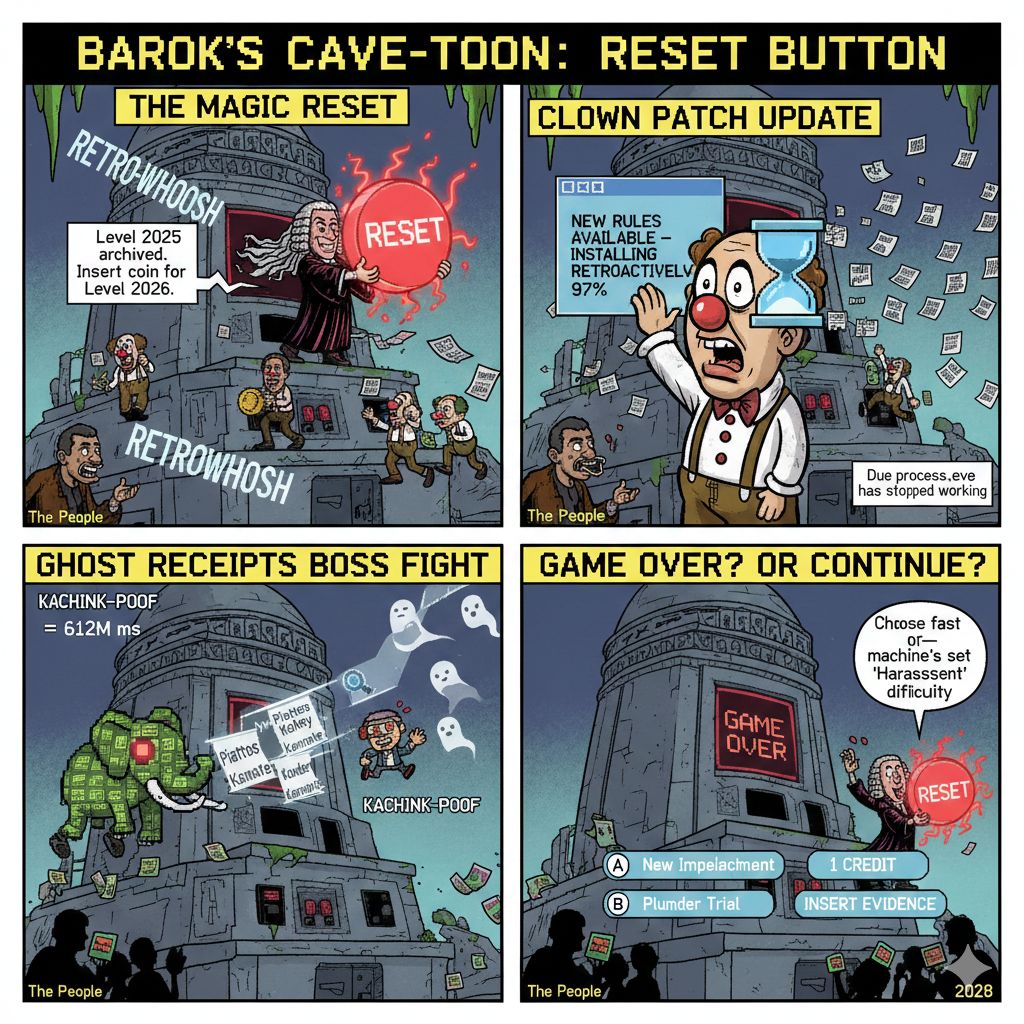
And now, to the Brethren in their Ivory Tower, those Honorable Members of the Solomonic Temple, who in Duterte v. House of Representatives (2025) wielded their gavel like a magician’s wand, retroactively imposing rules that turned the House’s impeachment into a procedural phantom. Was this a necessary correction to enforce due process at all stages, as they piously proclaimed? Or a blatant judicial coup de main, overreaching into Congress’s exclusive domain under separation of powers? Contrast this activist flair with their historical timidity in political questions—remember Francisco v. House of Representatives (G.R. No. 160261, November 10, 2003), where the Court struck down a second impeachment against Chief Justice Davide for violating the one-year bar, but only after affirming judicial review for “grave abuse of discretion”? Back then, they measured consistency; now, it’s hypocrisy on steroids. The retroactive twist smacks of ex post facto mischief, punishing the House for rules that didn’t exist when they filed. Kafka would applaud: a trial where the rules are written after the verdict.
2. Prosecuting the Scandal (Beyond the Legalese)
The “Confidential Fund” Farce
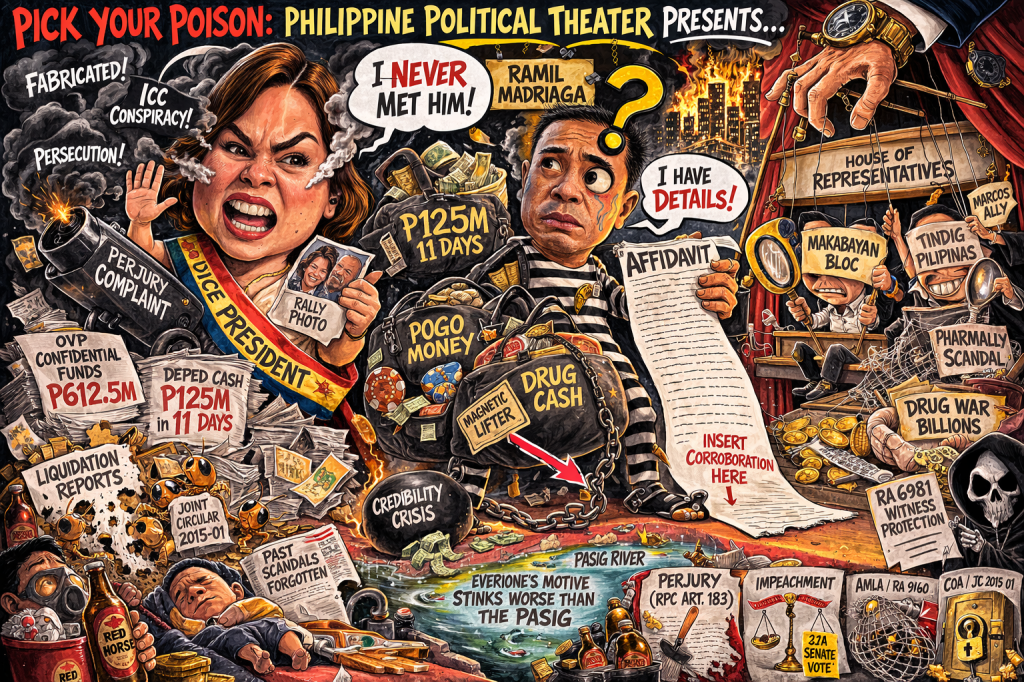
Ah, the P612.5 million in confidential funds—nay, let’s balloon it to the Commission on Audit (COA)-flagged P2.762 billion, including P650 million in 2023 unliquidated mysteries—that vanished faster than a politician’s principles at election time. We’re not talking mere accounting errors; this is a masterpiece of creative writing, featuring receipts signed by “Mary Grace Piattos,” “Kokoy Villamin,” and “Jay Kamote”—pseudonyms so absurd they insult the nation’s collective IQ, as if the Office of the Vice President (OVP) and Department of Education (DepEd) were scripting a bad sitcom instead of safeguarding public trust. Frame it legally: This screams violations of Republic Act (RA) No. 3019 (Anti-Graft and Corrupt Practices Act, Section 3(e)), causing undue injury through manifest partiality) and RA No. 7080 (Plunder Law), amassing ill-gotten wealth over P50 million via misuse). Toss in COA guidelines demanding proper liquidation, and RA No. 6713 (Code of Conduct and Ethical Standards for Public Officials and Employees, Section 7), mandating transparency)—all trampled like confetti at a fiesta. P125 million in 11 days? That’s not intelligence gathering; that’s a heist disguised as national security, with “ghost recipients” haunting the ledgers.
The Political Bedlam
But oh, the intrigue! This isn’t isolated; it’s a toxic cocktail of Philippine Offshore Gaming Operators (POGO) whispers funding Duterte’s empire, Department of Public Works and Highways (DPWH) “budget insertions” ballooning to P1 billion for allies, the Marcos-Duterte feud simmering like adobo gone bad, and the 2028 electoral shadowboxing where impeachment becomes a cudgel, not a scalpel. Rumors swirl of drug ties via hubby Mans Carpio, International Criminal Court (ICC) ghosts from daddy’s era, and Duterte’s “arrogance” in dodging accountability, all amplified on X like a digital echo chamber. These poisons infect the legal veins, transforming impeachment and plunder complaints into weapons of clan warfare—Marcos vs. Duterte—rather than beacons of justice. Public opinion splits like a rotten mango: 50% see harassment, the rest demand blood. It’s bedlam, folks, where ethics (Article XI, Section 1 of the 1987 Constitution: public office as public trust) drown in the swamp of ambition.
3. Staging a Constitutional Trial of the Institutions
The House of Clowns
Enter the House, that vaudeville troupe filing multiple complaints like confetti, triggering the one-year bar and earning a SC smackdown. Incompetent? Or cunning foxes, testing waters for political gain? Their procedural bungling—archiving the first three on February 5, 2025, then rushing a fourth—reeks of amateur hour, violating Article XI, Section 3(5) and due process basics. Yet, in their defense, the SC’s retroactive redefinition of “initiation” caught them mid-act, like changing the rules in a game of patintero.
The Senate’s Silent Acquiescence
Then the Senate, those august spectators, voting 19-4-1 to “archive” the articles post-SC ruling—a move as bold as a whisper in a typhoon. Prudence? Or cowardice, dodging a trial that might expose Duterte allies? This silent bow to judicial fiat mocks their role as impeachment court, turning accountability into a shelf ornament.
The Supreme Court’s “Activist” Turn
Ah, the crowning hypocrisy: The Solomonic Temple’s vigorous defense of due process for the VP, retroactively voiding proceedings while preaching separation of powers. Judicial overreach in procedural drag! Does this outweigh their historic duty as a check on power? In Francisco, they intervened sparingly; now, they rewrite rules mid-game. Is the Court guarding the Constitution or the political status quo, shielding a dynasty from the mob? We demand answers, Brethren—your activism smells of convenience, not conviction.
4. Adjudicate All Possible Endgames
Mapping the labyrinth:
- A new impeachment in 2026—House refiles post-bar, endorsed by Akbayan types; Senate trials, acquittal likely via Duterte loyalists (winners: Sara, maintaining 2028 momentum; losers: accusers, branded harassers; collateral: Precedent for endless filings, eroding stability).
- Plunder indictment at the Office of the Ombudsman (Ombudsman, governed by RA No. 6770)—evidence mounts, Sandiganbayan convicts (winners: justice advocates; losers: Dutertes, facing prison and disqualification; damage: Public faith in anti-corruption, if swift, or cynicism if delayed).
- Grand bargain—political truce, resignation, or fade-out (winners: Marcos clan; losers: transparency; Republic suffers forgotten scandals).
- SC denies MR, solidifying rules (winners: procedural purists; losers: Congress; damage: Weakened checks).
Prognosticate: 2028 elections? Duterte weakened, Marcos ascendant, but polarization festers. Public trust? Plummets, with 50% already skeptical. Confidential funds? Stricter COA audits. Rule of law? Anemic already, this could be the fatal bleed—precedents like Francisco reinforced, but at the cost of institutional warfare.
5. The Peroration – A Call to Arms
In this theater of the absurd, where confidential funds vanish like smoke and institutions pirouette around accountability, we must roar: Supremacy to the rule of law, not the rule of men, connections, or shadowy slush funds! This scandal holds a mirror to our Republic’s pockmarked face—reflecting graft, intrigue, and hypocrisy that would make Machiavelli blush.
To the Ombudsman: Act with haste and independence, shielded from the political gale—indict on RA 7080 if the evidence bites, don’t let plunder dissolve in delays.
To Congress: Amend your rules, grow a spine sans histrionics—clarify “initiation” legislatively, but honor Article XI without turning impeachment into a circus tent.
To the Supreme Court: Reclaim your legacy, Brethren—rule on the MR with transparent logic, consistent with Francisco, not convenient for the powerful.
And to you, the public: Demand accountability, not spectacle—petition, vote, rage against the machine that treats public trust like Piattos crumbs.
Rise, Philippines, or watch the web of folly ensnare us all. Until next time, from the kweba—stay vigilant, stay savage.
Kweba closed. Circus continues.
– Barok
Key Citations
Primary Legal Sources
- “The 1987 Constitution of the Republic of the Philippines.” Official Gazette of the Republic of the Philippines. Accessed 4 Jan. 2026.
- Francisco, Jr. v. House of Representatives, G.R. No. 160261, Supreme Court of the Philippines, 10 Nov. 2003, LawPhil Project.
- Republic Act No. 3019, Anti-Graft and Corrupt Practices Act, 17 Aug. 1960, Official Gazette of the Republic of the Philippines.
- Republic Act No. 6713, Code of Conduct and Ethical Standards for Public Officials and Employees, 20 Feb. 1989, Official Gazette of the Republic of the Philippines.
- Republic Act No. 6770, The Ombudsman Act of 1989, 17 Nov. 1989, Official Gazette of the Republic of the Philippines.
- Republic Act No. 7080, An Act Defining and Penalizing the Crime of Plunder, 12 July 1991, Official Gazette of the Republic of the Philippines.
Primary News Article


 KWEBA ni BAROK
Leave a comment