Boying Drops the Bomb: ‘Matindi Ho ‘Yung Judiciary’ – As If We Didn’t Already Suspect It
By Louis ‘Barok‘ C. Biraogo — January 6, 2026
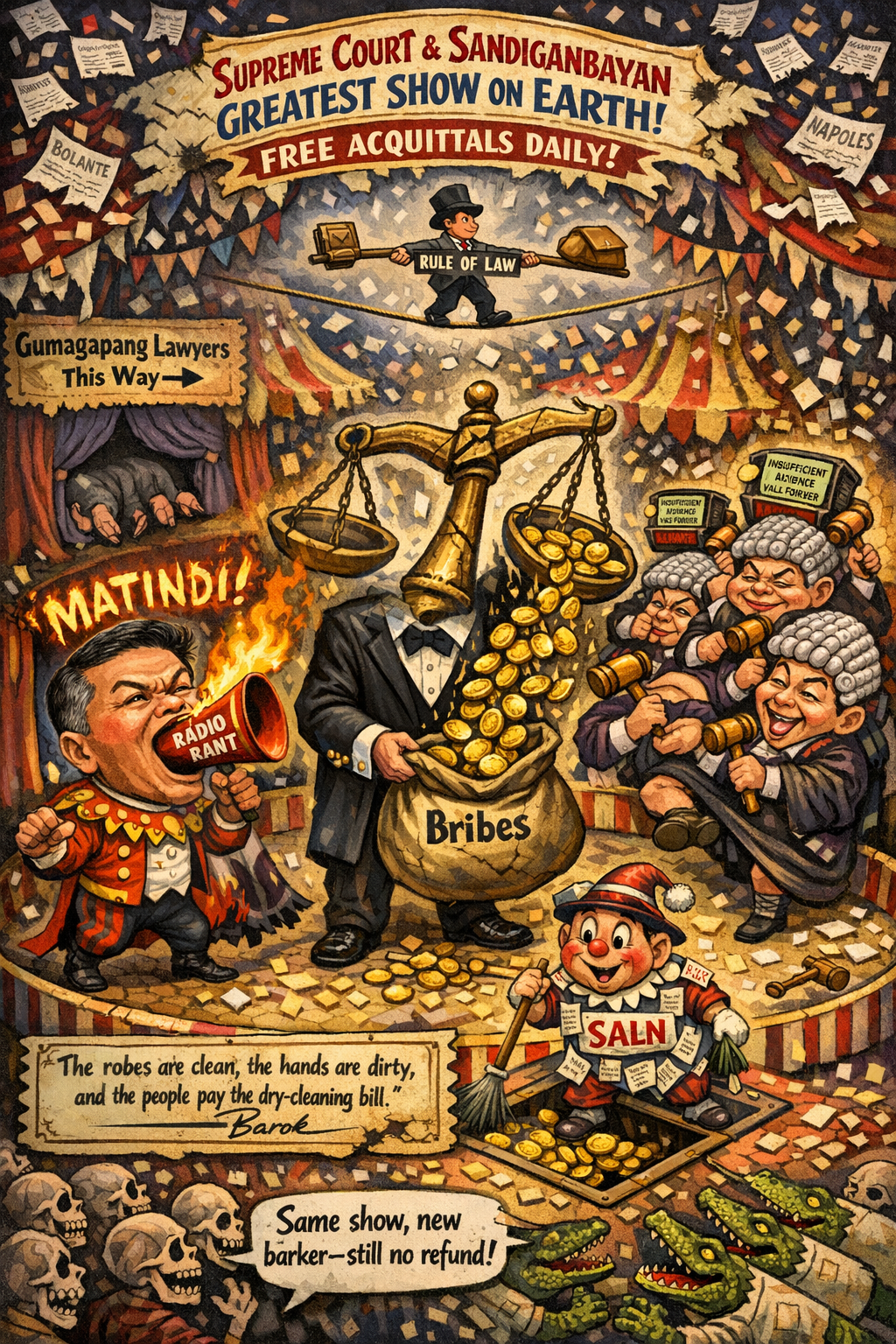
In a radio rant that scorched the sacred veil of inter-branch comity, Ombudsman Jesus Crispin “Boying” Remulla just lit a match under the judiciary’s robe, declaring corruption there “matindi” too. Farewell to the polite fiction that graft stops at the courtroom door – hello to open warfare between the graft-buster and the bench.
MGA ka-kweba, buckle up. Our freshly minted Ombudsman – appointed in late 2025 amid whispers of political favoritism – decided his New Year’s resolution was to torch the fragile truce between constitutional branches. On his dzRH radio show, Boying didn’t whisper; he bellowed that corruption isn’t just an executive or legislative vice – it’s “severe” in the judiciary. And to drive the point home, he mocked the Sandiganbayan (the Philippines’ anti-graft court) as magicians extraordinaire at acquittals. Oh, the delicious irony: the protector of the people publicly prosecuting the dispensers of justice.

Prosecutor vs. Bench: The Anatomy of an Accusation
Let’s dissect Boying’s broadside like a frog in law school. He zeroed in on the Sandiganbayan’s “galing” at finding “lahat ng dahilan para mag-acquit.”
- Exhibit A: The 2016 acquittal of Joc-Joc Bolante in the P723-million fertilizer fund scam – a case so ripe for plunder it practically smelled like overripe durian, yet poof, gone on insufficient evidence.
- Exhibit B: The Priority Development Assistance Fund (PDAF) pork barrel bonanza, where heavyweights like the late Juan Ponce Enrile, Gigi Reyes, and Janet Lim-Napoles danced free in late 2025 on graft counts, despite what Remulla insists was ironclad evidence from his office. “Huling-huli ‘yun,” he fumed. You can’t blame the Ombudsman for weak proof, he says – implying the bench twisted itself into pretzels to let them walk.
These aren’t legal masterpieces; they’re judicial contortions worthy of a circus. The Sandiganbayan, tasked with anti-graft glory, has a habit of turning slam-dunks into airballs. Is it rigorous adherence to “beyond reasonable doubt,” or something more… transactional?
Enter the Integrated Bar of the Philippines (IBP), stage left, with their velvet-gloved rebuttal. IBP President Allan Panolong agrees corruption “exists” (how generous), praises the Supreme Court’s Judicial Integrity Board as a cure-all, and insists it’s not “rampant.” More ethical judges than corrupt ones, he claims, and Sandiganbayan decisions rest purely on evidence appreciation. This is a press conference in tailored barong versus Boying’s street-brawl radio tirade – one side polishing the halo, the other swinging a sledgehammer.
The “Boying” Calculus: Motive, Method, and Mayhem
Why now, Boying? Fresh off his controversial appointment – criticized even by VP Sara as a pick she wouldn’t make – Remulla’s been positioning himself as the anti-corruption disruptor: vowing AI tools, shorter deadlines, and direct appeals to the Supreme Court on lost cases. Is this genuine reformer’s zeal, spotting a cancer the establishment ignores?
Or cynical deflection? His office loses big cases – Bolante, Enrile, Revilla, Estrada – and suddenly the bench is the villain, not prosecutorial fumbles. Maybe it’s intimidation: a warning shot to judges ahead of flood control mega-scandals or other marquee probes. Or pure political theater for the Marcos base, burnishing that tough-on-graft image while excusing future flops.
Then there’s the “gumagapang” gambit – those shadowy lawyers who “crawl” through corridors, lobbying outcomes with envelopes thicker than case folders. No names, of course (libel chills even the boldest), but we all know the rumors: fixers whispering to clerks, intermediaries “facilitating” for a fee, a parallel justice system where merit bows to money. It’s the open secret fueling public cynicism – cases decided not in open court, but in backrooms over coffee and cash.
The Law of the Jungle vs. The Rule of Law
Here’s the meat, mga kaibigan: Remulla’s outrage has constitutional teeth. Under Article XI of the 1987 Philippine Constitution, the Ombudsman is the people’s protector, empowered by Republic Act No. 6770 (The Ombudsman Act of 1989) to investigate any public official – including judges – for graft. History backs him: remember the “hoodlums in robes” era? The mandate isn’t polite suggestion; it’s muscular probe power.
But hold the applause. Leaping from acquittal to corruption is a logical somersault that tramples judicial independence under Article VIII of the 1987 Philippine Constitution. Acquittals aren’t proof of bribery; they’re the Bill of Rights in action – guilt beyond reasonable doubt, or freedom. The Supreme Court has slapped down overreach before: in Maceda v. Vasquez, it ruled the Ombudsman can’t casually probe judges for duty-related acts without first referring to the Court’s administrative supervision. Fabian v. Desierto reinforced boundaries. Remulla’s radio grandstanding risks spiteful rulings against his office – judges are human, after all.
And those safeguards? The New Code of Judicial Conduct for the Philippine Judiciary, Judicial Integrity Board (now reorganized as the Judicial Integrity Office under A.M. No. 23-12-05-SC) – noble on paper, but bureaucratic mazes in practice. A club protecting its own, where complaints vanish into labyrinths while the powerful skate.
The Fallout: A Nation of Cynics
Boying just said the quiet part loud: the judiciary isn’t pristine. Public service or poison? He might lance a festering wound, forcing scrutiny on a branch Filipinos already distrust. Or he’s dousing justice’s well with gasoline, breeding deeper cynicism – why respect courts if even the Ombudsman calls them corrupt?
Institutional war looms. Will the Supreme Court cite him for contempt, or quietly seethe as graft cases sour? Judges ruling against the Ombudsman out of pique? A full-blown constitutional crisis beckons.
His “solutions” – 20 new lawyers by Jan. 15, proposed Ombudsman marshals for enforcement, tight deadlines – smell like PR band-aids. Flashy hires and muscle won’t fix systemic rot if prosecutions remain sloppy or evidence leaks like a sieve.
The Verdict of Barok
Boying’s methods are chaotic, his rhetoric a flamethrower in a library – but damn if he isn’t shining a floodlight on a real tumor. Judicial corruption isn’t myth; it’s the whispered plague the bar prefers hallway gossip over hallway reckoning. Acquittals in blockbuster scams aren’t always justice; sometimes they’re escape hatches for the connected.
We need brutal reforms: mandatory, forensic-audited public Statements of Assets, Liabilities, and Net Worth (SALNs) for all judges; real-time online case tracking with logs of every motion, interlocutor, and delay; and a truly independent anti-graft body – not the self-policing Integrity Board – to probe those crawling lawyers and hooded robes.
In the end, the cruelest irony: the people’s protector risks shattering faith in justice to salvage it. But if Boying forces the club to clean house, perhaps the bomb was worth the blast. Or maybe we’ve just watched the rule of law commit seppuku on live radio. Panoorin natin – indeed.
The robes are clean, the hands are dirty, and the people pay the dry-cleaning bill. Salamat sa comedy show, mga mahal na hukom.
– Barok
Key Citations
- Andal, Jonathan. “Corruption in Judiciary Also Severe — Ombudsman Remulla.” GMA News Online, 2 Jan. 2026. Accessed 4 Jan. 2026.
- Republic Act No. 6770, The Ombudsman Act of 1989, 17 Nov. 1989, LawPhil Project.
- Republic Act No. 3019, Anti-Graft and Corrupt Practices Act, 17 Aug. 1960, LawPhil Project.
- Supreme Court of the Philippines. “Article VIII: Judicial Department.” The 1987 Constitution of the Republic of the Philippines, 1987.
- Supreme Court of the Philippines. “Article XI: Accountability of Public Officers.” The 1987 Constitution of the Republic of the Philippines, 1987.
- Supreme Court of the Philippines. Maceda v. Vasquez, G.R. No. 102781, 22 Apr. 1993, LawPhil Project.
- Supreme Court of the Philippines. Fabian v. Desierto, G.R. No. 129742, 16 Sept. 1998, Supreme Court E-Library.
- Philippines, Supreme Court. “SC Approves A.M. No. 25-04-04-SC, The 2025 Code of Judicial Conduct and Accountability.” Supreme Court of the Philippines, 13 Nov. 2025.
- ₱75 Million Heist: Cops Gone Full Bandit

- ₱6.7-Trillion Temptation: The Great Pork Zombie Revival and the “Collegial” Vote-Buying Circus

- ₱1.9 Billion for 382 Units and a Rooftop Pool: Poverty Solved, Next Problem Please

- ₱1.35 Trillion for Education: Bigger Budget, Same Old Thieves’ Banquet

- ₱1 Billion Congressional Seat? Sorry, Sold Out Na Raw — Si Bello Raw Ang Hindi Bumili

- “We Will Take Care of It”: Bersamin’s P52-Billion Love Letter to Corruption
- “Skewed Narrative”? More Like Skewered Taxpayers!

- “Scared to Sign Vouchers” Is Now Official GDP Policy – Welcome to the Philippines’ Permanent Paralysis Economy

- “Robbed by Restitution?” Curlee Discaya’s Tears Over Returning What He Never Earned

- “My Brother the President Is a Junkie”: A Marcos Family Reunion Special

- “Mapipilitan Akong Gawing Zero”: The Day Senator Rodante Marcoleta Confessed to Perjury on National Television and Thought We’d Clap for the Creativity

- “Just Following Orders” Is Dead: How the Hague Just Turned Tokhang’s Finest Into International Fugitives



 KWEBA ni BAROK
Leave a comment