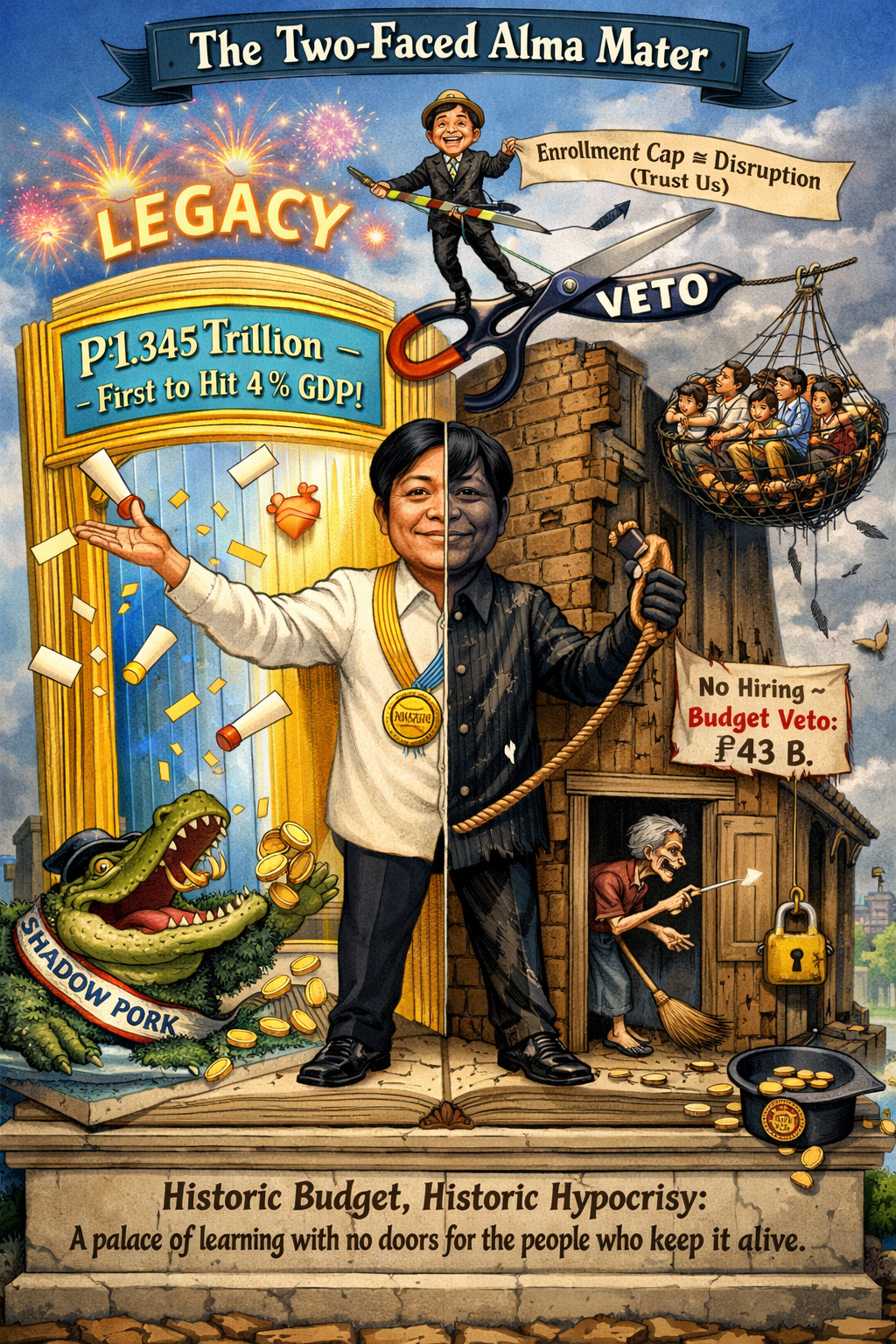
Marcos Delivers UNESCO Dreams While Delivering Nightmares to Contract Professors
By Louis ‘Barok‘ C. Biraogo — January 8, 2026
IN A small provincial classroom, a quiet hero clocks in for her 20th year of temporary work. Professor Elena, 59, doesn’t have job security, a pension, or an office she can call her own. What she does have is love—for the history she teaches, the future teachers she guides, and the glorious flexibility of her 10-month contract. Who needs benefits when you have purpose? Who needs stability when every May brings the exhilarating mystery of whether you’ll be rehired? Her story isn’t a cautionary tale; it’s a testament to the unsung, disposable heart of higher education.
Now, as retirement age approaches, she is afraid: What if her terminal leave benefits are delayed or outright denied? What if the bright kids who topped their public high schools in her town—children of farmers and fishermen—are suddenly told, “Sorry, we’re fully enrolled,” simply because there are no new teachers or staff that can be hired?
This is the human face of President Ferdinand Marcos Jr.’s P43.245-billion veto in the 2026 national budget. It is not an abstract number in Malacañang’s ledger. It is a life quietly unraveling—in the most polite, bureaucratic way possible..
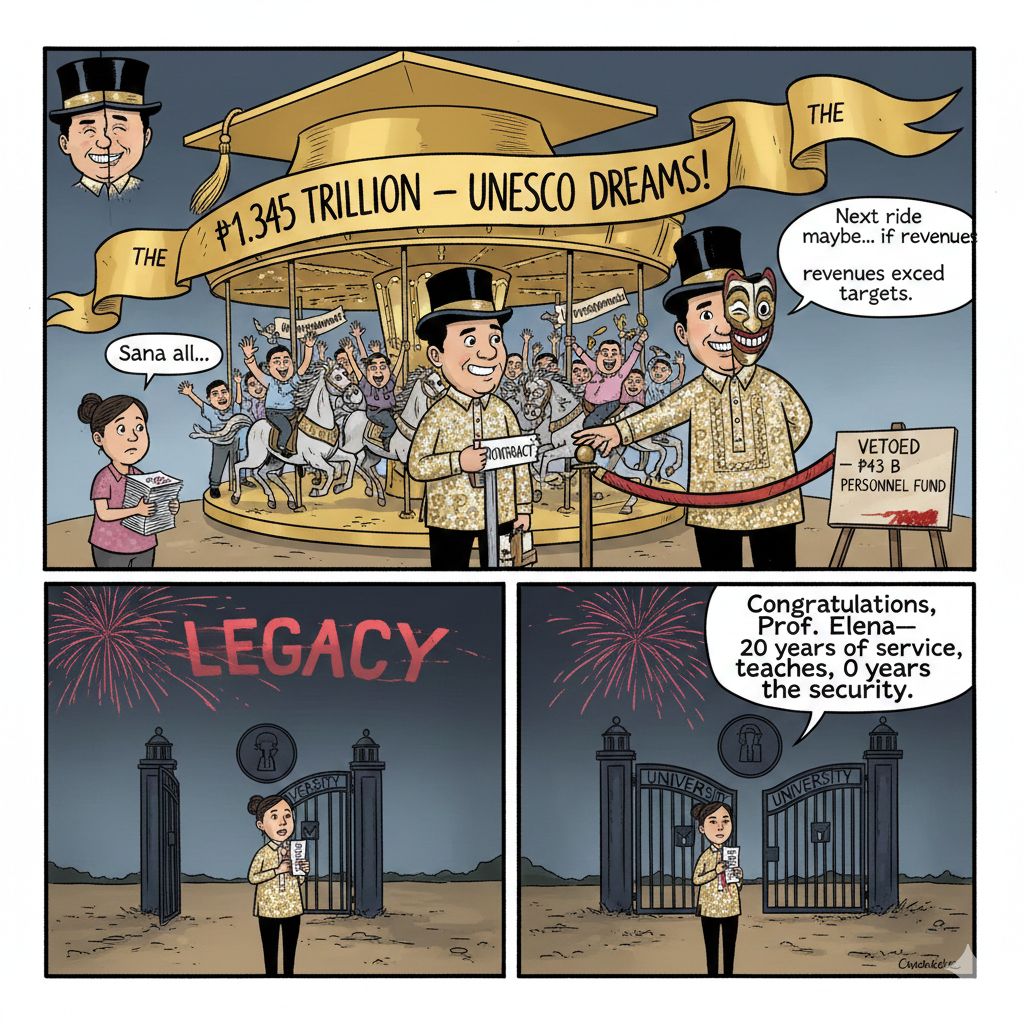
The Two Faces of Truth
First, let us admit: Marcos is not wrong to be wary of unprogrammed appropriations.
These standby funds—spendable only when government revenues exceed targets—have long been branded “shadow pork” by budget watchdogs like the People’s Budget Coalition. Their release mechanisms are opaque, easily weaponized for political leverage, and often serve as backdoors for discretionary spending. When Marcos declared they are “not blank checks,” he was right. In an era of debt and global uncertainty, fiscal discipline matters. The watchdogs cheered—finally, a veto striking at potential cesspools of corruption rooted in the pork-barrel scandals of the past.
But the second truth hurts more:
State universities and colleges (SUCs) do not run on fiscal prudence alone. They run on people.
On contract instructors like Prof. Elena, on janitors and clerks with no security, on overworked lab technicians. When CHED Chairperson Shirley Agrupis warned that enrollment might have to be capped due to hiring uncertainty, she was not being dramatic. It was reality: No responsible university president will admit thousands of new students without confidence that someone will teach them.
The contradiction? This veto comes from the very same administration that delivered a record-high education budget—P1.345 trillion, the first time the Philippines has met the UNESCO benchmark of 4–6% of GDP. The macro picture is grandiose, but at the micro level, it feels like building a palace while locking the cleaners and adjuncts in the basement.
Shirley Agrupis’s Bureaucratic Judo
Agrupis walks a tightrope.
On one hand, she acknowledges the problem:
“Very problematic now in higher education institutions.”
She says enrollment caps are possible if hiring clarity does not come soon.
On the other hand, reassurance mode:
- No disruption to the teaching environment
- Agencies can still justify additional contract workers if there are “additional deliverables”
- Everyone is simply waiting for ROSS II to convert administrative contracts into permanent positions
Bravo for the balancing act—bureaucratic judo at its finest.
But let us ask: Why the judo? Why not a straight answer to the contract workers’ question: When will we finally become regular employees? Her “no data yet” on how many workers are affected feels like saying, “Let’s not count the wounds while they’re still bleeding.” Is she pragmatic, or an apologist minimizing fallout for the administration?
The Grand Irony of Marcos Jr.
And President Marcos? Ah, the schizophrenia of scale.
In one hand, historic generosity:
The largest education allocation ever—surpassing:
- Duterte (steady increases but never reached the UNESCO threshold)
- Aquino (consistent growth but smaller in scale)
- Arroyo (operating with far less fiscal space)
Credit where it is due—this is the first administration to deliver the scale long demanded by UNESCO.
In the other hand, the micro-cruelty of the veto.
Why veto funds you yourself proposed in the National Expenditure Program? No explanation, no commitment to supplemental appropriations.
Rep. Antonio Tinio of ACT Teachers put it sharply:
“Another year as underpaid yet overworked.”
Tinio is right—his critique cuts like a scalpel. Yet even he, from the vantage of opposition politics, sometimes oversimplifies: This fiscal maze is not black-and-white; there is real shadow pork that needs cutting.
The political calculus? Is this legacy-cleansing after past scandals? Appeasement of watchdogs to look anti-corruption? Or simply control—centralizing executive discretion while starving institutions of predictability?
The Root of All Evil: Unprogrammed Appropriations
Let us not forget the root of all evil: unprogrammed appropriations themselves.
Not just a line item; a symptom of a sick system. A backdoor for leverage, a perennial source of uncertainty that cripples long-term planning in SUCs. It traces its lineage straight back to the pork-barrel era—from Arroyo through Aquino to Duterte, always these shadow funds serving as vehicles for patronage.
Now, in the name of transparency, P43 billion for personnel has been slashed—yet the grandeur of the P1.345-trillion education budget loses all meaning if there are no people to run it.
Budget size without sanity and moral implementation?
It is a big house with no doors.
The Manifesto: What Must Be Done
The veto is a step, not victory. One limb of the resurrected pork barrel has been severed, but the body still writhes. Half-measures will not do. The demands must be uncompromising:
- Hold Congress accountable.
Investigate the Bicameral Committee’s midnight shift of mandatory personnel funds into unprogrammed appropriations. Let the Ombudsman and COA expose every insertion. If laws were broken, let consequences follow. - Make personnel benefits untouchable.
Legislate an iron-clad rule: salaries, upgrades, retirement, and terminal leave must forever remain programmed obligations — never contingent on revenue roulette. - Regularize the contractual precariat now.
Accelerate ROSS II. Convert job-order and contract-of-service workers in SUCs and government into permanent plantilla positions. Justice delayed is justice denied. - Impose merciless transparency on remaining unprogrammed funds.
Real-time public logging, clear triggers, named beneficiaries, independent oversight. Any surplus must first fund mandated benefits — not pet projects. - Take it to the Supreme Court.
Petitioners — unions, faculty, retirees, citizens — must challenge the very existence of unprogrammed appropriations for foreseeable obligations. Invoke Belgica and Araullo. Finish what those rulings started.
This is not compromise. This is completion.
The fight against shadow pork does not pause with a veto — it escalates.
Prof. Elena deserves certainty.
The students at the gates deserve open doors.
The Filipino people deserve a budget without tricks.
Until the entire mechanism is uprooted, the Kweba will keep shouting.
The Final, Biting Question
The President has drawn his pen across one limb of the resurrected pork barrel. Good — but is that enough?Will this administration settle for cutting a single tentacle while the body of unprogrammed appropriations still writhes, still hungers, still gambles with the livelihoods of teachers, soldiers, and retirees?
Or will it finish the job — uproot the entire mechanism, burn the shadow ledgers, and give Prof. Elena, her students, and every civil servant the certainty they have earned through decades of service?
The veto bought time.
The Filipino people are still waiting for justice.
The Kweba watches.
And we will not stop asking.
- — Barok, from the depths.
Citations:
- “’Uncertain pay’: P43B for gov’t salaries, benefits moved to unprogrammed funds in 2026.” Philstar.com, 2 Jan. 2026.
- Belgica v. Ochoa, G.R. No. 208566, Supreme Court of the Philippines, 19 Nov. 2013, LawPhil Project.
- Araullo v. Aquino, G.R. No. 209287, Supreme Court of the Philippines, 1 July 2014.
- ₱75 Million Heist: Cops Gone Full Bandit

- ₱6.7-Trillion Temptation: The Great Pork Zombie Revival and the “Collegial” Vote-Buying Circus

- ₱1.9 Billion for 382 Units and a Rooftop Pool: Poverty Solved, Next Problem Please

- ₱1.35 Trillion for Education: Bigger Budget, Same Old Thieves’ Banquet

- ₱1 Billion Congressional Seat? Sorry, Sold Out Na Raw — Si Bello Raw Ang Hindi Bumili

- “We Will Take Care of It”: Bersamin’s P52-Billion Love Letter to Corruption

- “Skewed Narrative”? More Like Skewered Taxpayers!

- “Scared to Sign Vouchers” Is Now Official GDP Policy – Welcome to the Philippines’ Permanent Paralysis Economy

- “Robbed by Restitution?” Curlee Discaya’s Tears Over Returning What He Never Earned

- “My Brother the President Is a Junkie”: A Marcos Family Reunion Special

- “Mapipilitan Akong Gawing Zero”: The Day Senator Rodante Marcoleta Confessed to Perjury on National Television and Thought We’d Clap for the Creativity

- “Just Following Orders” Is Dead: How the Hague Just Turned Tokhang’s Finest Into International Fugitives






 KWEBA ni BAROK
Leave a comment