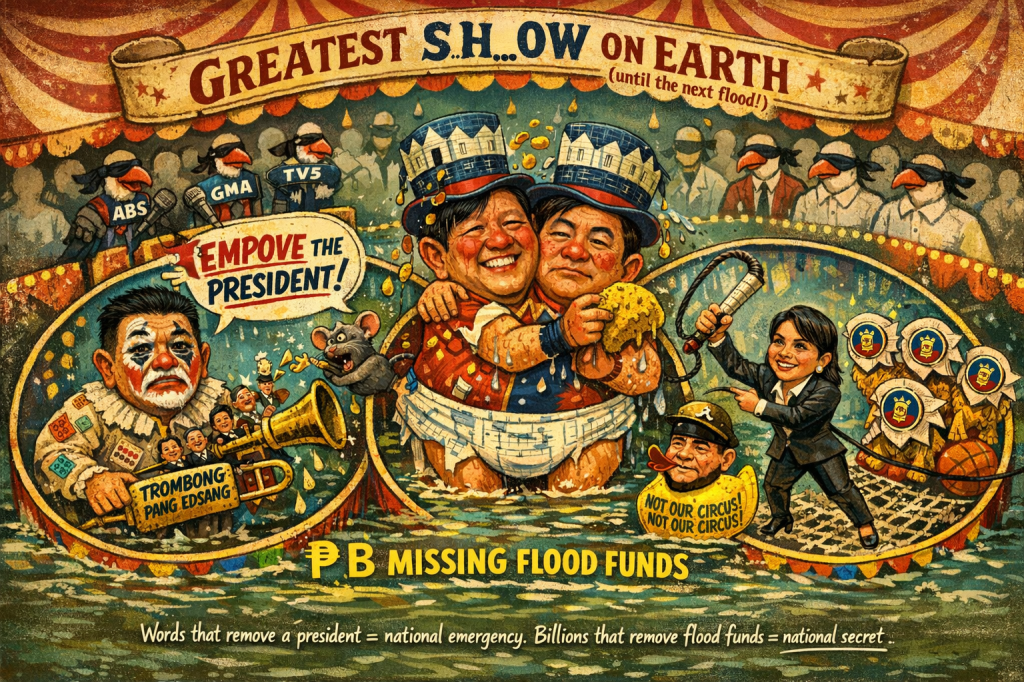
Words That “Remove the President” = National Emergency; Billions That Remove Flood Funds = National Secret
By Louis ‘Barok‘ C. Biraogo — January 8, 2926
MGA ka-kweba, welcome to the latest episode of Philippine Political Telenovela: Dynasty Edition. This time, our anti-hero is none other than Luis “Chavit” Singson—the jueteng whistleblower turned perpetual provocateur—who’s calling for a “one-time, big-time” rally to boot President Ferdinand Marcos Jr. out of Malacañang over alleged billion-peso graft in flood control projects. Malacañang’s lawyer-spokesperson Atty. Claire Castro fires back: that’s inciting to sedition (Philippine Daily Inquirer, 7 Jan. 2026). The Department of Justice (DOJ) gets the hot potato, and the Armed Forces of the Philippines (AFP) politely says, “Not our circus, not our monkeys.” Let’s dissect this circus with the scalpel of the law, a dash of sarcasm, and zero tolerance for hypocrisy.

1. The Cast of Clowns & Their Scripts
First, the players.
Luis “Chavit” Singson:
The aging warlord from Ilocos Sur, once a Marcos ally, now positioning himself as the avenging angel against corruption. He urges religious groups for a massive rally “ASAP,” appeals to the military and police (“you get crumbs while others take billions”), and dares Marcos and Martin Romualdez to a debate on flood control anomalies. Classic Chavit: part whistleblower (remember EDSA II and Estrada’s jueteng?), part showman, part opportunist with his own plunder complaints hanging over him like a bad hangover. His script? “I’m the brave truth-teller fighting graft!” Underlying motive: personal grudge after falling out with the Marcos camp over projects, contracts, or just plain ego. The absurdity? A man facing graft raps himself demanding the President’s head on a platter.
Atty. Claire Castro:
Palace press officer and self-proclaimed lawyer-on-duty. She opines that calling to “remove the President” is inciting to sedition, then quickly passes the buck: “Up to the DOJ.” Her dismissal of the debate challenge—“The President is busy; action, not vacation”—is pure snark wrapped in loyalty. Script: Defender of the realm, shielding the busy Chief Executive from pesky debates. Underlying theater: Loyal attack dog signaling “we’re not amused” while avoiding direct executive overreach. Absurdity? A lawyer invoking sedition for words while her boss faces zero probes on the very corruption allegations Chavit raises.
The AFP
Col. Francel Margareth Padilla’s response perfectly upholds Article II, Section 3 of the 1987 Constitution (civilian supremacy) and the AFP’s duty to protect the people and State—strictly under civilian authority. She delivers the no-nonsense line: anti-corruption is great, but leave it to civilian courts. No applause for Chavit’s military bait. Tension is low here, yet it highlights the danger—any military flirtation with unrest breaches civilian supremacy. Good job staying neutral; shame for not pushing harder on the corruption claims.
This isn’t principled discourse; it’s elite infighting dressed as national crusade.
2. Legal Thunderdome: The Seditious Spectacle
For Prosecution: Castro’s “Inciting to Sedition” Claim
Atty. Castro argues that encouraging people to “overthrow” or “remove” the President fits inciting to sedition under Article 142 of the Revised Penal Code (RPC) (as amended by Republic Act No. 10951). The elements: (1) uttering speeches or representations (2) that tend to incite others to sedition (defined in Article 139 of the RPC as public, tumultuous uprising to attain forbidden objects like preventing government functions by force or illegal means). Classic jurisprudence like People v. Perez (G.R. No. L-21049, December 22, 1923) convicted a man for shouting seditious words against the Governor-General, holding that statements tending to instigate rebellion or disturb peace are punishable even without actual uprising. Chavit’s call for a rally to oust the President, plus baiting the military, could be spun as tending to “disturb lawful authorities” or incite “rebellious conspiracies.”
Against Prosecution: Protected Political Speech
Now, let’s pivot hard. Singson’s words are classic political hyperbole—calling for peaceful assembly against corruption, not armed revolt. Protected under Article III, Section 4 (freedom of speech/expression) and Section 8 (peaceable assembly) of the 1987 Constitution of the Republic of the Philippines. Philippine courts favor the clear and present danger doctrine (Chavez v. Gonzales, G.R. No. 168338, February 15, 2008): speech is punishable only if it creates a serious, imminent evil that the State has a right to prevent. Mere calls for resignation or protests? No clear danger here—no advocacy of violence, no tumult yet. Historical sedition cases (e.g., dismissed raps against Duterte critics) show courts hesitate when speech is anti-corruption dissent. Chavit’s rally pitch is EDSA-lite, not coup d’état.
The AFP’s Po-faced Disclaimer
Padilla’s response is textbook adherence to Article II, Section 3 of the 1987 Constitution (civilian supremacy) and the AFP’s constitutional duty as protector of the people and State—but under civilian authority. By redirecting to “legal processes” and urging discernment amid West Philippine Sea tensions, they deftly sidestep Chavit’s bait. Tension? Minimal here, but it exposes the peril: any military wink at political unrest violates civilian supremacy. Bravo for staying in lane; boo for not probing corruption allegations more aggressively.
3. Prosecution Pathways & Legal Quicksand
The DOJ can go motu proprio: fact-finding, subpoenas, preliminary investigation under Rule 112, Rules of Court—determine probable cause, file information in Regional Trial Court (RTC) if warranted. Steps: gather evidence (Chavit’s presscon video, statements), hear counter-affidavits, resolve within months.
Viability? Legally shaky—free speech defenses strong, conviction rare without violence. Politically explosive: pursuing it paints the administration as tyrannical, chilling dissent amid real corruption scandals. Ignoring it risks looking weak. It’s quicksand: a doomed case could boomerang into martyrdom for Chavit.
4. The Shadow Play: Rumors, Intrigues & The Real “Jueteng”
This isn’t random. The Marcos-Singson rift traces to broken alliances post-2022 elections, exacerbated by the massive flood control projects scandal—billions allegedly siphoned through ghost contracts, overpriced pumps, and unfinished dikes, implicating allies of the President and Speaker Romualdez. Chavit, once a Marcos backer, now accuses them of masterminding the “biggest corruption scheme.” Historical grudge? Singson’s jueteng exposé toppled Estrada; now he wants encore against a former friend. Subtext: positioning for relevance, perhaps aligning with Duterte forces amid UniTeam cracks, or angling for flood project scraps gone sour. The real jueteng here is elite gambling with public funds while floods drown the poor.
5. Options, Endgames & Fallout: A Game Theory for Knaves
For Singson: Go full martyr—hold the rally, dare arrest, launch media blitz/counter-suits for libel against accusers. Or pivot to “debate me” circus for relevance. Rebirth as anti-corruption icon or fade as crank.
For Castro/Admin: Full pursuit risks tyrannical optics; silence looks like admitting corruption. Best: let DOJ “independently” decline, then announce flood probes to steal thunder.
For the DOJ: Pursue the sedition complaint aggressively (“wield the sword of justice”), as required by their ethical duty under Canon 1 of the Code of Professional Responsibility—to uphold justice impartially, without fear or favor—or exercise prosecutorial discretion to drop the case and avoid turning the law into a political weapon against critics. Either way, they walk a tightrope: if the public perceives the DOJ as “captured” by Malacañang, its credibility collapses, no matter the decision.
Resolutions: Whitewash (“no probable cause”), charged-but-acquitted trial, backroom truce (debate or joint probe), or rally fizzles/escalates into broader unrest.
6. Supreme Irony & The Rule of Law Mantra
Everyone invokes “rule of law”—Chavit for his exposé, Castro for sedition threat, AFP for legal channels. Hypocrisy jackpot: the side facing billion-peso graft probes cries sedition against words, while ignoring substantive allegations. Selective outrage at its finest—law as cudgel for power, not shield for truth.
7. Barok’s Verdict & Prescriptions
This is elite clownery masquerading as principle. Chavit’s speech is protected bluster; prosecuting it would be folly.
To the DOJ: Act independently—probe sedition claim and drop it fast for lack of clear danger, but launch real investigation into flood control graft. Admit capture or prove neutrality.
To the Public: See this for what it is—dynastic spat, not revolution. Demand accountability on corruption, not rallies.
To the Media: Stop the sedition sideshow; forensic dive into the billions missing in flood projects.
Equal law for all, not a toy for the powerful. Or else, we’re all drowning—not in floods, but in bullshit.
Barok
Kweba ni Barok
January 8, 2026
Key Citations
- Cabato, Luisa, and Jason Sigales. “Up to DOJ to Investigate Singson’s ‘Seditious’ Call, Says Castro.” Philippine Daily Inquirer, 7 Jan. 2026.
- The 1987 Constitution of the Republic of the Philippines. Official Gazette of the Republic of the Philippines. Accessed 8 Jan. 2026.
- Act No. 3815: The Revised Penal Code of the Philippines (as Amended). The LawPhil Project. Accessed 8 Jan. 2026.
- Philippines. Supreme Court. The Revised Rules of Criminal Procedure (Rules 110-127, Rules of Court). 1 Dec. 2000. The LawPhil Project.
- Philippines. Supreme Court. A.M. No. 22-09-01-SC: Code of Professional Responsibility and Accountability. 11 Apr. 2023. Supreme Court of the Philippines.
- Chavez v. Gonzales, G.R. No. 168338. Supreme Court of the Philippines, 15 Feb. 2008, LawPhil Project.
- People v. Perez, G.R. No. L-21049. Supreme Court of the Philippines, 22 Dec. 1923, LawPhil Project.

 KWEBA ni BAROK
Leave a comment