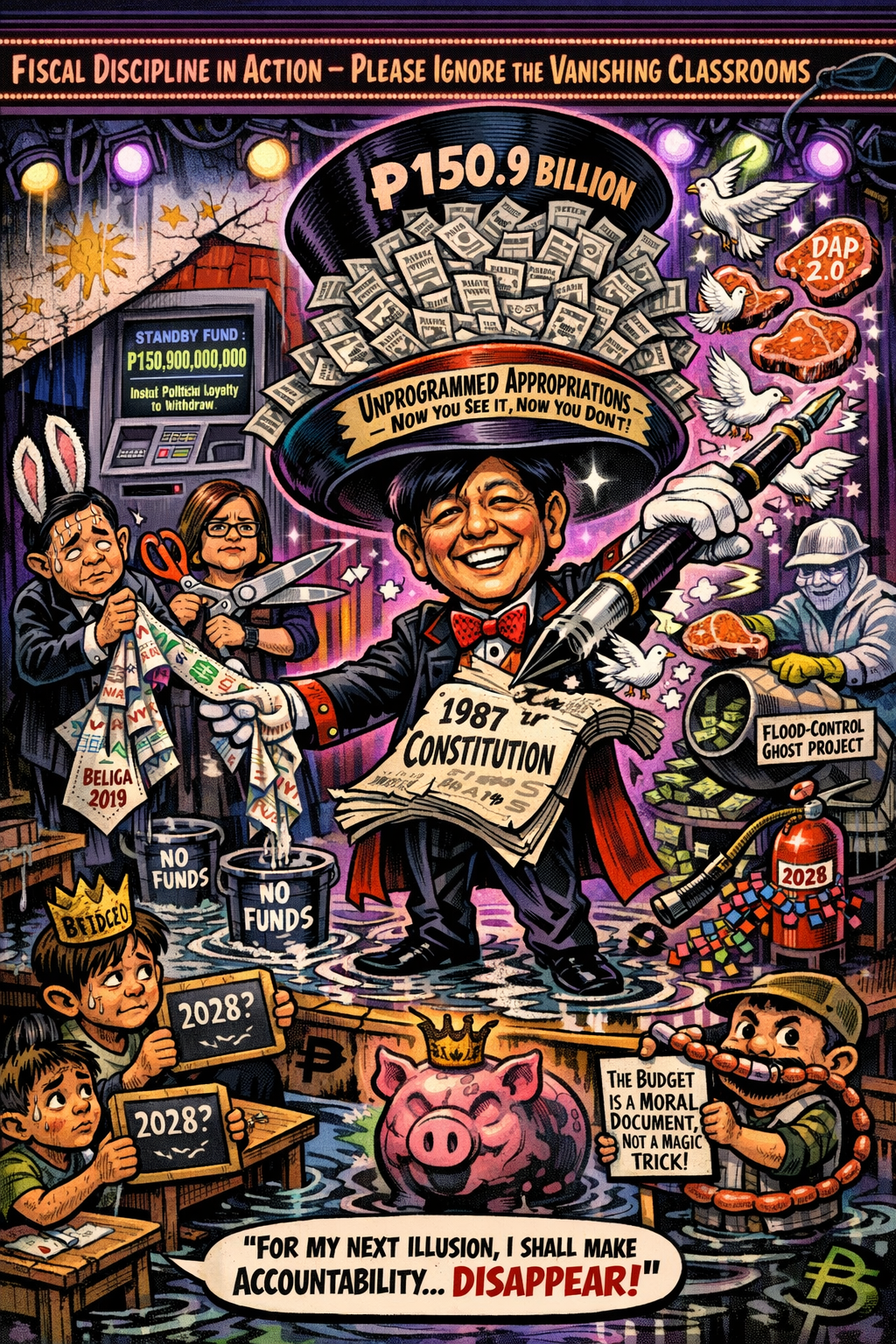
P150.9 Billion in “Standby” Cash: Because Nothing Says Fiscal Discipline Like a Presidential Slush Fund on Life Support
By Louis ‘Barok‘ C. Biraogo — January 10, 2025
MY fellow Filipinos, a new year has dawned, yet the stench of corruption in the budget remains as foul as ever. While schools struggle with crumbling classrooms and hospitals lack essential medicines, a staggering P150.9 billion in Unprogrammed Appropriations (UA) sits embedded in the 2026 General Appropriations Act (GAA)—a “standby fund” larger than the entire budget of several government agencies. And who has petitioned the Supreme Court (SC) to declare it unconstitutional? None other than Mamamayang Liberal Party-list Representative Leila de Lima and Caloocan 2nd District Representative Edgar Erice (Inquirer.net, 8 Jan. 2026). Is this a masterclass in constitutionalism, or mere political theater in preparation for the 2028 elections?

Constitutional Carnage: The Legal Frame Job
First, the petitioners’ argument. They contend that the UA inverts the constitutional order. Under Article VI, Section 25(4) of the 1987 Constitution, special appropriations must be supported by funds actually available as certified by the National Treasurer at the time of enactment. Meanwhile, Article VII, Section 22 requires the budget to be based on actual sources of financing.
What does the UA do? It authorizes expenditures in anticipation of revenues that are still speculative—such as excess collections or foreign grants that have yet to materialize. There is no certification that funds are “actually available” upon enactment. This, they argue, constitutes an undue delegation of legislative power, effectively turning P150.9 billion into a Presidential slush fund. Blanket authority for the President to spend when “conditions are met”—conditions he himself will determine.
Is the claim strong? Yes—pure textualism at its finest. This is not political theater; it is a direct assault on a structural defect repeatedly exploited to bypass Congress’s power of the purse.
Second, the defense of the Department of Budget and Management (DBM). They lean heavily on Belgica v. Executive Secretary (G.R. No. 210503, October 8, 2019), where the Supreme Court upheld the UA because it included an annex specifying purposes and amounts—not a prohibited lump-sum, but one with a “discernible purpose” (Philippine News Agency, 8 Jan. 2026).
My verdict? A facile and dangerous misreading. Belgica (2019) addressed the lump-sum issue, not revenue certainty. It did not hold that appropriations may proceed without actual sources at enactment. The Constitution is clear: constitutionality is tested at the time of enactment, not release. Later certification? It does not cure an unconstitutional law. And what if the “excess revenues” never arrive? We are left with appropriated debt all the same.
Let us wield precedents as weapons: In Araullo v. Aquino (G.R. No. 209287, July 1, 2014), the Court declared the Disbursement Acceleration Program (DAP)—which drew from unprogrammed funds—unconstitutional for failing strict compliance with conditions, exposing the historical abuse of contingent funds. Meanwhile, Belgica (2013) killed the Priority Development Assistance Fund (PDAF) as undue delegation. Why, then, is its successor thriving?
Motive Mongering: The Theater of Shadows
The petitioners: De Lima and Erice. Is this pure constitutionalism? Or a brilliant opposition maneuver to paint the Marcos administration as corrupt? De Lima—once detained, now on a redemption arc as fiscal watchdog? Erice, a minority leader long complaining about budgets. I am cynical: there is political positioning here, especially with 2028 approaching. Yet even with ulterior motives, the argument stands. Motive does not diminish constitutional infirmity.
The respondents: DBM and the Executive. “Fiscal flexibility” for emergencies, they say. And the President’s P92.5 billion veto? A sign of genuine discipline? Or a mere PR stunt to blunt criticism? Let us be clear: the remaining P150.9 billion is still enormous—larger than the Department of Education (DepEd) budget for classrooms. Historically, UA has been “budgetary dark matter”—routinely used for discretionary spending. In an era of soaring national debt, is this truly flexibility, or executive aggrandizement?
The Corruption Ecosystem: “Unprogrammed” as the New Pork
Let us not fool ourselves: the UA is the institutionalized successor to the PDAF. After pork barrel was slain in 2013, the DAP emerged (slain in 2014), and now UA wears the crown. Why? Because it is labeled “standby,” yet in reality it funds recurring items—such as flood control projects now mired in scandal.
Thousands of “ghost projects,” overpriced structures, contractor monopolies—all funded from unprogrammed funds in recent years. Is this an anomaly? No—it is a feature of the system. The UA has become a discretionary fund for the powerful, insulated from real-time congressional scrutiny. While ordinary Filipinos drown in floods, the money vanishes into “contingencies.”
War-Game the Fallout: Scenarios & Consequences
If the SC upholds (following Belgica 2019): The petition is dismissed. UA continues, with “tighter safeguards.” Implication? Fiscal flexibility triumphs, but public trust dies. UA will balloon in future budgets, debt will worsen.
If struck down entirely: Section XLIII of the 2026 GAA is void. Immediate chaos—reallocation required, possible fiscal crisis in emergencies. Yet it strengthens Congress’s power of the purse, setting precedent to banish UA forever.
If a narrow ruling: Allowed, but with stricter conditions—no release without prior congressional approval. The best compromise?
Strategic moves: Petitioners must push for a Temporary Restraining Order (TRO) at all costs—otherwise, the case becomes moot once funds are spent. DBM? Fast-track releases to moot the case. Dirty, but effective.
Broader impacts: In the 2028 elections, this will fuel narratives of corruption versus reform. With national debt climbing, interest payments will choke essential services while schools crumble. Public morale? Already soaked in disillusionment.
The Barok Manifesto: Call to Arms
What is this standby fund larger than the entire budget of the Department of Environment and Natural Resources (DENR)? Peak absurdity—P150.9 billion in “maybe” funds while children study under leaking roofs and farmers lack irrigation. Is this the “fiscal discipline” the DBM boasts of? Sarcasm intended: bravo for “tight controls” that still permit flood-control ghosts!
The budget is a moral document—every peso must be accounted for, fought for, and spent on the people, not hidden in the Palace’s magician’s hat. We demand: A constitutional amendment to ban unprogrammed appropriations outright? Or a new Budget Reform Act requiring actual revenue certification before enactment? Mass voter awareness—stop voting for traditional politicians who treat the budget as their personal ATM.
Fellow citizens, it is time to awaken. If we do not halt this institutional rot, the Constitution becomes meaningless. Fight for genuine pro-people governance—every peso, for the nation!
- —Barok, still refusing to bow to the magicians who make public money disappear.
Key Citations
- Republic Act No. 6713 (Code of Conduct and Ethical Standards for Public Officials and Employees). Official Gazette of the Republic of the Philippines, 20 Feb. 1989.
- Republic Act No. 12314 (General Appropriations Act of 2026). Department of Budget and Management, 2026.
- The 1987 Constitution of the Republic of the Philippines. Official Gazette of the Republic of the Philippines.
- Araullo v. Aquino III, G.R. No. 209287. Supreme Court of the Philippines, 1 July 2014, LawPhil Project.
- Belgica v. Executive Secretary, G.R. No. 210503. Supreme Court of the Philippines, 8 Oct. 2019, LawPhil Project.
- Gascon, Melvin. “De Lima, Erice Ask SC to Junk P150-B Standby Funds.” Inquirer.net, 8 Jan. 2026.
- Gita-Carlos, Ruth Abbey. “Unprogrammed Funds in 2026 GAA ‘Constitutional, Clearly Defined’ – DBM.” Philippine News Agency, 8 Jan. 2026.


 KWEBA ni BAROK
Leave a comment