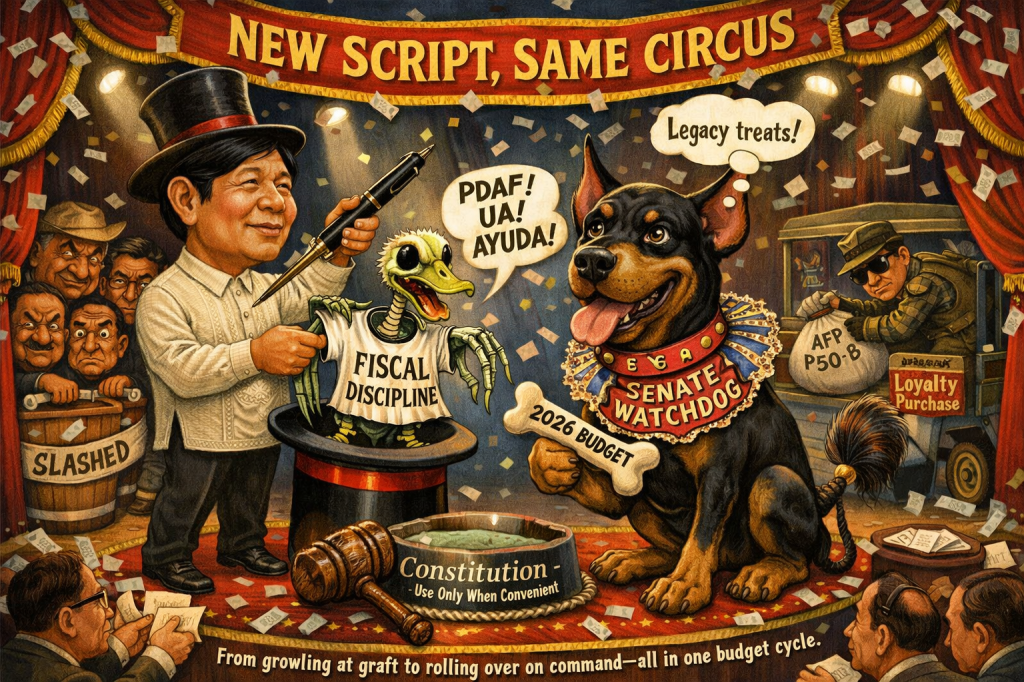
From Growling at Graft to Wagging the Tail for Malacañang’s Treats
By Louis ‘Barok‘ C. Biraogo — January 9, 2026
NAKS, the 2026 General Appropriations Act (Republic Act No. 12314)—signed with great fanfare by President Ferdinand Marcos Jr., complete with a “heroic” veto of P92.5 billion in unprogrammed appropriations and a stern prohibition on politicians meddling in “ayuda” (financial assistance) distribution. And who should rush to the microphones first but Senate President Pro Tempore Panfilo “Ping” Lacson, beaming like a proud father, hailing it as a triumph over “questionable spending and political patronage”? How touching. How coordinated. How utterly rehearsed.
This isn’t reform, ladies and gentlemen. This is a performative ballet of reform, a carefully choreographed pas de deux between Marcos and Lacson designed to scrub the budget’s image clean after the festering scandals of 2024. Remember those? The “highly questionable” special provisions slipped into unprogrammed funds involving government-owned and controlled corporations (GOCCs) and foreign-assisted projects that Lacson himself decried as potentially “disastrous”? Suddenly, with one veto pen stroke and a few amendments, we’re supposed to believe the system is purified. Spare me the self-congratulatory press releases. Is this genuine statesmanship, or a strategic laundering ritual to distance the administration from past sins while preserving just enough discretion for future ones? Because if it looks like a duck, quacks like a duck, and waddles with executive whim—it’s probably still pork, just rebranded as “fiscal discipline.”
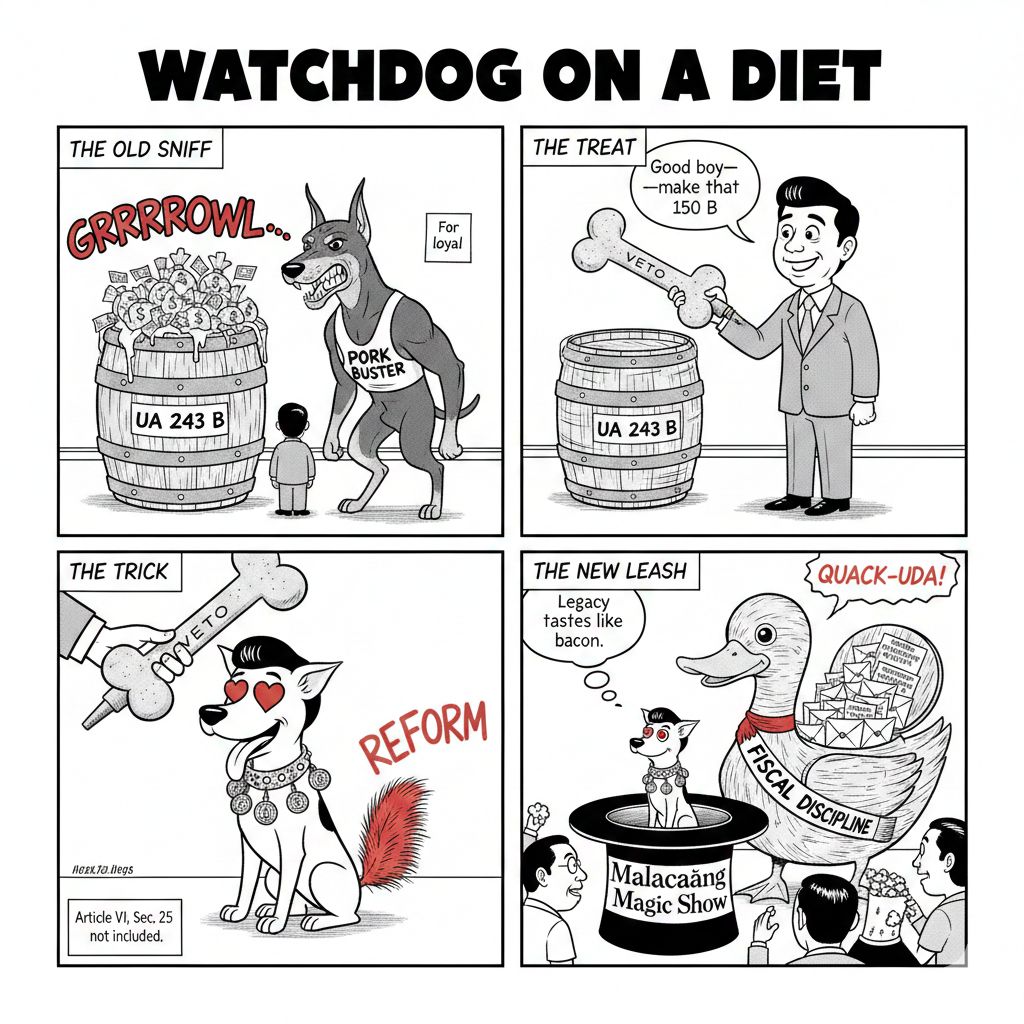
The Unprogrammed Appropriations Mirage: Pork Barrel’s Polite Successor
Let’s dissect the star of this farce: Unprogrammed Appropriations (UA), that shadowy P243.4 billion slush fund whittled down to a “mere” P150.905 billion post-veto. Lacson assures us these are “non-cash items” usable only under “specific conditions”—excess revenue, new loans, presidential nod. How reassuring. Except this is nothing but institutionalized fiscal sleight-of-hand, the budget’s secret offshore account where money materializes like magic when convenient.
Constitutionally? UA is a walking violation waiting for its day in court. Article VI, Section 25 of the 1987 Philippine Constitution demands appropriations be specific in purpose and amount—no vague riders, no open-ended pots. Yet here we have lump sums triggered post-enactment by executive discretion. Sound familiar? It’s the direct descendant of the Priority Development Assistance Fund (PDAF), that infamous “pork barrel” the Supreme Court eviscerated in Belgica v. Ochoa (G.R. No. 208566, November 19, 2013) for violating separation of powers and enabling post-enactment legislator (and executive) meddling in fund allocation. The Court struck down PDAF precisely because it allowed discretionary identification and release of funds after the budget law—exactly what UA does, but with the Senate’s blessing and presidential gatekeeping.
But wait, there’s more in this corruption blueprint. Step one: Manipulate revenue targets low enough to guarantee “excess” collections, unlocking the UA vault. Step two: Vague triggers leave release to presidential “approval”—a fancy word for whim. Step three: Double-fund projects for maximum rent-seeking, like that vetoed P35.769 billion for “duplicative” foreign-assisted counterparts Lacson cheered cutting. Why was it there in the first place? Because redundancy is the graft artist’s best friend—one pot for the legitimate need, the other for kickbacks. And even the surviving P97.3 billion for foreign projects? Don’t be naive; opacity in “support” lines is where collusion thrives.
Is this contingency planning, or a designed feature for transactional politics? Because trimming UA doesn’t kill the beast—it just puts it on a diet.
The Anti-Patronage Charade: A Fig Leaf Over Decades of Decay
Now, the pièce de résistance: the ban on “political involvement” in distributing cash assistance. Marcos directs “strict enforcement,” Lacson crows about pushing it hard in the bicameral conference committee—aid must go “fairly and based solely on need.” Bravo. Except this is a cosmetic fix so flimsy it wouldn’t cover a barangay fiesta envelope.
The loopholes are glaring, purposeful, and hilarious in their audacity. The provision bans “physical distribution”? Fine—politicians can still endorse beneficiary lists, host “pre-registration” rallies (wink-wink), or dispatch loyal barangay captains to hand out the cash with a smile and a campaign sticker. No direct handoff? No problem; the “utang na loob” (debt of gratitude) shifts seamlessly to the local proxy.
This pretends to solve violations of Republic Act No. 3019 (Anti-Graft and Corrupt Practices Act) and Republic Act No. 6713 (Code of Conduct and Ethical Standards for Public Officials and Employees)—using public funds for partisan gain—that have plagued us for decades. Yet it offers no new penalties, no real-time public databases, no independent audits. It’s insulting: Do they think we’re idiots who’ll believe a single budget line erased entrenched patronage? Election periods approach, and suddenly we’re “clean”? Please. This isn’t reform; it’s a fig leaf over the naked truth that ayuda remains electoral currency.
Actor Motive Analysis: Beyond the Halo-Polishing
- Marcos Jr.: This “virtuous veto” isn’t altruism—it’s centralization. By slashing UA, he weakens rivals in the House of Representatives and local government units (LGUs) who rely on those funds for their machines. Retaining P50 billion for Armed Forces of the Philippines (AFP) Modernization? That’s not just “national security”—it’s buying institutional loyalty from the military, a classic Marcos playbook move.
- Lacson: The “suddenly-saintly senator” plays watchdog for legacy points, sure. But defunding patronage also strategically starves potential 2028 rivals and House heavyweights. Conveniently cleaning house for the administration? Or positioning himself as the untouchable technocrat in a sea of transactional politicos?
- The House of Representatives: Poor foiled beneficiaries—their traditional pork playground gutted. Simmering tension with the executive and Senate? Absolutely. This veto screams power shift, and they’re the losers nursing grudges.
Systemic Indictment: The Rot Is the Architecture
This isn’t about bad apples; it’s the barrel itself. UA and political ayuda aren’t anomalies—they’re designed features of a system built on transactional politics, where public funds fuel dynasties and loyalty, not development. The 2024 controversies weren’t aberrations; they were the system working as intended. Vetoes and bans are band-aids on gangrene.
The Barok Manifesto: Demands, Not Pleas
Enough theater. Here are the non-negotiable demands:
- Abolish, don’t trim: Total elimination of Unprogrammed Appropriations as unconstitutional vehicles for post-enactment discretion—shadow pork in sheep’s clothing.
- Judicial reckoning: File that Supreme Court test case now. Let the Court apply Belgica v. Ochoa and Article VI, Section 25‘s specificity doctrine to finally bury UA for good.
- Teeth for the ban: Back it with specific penalties under amendments to RA 3019, mandatory real-time public beneficiary databases, and independent Commission on Audit (COA) audit trails. No more hollow rhetoric.
- Philosophical shift: From pro-political to pro-people governance. Public funds are not electoral bait—they belong to the Filipino, not the politician’s gratitude ledger.
Will they listen? Probably not. But the rot endures only if we pretend this veto is victory. It’s not. It’s just the latest act in the endless Philippine political circus. Curtain call, anyone? Or shall we demand a new script?
Yours in eternal vigilance against the thieves in barong,
- –Barok, still watching while they pretend to repent.
Key Citations
- “Lacson Hails Marcos Veto of Non-Essential Funds, Ban on Political ‘Ayuda’ Distribution.” Philippine Information Agency, 6 Jan. 2026. Accessed 8 Jan. 2026.
- Republic Act No. 12314 (General Appropriations Act of 2026). Department of Budget and Management, 2026.
- Philippines. Republic Act No. 3019: Anti-Graft and Corrupt Practices Act. 17 Aug. 1960. Official Gazette of the Republic of the Philippines.
- Republic Act No. 6713 (Code of Conduct and Ethical Standards for Public Officials and Employees). Congress of the Philippines, 20 Feb. 1989, LawPhil Project.
- Belgica v. Executive Secretary Paquito N. Ochoa, Jr., G.R. No. 208566, Supreme Court of the Philippines, 19 Nov. 2013, LawPhil Project.
- The 1987 Constitution of the Republic of the Philippines. Congress of the Philippines, 2 Feb. 1987. (Particularly Article VI, Section 25).
- ₱75 Million Heist: Cops Gone Full Bandit

- ₱6.7-Trillion Temptation: The Great Pork Zombie Revival and the “Collegial” Vote-Buying Circus

- ₱1.9 Billion for 382 Units and a Rooftop Pool: Poverty Solved, Next Problem Please

- ₱1.35 Trillion for Education: Bigger Budget, Same Old Thieves’ Banquet

- ₱1 Billion Congressional Seat? Sorry, Sold Out Na Raw — Si Bello Raw Ang Hindi Bumili

- “We Will Take Care of It”: Bersamin’s P52-Billion Love Letter to Corruption

- “Skewed Narrative”? More Like Skewered Taxpayers!

- “Scared to Sign Vouchers” Is Now Official GDP Policy – Welcome to the Philippines’ Permanent Paralysis Economy
- “Robbed by Restitution?” Curlee Discaya’s Tears Over Returning What He Never Earned

- “No Pressure” Luistro? The House Pork Bazaar Exposed
- “My Brother the President Is a Junkie”: A Marcos Family Reunion Special

- “Mapipilitan Akong Gawing Zero”: The Day Senator Rodante Marcoleta Confessed to Perjury on National Television and Thought We’d Clap for the Creativity



 KWEBA ni BAROK
Leave a comment