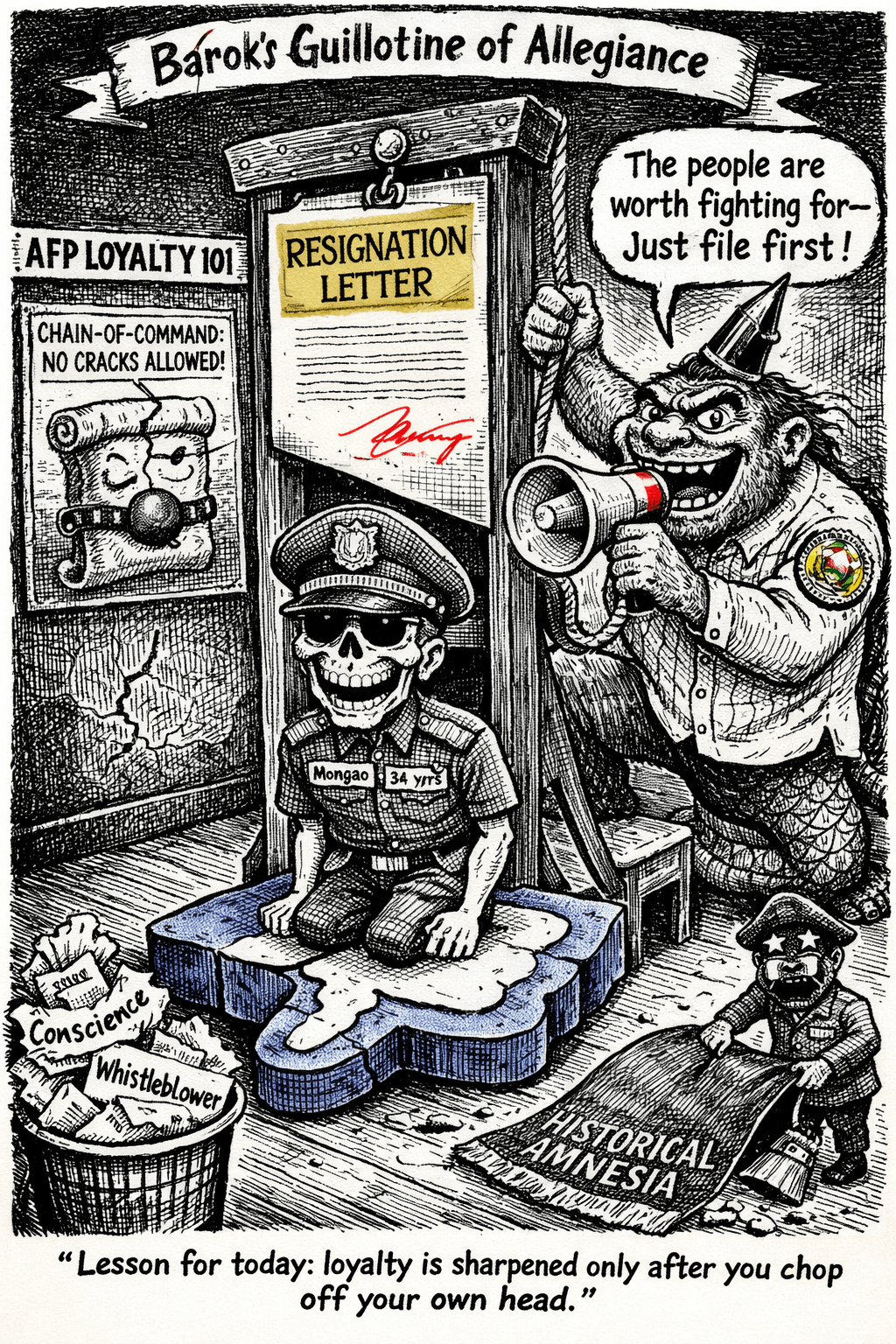
When Col. Mongao Said ‘Sobra Na’ — AFP Replied ‘Sobra Rin: Resign Before You Resist’
By Louis “Barok” C. Biraogo — January 10, 2026
IN THE quiet hierarchy of military life, few acts carry the symbolic weight of a senior officer publicly declaring he has withdrawn “personal support” from the sitting President and Commander-in-Chief. Yet that is precisely what Col. Audie A. Mongao, a 34-year veteran of the Philippine Army (PA), did on January 9, 2026 (Philstar.com, 9 Jan. 2026). His post —
“Effective today, Friday, 9 January 2026, I, COL AUDIE A MONGAO… is withdrawing my personal support to our President and Commander in Chief, Ferdinand ‘Bongbong’ Marcos Jr! Sobra na, tama na! The Filipino people is worth fighting for.”
— triggered immediate relief from command, placement in awaiting orders status, and an ongoing investigation.
The Army’s response was swift, predictable, and — on paper — textbook. But the incident demands more than procedural recitation. It requires a rigorous dissection of law, ethics, institutional reflexes, and the fragile boundary between individual conscience and military discipline in a democracy still scarred by its authoritarian and coup-prone past.

The Act Itself: Not Just Words, But a Political-Military Statement
Mongao’s declaration was no private journal entry. Posted on social media by a senior active-duty colonel (O-10933 INF, complete with rank and service credentials), it arrived amid swirling corruption allegations involving billions in flood control funds — scandals that have already fueled retired generals’ behind-the-scenes maneuvering last September. The timing, platform, and phrasing (“Sobra na, tama na!”) transform it from personal gripe into a symbolic act of dissent, legible to the public, the ranks, and inevitably, political factions eager for military fracture lines.
This is not mere speech; it is a performative withdrawal of symbolic allegiance from the constitutional Commander-in-Chief, delivered in uniform (figuratively, if not literally). Perception matters in military law more than intent, and the perception here is unmistakable: a crack in the chain of command at a moment of political vulnerability.
Legal Scaffold: Loyalty to Constitution, Not to Person — But With Sharp Edges
The 1987 Constitution could not be clearer in Article XVI, Section 3: “The Armed Forces of the Philippines (AFP) shall be the protector of the people and the State. Its goal is to secure the sovereignty of the State and the integrity of the national territory.” Jurisprudence has long interpreted this as institutional loyalty to the constitutional order and the civilian government it produces — including the President as Commander-in-Chief — irrespective of personal approval ratings.
Enter the Articles of War (Commonwealth Act No. 408), particularly Article 96 (Conduct Unbecoming an Officer and Gentleman) and Article 97 (Disorders and Neglects to the Prejudice of Good Order and Military Discipline). These provisions are deliberately broad, designed to capture acts that erode trust in the officer corps or disrupt unit cohesion. Publicly distancing oneself from the Commander-in-Chief while still in active service fits comfortably within their ambit.
Add Republic Act No. 6713 (Code of Conduct and Ethical Standards for Public Officials and Employees), which demands political neutrality and avoidance of conduct that impairs public confidence in institutions. While military personnel are governed by special rules, RA 6713 supplies the ethical baseline: public servants, especially those in uniform, do not get to freelance political endorsements or withdrawals.
Supreme Court precedents reinforce this hierarchy. The Court has upheld stricter regulation of speech and political activity for members of “disciplined services” when necessary to protect compelling state interests like national security, chain-of-command integrity, and civilian supremacy. Freedom of expression exists — but it is not absolute for those who voluntarily accept the military’s unique constraints. As the legal brief prepared for the Army correctly notes, Mongao could have spoken freely after retirement. While on active duty, he speaks with the weight of institutional authority whether he likes it or not.
Motivation Forensics: Conscience, Frustration, or Something Else?
Mongao’s defenders frame his act as moral courage — a whistleblower-like stand against perceived loss of “moral ascendancy” amid corruption scandals, a reaffirmation of loyalty to the people over any individual leader. The phrase “The Filipino people is worth fighting for” echoes classic post-EDSA rhetoric.
Yet the Army sees institutional threat: a precedent that could embolden factionalism, invite politicization via social media, and revive ghosts of Honasan and Oakwood. The swift relief from command — a preventive, not punitive, measure — signals zero tolerance for boundary-testing by active officers.
Both sides have plausible motivations. Mongao’s may stem from genuine conviction, accumulated frustration, or reaction to scandals. The AFP’s response reflects learned institutional trauma: after multiple coups and mutinies, early action against perceived politicization is doctrine.
Historical Echoes: Why the Zero-Tolerance Reflex?
Philippine civil-military relations have never been serene. From the Honasan coups (armed rebellion) to the Oakwood mutiny (organized moral protest with arms) to retired generals’ periodic interventions, the AFP has internalized a simple lesson: small acts of dissent can metastasize. Mongao’s case is milder — individual, digital, symbolic — but it arrives in the social media era, where one post can go viral faster than a barracks rumor.
The Army’s reaction mirrors comparative systems (U.S. Uniform Code of Military Justice, ASEAN militaries) where active-duty political dissent is met with relief, reprimand, or worse. Compared to past Philippine cases, Mongao’s act is far from rebellion. Yet the institutional memory is unforgiving: better to overreact early than allow contagion.
Consequences: A Chilling Effect or Necessary Firewall?
The ramifications are layered. Short-term, the Army reaffirms discipline and neutrality, protecting civilian supremacy. Long-term, overly broad enforcement risks chilling legitimate internal critique or whistleblowing on genuine misconduct. Public trust could erode if the process appears heavy-handed or politically motivated.
For the Marcos administration, the episode amplifies narratives of suppressing dissent. For the rule of law, everything hinges on due process: fair hearing, evidence-based findings, proportionate sanctions.
Prescriptive Path Forward
The way out is not leniency or severity for its own sake, but fidelity to procedure and principle.
- Conduct a transparent, impartial investigation that rigorously separates personal opinion from institutional harm.
- Impose sanctions proportionate to proven violations — administrative reprimand rather than career-ending measures unless aggravating factors emerge.
- Reinforce AFP education on the precise meaning of constitutional loyalty: to the office and the system, not the person.
- Most critically, reaffirm that civilian supremacy and military professionalism are not served by silencing conscience but by channeling it through lawful means — internal reporting, resignation, or post-retirement advocacy.
Col. Mongao’s post is a symptom, not the disease. The deeper malaise is the persistent tension between an apolitical military ideal and a polity where corruption scandals repeatedly tempt officers to see themselves as moral guardians rather than subordinate professionals. The cure lies not in punishing one colonel, but in ensuring that governance earns the loyalty it demands — and that when it falters, the remedies remain firmly civilian and constitutional.
The Filipino people are indeed worth fighting for. The question is whether that fight belongs inside the barracks or in the institutions designed to hold power accountable.
The rule of law must answer — calmly, fairly, and without fear or favor.
From the cave where facts still have teeth,
- –Barok — Serving biting commentary daily. No apologies included.
Key Citations
A. Legal & Official Sources
- 1987 Constitution of the Republic of the Philippines. Official Gazette of the Republic of the Philippines.
- Articles of War. Commonwealth Act No. 408, LawPhil Project.
- Code of Conduct and Ethical Standards for Public Officials and Employees. Republic Act No. 6713, LawPhil Project.
B. News Report
- “Army colonel relieved after his alleged ‘withdrawal’ of support for Marcos.” Philstar.com, 9 Jan. 2026.
- “PH Army relieves colonel who allegedly withdrew support for Marcos.” Inquirer.net, 9 Jan. 2026.
- ₱75 Million Heist: Cops Gone Full Bandit

- ₱6.7-Trillion Temptation: The Great Pork Zombie Revival and the “Collegial” Vote-Buying Circus

- ₱1.9 Billion for 382 Units and a Rooftop Pool: Poverty Solved, Next Problem Please

- ₱1.35 Trillion for Education: Bigger Budget, Same Old Thieves’ Banquet

- ₱1 Billion Congressional Seat? Sorry, Sold Out Na Raw — Si Bello Raw Ang Hindi Bumili

- “We Will Take Care of It”: Bersamin’s P52-Billion Love Letter to Corruption
- “Skewed Narrative”? More Like Skewered Taxpayers!

- “Scared to Sign Vouchers” Is Now Official GDP Policy – Welcome to the Philippines’ Permanent Paralysis Economy
- “Robbed by Restitution?” Curlee Discaya’s Tears Over Returning What He Never Earned

- “No Pressure” Luistro? The House Pork Bazaar Exposed
- “My Brother the President Is a Junkie”: A Marcos Family Reunion Special

- “Mapipilitan Akong Gawing Zero”: The Day Senator Rodante Marcoleta Confessed to Perjury on National Television and Thought We’d Clap for the Creativity


 KWEBA ni BAROK
Leave a comment