
Fiscal Discipline, Palace Edition: Now With 100% More Veto-by-Another-Name
By Louis ‘Barok‘ C. Biraogo — January 11, 2025
IN THE grand theater of Philippine governance, where public funds are the props and accountability is the missing script, we have a fresh act: President Ferdinand “Bongbong” Marcos Jr. — fresh from the 2025 flood control scandal that saw billions vanish into “ghost projects”, substandard dikes, and kickback empires — now proclaims himself the guardian of fiscal discipline. The Department of Budget and Management (DBM) dutifully parrots that the President has imposed “stricter conditions” on releasing funds under the P6.793-trillion 2026 budget, especially those pesky congressional “adjustments” and new items. No automatic releases, mga ka-kweba (GMA Network, 9 Jan. 2026). Everything now bows to cash programming, prudent management, compliance rules, and — cue the dramatic pause — presidential approval based on “programmed priorities.”
How noble. How timely. How utterly transparent as mud.
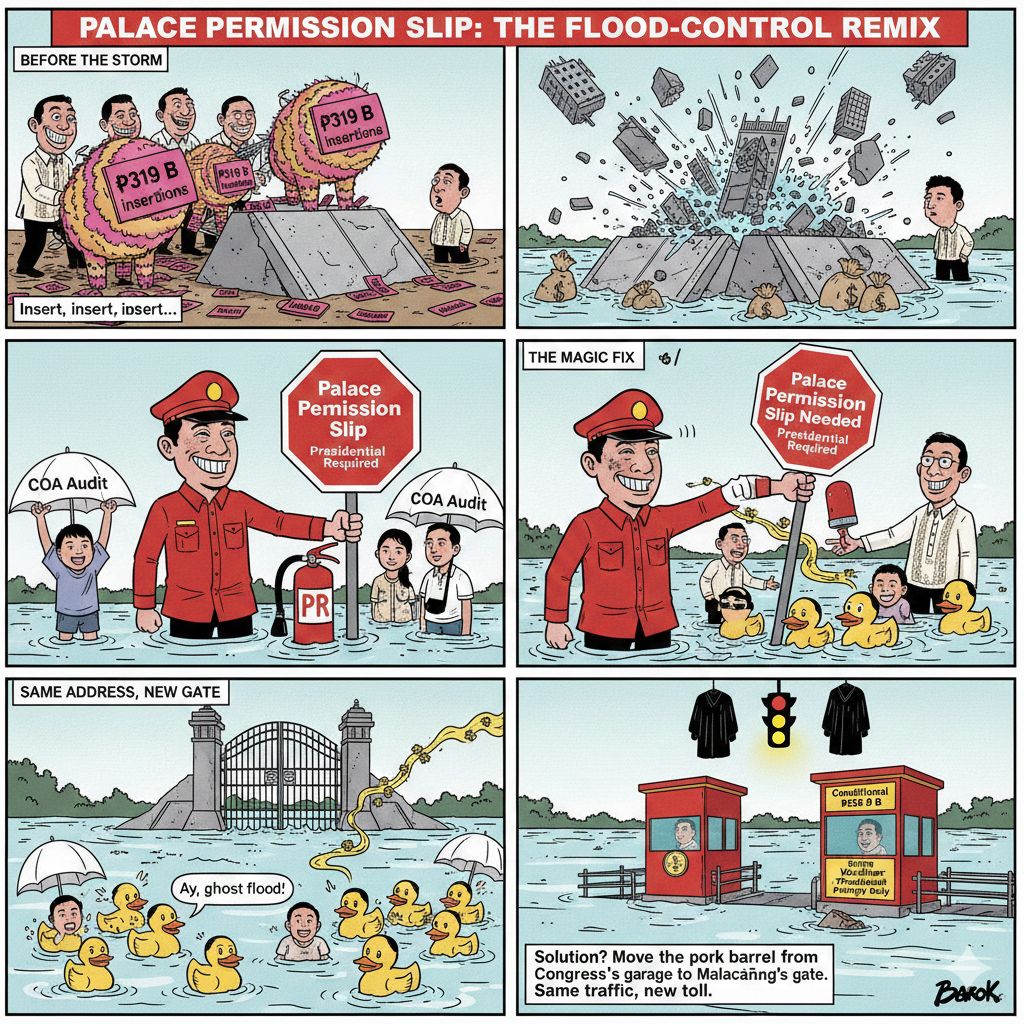
The Central Con: Damage Control Masquerading as Reform
This isn’t reform; it’s scandal containment with extra steps. Remember the flood control fiasco? Billions funneled through the Department of Public Works and Highways (DPWH) to favored contractors (hello, Discayas and Cos), overpriced or nonexistent projects, kickbacks to engineers, politicians, and their relatives — a scheme so brazen it sparked protests, Senate hearings, arrests of mid-level officials, and public outrage that the administration was slow to touch the “big fish.” Estimates peg annual losses at ₱42–118 billion since 2023, much of it from unprogrammed appropriations (UA) in prior years, with over 421 ghost projects identified out of thousands inspected.
And now? The Palace’s solution is… conditional releases? After the horse has bolted, been sold for parts, and the barn turned into a luxury condo? Marcos vetoed a mere ₱92.5 billion from UA, trimming them to ₱150.9 billion — the “lowest since 2019,” they crow — while leaving plenty of room for discretion. Critics called for vetoing up to ₱319 billion in questionable items; watchdogs like Social Watch Philippines decried the budget as still “captive to abuse.” Yet here we are, with the executive gatekeeping congressional insertions under the guise of “fiscal discipline.”
This is not cleaning house. This is readdressing the loot — moving the slush fund from Congress’s pork barrel to Malacañang’s conditional vault. UA has long been the shadow pork: standby funds activated on “triggers” but ripe for political favoritism. Now, the President conditions even programmed items, turning execution into a presidential veto-by-another-name.
Legal Jiu-Jitsu: Executive Whim vs. Power of the Purse
The Executive trots out Article VII’s “faithful execution“ clause and fiscal responsibility, claiming they’re just ensuring lawful spending. The veto message intones: “I stand firm in my constitutional duty… [to] condition the implementation of certain provisions… to conform to existing laws, policies, rules, and regulations.”
Nice try. But this is textbook post-enactment veto — the very abomination struck down in landmark cases.
- Belgica v. Ochoa (G.R. No. 208566. Nov. 19, 2013), the Priority Development Assistance Fund (PDAF) pork barrel case: The Supreme Court demolished post-enactment discretion that lets legislators (or, by extension, the Executive) meddle in fund release after appropriation. It violates separation of powers; once Congress appropriates, execution is ministerial, not conditional on executive whim.
- Araullo v. Aquino III (G.R. No. 209287. July 1 2014), the Disbursement Acceleration Program (DAP) case: Executive realignment and withholding of funds without statutory basis? Unconstitutional. “Savings” or “efficiency” don’t justify usurping legislative priorities.
- Philconsa v. Enriquez (G.R. No. 113105, Aug. 19, 1994): Veto power is item-specific and pre-enactment; no constitutional license for ongoing conditions that effectively amend the law.
Here, “conditional implementation” applies to special provisions like Quick Response Fund (QRF), retirement benefits, capacity programs — items Congress already appropriated. Requiring presidential approval based on vague “programmed priorities” creates a new discretionary fund controlled solely by Malacañang. If this stands, the power of the purse (Article VI, Section 29) becomes advisory. Congress authorizes; the President decides if and when it happens.
Grave abuse of discretion? Absolutely. Arbitrary, opaque, and hostile to the Constitution.
The Cast of Characters: Hypocrites, Accomplices, and Wounded Looters
- Marcos: Statesman or scandal firefighter-in-chief? With 2028 looming (and midterm echoes), this is power consolidation. Centralize releases to reward allies, starve opponents, and rebuild the “anti-corruption” brand after flood control ghosts haunted the administration. Genuine prudence? Perhaps, but selective timing post-exposé reeks of damage control.
- DBM: Diligent guardians or palace enablers? They’re laundering the budget’s reputation with press releases about “accountability” while implementing conditions not in the General Appropriations Act (GAA) itself. Complicit in the new normal: executive whim over legislative law.
- Congress: The wounded pork-deprived choir. These are the same solons who stuffed the budget with insertions, lump-sums, and “sneaky pork” disguised as adjustments. Now they cry foul when the Palace gatekeeps their loot? Hypocrisy on stilts.
- Civil Society & the Public: The only honest chorus. X (formerly Twitter) and watchdogs scream “partial cover-up” — veto ₱92B but leave ₱150B+ UA dangling like bait. Rumors of fragmented pork, pre-election maneuvering, and soft patronage persist because the press release ignores the visceral truth: trust is gone.
Systemic Evisceration: The Ecosystem of Rot
This isn’t one policy; it’s the symptom of institutionalized plunder. After billions disappeared into flood control phantoms — with contractors cornering contracts, engineers taking cuts, and politicians allegedly in on it — the fix is more bureaucracy? Where were these “stricter conditions” when the scandal was brewing? The system doesn’t prevent corruption; it relocates it. From congressional pork to executive conditional funds. Same game, new address: Malacañang.
Even side dramas, like the falsified notarized affidavit of Senate witness Orly Guteza in the same hearings (ruled forged by a Manila court in October 2025, highlighting perjury risks under the 2004 Rules on Notarial Practice), underscore how fragile accountability remains when documents can be manipulated amid billion-peso scandals.
Absurdity level: expert. The solution to unchecked releases is… unchecked executive discretion?
Call to Action: Time for the Supreme Court to Step In
Enough theater. File the petitions. Use the template: Certiorari and Prohibition under Rule 65, seeking Temporary Restraining Order (TRO)/injunction. Declare this conditional farce unconstitutional, annul DBM issuances, and order strict GAA release. Demand real transparency — not press releases, but real-time, line-item public tracking of every “conditionally implemented” peso.
If this stands, we cement total executive domination of public funds. If struck down, the “reform” is exposed as the legal sham it is.
The 2026 budget isn’t about discipline. It’s about control. And the Filipino people — tired of ghost projects, vanished billions, and palace spin — deserve better than a system where the cure is worse than the disease.
The prosecutor’s brief is open. The court of public opinion has already ruled: guilty of hypocrisy. Now let the Supreme Court deliver the verdict.
–Barok
Key Citations
- GMA Integrated News. “Marcos Imposed Stricter Conditions in Releasing Funds under P6.793-T Budget — DBM.” GMA Network, 9 Jan. 2026.
- Salcedo, Mary Joy.“Dizon: 421 of 8,000 Flood Control Works in PH Are ‘Ghost Projects.’” INQUIRER.net, 9 Oct. 2025.
- Belgica v. Ochoa. G.R. No. 208566. Supreme Court of the Philippines. 19 Nov. 2013. The Lawphil Project.
- “Pork Barrel Scam.” Wikipedia: The Free Encyclopedia, Wikimedia Foundation, 20 Nov. 2025.
- Araullo v. Aquino III. G.R. No. 209287. Supreme Court of the Philippines. 1 July 2014. The Lawphil Project.
- “Disbursement Acceleration Program.” Wikipedia: The Free Encyclopedia, Wikimedia Foundation, 29 Dec. 2025.
- Philippine Constitution Association vs. Enriquez. G.R. No. 113105, 19 Aug. 1994, Lawphil.
- The 1987 Constitution of the Republic of the Philippines. Official Gazette of the Republic of the Philippines.
- Bautista, Jane. “Manila RTC: Senate Probe Witness’ Affidavit Falsified.” Inquirer.net, 29 Oct. 2025.
- 2004 Rules on Notarial Practice. A.M. No. 02-8-13-SC, 1 Aug. 2004, Supreme Court of the Philippines.
- “Rule 65: Certiorari, Prohibition and Mandamus.” 1997 Rules of Civil Procedure, 1 July 1997, Lawphil.
- ₱75 Million Heist: Cops Gone Full Bandit

- ₱6.7-Trillion Temptation: The Great Pork Zombie Revival and the “Collegial” Vote-Buying Circus

- ₱1.9 Billion for 382 Units and a Rooftop Pool: Poverty Solved, Next Problem Please

- ₱1.35 Trillion for Education: Bigger Budget, Same Old Thieves’ Banquet

- ₱1 Billion Congressional Seat? Sorry, Sold Out Na Raw — Si Bello Raw Ang Hindi Bumili

- “We Will Take Care of It”: Bersamin’s P52-Billion Love Letter to Corruption

- “Skewed Narrative”? More Like Skewered Taxpayers!

- “Scared to Sign Vouchers” Is Now Official GDP Policy – Welcome to the Philippines’ Permanent Paralysis Economy
- “Robbed by Restitution?” Curlee Discaya’s Tears Over Returning What He Never Earned

- “No Pressure” Luistro? The House Pork Bazaar Exposed
- “My Brother the President Is a Junkie”: A Marcos Family Reunion Special

- “Mapipilitan Akong Gawing Zero”: The Day Senator Rodante Marcoleta Confessed to Perjury on National Television and Thought We’d Clap for the Creativity




 KWEBA ni BAROK
Leave a comment