
Teachers Lose Pay for a Sick Day, Senators Lose Nothing for Disappearing—Welcome to Elite Privilege 101
By Louis ‘Barok‘ C. Biraogo — January 11, 2026
IN A nation where public school teachers get docked pay for missing a single day, where ordinary workers are hounded by the merciless logic of “no work, no pay,” the Philippine Senate has once again reminded us that elite privilege operates under a different constitution—one written in invisible ink and enforced with a wink. Enter Senator Ronald “Bato” dela Rosa, the former Philippine National Police (PNP) chief turned absentee lawmaker, who has been absent without official leave (AWOL) from the Senate since November 11, 2025. As of January 11, 2026, two months in, no formal leave, no public sighting, no reply to texts from his own colleagues—and yet, the taxpayers’ money continues to flow into his bank account like clockwork. This isn’t mere absenteeism. This is legalized looting dressed up as legislative prerogative.
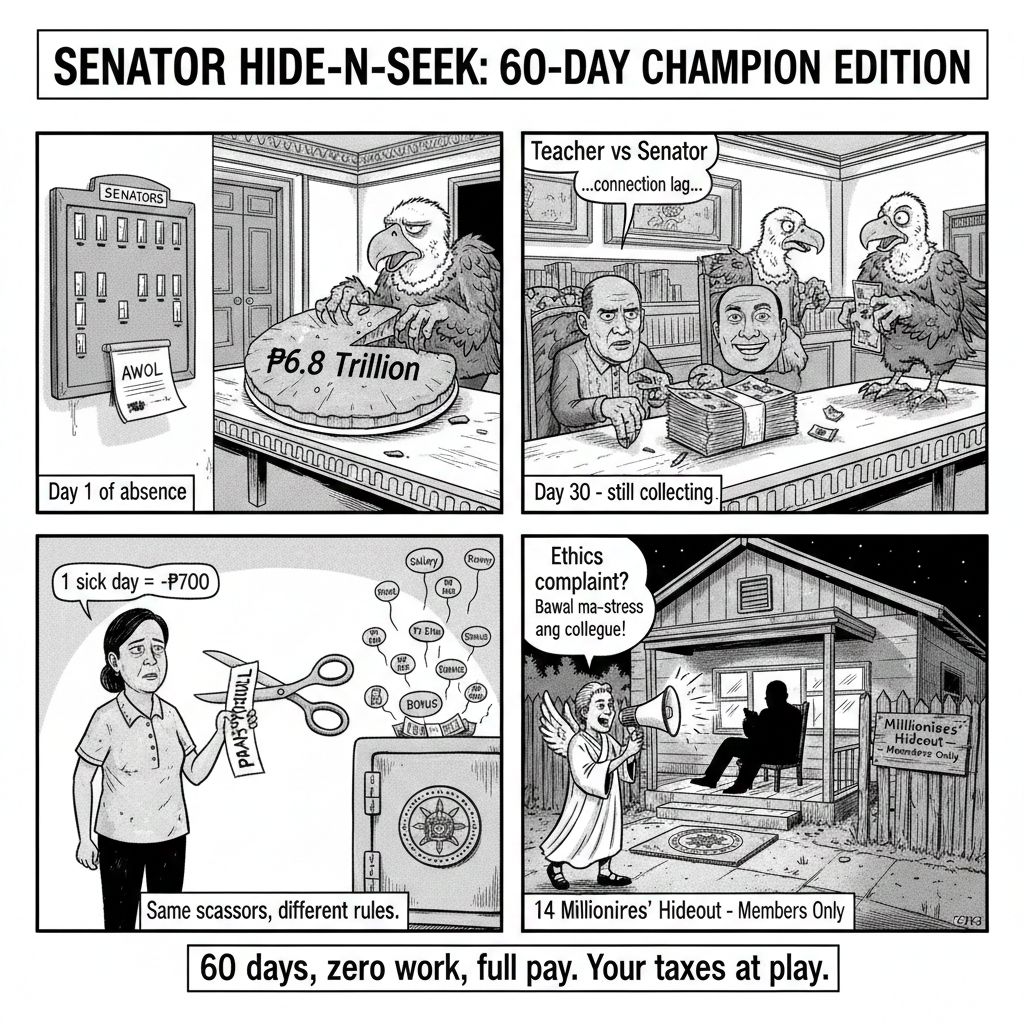
The Fugitive Senator in Plain Sight
Let’s dispense with the polite fiction that Dela Rosa is merely “working remotely.” His lawyer mumbles something about “personal safety,” Senate President Vicente “Tito” Sotto III admits the man ignores group chats and text messages, and the rumor mill—fueled by Ombudsman Jesus Crispin Remulla’s claim of an unofficial International Criminal Court (ICC) arrest warrant—has him bouncing between friends’ houses like a wanted man playing hide-and-seek. He even skipped the bicameral conference committee on the 2026 national budget, the single most important piece of legislation of the year, depriving his constituents of representation while the ₱6.793-trillion pie was sliced.
This is not illness. This is not official business. This is a senator who appears to be treating the upper chamber as a revolving door he can exit whenever the shadow of The Hague grows too long. Call him what he is: a fugitive in plain sight, drawing a full salary while hiding from potential accountability for his role in the bloody drug war. The man who once boasted he would join Duterte in facing the ICC now seems more interested in collecting pensioner perks than performing senatorial duties. He is no longer a legislator—he is a pensioner squatting in the Senate’s payroll.
The Complicit Senate: An Enablers’ Club in Silk
And where is the outrage from the chamber itself? Crickets. Senate President Vicente “Tito” Sotto III shrugs that there’s no “no work, no pay” rule for senators, and that only an ethics complaint can stir the pot. Sen. Sherwin Gatchalian echoes the same tired refrain: “It doesn’t apply to us.” Translation: We’re special. We’re above the rules we impose on everyone else.
This is collegial coddling at its most nauseating. The Senate—self-styled guardian of the republic—has become the ultimate old boys’ club, where loyalty trumps duty and camaraderie excuses cowardice. They defend “internal rules” as if the Constitution were a mere suggestion, conveniently forgetting that Article VI, Section 16(3) of the 1987 Philippine Constitution grants them the power (and duty) to punish disorderly behavior—including prolonged, unexplained absence—with censure, suspension, or even expulsion by a two-thirds vote.
Instead, they do nothing. No public ultimatum. No suspension of privileges. Just the quiet hope that the public will forget, or that Dela Rosa will magically reappear once the heat dies down. This is not institutional restraint; it is institutional complicity.
The Legal Charade: When “Public Trust” Becomes a Punchline
Let us speak plainly about the law, since the Senate refuses to.
Article XI, Section 1 of the 1987 Philippine Constitution declares: “Public office is a public trust.” The Supreme Court has repeatedly held that public officials hold their positions as fiduciaries for the people—not as personal sinecures. Dela Rosa’s extended disappearance, without justification, constitutes a blatant breach of that trust.
Republic Act No. 6713 (the Code of Conduct and Ethical Standards for Public Officials and Employees, or RA 6713) demands in Section 4 “professionalism” and “devotion to duty.” Public officials shall not be absent without official leave “to the prejudice of the public interest.” Try explaining how vanishing for months during budget deliberations serves any interest except self-preservation.
Even Republic Act No. 3019 (the Anti-Graft and Corrupt Practices Act, or RA 3019) lurks in the background. Section 3(e) penalizes causing “undue injury” to the government through manifest partiality or gross inexcusable negligence. Paying full salary and perks to a non-performing senator arguably inflicts such injury—though proving it against a constitutionally protected official would require prosecutorial courage few possess.
Procedural options exist, if anyone had the spine:
- File an ethics complaint immediately, triggering Senate investigation.
- Seek Ombudsman scrutiny for grave misconduct or neglect of duty.
- In the nuclear scenario, pursue a quo warranto petition before the Supreme Court arguing abandonment of office—a doctrine the Court has applied to lesser officials.
But none of this happens. Why? Because the Senate would rather protect one of its own than protect the public purse.
The Teacher’s Tax Pesos at Play: A Tale of Two Absences
Contrast this farce with the reality faced by the Alliance of Concerned Teachers (ACT), who rightly called Dela Rosa’s paid absence an “injustice to workers” and an “obscene display of entitlement.” Teachers lose pay for a sick day; laborers are terminated for chronic no-shows. Yet a senator can ghost the chamber for months, miss critical budget votes, and still collect millions in salary, allowances, and pork—courtesy of the same taxpayers whose children sit in overcrowded classrooms.
This is not an anomaly. This is the system working as designed: a two-tiered justice where the elite enjoy impunity while the rest scrape by. The Senate’s exceptionalism isn’t a bug; it’s the feature.
Demands That Can No Longer Be Ignored
Enough. The public must demand:
- Immediate filing of a formal ethics complaint against Dela Rosa for dereliction of duty and conduct unbecoming.
- Suspension of his salary, benefits, and perks until he appears or is declared incapacitated.
- A public ultimatum from Senate leadership: Show up, explain yourself, or face expulsion proceedings.
- Legislative reform: Enact a statutory “No Show, No Pay” clause for Congress, with automatic forfeiture after 30 days of unjustified absence.
- Overhaul the Senate Ethics Committee into an independent body with citizen representation—no more self-policing by the foxes guarding the henhouse.
The Senate can reclaim its honor only by holding its own accountable. Until then, it remains what it has become: the House of Lords without the dignity, a millionaires’ club that treats public office as a retirement plan for the politically connected.
Filipinos deserve better than a legislature that pays its fugitives. The time for outrage is now—before the next scandal reminds us how cheap our democracy has become.
Yours in unrelenting disgust for the entitled and the evasive,
- –Barok (Because some senators apparently think public office comes with a lifetime hide-and-seek warranty.)
Key Citations
A. Legal & Official Sources
- 1987 Constitution of the Republic of the Philippines. Official Gazette of the Republic of the Philippines.
- Republic Act No. 6713: Code of Conduct and Ethical Standards for Public Officials and Employees. February 20, 1989. Official Gazette of the Republic of the Philippines.
- Republic Act No. 3019: Anti-Graft and Corrupt Practices Act. August 17, 1960. Official Gazette of the Republic of the Philippines.
B. News Report
- ₱75 Million Heist: Cops Gone Full Bandit

- ₱6.7-Trillion Temptation: The Great Pork Zombie Revival and the “Collegial” Vote-Buying Circus

- ₱1.9 Billion for 382 Units and a Rooftop Pool: Poverty Solved, Next Problem Please

- ₱1.35 Trillion for Education: Bigger Budget, Same Old Thieves’ Banquet

- ₱1 Billion Congressional Seat? Sorry, Sold Out Na Raw — Si Bello Raw Ang Hindi Bumili

- “We Will Take Care of It”: Bersamin’s P52-Billion Love Letter to Corruption

- “Skewed Narrative”? More Like Skewered Taxpayers!

- “Scared to Sign Vouchers” Is Now Official GDP Policy – Welcome to the Philippines’ Permanent Paralysis Economy
- “Robbed by Restitution?” Curlee Discaya’s Tears Over Returning What He Never Earned
- “No Pressure” Luistro? The House Pork Bazaar Exposed
- “My Brother the President Is a Junkie”: A Marcos Family Reunion Special

- “Mapipilitan Akong Gawing Zero”: The Day Senator Rodante Marcoleta Confessed to Perjury on National Television and Thought We’d Clap for the Creativity




 KWEBA ni BAROK
Leave a comment