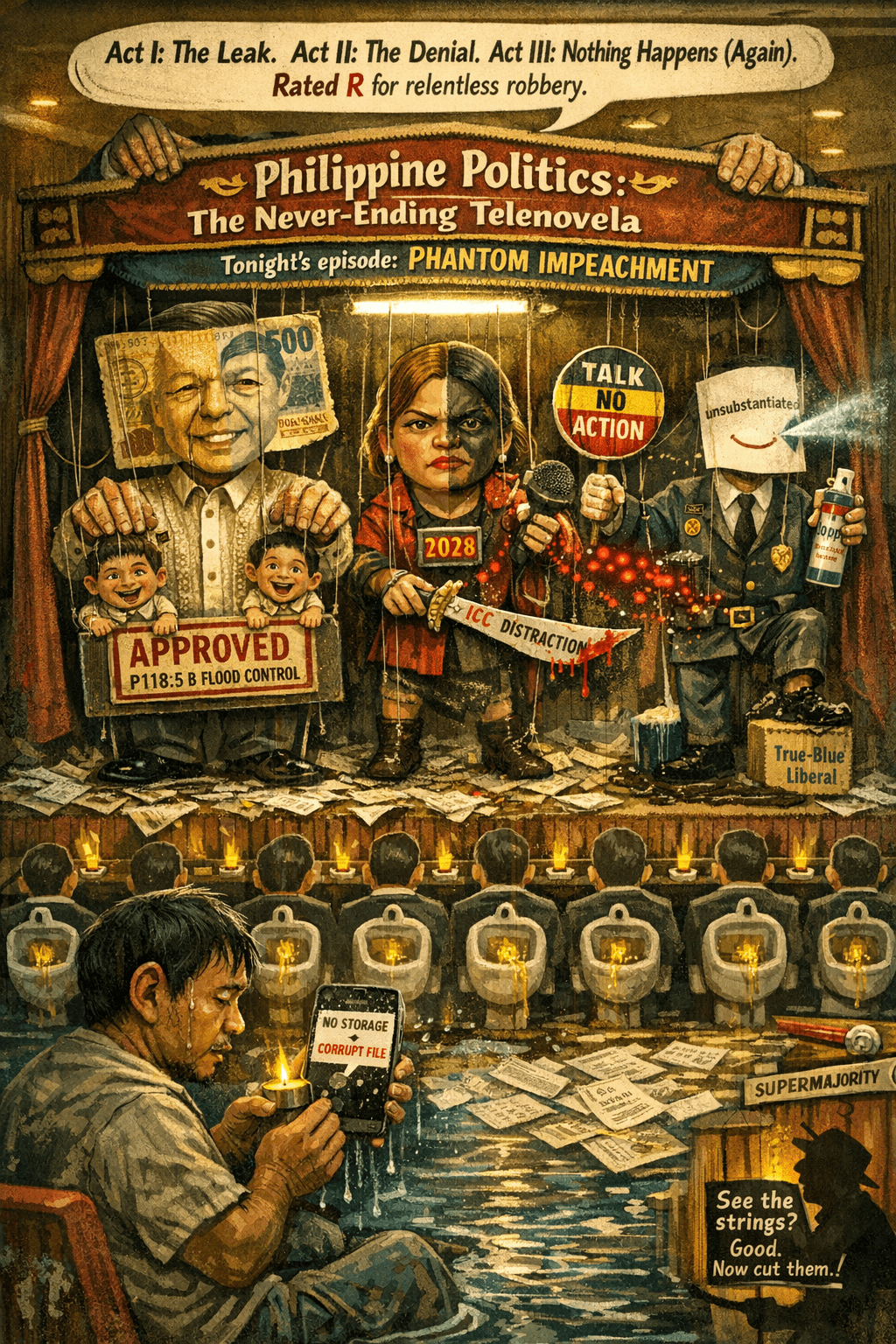
Act I: The Leak. Act II: The Denial. Act III: Nothing Happens (Again)
By Louis ‘Barok‘ C. Biraogo — January 13, 2026
MGA ka-kweba, ladies and gentlemen of this benighted republic, gather ’round for another episode of Philippine Politics: The Never-Ending Telenovela. This week’s installment features President Ferdinand R. Marcos Jr. in the role of the embattled patriarch, Vice President Sara Duterte as the vengeful ex-partner, and a supporting cast of congressional opportunists performing what can only be described as the Grand Theatre of the Absurd.
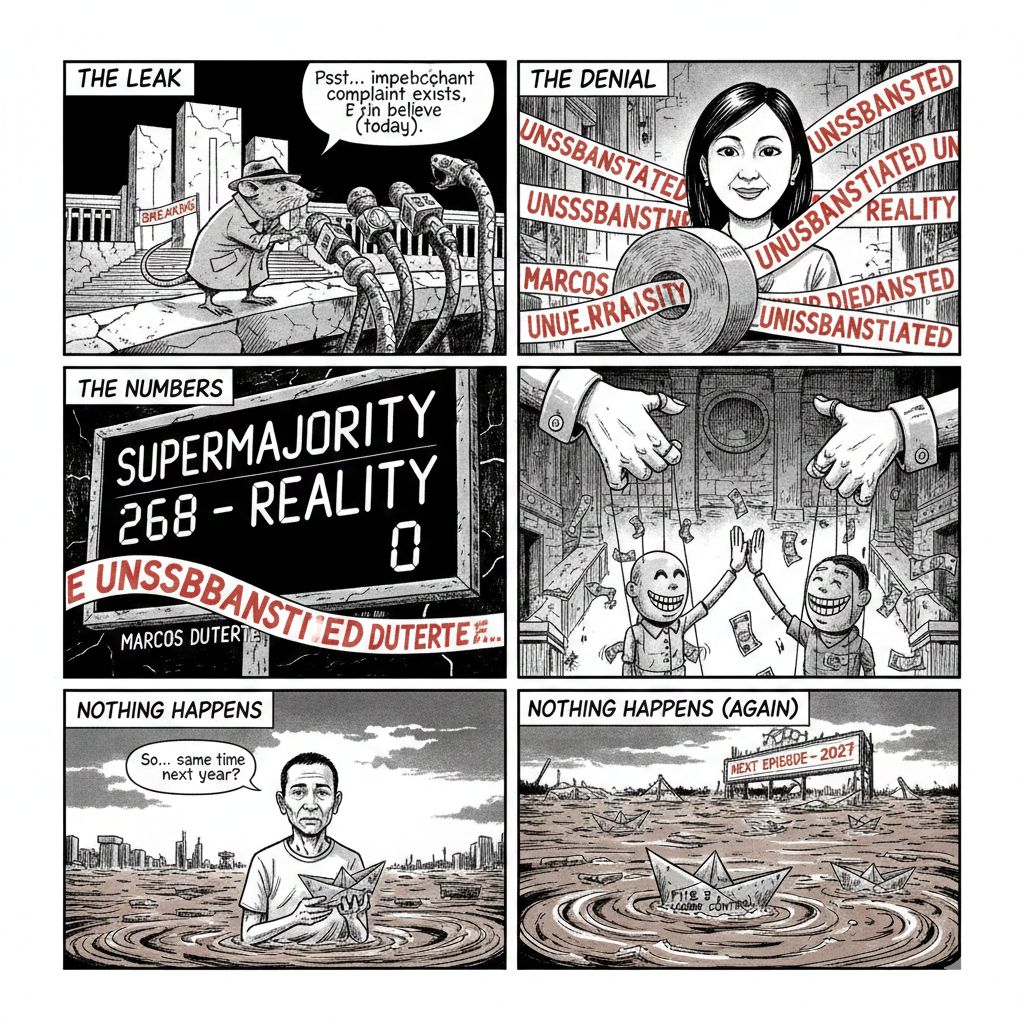
We open with Caloocan Rep. Edgar Erice breathlessly announcing that shadowy figures have approached him to endorse an impeachment complaint against the President—ground? The ever-versatile “betrayal of public trust”—naturally. Malacañang, through the ever-loyal Press Officer Claire Castro, swats it away as “unsubstantiated” political maneuvering. No complaint has been filed, no endorser named, no evidence presented. Yet here we are, national media in a frenzy, as if the mere whisper of impeachment constitutes high drama.
Who is performing for whom? Simple: the pro-Duterte faction is putting on a show for their base, signaling that they can still draw blood even after the UniTeam’s spectacular implosion. The Palace, meanwhile, plays the dignified adult, insisting it’s all noise while quietly counting heads in the House supermajority. This isn’t accountability theater—it’s elite factional warfare with constitutional props. Both sides know the script: float the threat, watch the enemy flinch, then retreat to fight another day. The only losers, as usual, are the Filipino people, who get to watch their leaders cosplay governance while the treasury bleeds.
Character Assassination (With Legal Footnotes)
Let us begin with Edgar Erice, the self-appointed “neutral arbiter” who claims he won’t endorse any complaint but helpfully amplifies its existence to every microphone in sight. Spare me. This is the same Erice who positions himself as a “true blue Liberal” while conveniently stirring the pot without getting his hands dirty. Raising “questions” before the Committee on Justice without committing to a complaint is the political equivalent of gossiping about someone’s infidelity while piously declaring you don’t condone adultery. It’s cowardice dressed as principle.
Erice cites Supreme Court rulings—Francisco v. House of Representatives (2003)—to remind us that complaints must meet form and substance. Brilliant observation, congressman. Perhaps next he’ll remind us that water is wet. The man is not a guardian of process; he’s a traffic cop directing chaos he helped create. His performance is pure political opportunism: keep the Marcos-Duterte feud boiling, position himself as the reasonable center, and hope some crumbs of relevance fall his way.
Then we have Claire Castro, Palace mouthpiece extraordinaire, dismissing the entire affair as “unsubstantiated statements allegedly coming from the supporters of a certain politician.” Translation: Duterte diehards are at it again. Castro’s language is a masterclass in controlled deflection—calm, procedural, laced with that patented Malacañang condescension. “The President respects constitutional processes,” she intones, as if the Palace hasn’t spent decades perfecting the art of bending those same processes to its will.
But let’s not pretend this is mere loyal service. Castro’s rebuttal isn’t just defense; it’s willful blindness. When billions in flood control funds vanish into “ghost projects” and family members like Sandro Marcos and Martin Romualdez mysteriously receive massive allocations, “unsubstantiated” starts to sound less like prudent caution and more like deliberate obfuscation. The Palace wants us to believe the President is laser-focused on governance while his own kin feast at the budgetary trough. The cynicism is palpable.
The Festering Core: Scandals & Systemic Rot
This impeachment chatter isn’t happening in a vacuum. It’s the fever chart of a body politic riddled with infection.
At the center: the P118.5-billion flood control scandal—billions allocated for projects that exist only on paper, while actual floods continue to drown the poor. Tie that to the serial budget insertions across the 2023–2025 General Appropriations Acts (GAAs): “allocables,” unprogrammed funds, line-item vetoes conspicuously not exercised when family members and allies stood to gain. Sandro Marcos gets P15.8 billion. Martin Romualdez, P14.4
billion. Essential programs like PhilHealth get shoved into unprogrammed appropriations while patronage projects bloom like mold.
This isn’t mere inefficiency. This is institutionalized lootocracy—the systematic conversion of public funds into private political capital, enabled by a President who signs the bills and a Congress that stuffs them. The Palace trumpets anti-corruption probes it supposedly initiated, but those probes conveniently stop short of the real beneficiaries. Meanwhile, the stench of graft rises so high even the constitutional air fresheners can’t mask it.
Contrast the Palace’s “focus on governance” mantra with reality: a government where betrayal of public trust isn’t an aberration—it’s standard operating procedure.
Legal & Constitutional Farce
Article XI of the 1987 Constitution lists impeachable offenses with solemn gravity: culpable violation of the Constitution, graft and corruption, betrayal of public trust—the catch-all clause that swallowed Renato Corona whole in 2012 for failing to declare assets. The same clause could, in theory, apply here: signing budgets riddled with anomalies, enabling family enrichment, presiding over systemic plunder. Precedent exists—Belgica v. Ochoa (2013) declared pork barrel unconstitutional; Corona’s conviction showed betrayal need not be criminal, merely “grossly offensive to the sensibilities of the people.”
But theory is where it ends. Impeachment in the Philippines isn’t a legal remedy; it’s a political execution requiring political will that simply does not exist. Marcos commands a House supermajority. The Committee on Justice is gatekept by allies. The one-year bar rule—freshly reinforced in the 2025 Duterte impeachment ruling—adds another layer of procedural armor. Even if a verified complaint somehow materialized, it would die quietly in committee, killed not by lack of merit but by raw political math.
And that’s the real farce: the Constitution’s most solemn accountability mechanism reduced to a partisan cudgel in a proxy war between Marcos and Duterte camps. One side floats impeachment to distract from the VP’s own vulnerabilities; the other dismisses it to project stability. Both treat the process like a bargaining chip in their endless game of thrones.
Motivations & Endgames
What does the pro-Duterte faction gain? A distraction from Sara’s legal troubles, a bargaining chip in coalition negotiations, and red meat for the base ahead of 2028. Floating Marcos’ impeachment neutralizes the threat against her and keeps the faithful mobilized.
The Palace’s endgame is simpler: project unflappable stability, wait for the news cycle to move on, and quietly purge any remaining Duterte sympathizers from the coalition. Castro’s dismissals aren’t just rebuttal—they’re signaling to wavering allies that the administration remains in control.
Both sides understand the golden rule of Philippine politics: he who controls the House controls survival.
Impacts & Consequences
This spectacle does lasting damage.
- Politically, it deepens the nation’s polarization, turning every institution into a battlefield. Legislative function grinds to a halt as members posture instead of legislate.
- Economically, “political noise” of this magnitude spooks investors already nervous about governance risk. Capital flight, delayed projects, weakened recovery—standard side effects of elite infighting.
- Socially, public trust—already threadbare—frays further. When impeachment is wielded as theater rather than remedy, citizens learn that accountability is for suckers.
- Legally, the process itself is debased. A constitutional safeguard becomes just another partisan tool, its gravity diluted with every empty threat.
Final Judgment & Recommendations
This is not the birth pangs of accountability. This is the death rattle of principled governance—a republic where systemic rot is managed, not cured, and the powerful play musical chairs with impunity.
Verdict: guilty—all of them. Guilty of turning the Constitution into a prop, the budget into a piggy bank, and the public into an exhausted audience.
Recommendations, sharp and specific:
- The Ombudsman must pursue the flood control scandal independently, following the money to whoever benefited—family names included. Hiding behind “political theater” is not an option.
- Congress must abolish the “allocable” monster and unprogrammed fund loopholes that have replaced PDAF as the new pork barrel. Pass real budgetary reform or admit you’re complicit.
- The House Committee on Justice should publicly commit to transparent, evidence-based review of any complaint—though we all know it won’t happen under the current supermajority.
- And to the public: stop waiting for these clowns to save you. See the charade for what it is—elite survival cosplaying as democracy—and demand substance over spectacle. Because if we don’t, the next act will be even uglier.
Until then, stay vigilant, stay angry, and keep the light on the rot.
— Barok
Key Citations
A. Legal & Official Sources
- “The 1987 Constitution of the Republic of the Philippines, Article XI: Accountability of Public Officers.” Official Gazette of the Republic of the Philippines.
- Francisco, Ernesto B., Jr., et al. v. The House of Representatives, et al. G.R. No. 160261, Supreme Court of the Philippines, 10 Nov. 2003, LawPhil Project.
- Belgica, Greco Antonious Beda B., et al. v. Hon. Executive Secretary Paquito N. Ochoa, Jr., et al. G.R. No. 208566, Supreme Court of the Philippines, 19 Nov. 2013, LawPhil Project.
B. News Reports
- “Rep. Edgar Erice, hinihikayat na mag-endorso ng impeachment laban kay PBBM.” YouTube, uploaded by UNTV News and Rescue, 12 Jan. 2026.
- Esguerra, Darryl John. “Political maneuverings, Palace says of Marcos impeachment talks.” Philippine News Agency, 11 Jan. 2026.
- Latoza, Guinevere. “’Allocables’ Are the New Pork and Sandro Marcos and Martin Romualdez Are the Pork Barrel Kings.” Philippine Center for Investigative Journalism, 29 Nov. 2025.
- “Flood Control Projects Scandal in the Philippines.” Wikipedia, Wikimedia Foundation.

- ₱75 Million Heist: Cops Gone Full Bandit

- ₱6.7-Trillion Temptation: The Great Pork Zombie Revival and the “Collegial” Vote-Buying Circus

- ₱1.9 Billion for 382 Units and a Rooftop Pool: Poverty Solved, Next Problem Please

- ₱1.35 Trillion for Education: Bigger Budget, Same Old Thieves’ Banquet

- ₱1 Billion Congressional Seat? Sorry, Sold Out Na Raw — Si Bello Raw Ang Hindi Bumili

- “We Will Take Care of It”: Bersamin’s P52-Billion Love Letter to Corruption

- “Skewed Narrative”? More Like Skewered Taxpayers!

- “Scared to Sign Vouchers” Is Now Official GDP Policy – Welcome to the Philippines’ Permanent Paralysis Economy

- “Robbed by Restitution?” Curlee Discaya’s Tears Over Returning What He Never Earned

- “No Pressure” Luistro? The House Pork Bazaar Exposed
- “My Brother the President Is a Junkie”: A Marcos Family Reunion Special

- “Mapipilitan Akong Gawing Zero”: The Day Senator Rodante Marcoleta Confessed to Perjury on National Television and Thought We’d Clap for the Creativity




 KWEBA ni BAROK
Leave a comment