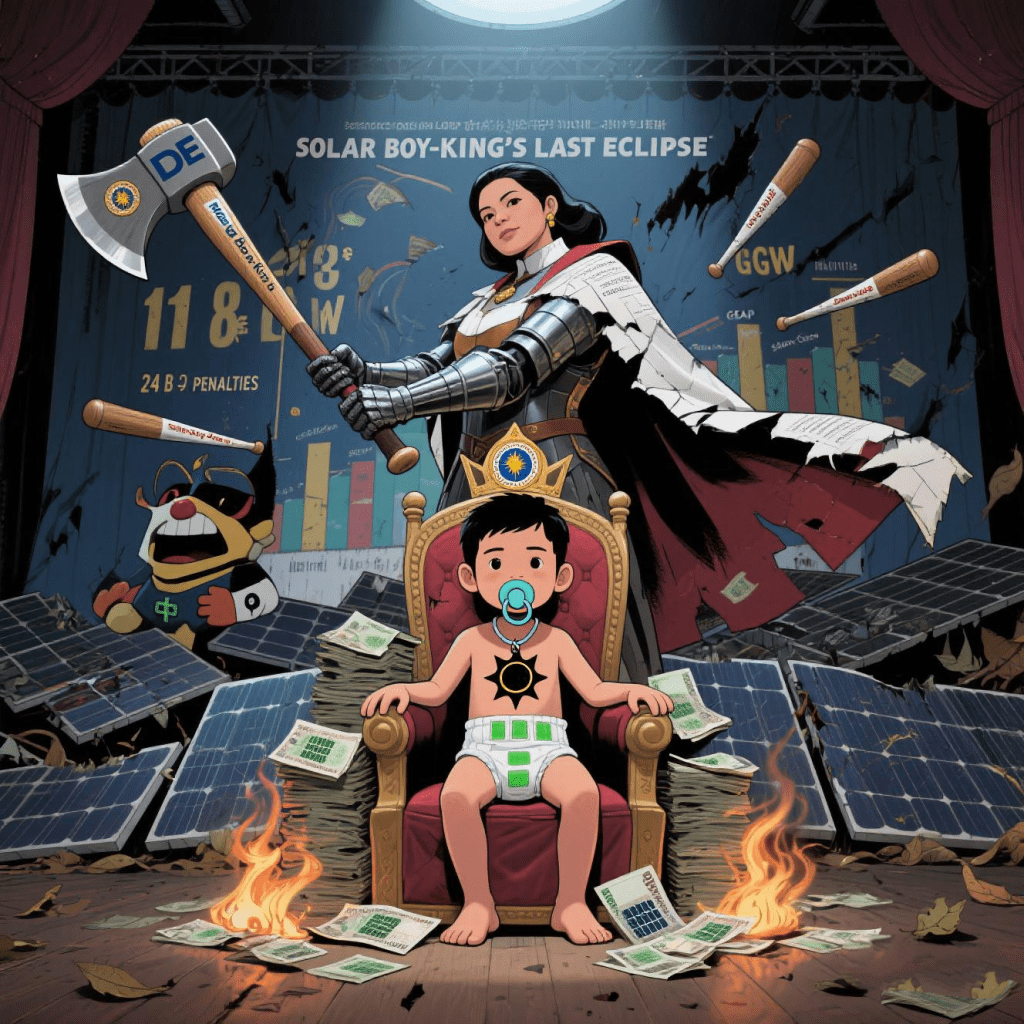
The Rise, the Hype, the Silence, and the Inevitable Axe
By Louis ‘Barok‘ C. Biraogo — January 14, 2026
MGA ka-kweba, it feels like another Philippine teleserye unfolding in the energy sector: a villain carrying her own scandals, a privileged young hero posing as a green pioneer, and thousands of megawatts of promised power vanishing into thin air.
Nearly 18 gigawatts of renewable energy contracts—gone. Terminated by the Department of Energy (DOE) over just two years. The biggest loser? Solar Philippines Power Project Holdings Inc., the crown jewel of Batangas Rep. Leandro “The Solar Boy-King” Leviste—11,427 MW, roughly 64% of all cancellations. The DOE is now chasing P24 billion in penalties, according to the Daily Tribune report.
And wielding the axe? None other than Energy Secretary Sharon Garin, suddenly cast as the great system-cleaner.
This is classic Philippine tragedy: regulatory capture colliding with political survival, while the rest of us wait in the dark.
The Garin Gambit: A Convenient Clean-Up
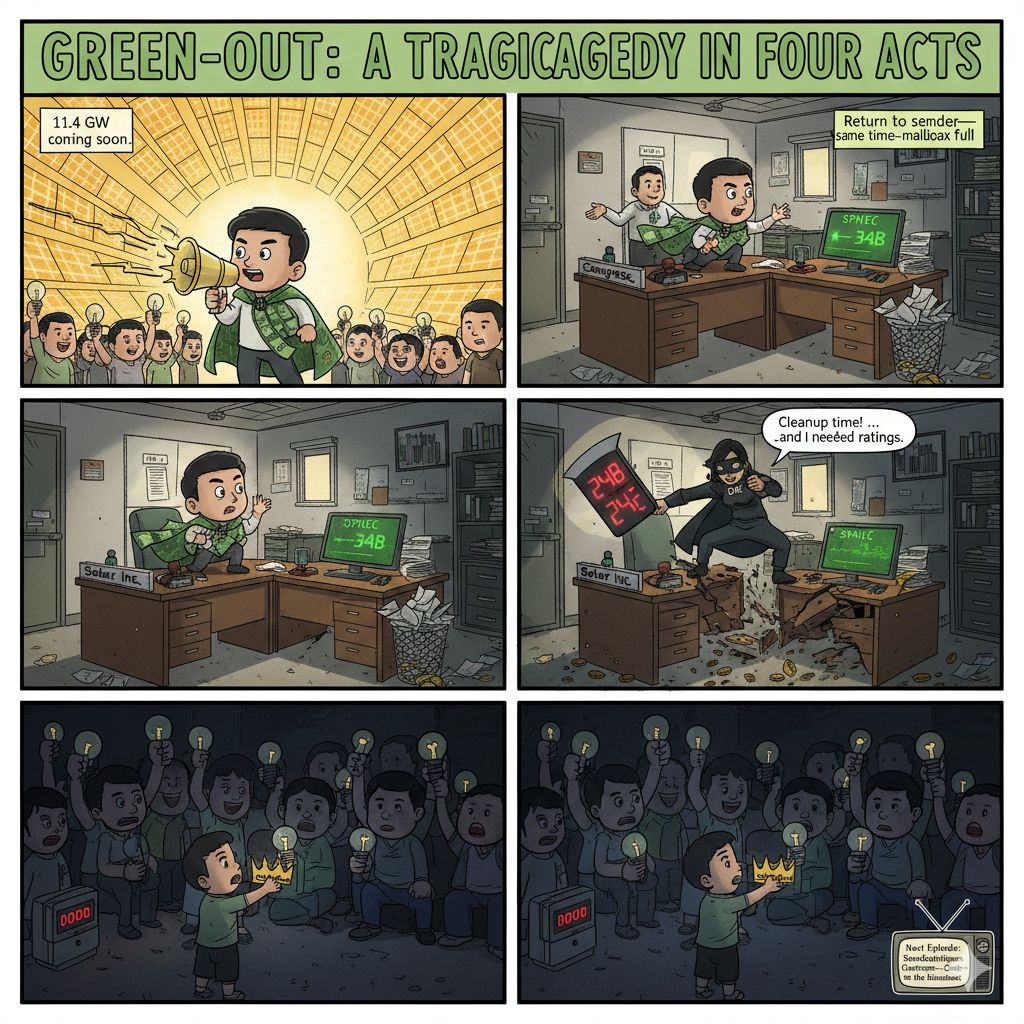
Secretary Garin stands before the press, declaring that the DOE has “consistently sent notices, even Show Cause Orders” to Solar Philippines, yet received no response, no renewed bonds, nothing. For the first time, she said, the department will actually collect the penalties. She frames it as a grand clean-up: freeing stranded capacity, welcoming “legitimate investors” with real financial, technical, and legal muscle—all to keep our 35% renewable energy share by 2030 and 50% by 2050 on track.
But let us not be dazzled. This is political theater. Garin wields the axe with the fervor of someone who needs a highly visible “win.” The scale of failure happened under her department’s watch—yet now she positions herself as the stern matrona sweeping the mess. Due process, she insists. Yet the pot calling the kettle black, when Garin herself faces graft complaints at the Ombudsman. Selective enforcement? The materials certainly allow the question to linger.
The Leviste Labyrinth: Conflict of Interest in Plain Sight
The real star is The Solar Boy-King—Leandro Leviste, who amassed 11,427 MW of contracts under the Green Energy Auction Program (GEAP) like a dragon hoarding gold, only to watch them crumble. He sold the “green pioneer” narrative beautifully, yet when notices came, silence. Just the quiet cash-out—remember that suspiciously timed P34-billion SPNEC stake sale to Meralco?
The deeper rot is legal. A sitting congressman—whose branch controls the DOE’s budget and oversees energy policy—a beneficial owner of a company dependent on DOE approvals? This is a textbook high-risk scenario under:
- Republic Act No. 6713 (Code of Conduct and Ethical Standards for Public Officials and Employees), Section 7(a) prohibits financial interest in transactions requiring approval of one’s office.
- Republic Act No. 3019 (Anti-Graft and Corrupt Practices Act), Section 3(h) criminalizes indirect interest where the official can intervene—even informally (see Domingo v. Sandiganbayan).
The DOE’s hardline enforcement? Partly self-protection—over-correcting to dispel favoritism.
The Legal Theatre Ahead
This will not end quietly. Potential consequences include:
- For Leviste/Solar Philippines:
- Civil suits for P24 billion in bonds and damages.
- Administrative blacklisting under Republic Act No. 9184 (Government Procurement Reform Act).
- Criminal exposure under Republic Act No. 9513 Section 36 or RA 3019 if fraud is proven.
- Penalties under Presidential Decree No. 1759 for prejudicial violations.
- For Garin: Counterclaims of abuse of discretion or bad faith (see Arias v. Sandiganbayan).
The stage is set for years of Sandiganbayan drama.
The Opera of Motives
Everyone gains something—except the public. Garin needs a scalp to deflect her controversies. Leviste’s model looked like profit-from-chaos until the axe fell. The DOE saves face after years of laxity. Some whispers suggest political undermining of a Duterte-aligned scion (those favors under Republic Act No. 11357 did not go unnoticed). And that SPNEC-Meralco windfall? Suspicious timing.
The Fallout: A Hobbling of the RE Transition
- Short-term capacity gaps and delayed emission cuts.
- Chilled investors facing sudden rigidity.
- A government failing at both promotion and punishment.
Resolutions may include negotiated settlement, prolonged litigation (DOE likely prevails on enforcement authority), or congressional inquiry.
Enough of This Farce
Mga ka-kweba, this is the rotting core of Philippine governance. I call on the Ombudsman, Congress (even with conflicted members), and the judiciary to intervene swiftly.
Recommendations:
- Compulsory divestment or blind trusts for officials in regulated industries.
- Independent audit of the entire GEAP.
- Moratorium on new awards until the system is politician-proof.
While the nation waits in vain for real power, real change, real accountability,
Barok stays appalled—unshaken, unfooled, and utterly unsurprised.
Because in this circus, the clowns change costumes… but the show never ends
Key Citations
A. Legal & Official Sources
- Renewable Energy Act of 2008. Republic Act No. 9513, Official Gazette of the Republic of the Philippines, 16 Dec. 2008.
- Code of Conduct and Ethical Standards for Public Officials and Employees. Republic Act No. 6713, LawPhil Project, 20 Feb. 1989.
- Anti-Graft and Corrupt Practices Act. Republic Act No. 3019, LawPhil Project, 17 Aug. 1960.
- Philippines. Republic Act No. 9184: Government Procurement Reform Act. 10 Jan. 2003. Official Gazette of the Republic of the Philippines. Accessed January 14, 2016.
- Penalizing Contractors and Sub-Contractors Who Violate Any Material Provisions of Contracts Involving Government Public Works Projects. Presidential Decree No. 1759, LawPhil Project, 2 Jan. 1981.
- An Act Granting Solar Para sa Bayan Corporation a Franchise. Republic Act No. 11357, LawPhil Project, 31 Jul. 2019.
- Domingo v. Sandiganbayan. G.R. No. 109376, Supreme Court of the Philippines, 20 Jan. 2000, LawPhil Project.
- Arias v. Sandiganbayan. G.R. No. 81563, Supreme Court of the Philippines, 19 Dec. 1989, LawPhil Project.
B. News Reports
- “Forthwith” to Farce: How the Senate is Killing Impeachment—And Why Enrile’s Right (Even If You Can’t Trust Him)
- “HINDI AKO NAG-RESIGN!”

- “I’m calling you from my new Globe SIM. Send load!”

- “Mahiya Naman Kayo!” Marcos’ Anti-Corruption Vow Faces a Flood of Doubt

- “Meow, I’m calling you from my new Globe SIM!”

- “No Special Jail for Crooks!” Boying Remulla Slams VIP Perks for Flood Scammers

- “PLUNDER IS OVERRATED”? TRY AGAIN — IT’S A CALCULATED KILL SHOT

- “Several Lifetimes,” Said Fajardo — Translation: “I’m Not Spending Even One More Day on This Circus”

- “Shimenet”: The Term That Broke the Internet and the Budget
- “We Did Not Yield”: Marcos’s Stand and the Soul of Filipino Sovereignty

- “We Gather Light to Scatter”: A Tribute to Edgardo Bautista Espiritu

- $150M for Kaufman to Spin a Sinking Narrative




 KWEBA ni BAROK
Leave a comment