
When Bruised Egos Declare War on Internal Organs
By Louis ‘Barok‘ C. Biraogo — January 15, 2026
MGA ka-kweba, here in Barok’s Cave, we don’t just count nonsense—we dissect it, mock it, and tear it down to the bone.
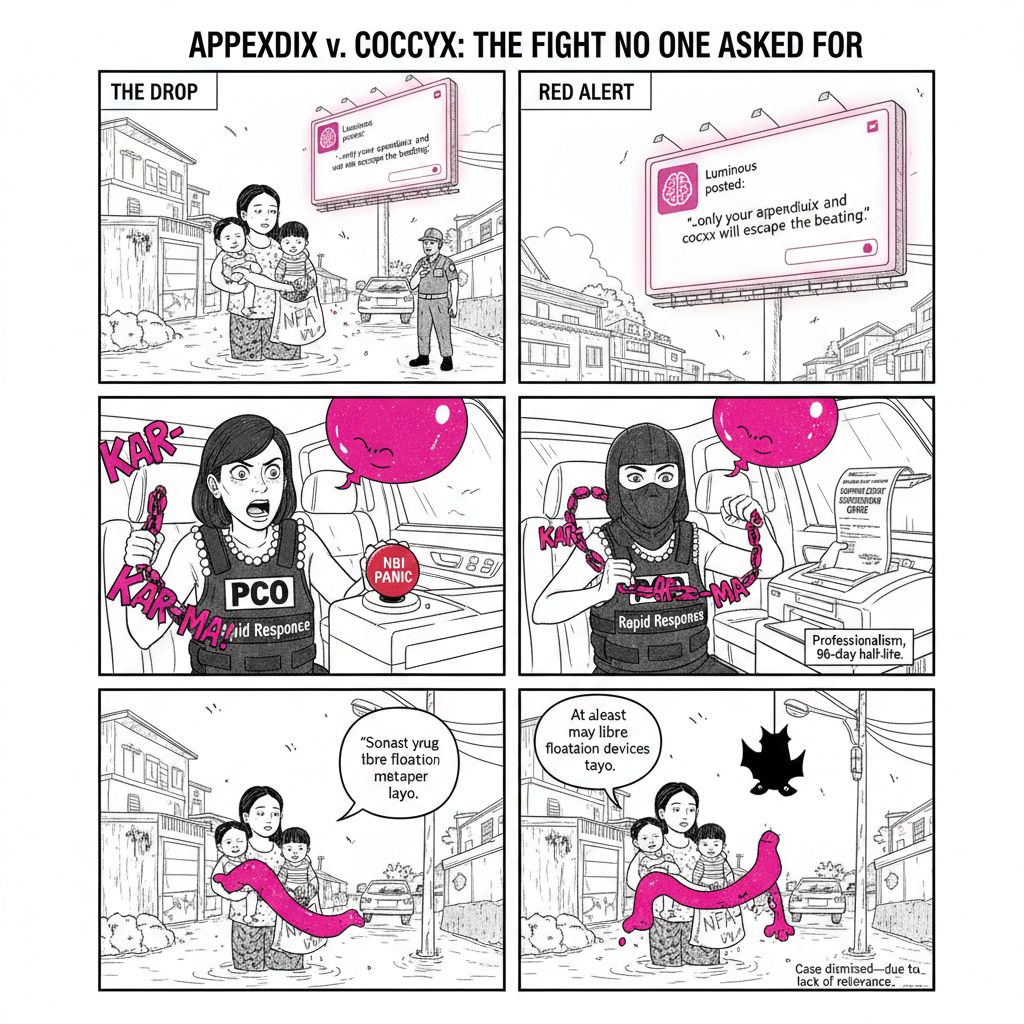
Right now, while floods, corruption, and hunger devour the nation, we’ve suddenly been handed a new telenovela: the Appendix Affair, or if you prefer it more dramatic, the Battle of the Bruised Egos between Atty. Claire Castro and Atty. Trixie Cruz-Angeles.
It all started with a single Facebook post. One metaphor about the appendix and coccyx. And boom—a blotter report at the National Bureau of Investigation (NBI), fear for one’s life, and a national headline. While Filipinos suffer from inflation and joblessness, this is what two lawyers—both officers of the court—choose to focus on.
The “Threat” Under the Microscope
Let us examine exactly what was said in the post made on January 2, 2026, on the page “Luminous by Trixie Cruz-Angeles & Ahmed Paglinawan”:
“I hope that in this new year, you finally understand that when your masters drop you, only your appendix and coccyx will be left without bruises, as a result of what you’ve been doing.”
It means: when your bosses abandon you, only your appendix and coccyx will escape the beating.
This is clearly a metaphor—political downfall, karma, the consequences of one’s actions. But Castro? She calls it a “death threat.” She says she was terrified. “Saying that only parts of my body will be left unhurt means something else.”
Let us look at it under the law. Article 282 of the Revised Penal Code (RPC)—Grave Threats—requires a threat to commit a crime (e.g., to kill or injure), intent to cause fear, and that the fear be reasonable.
Is any of that present here? There is no “I will kill you.” No specific act, no timeframe, no direct address. It is merely a metaphor for a political beating—something utterly commonplace on our social media.
If this qualifies as a grave threat, then every “karma will get you” post could land someone in jail. What then of the real threats faced by journalists and activists—the ones with explicit “kill this person” messages and gun photos? Those often go unaddressed. But an appendix joke? Straight to the NBI?
In Disini v. Secretary of Justice (G.R. No. 203335, 2014), the Supreme Court declared that online speech enjoys heightened protection, especially when political. Hyperbolic language cannot simply be criminalized—particularly under the Republic Act No. 10175 (Cybercrime Prevention Act of 2012).
Character Assassination (With Receipts)
Let us not pretend either of these two is a saint.
Claire Castro—former media personality, now Presidential Communications Office (PCO) Undersecretary zealously defending President Marcos against VP Sara. She had a viral 2025 video showing high emotion over Duterte’s allegations. And in 2015? She was detained for “hysterical” behavior in front of police. Now she is suddenly terrified by an appendix joke? This looks like selective hypersensitivity—strategic victimhood designed to silence pro-Duterte critics.
Trixie Cruz-Angeles—former Marcos Press Secretary who left, ostensibly for health reasons, after only 96 days. Then abruptly became an anti-Marcos, DDS-aligned critic. She has two Supreme Court suspensions: one in 2016 for negligence in a client’s case, and another in 2023 for “grossly abusive” language. She is an officer of the court, yet shows a pattern of unethical conduct that violates the Code of Professional Responsibility and Accountability (CPRA). Now co-owner of a page posting this kind of metaphor—irresponsible and beneath the dignity an attorney should uphold.
Both carry drama, both carry political baggage, and both weaponize the law for personal vendettas.
The Legal Carnival
If Castro files formal Grave Threats charges (RPC Article 282 + Republic Act No. 10175 Section 6), the prosecution must prove criminal intent and reasonable fear. Given the context? The case will likely be dismissed at the preliminary investigation stage.
If she tries cyberlibel instead, she must prove the statement is defamatory and malicious. Truth and fair comment on a public official are powerful defenses. In People v. Soliman (G.R. No. 256700, 2023), the Supreme Court favored fines over imprisonment—but will it even get that far?
The most probable outcome? It fizzles out. The NBI investigates, the DOJ declares insufficient evidence, and both parties return to posting on Facebook. Classic Philippine legal theater—lots of noise, no substance, and taxpayer money wasted.
The Political Petri Dish
This is the most nauseating part. While the Marcos and Duterte camps feud over impeachment and corruption probes, this appendix joke becomes a proxy war. Castro is a Marcos loyalist. Angeles was once Marcos but is now DDS-aligned.
It is a distraction from the real problems: poverty, crumbling infrastructure, and persistent corruption. This is weaponization of the law—using the NBI and cybercrime statutes to intimidate opponents.
The Court of Public Opinion
On social media, opinion is split. Some call Castro’s reaction an overreach, using the victim card. Others say Angeles was reckless. In the end, both gain engagement—and we lose meaningful discourse.
The chilling effect is real—many will now fear criticizing the government. But violent rhetoric also gets normalized. The net result: the quality of our political debate sinks even lower.
A Manifesto for Better Politics
Enough of this kind of politics. Enough of the personal attacks, trivial feuds, and self-serving drama masquerading as discourse.
- To those in government: speak about policy—how to reduce poverty, how to fix infrastructure, how to fight corruption.
- To critics: criticize with substance, evidence, and alternatives.
- To us ordinary citizens: refuse to be the audience for this circus. Stop sharing, stop liking, stop giving oxygen to these pointless fights. Demand a higher standard—politics with integrity, substance, and genuine care for the nation.
Otherwise, we remain a country full of talented lawyers but empty of justice.
— Barok
Because apparently the real national emergency is a Facebook appendix joke.
Good night, Philippines. Try not to die of second-hand embarrassment.
Key Citations
A. Legal & Official Sources
- The Revised Penal Code. Act No. 3815, LawPhil Project.
- Cybercrime Prevention Act of 2012. Republic Act No. 10175, Official Gazette of the Republic of the Philippines, 12 Sept. 2012.
- Disini, Jr. v. Secretary of Justice. G.R. No. 203335, Supreme Court of the Philippines, 11 Feb. 2014, LawPhil Project.
- People v. Soliman. G.R. No. 256700, Supreme Court of the Philippines, 25 Apr. 2023, LawPhil Project.
- Code of Professional Responsibility and Accountability. A.M. No. 22-09-01-SC, Supreme Court of the Philippines, 11 Apr. 2023.
B. News Reports

- ₱75 Million Heist: Cops Gone Full Bandit

- ₱6.7-Trillion Temptation: The Great Pork Zombie Revival and the “Collegial” Vote-Buying Circus

- ₱1.9 Billion for 382 Units and a Rooftop Pool: Poverty Solved, Next Problem Please

- ₱1.35 Trillion for Education: Bigger Budget, Same Old Thieves’ Banquet

- ₱1 Billion Congressional Seat? Sorry, Sold Out Na Raw — Si Bello Raw Ang Hindi Bumili

- “We Will Take Care of It”: Bersamin’s P52-Billion Love Letter to Corruption

- “Skewed Narrative”? More Like Skewered Taxpayers!

- “Scared to Sign Vouchers” Is Now Official GDP Policy – Welcome to the Philippines’ Permanent Paralysis Economy
- “Robbed by Restitution?” Curlee Discaya’s Tears Over Returning What He Never Earned

- “No Pressure” Luistro? The House Pork Bazaar Exposed
- “My Brother the President Is a Junkie”: A Marcos Family Reunion Special

- “Mapipilitan Akong Gawing Zero”: The Day Senator Rodante Marcoleta Confessed to Perjury on National Television and Thought We’d Clap for the Creativity



 KWEBA ni BAROK
Leave a comment