Two Decades of Rigged Bids, One Dramatic Scolding, and Still No Receipts in Sight
By Louis ‘Barok‘ C. Biraogo — January 18, 2026
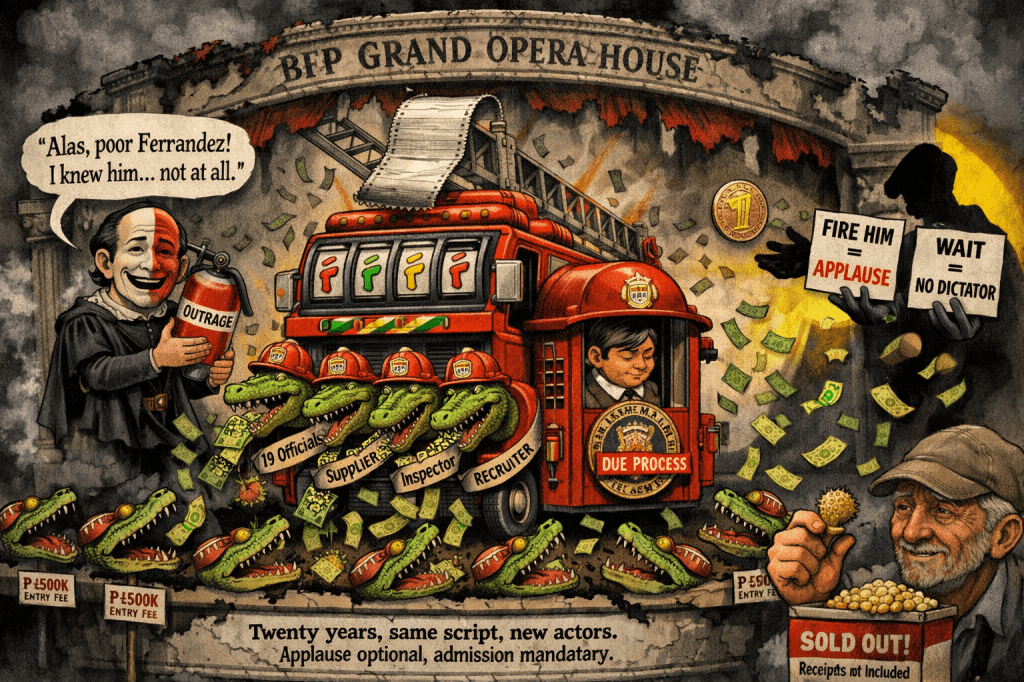
MGA ka-kweba, welcome back to the Cave. Today we dissect the latest chapter of our national telenovela: “Jonvic vs. The Fire Chief: A Tale of Indignation, Kickbacks, and ₱15 Billion Annual Leakage.” This is not merely a corruption story. No. This is Shakespearean drama—Macbeth colliding with The Comedy of Errors, except there is no comedy, only errors.
Secretary Jonvic Remulla plays the outraged hero, suddenly awakening like Hamlet to his moral compass. BFP Chief Jesus Fernandez is cast as the tragic villain—reportedly bowing his head, unable to meet Remulla’s gaze, looking every bit like a high-school student caught cheating on an exam. In the background stands the chorus of 19 officials: bid riggers, extortionists, and overpricing enthusiasts—loyal extras in a production that has been running for two full decades.
And of course, the ultimate director: President Ferdinand “Bongbong” Marcos Jr., now holding a script with only two possible endings: “Fire him immediately for applause” or “Wait for due process so no one can call you a dictator.” Classic Philippine political theater—feigned outrage, silent confrontation, hearsay evidence, and in the end, systemic rot that nobody dares truly touch.
Eviscerating the Narrative: A Story Made of Hot Air
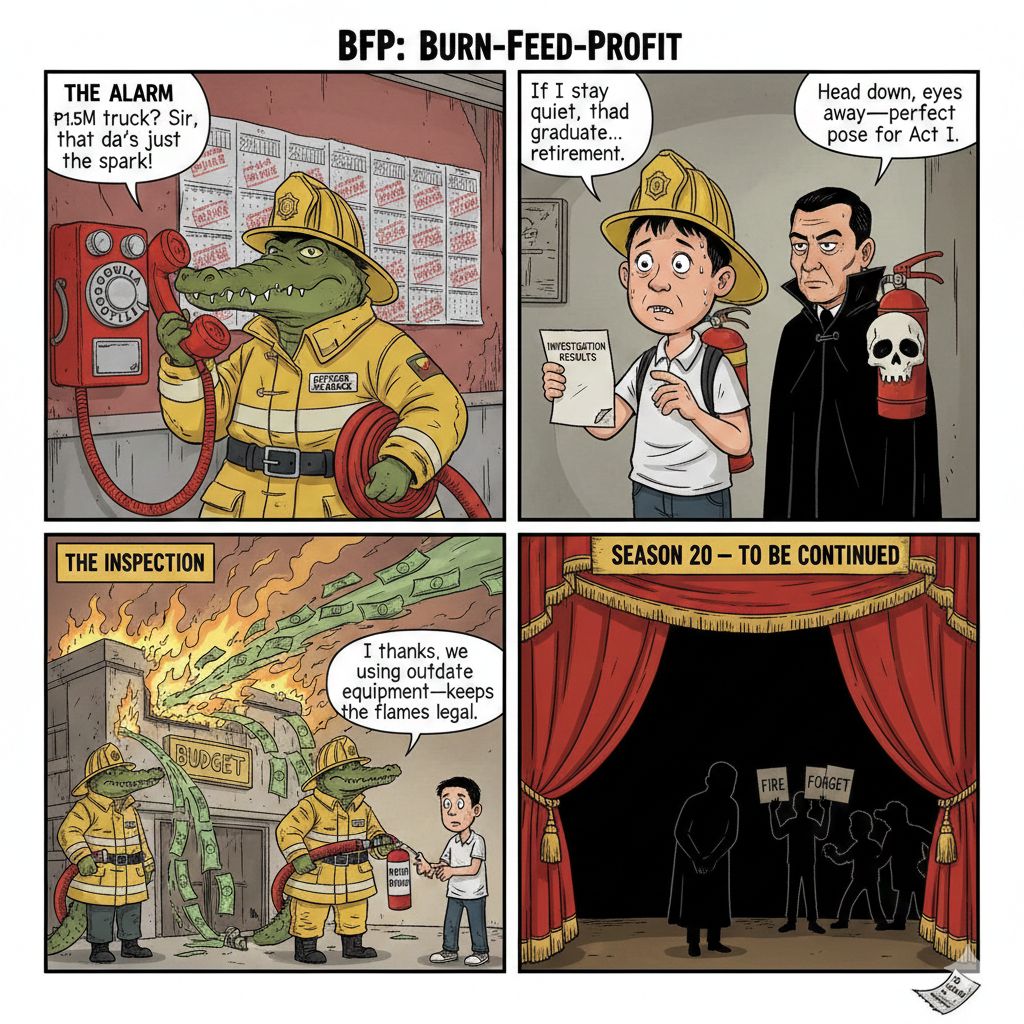
The official storyline is simple and dramatic: A subordinate of Fernandez allegedly approached a “friend” of Remulla and offered ₱1.5 million in kickbacks for every fire truck purchased. Remulla, furious, reportedly berated Fernandez the very next day. The chief’s response? Silence. Head bowed, eyes averted. Pure teleserye material—missing only the slow-motion shot and mournful violin.
But wait—where is the evidence? Hearsay relayed through a “friend,” no recording, no affidavit, no paper trail. Even more amusing: Remulla himself admitted he has not spoken with Fernandez since the alleged confrontation. So how exactly does he know the chief “bowed his head and could not look him in the eye”? Telepathy, Secretary?
Now contrast this with the
voluminous dossier of institutionalized corruption that detail institutionalized corruption in the Bureau of Fire Protection (BFP) stretching back 20 years: bid rigging with terms of reference tailor-made for favored suppliers, a “pay-to-enter” scheme requiring ₱500,000 per slot for new recruits, extortion through Fire Safety Inspection Certificates (FSICs) reaching ₱30 million per building for grossly overpriced extinguishers. The estimated annual leakage? ₱15 billion. Not million—billion.
Why did this suddenly explode now? Why did Secretary Remulla only awaken to the “most corrupt bureau” under his very nose at this precise moment? And why the theatrical public announcement—complete with public shaming—before the CIDG investigation is even finished? Timing, my friends. Timing. (Read the full report in the Philstar article “Jonvic asks Marcos Jr.: Fire BFP chief”, January 16, 2026.)
Legal Labyrinth & Prosecution Theatre: Where Cases Die on Paper
Let us map the legal maze:
- Republic Act No. 3019 (Anti-Graft and Corrupt Practices Act): Section 3(b) prohibits soliciting or accepting gifts in connection with contracts; Section 3(e) covers causing undue injury or giving unwarranted benefits through manifest partiality.
- Republic Act No. 6713 (Code of Conduct and Ethical Standards for Public Officials and Employees): Public office is a public trust; prohibits gifts and conflicts of interest.
- Revised Penal Code (Articles 210–211 – Direct and Indirect Bribery).
- Republic Act No. 9184 (Government Procurement Reform Act): Penalizes bid rigging and collusion in the Bids and Awards Committee (BAC).
Prosecution pathway? First the Ombudsman for probable cause, then trial at the Sandiganbayan. Administrative cases can be initiated motu proprio by the DILG or Ombudsman—only preponderance of evidence required, not proof beyond reasonable doubt.
Viability? Weak for Fernandez and the 19 officials. The “kickback offer” remains hearsay without corroboration. Fernandez’s silence? Usable as circumstantial evidence in administrative proceedings (Fajardo v. Corral doctrine), but far from sufficient in criminal court. Command responsibility exists in theory, but requires clear proof that he knew and allowed the acts.
The much-touted CIDG report that is “80% complete”? Good luck. If it remains mostly testimonial with no solid documentary trail, it will die quietly during preliminary investigation.
The proposed reform packages in the research are brilliant on paper: inspector-supplier firewalls, randomized assignments, centralized procurement, full digitization, whistleblower rewards, separation of inspection and enforcement functions. Technically excellent, aligned with the Ease of Doing Business Act and international best practices.
But in the Philippines? Ha! These same reforms have been “recommended” in countless scandals—COA reports, Ombudsman findings, congressional hearings—only to remain cosmetic. Why? Because the system itself protects the rot. These reforms are like trying to repair the Titanic with duct tape while it continues to sink.
Motives & Machinations: Everyone Has an Agenda
Is Remulla a genuine reformer? Or is this political positioning for 2028? Power consolidation within DILG attached agencies? Damage control for other controversies? A sudden anti-corruption crusader after twenty years of quiet observation of the scheme? Convenient.
Fernandez and his cadre—simple greed? Or survival within a culture where “everyone does it”? When corruption is institutionalized, they are no longer villains—they are products of the system.
And President Marcos Jr.? His decision is not legal—it is pure political calculus. Fire Fernandez now = strong leadership optics. Keep him = accusation of tolerance for corruption. Which choice improves the ratings more? (See Republic Act No. 9263, which grants the President authority to appoint and remove the BFP chief.)
The Rot Is the System: Not Individuals, but the Institution
This is the core thesis: This is not an aberration. This is the BFP’s business model.
Monopoly power over FSICs + wide inspector discretion + procurement capture + low detection risk = perfect recipe for ₱15 billion in annual leakage. Pay-to-enter schemes, bid rigging, permit extortion—all interconnected. It is not just Fernandez and the 19. This is generational, cross-administration, cross-political-color corruption.
The BFP stands as a textbook case of Philippine bureaucratic cancer: regulatory capture transformed into organized crime. Until the entire architecture is changed—digitization, firewalls, independent oversight—this will continue, no matter who occupies the positions.
Demands & Mock Recommendations: Because We Need a Punchline
Therefore I demand:
- Immediate independent investigation—outside the DILG and CIDG. Assign a special prosecutor under the Ombudsman. (Though we all know how these usually end.)
- Full transparency: Release the complete CIDG report, all affidavits, all documentary evidence. Not selective leaks.
- Prosecute the masterminds, not just the fall guys. When a scheme has run for 20 years, many people far above have benefited.
- Implement the real reforms—digitization, firewall rules, whistleblower protection, centralized procurement. (And while we’re dreaming, perhaps flying cars over EDSA too.)
To Secretary Remulla—congratulations on your performance. The indignation, the timing, the dramatic confrontation were truly convincing. You are already nominated for Best Actor at the Gawad Urian of Philippine Politics. But for a clean-government award? Sorry, Secretary—we’re not there yet. Prove us wrong.
Mga ka-kweba, keep your outrage fresh, your receipts notarized, and your cynicism fully charged.
The show never ends—just the actors.
— Barok
Watching from the cheap seats with popcorn and contempt.
Key Citations
A. Legal & Official Sources
- Republic Act No. 3019. Anti-Graft and Corrupt Practices Act. Official Gazette of the Republic of the Philippines, 17 Aug. 1960.
- Republic Act No. 6713. Code of Conduct and Ethical Standards for Public Officials and Employees. Official Gazette of the Republic of the Philippines, 20 Feb. 1989.
- Republic Act No. 9184. Government Procurement Reform Act. Official Gazette of the Republic of the Philippines, 10 Jan. 2003.
- Republic Act No. 9263. Bureau of Fire Protection and Bureau of Jail Management and Penology Professionalization Act of 2004. Official Gazette of the Republic of the Philippines, 10 Mar. 2004.
- Act No. 3815. Revised Penal Code. Official Gazette of the Republic of the Philippines, 8 Dec. 1930.
B. News Reports
- ₱75 Million Heist: Cops Gone Full Bandit

- ₱6.7-Trillion Temptation: The Great Pork Zombie Revival and the “Collegial” Vote-Buying Circus

- ₱1.9 Billion for 382 Units and a Rooftop Pool: Poverty Solved, Next Problem Please

- ₱1.35 Trillion for Education: Bigger Budget, Same Old Thieves’ Banquet

- ₱1 Billion Congressional Seat? Sorry, Sold Out Na Raw — Si Bello Raw Ang Hindi Bumili

- “We Will Take Care of It”: Bersamin’s P52-Billion Love Letter to Corruption

- “Skewed Narrative”? More Like Skewered Taxpayers!

- “Scared to Sign Vouchers” Is Now Official GDP Policy – Welcome to the Philippines’ Permanent Paralysis Economy
- “Robbed by Restitution?” Curlee Discaya’s Tears Over Returning What He Never Earned

- “No Pressure” Luistro? The House Pork Bazaar Exposed
- “My Brother the President Is a Junkie”: A Marcos Family Reunion Special

- “Mapipilitan Akong Gawing Zero”: The Day Senator Rodante Marcoleta Confessed to Perjury on National Television and Thought We’d Clap for the Creativity


 KWEBA ni BAROK
Leave a comment