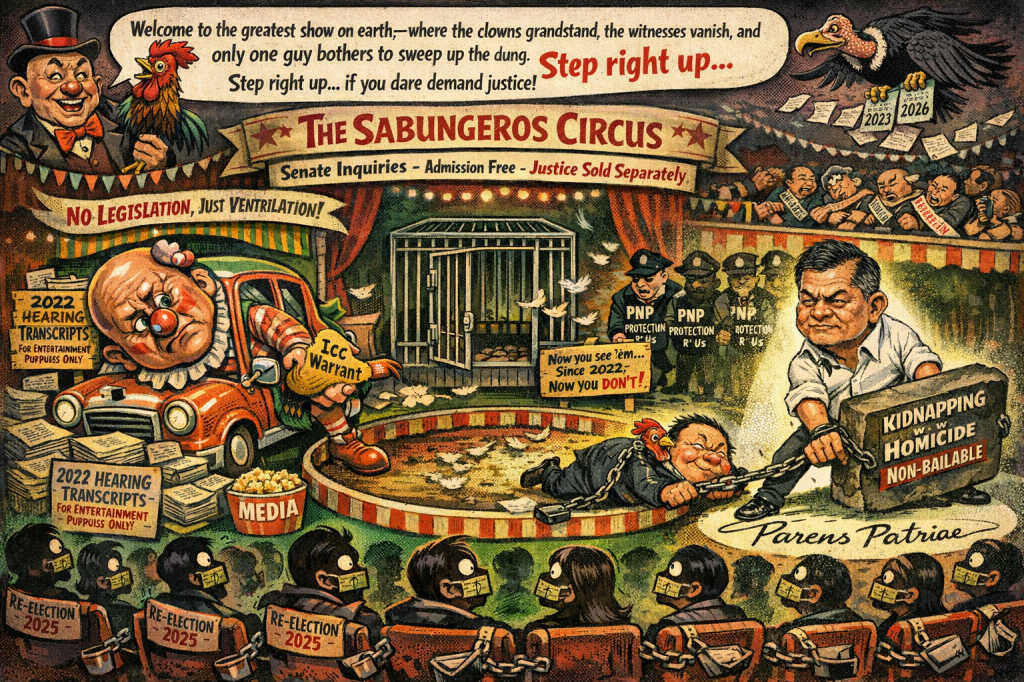
Parens Patriae: Because Some Families Can Be Bought, but the State Still Has to Show Up
By Louis “Barok” C. Biraogo — January 19, 2026
MGA ka-kweba, welcome back to the Kweba. Today we’re wading knee-deep into the festering swamp that is the missing sabungeros case — 34 cockfighting enthusiasts vanished into thin air, allegedly strangled and dumped into Taal Lake on the orders of gaming tycoon Charlie “Atong” Ang.
What we’ve got now is a full-blown inter-branch mud-wrestling match between Ombudsman (and former Justice Secretary) Jesus Crispin “Boying” Remulla and Senator Ronald “Bato” dela Rosa. Remulla says Bato’s 2022 Senate panel just “played with” (laro-laro lang) the case. Bato is nowhere to be seen in the Senate, probably busy dodging both local critics and the ICC’s long shadow.
Let’s dissect this mess with the scalpel it deserves — because while everyone loves a good political bloodsport, the real scandal is how a case involving kidnapping, homicide, and elite untouchables was allowed to go cold for years.
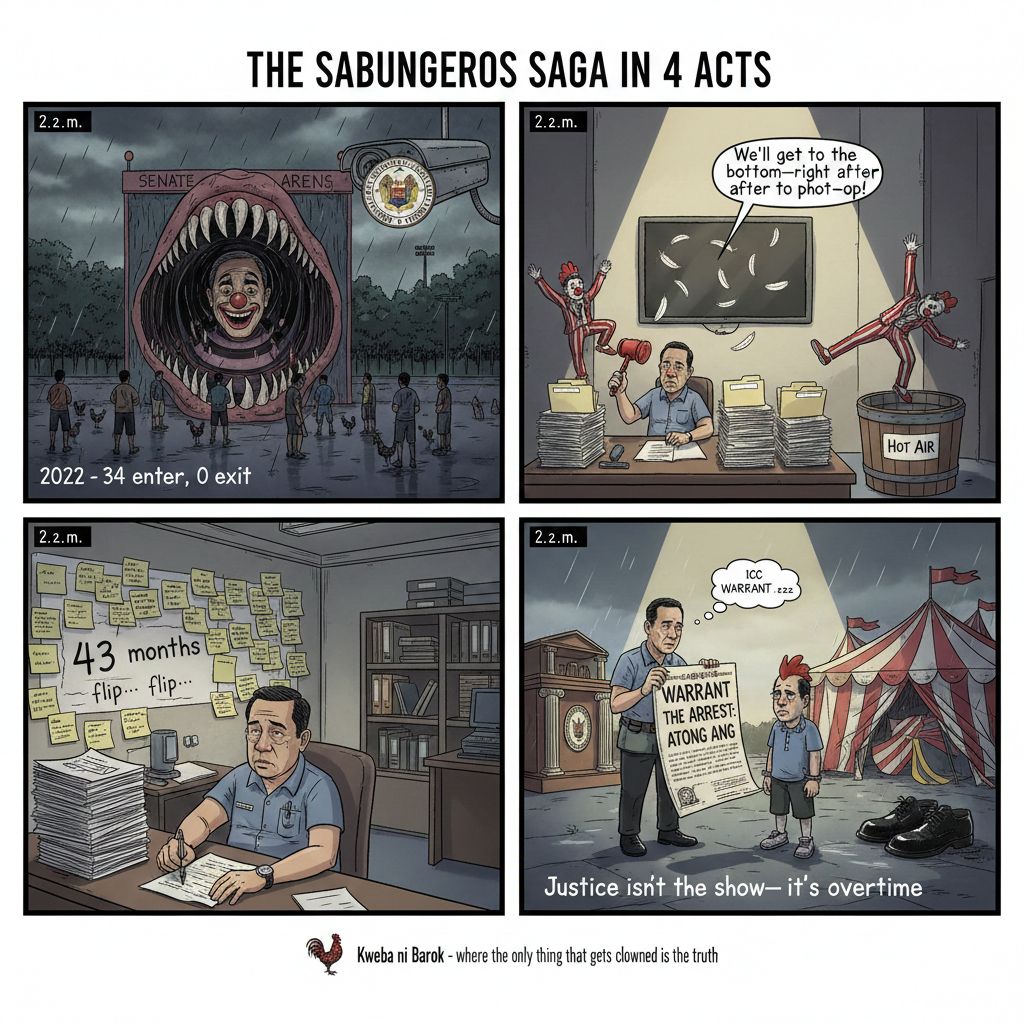
Institutional Theater: The Senate’s “Talk Show” vs. the DOJ’s Actual Grind
The Constitution gives the Senate the power to conduct inquiries “in aid of legislation.” Noble in theory. In practice? It often devolves into grandstanding theater — cameras rolling, senators pontificating, witnesses sweating, headlines exploding, and then… nothing. No indictments, no arrests, no legislation worth the paper it’s printed on.
Bato’s Committee on Public Order and Dangerous Drugs held hearings in 2022. They dragged in police officials, grilled a few witnesses, generated juicy soundbites, and — poof — the trail went cold again. No airtight case, no warrants, no breakthroughs. Just a lot of hot air.
Meanwhile, over at the Department of Justice (DOJ), Remulla and his team spent 43 months quietly building a fortress of evidence. They flipped the Patidongan brothers into state witnesses, overcame reluctant families who’d been “compromised,” and secured non-bailable arrest warrants from two regional trial courts for kidnapping with homicide.
Forty-three months of grinding investigative work on a case everyone else had labeled untouchable because it involved powerful gambling lords and allegedly complicit cops.
So when Remulla says the Senate panel “played with” the case, he’s not being rude — he’s being accurate. One branch performed for the cameras; the other did the actual prosecutorial heavy lifting. Guess which one produced arrest warrants for Atong Ang?
The Law: Kidnapping, Parens Patriae, and Why the State Doesn’t Walk Away
Let’s get clinical.
The charges fall squarely under Article 267 of the Revised Penal Code — Kidnapping and Serious Illegal Detention. When the victim is killed, it becomes the complex crime of Kidnapping with Homicide (Article 48, RPC), carrying reclusion perpetua and non-bailable. This is not some petty offense you can settle with a handshake and an envelope.
The DOJ’s case rests heavily on Julie Patidongan’s testimony: the sabungeros were abducted, strangled, and dumped in Taal Lake on Ang’s orders. The Patidongan brothers meet the criteria for state witnesses under Rule 119, Section 17 of the Rules of Court — not the most guilty, testimony absolutely necessary, no other direct evidence available.
But the real legal anchor here is the parens patriae doctrine — the State as “parent of the nation.” Established in Government of the Philippine Islands v. El Monte de Piedad, it gives the government standing to pursue justice even when private parties (victims’ families) settle or go silent.
Remulla invoked this beautifully: this is no longer a private wrong; it’s a public outrage. If the State walks away because some families took settlement money or feared retaliation, the message to every would-be kidnapper is clear — just pay off the relatives and you’re home free.
That’s the moral and legal high ground Remulla has held for 43 months while others looked the other way.
Motivations: Legacy vs. Self-Preservation
Remulla’s drive? Part genuine outrage at a heinous crime, part determination to crack a cold case that scared off previous administrations. He took on a gambling tycoon with alleged police protectors and delivered warrants. That’s legacy-building the hard way — not through press conferences, but through painstaking evidence-gathering.
Bato’s posture? Defensive. His committee’s hearings raised awareness (credit where due), but they stopped short of naming names or forcing real accountability. Now, with ICC arrest warrants reportedly circling former officials tied to the drug war he once spearheaded, Bato has gone conspicuously absent from the Senate. Suddenly he’s very concerned about “legislative prerogative” being trampled. Convenient timing.
The Bedrock: Systemic Corruption That Lets Monsters Thrive
This case didn’t go cold by accident.
The Philippine National Police (PNP) carries a documented very high corruption risk. Eleven police officers were recently dismissed in connection with this very scandal. When the police themselves are allegedly complicit in abductions tied to illegal gambling protection rackets, who investigates the investigators?
The judiciary? Also rated very high risk for corruption. Money and connections can delay, derail, or disappear cases involving the elite. Atong Ang — a man whose name pops up in every major gambling controversy for decades — evaded serious scrutiny until Remulla’s DOJ finally moved.
And don’t get me started on e-sabong regulation: a chaotic mess where PAGCOR, NTC, and PNP all pointed fingers at each other while billions flowed through unlicensed platforms. Regulatory failure on stilts.
This isn’t one bad apple. It’s an entire orchard rotting from the inside.
Demands and the Only Path Forward
Enough with the public sniping. It erodes whatever trust citizens still have in institutions.
Immediate demands:
- Execute the arrest warrants. If Atong Ang is abroad (as whistleblowers claim), issue an Interpol Red Notice yesterday.
- Full, transparent trial. No more delays, no more side deals.
- End the inter-branch trash-talking in public forums. Handle disagreements behind closed doors or in the proper constitutional arenas.
Structural reforms we actually need:
- Anti-Corruption Overhaul: Strengthen the Ombudsman not just with more powers but with real safeguards — transparent case assignment, mandatory timelines, independent audits, ironclad whistleblower protection. Any executive anti-corruption body must be strictly limited to fact-finding, insulated from presidential meddling. Formalize inter-agency coordination with binding protocols, clear jurisdictional lines, and penalties for stonewalling.
- Witness Protection That Works: A truly robust, transparent, and adequately funded program. No more witnesses flipping back because they fear for their lives.
- Gambling Regulation Reset: Legislate clear, unambiguous rules for e-sabong and all online gambling. One lead regulator, no overlapping mandates, severe penalties for protection rackets.
Until we fix the system that allowed 34 men to vanish without consequence for years, we’re just waiting for the next batch of missing persons.
Remulla’s 43-month marathon doesn’t absolve the DOJ of all sins — far from it. But in this particular circus, he’s the one who actually moved the case forward while others performed for the crowd.
The sabungeros deserve justice. The country deserves institutions that work.
Hanggang sa susunod na kwebanata, mga tropa. Keep your eyes open — and your cocks safe.
— Barok
Key Citations
A. Legal & Official Sources
- The Revised Penal Code of the Philippines. Act No. 3815, 8 Dec. 1930, LawPhil Project.
- Government of the Philippine Islands v. El Monte de Piedad y Caja de Ahorros de Manila. G.R. No. L-9959, Supreme Court of the Philippines, 13 Dec. 1916, LawPhil Project.
- Rules of Criminal Procedure. Rules 110-127, LawPhil Project.
B. News Reports

- “Forthwith” to Farce: How the Senate is Killing Impeachment—And Why Enrile’s Right (Even If You Can’t Trust Him)
- “HINDI AKO NAG-RESIGN!”

- “I’m calling you from my new Globe SIM. Send load!”

- “Mahiya Naman Kayo!” Marcos’ Anti-Corruption Vow Faces a Flood of Doubt

- “Meow, I’m calling you from my new Globe SIM!”

- “No Special Jail for Crooks!” Boying Remulla Slams VIP Perks for Flood Scammers

- “PLUNDER IS OVERRATED”? TRY AGAIN — IT’S A CALCULATED KILL SHOT

- “Several Lifetimes,” Said Fajardo — Translation: “I’m Not Spending Even One More Day on This Circus”

- “Shimenet”: The Term That Broke the Internet and the Budget
- “We Did Not Yield”: Marcos’s Stand and the Soul of Filipino Sovereignty

- “We Gather Light to Scatter”: A Tribute to Edgardo Bautista Espiritu

- $150M for Kaufman to Spin a Sinking Narrative




 KWEBA ni BAROK
Leave a comment