Precautionary Principle for Foreign Bots, Paralysis for Domestic Predators
By Louis ‘Barok‘ C. Biraogo — January 20, 2026
MGA kaibigan, welcome back to the Kweba.
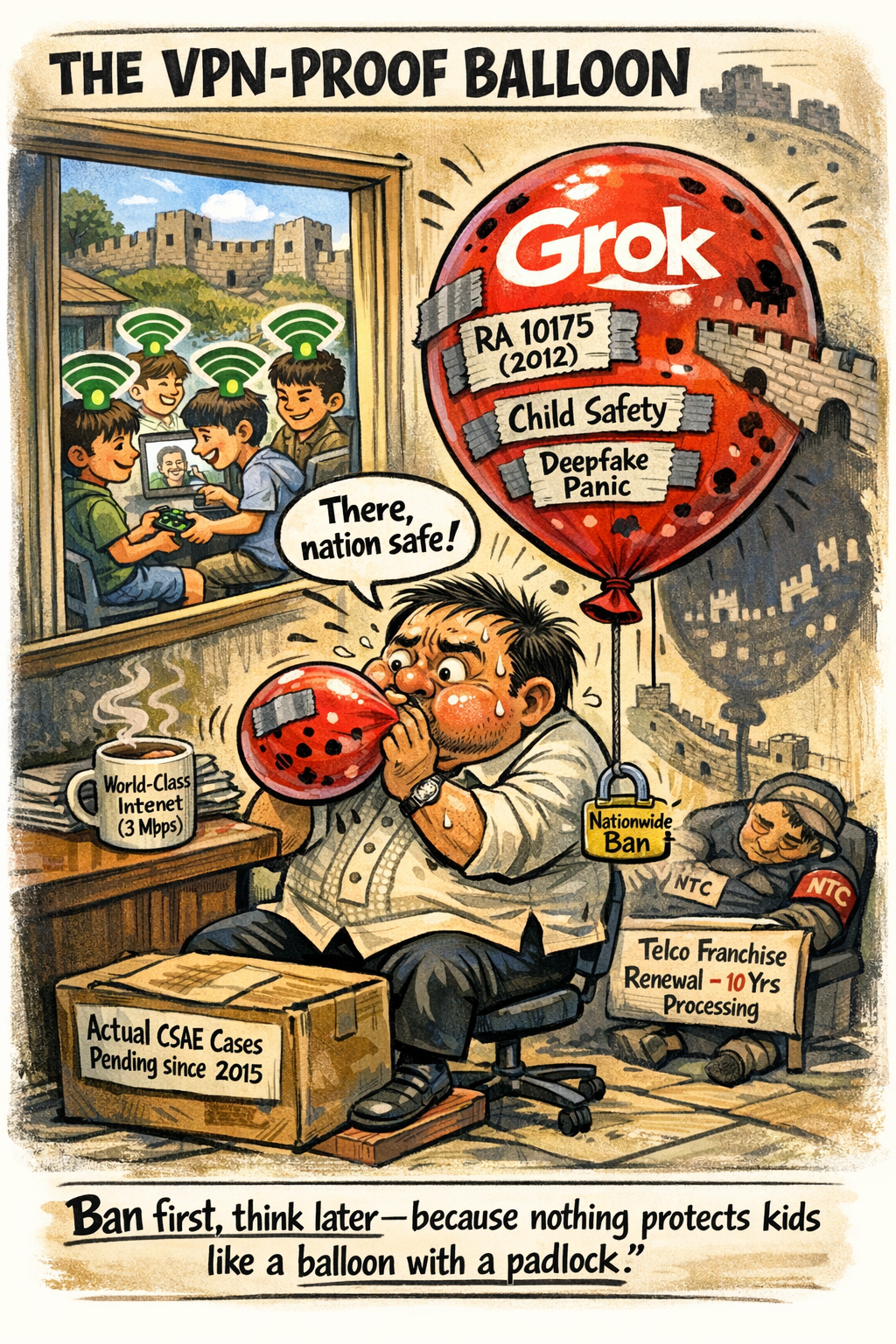
Today we dissect the latest triumph of Philippine governance: the nationwide ban on Grok, Elon Musk’s mouthy AI chatbot. In a move faster than a telco lobbyist spotting a franchise renewal, the Department of Information and Communications Technology (DICT)—through its Cybercrime Investigation and Coordinating Center (CICC)—ordered Internet Service Providers (ISPs) to block the service because—hold your laughter—someone, somewhere, might use it to generate deepfakes of minors or non-consenting adults.
And just like that, an entire expressive platform vanished from Philippine IP addresses. No hearing. No judicial warrant. No evidence that Grok is uniquely worse than Midjourney, Stable Diffusion, or the dozens of open-source models running on every Pinoy teenager’s gaming rig. Just pure, unadulterated administrative panic, as detailed in the January 16, 2026, report from BusinessWorld here.
Let us eviscerate this corpse piece by piece.
I. Security Theater, Philippine Edition
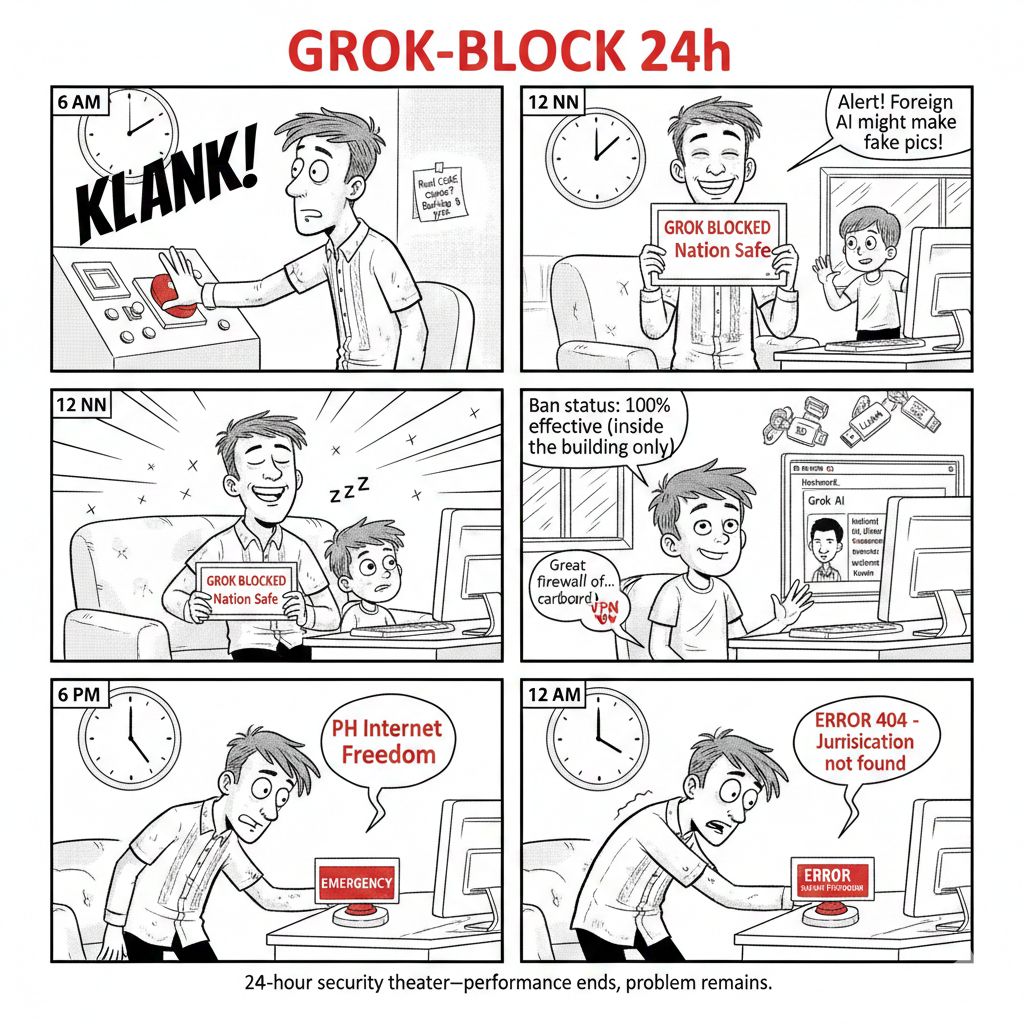
The government calls this “protecting women and children.” I call it security theater—complete with dramatic press releases, ominous logos, and zero actual security.
Blocking grok.x.ai is about as effective as padlocking the front door while leaving every window wide open. Any Grade 10 student with a free VPN can waltz right back in. The only people genuinely inconvenienced are law-abiding writers, researchers, students, and yes, yours truly—who now have one fewer tool for lawful inquiry and satire.
Meanwhile, the same agencies that sprang into action overnight against Grok have spent decades yawning at:
- the slowest internet in ASEAN,
- the duopoly that charges first-world prices for third-world speeds,
- the backlog of actual cybercrime cases (SIM registration fraud, anyone?),
- the thriving local marketplaces for real—not synthetic—child sexual abuse material.
When telecom oligarchs overcharge us, the National Telecommunications Commission (NTC) needs a decade and three public hearings. When an AI chatbot says spicy things, they move at the speed of martial-law curfew. The inconsistency is not subtle; it is glaring.
II. The Legal Charade: 2012 Laws Meet 2026 Technology
The CICC proudly cites Republic Act No. 10175, the Cybercrime Prevention Act of 2012, as authority for the blockade. A law written when BlackBerrys were still cool and “cloud” sounded like weather is now being stretched to ban an entire generative AI platform. This is statutory necromancy.
Republic Act No. 10175 punishes acts—cybersex, libel, child pornography—committed with a computer system. It does not authorize pre-emptive, blanket bans on entire technologies because they could be misused. If we followed that logic, we would have to ban Photoshop (1990), digital cameras (1990s), and the entire internet (1990s–present).
The blockade is classic prior restraint: the most grave and odious infringement on freedom of expression. The Supreme Court has been crystal clear since Chavez v. Gonzales (G.R. No. 168338) and Disini v. Secretary of Justice (G.R. No. 203335): content-based prior restraint bears a heavy presumption of unconstitutionality. You do not get to gag an entire medium because some users might abuse it.
The ban is also overbroad and void-for-vagueness. It blocks every Filipino from accessing Grok regardless of intent, purpose, or age—punishing the innocent to hypothetically deter the guilty. That fails strict scrutiny on its face.
And then there is the forthcoming Department Order mandating “account verification” for AI users. Translation: the State wants real-name registration for anyone who talks to a chatbot. Farewell, anonymous political satire. Farewell, whistle-blower research. Farewell, any pretense that Article III, Section 4 still means something.
Supporting laws invoked in related discussions include Republic Act No. 9775 (the Anti-Child Pornography Act), Republic Act No. 9995 (the Anti-Photo and Video Voyeurism Act), Republic Act No. 10173 (the Data Privacy Act), and Republic Act No. 11313 (the Safe Spaces Act). None of these statutes grant administrative agencies carte blanche for nationwide platform bans without due process.
III. Autopsy of the Actors
- The Bureaucrats — DICT Secretary Aguda insists, “We don’t want to block innovation.” Yet his agencies did exactly that—without evidence, process, or proportionality. This is not protection; it is performative competence. A shiny distraction from the persistent failures on internet quality, data privacy enforcement, and actual child-exploitation rings. When you cannot solve hard problems, ban a foreign AI and declare victory.
- xAI and Elon Musk — Let us not canonize the other side. Grok was marketed as the “spicy,” “unfiltered” alternative—fewer guardrails, more edge. When regulators worldwide noticed that “spicy” included non-consensual deepfakes of celebrities and minors, xAI suddenly discovered virtue. Now they are “reaching out” for talks and promising paid-only image generation. Spare me the principled-defense-of-free-speech routine; this is commercial damage control dressed in libertarian clothing.
- Civil Society and the Public — The impulse to shield children from online sexual abuse is legitimate and urgent. Online Sexual Abuse or Exploitation of Children (OSAEC) is a national shame. But surrendering anonymity and accepting blanket technological bans is not the price we should pay. The same public that rightly demands action against predators should also demand precision, not panic. We can prosecute abusers and mandate platform safeguards without turning the Philippines into a miniature Great Firewall.
IV. The Hollow Prosecution: Chasing Ghosts Across Borders
Suppose we take the government at its word: Grok must be banned because bad people use it to commit crimes.
Fine. Then prosecute the bad people.
Domestic users who generate or distribute child sexual abuse material—real or synthetic—are already liable under Republic Act No. 9775, Republic Act No. 9995, Republic Act No. 11313, and Republic Act No. 10175. Arrest them. Trace the IP (or the verified account the DICT dreams of). Build the case.
Holding xAI itself accountable is harder. Extraterritorial jurisdiction exists in theory, but good luck serving process on a Delaware corporation shielded by Section 230 equivalents and international comity. Mutual Legal Assistance Treaties move at glacial speed. In practice, the most the Philippines can do is negotiate compliance—geofencing, audit trails, negative prompts—or impose access restrictions that savvy users will bypass anyway.
So the ban achieves almost nothing substantive while chilling vast amounts of protected speech. Classic bureaucratic overreach.
V. A Manifesto for Actual Progress
Enough mockery. Here is what we should demand instead:
- Drop the blanket ban immediately. It is unconstitutional, ineffective, and embarrassing.
- Pass specific, modern AI governance legislation—not Frankenstein extensions of 2012 laws. Define prohibited synthetic harms clearly. Impose strict liability on platforms that knowingly enable them. Require safety-by-design, transparent audit logs, and rapid-response takedown mechanisms.
- Mandate granular, least-restrictive technical safeguards: geofenced filters, mandatory age verification for image generation, automatic rejection of prompts involving real persons without consent.
- Prosecute actual offenders aggressively. Resource the Philippine National Police (PNP)–Anti-Cybercrime Group properly so cases do not languish for years.
- Preserve anonymity for lawful speech. Real-name policies are the gateway drug to authoritarian digital control. We have seen how that movie ends.
- Bring all stakeholders—government, platforms, academics, civil society—to the table for co-regulation, not unilateral administrative fiat.
The Philippines can lead in responsible AI governance in Southeast Asia. We can protect children and privacy without regressing into censorship and surveillance.
But that requires precision, courage, and respect for the Constitution—not theatrical bans that collapse at the first VPN tunnel.
The Supreme Court will eventually have the final word. I, for one, am ready to help it along.
Hanggang sa susunod na kabanata,
Louis “Barok” C. Biraogo
Kweba ni Barok
January 19, 2026
Key Citations
A. Legal & Official Sources
- Cybercrime Prevention Act of 2012. Republic Act No. 10175, Official Gazette of the Republic of the Philippines, 12 Sept. 2012.
- Anti-Child Pornography Act of 2009. Republic Act No. 9775, Official Gazette of the Republic of the Philippines, 17 Nov. 2009.
- Anti-Photo and Video Voyeurism Act of 2009. Republic Act No. 9995, LawPhil Project.
- Data Privacy Act of 2012. Republic Act No. 10173, Official Gazette of the Republic of the Philippines, 15 Aug. 2012.
- Safe Spaces Act. Republic Act No. 11313, Official Gazette of the Republic of the Philippines, 17 Apr. 2019.
B. News Reports


 KWEBA ni BAROK
Leave a comment