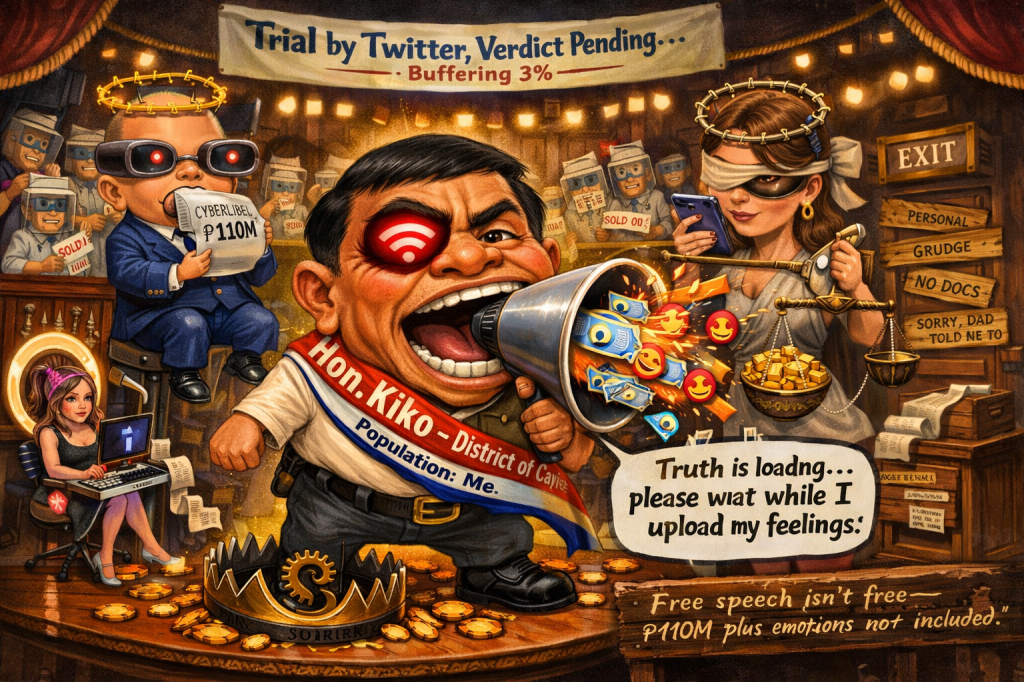
Accusation: Free. Defense: Expensive. Truth: Still Loading…
By Louis ‘Barok‘ C. Biraogo — January 20, 2026
MGA ka-kweba, in Philippine politics grudges don’t simmer quietly—they explode like a balikbayan box packed with firecrackers! Faster than barangay chismis, they turn into wild Facebook rants, blood-boiling podcasts, teleserye-style press statements, and—boom—straight to the courtroom where lawyers feast and truth gets buried under paperwork.
Latest drama: Cavite Rep. Francisco “Kiko” Barzaga vs. billionaire Enrique Razon Jr. This isn’t just politician-vs-tycoon beef—it’s a masterclass in unchecked mouths, personal grudges, big-money power, and weak institutions colliding in a country that jails libel while cashing in on outrage.
At the heart of it, cave folks: power without evidence, speech without brakes, and accountability without mercy. Santasumani!
I. The Accusation That Refuses to Leave the Mouth
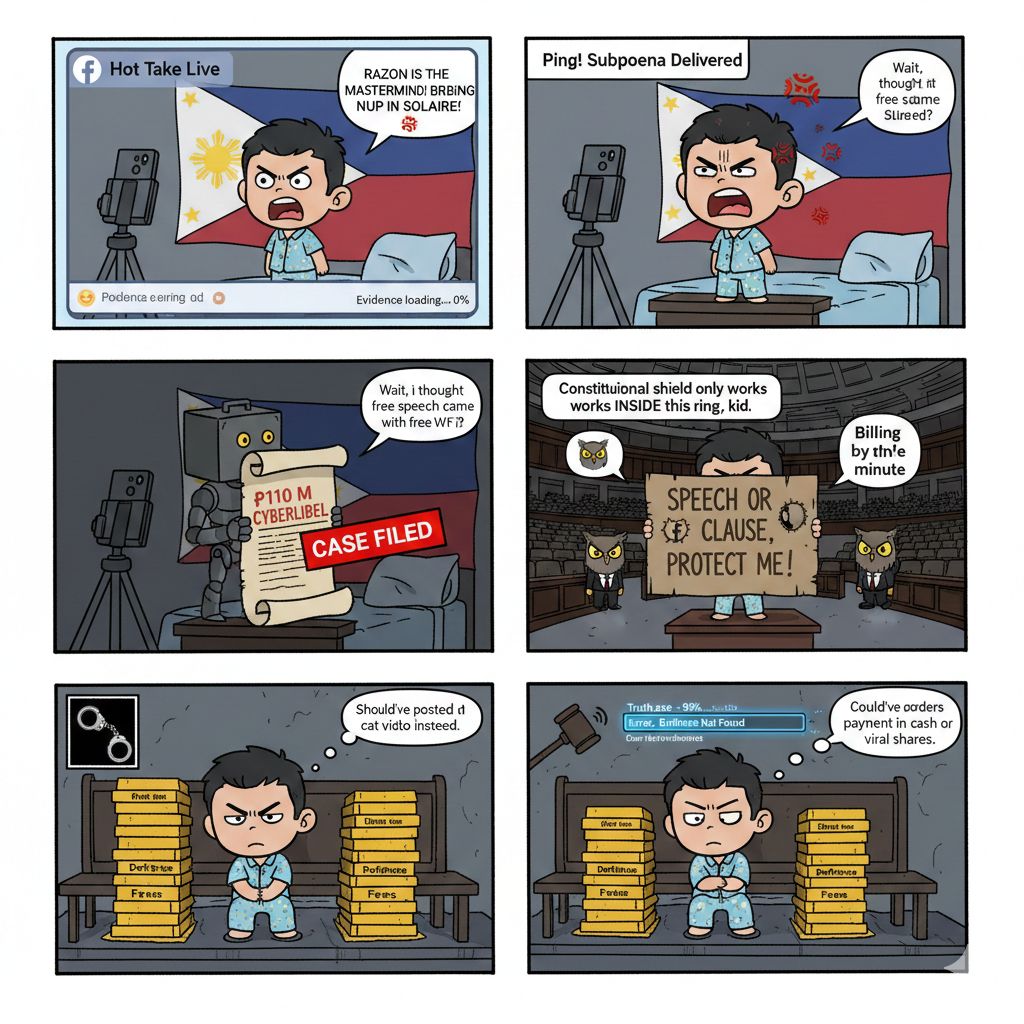
Out of nowhere, Barzaga publicly declared that Razon is “the mastermind behind corruption in Congress” and that he’s been bribing members of the National Unity Party (NUP) during gatherings at Solaire Resort to back Speaker Ferdinand Martin Romualdez.
These aren’t metaphors, cave dwellers! These are straight-up criminal imputations—right in the face!
Under Article 353 of the Revised Penal Code, libel is a public and malicious imputation of a crime, vice, or defect. When it happens online, it becomes cyberlibel under Section 4(c)(4) of Republic Act No. 10175—with even heavier penalties!
Barzaga’s problem? Not that he criticized a powerful businessman. The real problem: he named names, made the accusation, amplified it, but brought zero evidence! And he did it outside any protected legislative proceeding. Basic rookie mistake!
II. Don’t Trust the “Speech or Debate” Myth!
One of the strongest legends among our politicians: if you’re a congressman, you’re immune to everything you say.
Not true, cave dwellers!
Article VI, Section 11 of the 1987 Constitution only protects “speech or debate in Congress or in any committee thereof.” The Supreme Court has said it over and over: it does NOT cover press releases, media interviews, social media posts, or podcasts!
In Jimenez v. Cabangbang (G.R. No. L-15905, August 3, 1966) and the cases that followed, the line is crystal clear: if it’s not part of formal legislative deliberation, you’re on your own!
Barzaga’s accusations? Made on social media and podcasts—not on the House floor, not in committee, not in any inquiry in aid of legislation. No shield was used. No shield was available!
III. The Fatal Admission: Malice Walking Around on the Record
Libel law lives and dies on malice.
This is where Barzaga’s situation gets really dangerous.
In a podcast interview, he admitted his hostility toward Razon came partly from a personal grudge—he thought Razon snubbed his father’s wake. Later he found out his own father had told Razon not to come because of health reasons.
Why does this matter?
- Malice is presumed in defamatory imputations under Article 354 of the Revised Penal Code.
- When you admit personal animosity, you strengthen the presumption—you don’t rebut it!
He can claim good faith, political motive, public interest. But courts? They don’t like defendants who let emotion run ahead of verification.
In plain words: You can’t call someone a criminal first, fact-check later, then ask the court to admire your sincerity. No way!
IV. Is Truth a Defense? Not That Easy, Cave Dwellers!
Many think if it’s true, libel disappears.
Our law? Much stricter.
Under jurisprudence, truth alone isn’t enough unless:
- Made with good motives, and
- For justifiable ends.
So far, Barzaga hasn’t shown:
- Documentary evidence of bribery,
- Witness affidavits,
- Bank trails,
- Sworn testimony linking Razon to the acts.
Without that, the “truth” defense is just wishful thinking.
Even if corruption in Congress is a matter of public interest (of course it is!), reckless disregard for the truth can still make you liable—especially under cyberlibel!
V. Razon’s Side: Reputation Is Property Too
From Razon’s view, this is textbook defamation.
He is:
- Named directly,
- Accused of specific crimes,
- On platforms with massive reach,
- By a sitting congressman whose words carry institutional weight.
The Supreme Court has repeatedly ruled: reputation is a legally protected interest. Being a public figure doesn’t mean you forfeit your dignity.
₱100 million moral damages + ₱10 million exemplary? Sounds huge, but courts base it on the defendant’s status, the reach of the publication, and the gravity of the accusation.
This isn’t about silencing dissent. It’s about drawing a line between criticism and criminal imputation.
VI. The House, the Party, and Institutional Embarrassment
The House already suspended Barzaga for inflammatory conduct. The NUP is openly considering expulsion and separate legal action.
Can they do it? Yes!
Article VI, Section 16(3) of the Constitution allows Congress to discipline members for disorderly behavior—suspension, expulsion, as long as due process is followed.
Politically? Pure damage control.
Barzaga doesn’t just expose himself—he drags his party, his colleagues, and the entire House institution. Republic Act No. 6713 (Code of Conduct and Ethical Standards for Public Officials) requires public officials to maintain professionalism and justness in public dealings.
Publicly accusing unnamed colleagues of taking bribes without proof? That’s poison for the whole body!
VII. Motivations: Nobody Here Is Innocent of Strategy
Let’s be clear-eyed, cave dwellers.
Barzaga:
- Tried to claim moral high ground without any evidence to stand on.
- Let personal grudge grow into a public accusation.
- Probably thought anti-elite rhetoric would protect him politically.
Razon:
- Isn’t just defending reputation—he’s sending a deterrence message.
- Knows that silence in the face of criminal accusations equals acquiescence.
- Signaling loud and clear: being rich doesn’t make you vulnerable to baseless claims.
Nobody here is naïve. But only one side is criminally exposed.
VIII. The Dangerous Lesson If This Ends Wrong
If Barzaga gets convicted, critics will cry: libel laws chill speech.
If he gets acquitted without proof? The lesson is far worse:
Allegations don’t need to be substantiated—just amplified!
Our democracy can’t survive either extreme.
What we need is a principle that’s been missing from our political culture for way too long:
If you accuse, investigate first.
If you publish, prove it.
If you speak in anger, answer for it in court.
IX. Possible Endgames
- Judicial Resolution
Cyberlibel case proceeds; damages won or lost based on evidence. - Settlement
Apology, retraction, civil compromise (possible but not guaranteed). - Political Fallout
Barzaga’s expulsion or marginalization; a cautionary tale for others.
X. Grudges, Wi-Fi, and a Billionaire’s Receipts: Why Even the Untouchables Eventually Get Tagged
Mga ka-kweba, this isn’t about who’s richer, louder, or more powerful.
It’s about whether Philippine public life will finally internalize one simple rule:
Power is no excuse for recklessness.
Outrage is no substitute for evidence.
Personal pain is no license to accuse.
In the end, this isn’t the story of a billionaire versus a congressman.
It’s the story of how easily truth becomes collateral damage when grudges get Wi-Fi and the law is treated like an afterthought.
And that—more than any libel case—should worry us all!
Grudges go viral. Evidence goes missing. Kweba stays winning.
–Barok, gone!
Key Citations
A. Legal & Official Sources
- The 1987 Constitution of the Republic of the Philippines. Official Gazette of the Republic of the Philippines.
- Act No. 3815: An Act Revising the Penal Code and Other Penal Laws. 8 Dec. 1930. Official Gazette of the Republic of the Philippines.
- Republic Act No. 10175. Cybercrime Prevention Act of 2012, Official Gazette of the Republic of the Philippines, 12 Sept. 2012.
- Republic Act No. 6713. Code of Conduct and Ethical Standards for Public Officials and Employees, Official Gazette of the Republic of the Philippines, 20 Feb. 1989.
- Jimenez v. Cabangbang. G.R. No. L-15905, Supreme Court of the Philippines, 3 Aug. 1966. The Lawphil Project.
B. News Reports
- Lalu, Gabriel Pabico. “Barzaga to Apologize to Razon, Says Personal Grudge Fueled Remarks.” Inquirer.net, 19 Jan. 2026.
- “Razon Sues Barzaga for Cyber Libel.” Philstar.com, 15 Jan. 2026.
- “Razon Sues Barzaga for P110M over FB Post.” Inquirer.net, 15 Jan. 2026.
- “Razon Files Cyber Libel Case Against Cavite Lawmaker.” BusinessMirror, 15 Jan. 2026.
- ₱75 Million Heist: Cops Gone Full Bandit

- ₱6.7-Trillion Temptation: The Great Pork Zombie Revival and the “Collegial” Vote-Buying Circus

- ₱1.9 Billion for 382 Units and a Rooftop Pool: Poverty Solved, Next Problem Please

- ₱1.35 Trillion for Education: Bigger Budget, Same Old Thieves’ Banquet
- ₱1 Billion Congressional Seat? Sorry, Sold Out Na Raw — Si Bello Raw Ang Hindi Bumili

- “We Will Take Care of It”: Bersamin’s P52-Billion Love Letter to Corruption
- “Skewed Narrative”? More Like Skewered Taxpayers!

- “Scared to Sign Vouchers” Is Now Official GDP Policy – Welcome to the Philippines’ Permanent Paralysis Economy
- “Robbed by Restitution?” Curlee Discaya’s Tears Over Returning What He Never Earned
- “My Brother the President Is a Junkie”: A Marcos Family Reunion Special

- “Mapipilitan Akong Gawing Zero”: The Day Senator Rodante Marcoleta Confessed to Perjury on National Television and Thought We’d Clap for the Creativity
- “Just Following Orders” Is Dead: How the Hague Just Turned Tokhang’s Finest Into International Fugitives

 KWEBA ni BAROK
Leave a comment