
Accountability Feels Like Hold-up When You’re the One Holding the Bag
By Louis ‘Barok‘ C. Biraogo — January 21, 2025
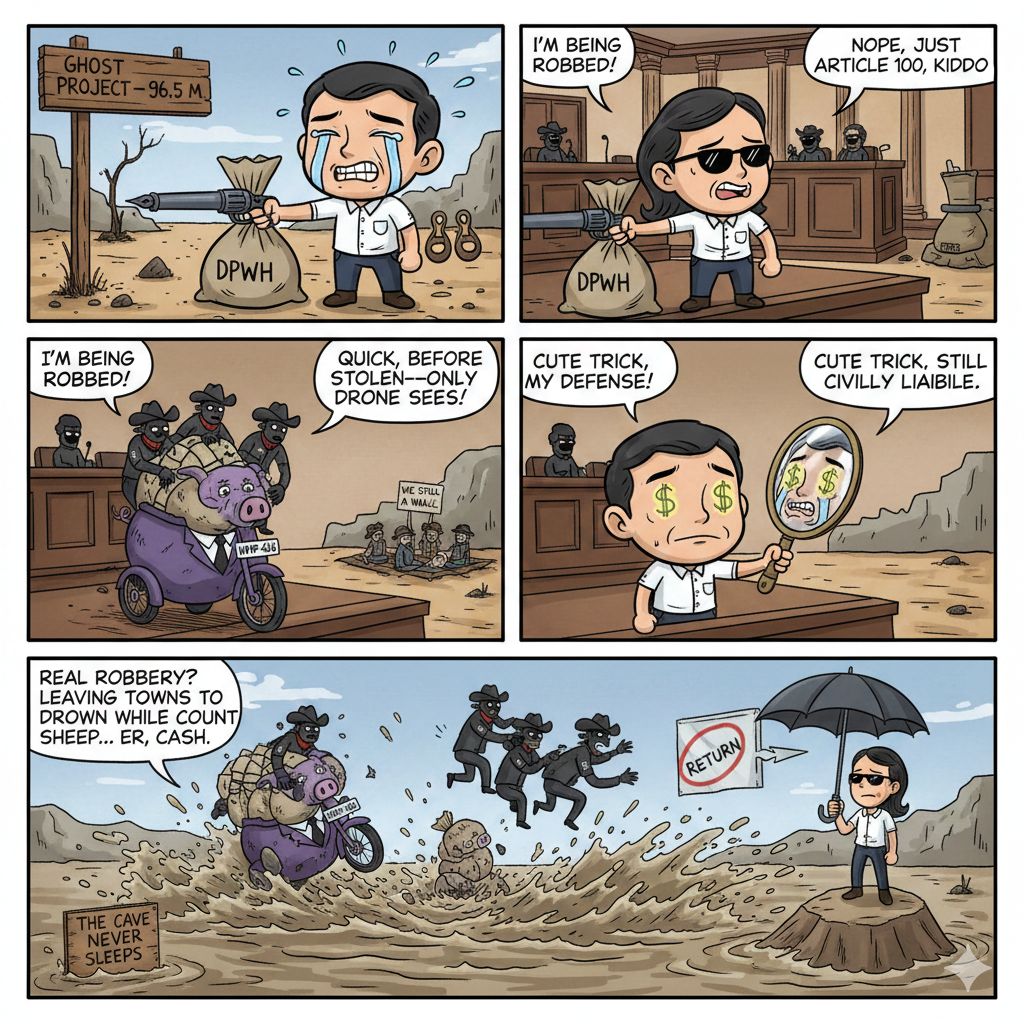
WELCOME back to the Cave, mga kababayan. Today, let’s talk about the latest Senate comedy: Pacifico “Curlee” Discaya crying foul like a robbery victim simply because the government asked him to return money he allegedly stole. Accountability? To him, it’s robbery. Unbelievable.
The “Robbery” Farce
Let me be direct: During the Senate Blue Ribbon Committee hearing, Curlee Discaya dramatically claimed he felt “robbed” when the government demanded the return of the P96.5 million paid for a flood control project that never existed. A ghost project, my friends—visible only on paper, completely absent in reality.
Then comes Assistant Ombudsman Mico Clavano, calm but cutting: “Returning stolen public funds is accountability, not robbery.” He’s absolutely right.
To strip away the theatrics and ground this in law—because I don’t buy drama without legal substance—let’s look at Article 100 of the Revised Penal Code (RPC): Every person criminally liable for a felony is also civilly liable. In plain terms, if you commit a crime, you are automatically obligated to return what you stole. This is not optional charity. It is a legal duty.
So who is really committing robbery here? The Discayas and their accomplices in government who pocketed public money, left Davao Occidental without flood protection, and exposed ordinary people to deadly floods. That is the true theft—of public trust and public safety.
Legal Autopsy: Statutes and Scandal
Let me dissect this case like a corpse on the slab.
First, Section 3(e) of Republic Act No. 3019 (RA 3019, Anti-Graft and Corrupt Practices Act)—causing undue injury to the government through manifest partiality or evident bad faith. Check. The project was fully paid despite zero work. Undue injury? P96.5 million vanished from the national treasury.
Second, Article 217 of the RPC—Malversation of Public Funds. Even though Discaya is a private contractor, once public funds are entrusted to him and he applies them to other purposes (or, in his case, to his pocket), it is malversation. The project was certified “100% complete” despite no revetment ever being built in Culaman, Jose Abad Santos—textbook case.
Third, Republic Act No. 9184 (RA 9184, Government Procurement Reform Act). Clear violations in the bidding and award process—how Discaya-linked firms secured the contract and how it was certified complete when it was a ghost.
And because there were fake completion reports and certifications, the door is wide open for Articles 171–172 of the RPC—Falsification of Public Documents. If this forms part of a larger pattern of theft exceeding P50 million, it may also constitute Republic Act No. 7080 (RA 7080, Plunder). That’s non-bailable, friends.
The prosecution’s evidence is strong: COA reports, site inspections showing no physical structure, yet full payment was made. The defense? Senate theatrics. Good luck in the Lapu-Lapu RTC trial.
The WPP Waltz & Strategic Moves
Now, the Witness Protection Program (WPP) dance. The Discayas wanted to become state witnesses—immunity in exchange for spilling on bigger fish. But their application stalled. Why?
Curlee complained that restitution was demanded upfront. DOJ Prosecutor General Richard Fadullon called it “lies.” According to him, the initial discussion was about what the Discayas could actually substantiate in their affidavits. But they went silent and failed to cooperate.
Let’s check the law: Rule 119, Section 17 of the Revised Rules of Criminal Procedure governs discharge as a state witness. The accused must not appear to be the most guilty, the testimony must be absolutely necessary, and there must be no other direct evidence available. Yet the Ombudsman has publicly stated the Discayas are too deeply involved—they don’t qualify.
Their options are now shrinking: face full trial on malversation and graft charges, or return to the negotiation table with real evidence and a willingness to return the money. But they seem uninterested in the latter. Too bad for immunity.
Systemic Critique & Real-World Impact
This is not just about the Discayas. It is a symptom of a deep disease: widespread, systemic, institutionalized corruption in the Department of Public Works and Highways (DPWH) and public procurement. Ghost projects repeated over and over, contractors acting as fronts for politicians, certifications that are pure fiction.
The real victims? The people of Davao Occidental left without flood control, now at greater risk from typhoons and flash floods. As Clavano pointed out, when funds for flood control are stolen, it is not just money that is lost—lives and property are put in jeopardy.
And those persistent rumors—luxury vehicles seized by Customs, properties allegedly purchased on behalf of politicians, connections in Congress—are no longer mere whispers. They are symptoms of a system rotten at the core.
Conclusion: The Ultimate Admission
So in the end, Curlee Discaya, thank you for your “robbery” lament. By whining that you are being robbed when asked to return what you stole, you have essentially admitted that you did steal something. If there was nothing taken, why fear returning it?
My recommendations:
- The Ombudsman and Department of Justice (DOJ) must push forward with full prosecution—no distractions from drama.
- Continue asset seizures and license revocations.
- Conduct a comprehensive review of the DPWH procurement system—independent engineers must inspect projects, not friends of the contractor.
- Congress should fearlessly investigate the names being mentioned—no cowering from political backlash.
Countrymen, the real robbery is not the government recovering stolen money. The real robbery is what people like the Discayas have done for years—stealing the future of Filipinos while pretending to be legitimate “contractors.”
While they cry over restitution, the flood victims still wait for walls that never came.
The cave never sleeps. Neither should you.
– Barok
Key Citations
A. Legal & Official Sources
- Act No. 3815. The Revised Penal Code, Official Gazette of the Republic of the Philippines, 8 Dec. 1930.
- Republic Act No. 3019. Anti-Graft and Corrupt Practices Act, Official Gazette of the Republic of the Philippines, 17 Aug. 1960.
- Republic Act No. 9184. Government Procurement Reform Act, Official Gazette of the Republic of the Philippines, 10 Jan. 2003.
- Republic Act No. 7080. An Act Defining and Penalizing the Crime of Plunder, Official Gazette of the Republic of the Philippines, 12 July 1991.
- “The Revised Rules of Criminal Procedure (Rules 110-127, Rules of Court).” The LawPhil Project, Arellano Law Foundation, 1 Dec. 2000.
B. News Reports

- “Forthwith” to Farce: How the Senate is Killing Impeachment—And Why Enrile’s Right (Even If You Can’t Trust Him)

- “HINDI AKO NAG-RESIGN!”

- “I’m calling you from my new Globe SIM. Send load!”

- “Mahiya Naman Kayo!” Marcos’ Anti-Corruption Vow Faces a Flood of Doubt

- “Meow, I’m calling you from my new Globe SIM!”

- “No Special Jail for Crooks!” Boying Remulla Slams VIP Perks for Flood Scammers

- “PLUNDER IS OVERRATED”? TRY AGAIN — IT’S A CALCULATED KILL SHOT

- “Several Lifetimes,” Said Fajardo — Translation: “I’m Not Spending Even One More Day on This Circus”

- “Shimenet”: The Term That Broke the Internet and the Budget

- “We Did Not Yield”: Marcos’s Stand and the Soul of Filipino Sovereignty

- “We Gather Light to Scatter”: A Tribute to Edgardo Bautista Espiritu

- $150M for Kaufman to Spin a Sinking Narrative



 KWEBA ni BAROK
Leave a comment