
280 Frozen Accounts Later, They Still Think a Gag Order Can Wash Away the Evidence
By Louis ‘Barok‘ C. Biraogo — January 20, 2926
MY fellow citizens, friends in the fight against corruption—this is Barok, returning once again to the cave to dismantle yet another outrage orchestrated by the powerful.
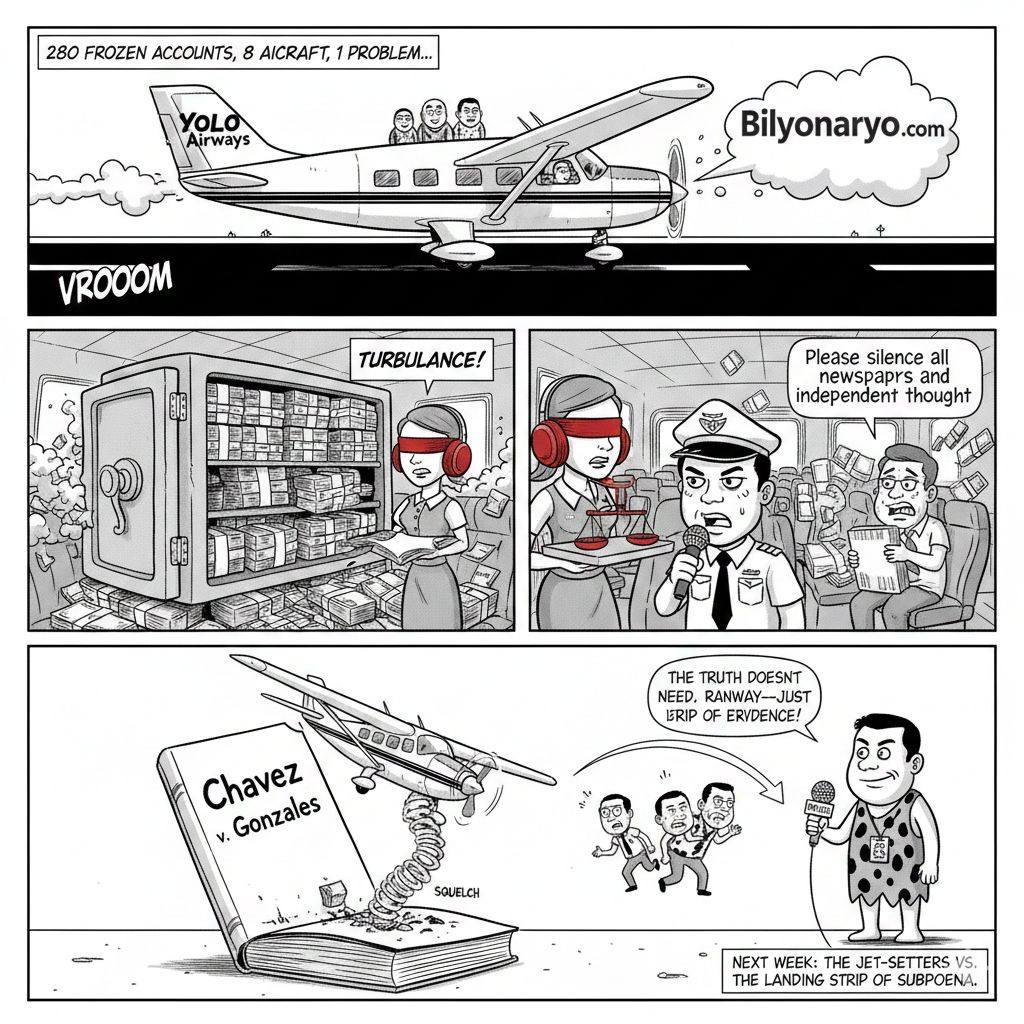
Today, let us discuss the latest drama unfolding at the Court of Appeals: the desperate bid by the so-called “cong-tractors”—Rep. Eric Yap, Rep. Edvic Yap, and Rep. Edwin Gardiola—to muzzle Bilyonaryo.com. Why? Because this courageous news outlet dared to report on their frozen assets: 280 bank accounts, 22 insurance policies, eight aircraft—including a P550-million Cessna jet that looks more like a family toy than a legitimate investment. And the root of it all? A staggering P16.6-billion scandal involving “ghost” flood control projects—paid in full on paper, yet leaving no trace of actual work on the ground.
This is not merely a media versus politician spat. This is a war between two kinds of secrecy:
- The legitimate secrecy: the confidentiality required under the Anti-Money Laundering Act of 2001 (Republic Act No. 9160) and Supreme Court rules for ex-parte freeze orders. This protection exists to prevent assets from vanishing while investigations proceed.
- The illegitimate secrecy: the shameless weaponization of that very same law by accused officials to shield their alleged crimes from public view. This is secrecy in service of impunity, not justice.
And now they are dragging the courts into their scheme, turning legal tools meant to fight crime into weapons against a news outlet simply doing its job.
The Motive: Money, Jets, and Fear of the Truth
Consider this: public servants who swore an oath to the Constitution are now begging for a gag order because their so-called “privacy” has been offended. Privacy? With a P550-million private jet? With 280 bank accounts allegedly swollen with proceeds from ghost projects? With a fleet of eight aircraft resembling a personal collection?
If there is any “trial by publicity” here, is it really more frightening than the “trial by evidence” already presented by the AMLC? The evidence—according to the freeze order issued by the CA Tenth Division on December 4, 2025—reveals a P4.76-billion money trail flowing directly into accounts linked to Silverwolves Construction and other companies allegedly still beneficially owned by Eric Yap, despite his claim of having divested years earlier.
And the most ironic part? The very people who own private jets are complaining about an unfair trial. Meanwhile, flood victims—who were supposed to be protected by that P16.6 billion—continue to suffer because the money allegedly ended up in the pockets of a few families. Hypocrisy level: congressional.
Dismantling the Legal Basis of the Gag Order
The motive is ugly—but the legal foundation is even weaker.
The Yaps and Gardiola rest their case primarily on the strict confidentiality provisions of the AMLA and Supreme Court rules. Yes, secrecy is necessary to prevent asset flight. But they are now trying to stretch that confidentiality into a blanket shield for the entire scandal, not merely to safeguard the investigation.
This is where Chavez v. Gonzales (G.R. No. 168338, 2008)—the cornerstone of press freedom in the Philippines—comes in. The Supreme Court declared that any state action restricting speech must face “examination so critical that only a danger that is clear and present” can justify it. Prior restraint is presumptively unconstitutional. When the real aim is simply to suppress the “free exercise of speech,” it becomes a “naked means” of censorship, plainly unconstitutional.
Does Bilyonaryo.com’s reporting create a clear and present danger? Will evidence disappear? No—the assets are already frozen! The only real “danger” here is to the political survival of the respondents, not to the administration of justice.
Nor should we forget Subido Pagente Certeza Mendoza & Binay Law Offices v. Court of Appeals (G.R. No. 216914, 2016): even though AMLC inquiries are confidential, that confidentiality does not automatically bar public scrutiny when the matter involves grave public concern. The Subido case itself became public through media reporting—there is no eternal, absolute gag order.
This gag petition is textbook prior restraint. The Court of Appeals should throw it out immediately.
Corruption Under the Microscope: RA 3019 and the “Beneficial Ownership” Fiction
Let us examine the substance of the allegations—not rumor, but charges with real legal teeth.
Under the Anti-Graft and Corrupt Practices Act (Republic Act No. 3019):
- Section 3(e): Causing undue injury to the government through manifest partiality, evident bad faith, or gross inexcusable negligence. Fully paid ghost flood control projects with nothing built? Check.
- Section 3(h): Direct or indirect financial interest in any government contract. Eric Yap’s alleged beneficial ownership of Silverwolves—despite claims of divestment—is a textbook violation.
In November 2024, the Supreme Court ruled that a mere procurement violation does not automatically result in a graft conviction—prosecutors must prove bad faith, manifest partiality, or gross negligence. Yet at this scale—P16.6 billion, hundreds of ghost projects, a clear money trail leading straight to family-linked companies—the pattern screams prima facie case. This is not coincidence; this is system.
What Must Be Done: Calls from the Cave
- To the Court of Appeals (Seventh and Tenth Divisions): Dismiss this gag petition outright. It is blatant prior restraint and a gross abuse of judicial process. Focus instead on the substantive cases—forfeiture and graft—not on silencing the press.
- To the AMLC and the Ombudsman: I commend you for the swift freeze orders. Now, press forward relentlessly: pursue civil forfeiture to permanently recover these assets, and file criminal cases in the Sandiganbayan without delay. The nation is watching.
- To the Media and the Public: To Bilyonaryo.com—my salute. You serve as the eyes and ears of the people in these scandals. And to all of us: keep the pressure on. This is our money—taxpayers’ money. The constitutional right to information on matters of public concern is sacred. Let us not be intimidated by cong-tractors who own private jets but lack conscience.
My fellow citizens, this fight is not just about Bilyonaryo.com. It is about us—our right to know where our money goes, and who has betrayed our trust.
Until the next corruption we crush here in the Cave..
The truth doesn’t need a gag order. Neither do I.
Keep the pressure on, ka-kweba.
— Barok
The cave is always open, the pen is always loaded
Key Citations
A. Legal & Official Sources
- Anti-Money Laundering Act of 2001. Republic Act No. 9160, Official Gazette of the Republic of the Philippines, 29 Sept. 2001.
- Anti-Graft and Corrupt Practices Act. Republic Act No. 3019, Official Gazette of the Republic of the Philippines, 17 Aug. 1960.
- Francisco Chavez v. Raul M. Gonzales, et al. G.R. No. 168338, Supreme Court E-Library, 15 Feb. 2008.
- Subido Pagente Certeza Mendoza and Binay Law Offices v. Court of Appeals. G.R. No. 216914, Supreme Court of the Philippines, 6 Dec. 2016. The Lawphil Project.


 KWEBA ni BAROK
Leave a comment