By Louis “Barok” C. Biraogo — January 22, 2026
IN THE Philippines, few institutions carry as heavy a burden as the Office of the Ombudsman. Created by the 1987 Constitution as the protector of the people against official abuse, it is meant to be the sharpest sword against corruption and the strongest shield for public trust. Yet for years, that sword has often felt blunted—cases languishing for decades, high-profile anomalies gathering dust, and a public increasingly convinced that justice is only for the powerless.
When Jesus Crispin “Boying” Remulla assumed office in October 2025, he inherited not just an institution but a crisis of faith. His first 100 days, far from routine housekeeping, represent a deliberate and courageous attempt to restore that faith.
The Stakes & The Mandate
The Ombudsman’s mandate is simple in principle but brutal in practice: investigate, prosecute, and prevent graft on its own initiative. When it fails to act swiftly, the entire democratic project suffers.
Under previous leadership, particularly that of Samuel Martires, the office was criticized for a cautious, almost passive approach—restricting public access to officials’ Statements of Assets, Liabilities, and Net Worth (SALNs), and allowing major cases to drift. Public trust eroded further.
Remulla entered this vacuum at a moment when Filipinos, battered by endless scandals, were desperate for proof that the system could still work. His early moves suggest he understands the stakes: this is not merely about filing cases but about rekindling belief in accountability itself.
The Action: A Prosecutorial Reset
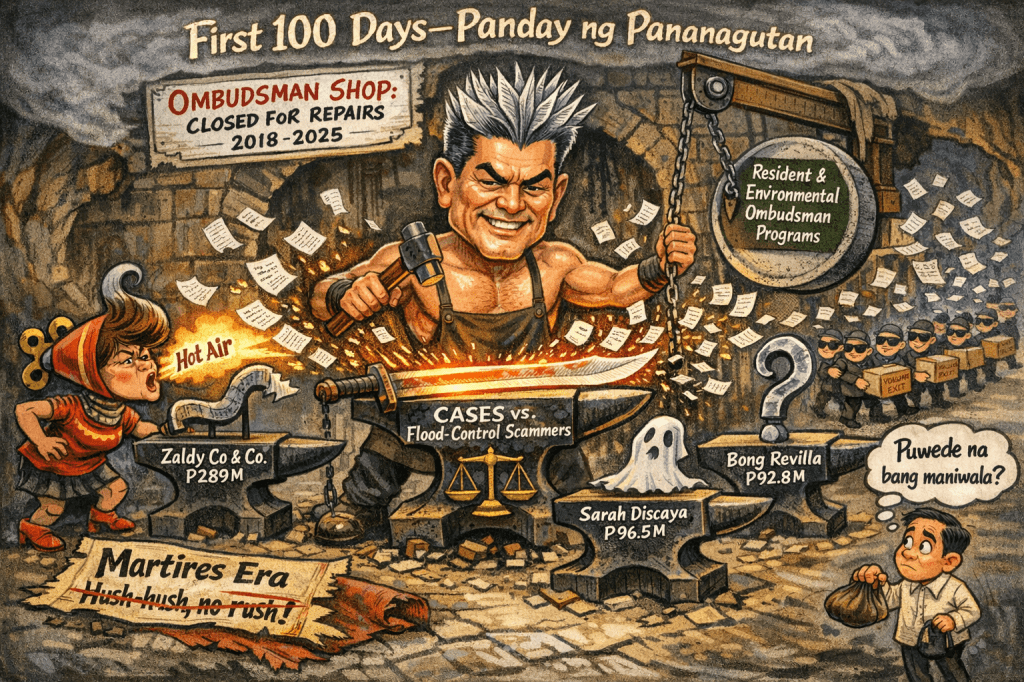
Remulla wasted no time signaling a break from the past. In his first 100 days, the Ombudsman’s prosecutors filed three separate batches of graft and malversation charges tied to the long-festering flood control anomalies—cases that had sat unresolved for years:
- Former Ako Bicol party-list representative Zaldy Co and 16 others over a P289-million substandard road dike in Oriental Mindoro.
- Contractor Sarah Discaya and accomplices over a P96.5-million ghost project in Davao Occidental.
- Former senator Ramon “Bong” Revilla Jr. and six others over an alleged P92.8-million ghost project in Pandi, Bulacan.
These are not minor administrative lapses; they are high-impact betrayals of public funds meant to protect communities from flooding.
Beyond the courtroom, Remulla took decisive institutional steps:
- Revived the Resident Ombudsman Program to embed fact-finding in high-risk agencies for faster action.
- Re-established the Environmental Ombudsman Program to pursue corruption linked to ecological destruction.
- Issued Memorandum Circular No. 3, Series of 2025, removing the consent requirement for releasing SALNs upon meritorious request—a direct reversal of Martires’ restrictive policy.
- Implemented the Revised Rules of Procedure with firm timelines to slash notorious delays.
- Scheduled the first strategic planning conference in over a decade for February 2026.
These are not cosmetic changes. They mark an assertive shift from the perceived lethargy of recent years toward a prosecutorial culture that engages early with law enforcement and prioritizes cases that matter most to ordinary Filipinos.
Navigating the Crucible: Controversy as Proof of Impact
No serious reform comes without resistance.
Remulla’s appointment was fiercely contested—Senator Imee Marcos publicly vowed to block it. Internal reorganization saw 97 senior officials asked to resign. Anonymous letters, health rumors, and online misinformation have swirled, including false claims that prompted an NBI investigation.
Yet these very storms are evidence that something significant is happening. When an institution long accused of inaction suddenly moves against powerful figures and entrenched practices, pushback is inevitable.
Remulla’s refusal to set arbitrary public deadlines—despite pressure—is not evasion; it is a principled commitment to due process, ensuring cases are airtight rather than rushed and ultimately dismissed. The intensity of the scrutiny suggests his reforms are threatening real interests.
Motivation & Vision: Decoding the Strategy
What drives this flurry of activity? The pattern is coherent and institution-building:
- Prioritizing long-pending flood control cases signals: no one is untouchable.
- Reviving resident and environmental programs decentralizes and broadens accountability.
- Easing SALN disclosure and tightening timelines attacks secrecy and delay at the root.
- Planning the first strategic conference in years shows thinking beyond his term.
This is the agenda of a leader who understands that public trust is won through systemic change that outlives any single personality—a vision that contrasts sharply with Martires’ low-profile tenure and echoes the aggressive prosecutorial style of earlier Ombudsmen like Conchita Carpio-Morales.
The Road Ahead: A SWOT Analysis for the Republic
Strengths
- Renewed prosecutorial energy targeting long-stalled cases
- Concrete transparency reforms (open SALN access)
- Revived ground-level programs bringing accountability closer to citizens
- Strong inter-agency coordination
Weaknesses
- Lingering perceptions of politicization tied to his appointment and family background
(These can be overcome through consistent, impartial action across the political spectrum)
Opportunities
- Secure historic convictions in flood control and other cases
- Embed procedural and cultural reforms that permanently reduce backlog
- Redefine the Ombudsman as a proactive guardian of the people
Threats
- Political retaliation from powerful figures under investigation
- Legal obstruction or case dismissals
- Misinformation campaigns exploiting rumors
- Shifting political winds
A Call to the People – The Ombudsman Reimagined
Jesus Crispin Remulla’s first 100 days offer something rare in Philippine governance: genuine reason for guarded optimism.
He has chosen the harder path—taking on entrenched corruption, reversing secrecy policies, and rebuilding institutional muscle—knowing full well the storms it would provoke.
Now the burden falls partly on us, the people.
We must demand convictions, not just indictments.
We must insist on lasting reforms that slash delays and bureaucracy.
We must expect unwavering transparency, efficiency, and effectiveness as the new normal.
Most of all, we must dare to believe again in an Ombudsman truly of the people, with the people, and for the people—an institution we can rely on because it has earned our trust through action.
Remulla has set the tone. Let us hold him, and ourselves, to it.
The republic deserves no less.
- “Forthwith” to Farce: How the Senate is Killing Impeachment—And Why Enrile’s Right (Even If You Can’t Trust Him)
- “HINDI AKO NAG-RESIGN!”

- “I’m calling you from my new Globe SIM. Send load!”

- “Mahiya Naman Kayo!” Marcos’ Anti-Corruption Vow Faces a Flood of Doubt

- “Meow, I’m calling you from my new Globe SIM!”

- “No Special Jail for Crooks!” Boying Remulla Slams VIP Perks for Flood Scammers

- “PLUNDER IS OVERRATED”? TRY AGAIN — IT’S A CALCULATED KILL SHOT

- “Several Lifetimes,” Said Fajardo — Translation: “I’m Not Spending Even One More Day on This Circus”

- “Shimenet”: The Term That Broke the Internet and the Budget

- “We Did Not Yield”: Marcos’s Stand and the Soul of Filipino Sovereignty

- “We Gather Light to Scatter”: A Tribute to Edgardo Bautista Espiritu

- $150M for Kaufman to Spin a Sinking Narrative




 KWEBA ni BAROK
Leave a comment