
Colonel Lachica vs. The Jailhouse Bagman: How One Cyberlibel Complaint Turned a Kidnap Kingpin into the VP’s Worst Nightmare
By Louis ‘Barok‘ C. Biraogo — January 22, 2026
MGA ka-kweba, grab your popcorn—or better yet, a duffel bag stuffed with “confidential” cash if you happen to have one lying around. The latest installment in our beloved Philippine political circus is the VPSPG Confidential Cash Carousel: a swirling tale of alleged cash deliveries, a jailed kidnap-for-ransom syndicate leader suddenly reborn as a “conscience-stricken whistleblower,” a colonel furiously scrubbing his reputation via cyberlibel complaints, and Vice President Sara Duterte, of course, declaring herself the innocent victim of yet another “demolition job.”
Allow me, Barok, to dissect this spectacle without mercy, armed with law, logic, and a healthy dose of acidic sarcasm. We won’t rest until every absurdity and contradiction has been laid bare.
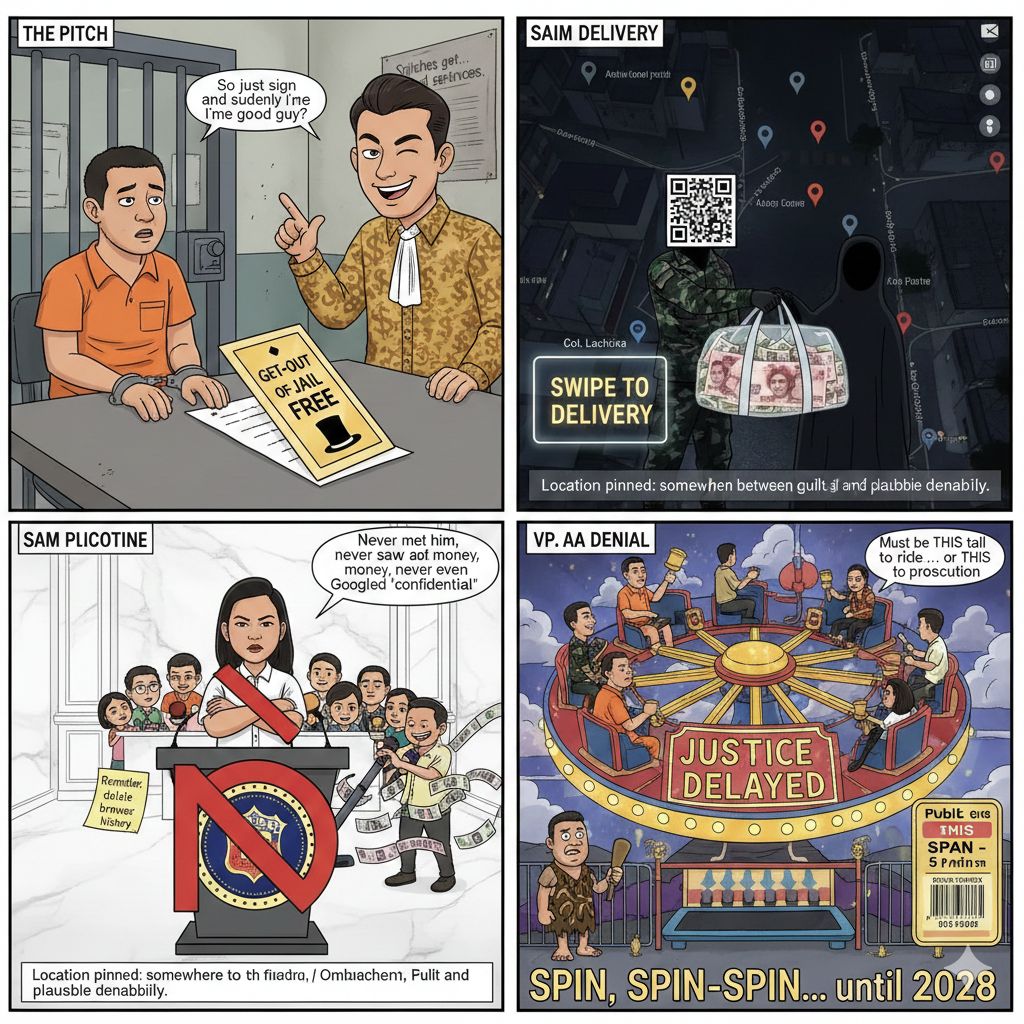
1. The Narrative Dissection: Unraveling the Cash Courier Chronicles
Center stage: Ramil Madriaga, self-proclaimed former aide to then-Davao City Mayor Sara Duterte, now detained as the alleged leader of one of the country’s most dangerous kidnap-for-ransom syndicates (arrested in 2023). In December 2025, from behind bars, he suddenly produces a notarized affidavit claiming he served as the “bagman” who delivered large sums of cash to various recipients on direct orders from Vice President Sara Duterte.
He further alleges that he coordinated these cash movements with Colonel Raymund Dante Lachica (former head of the Vice Presidential Security and Protection Group or VPSPG) and Colonel Dennis Nolasco—military officers supposedly facilitating the transport of the money.
Vice President Sara’s response? Flat denial: she claims she has never met Madriaga and labels the entire affidavit a political “demolition job” designed to torpedo her presumed 2028 presidential bid. Colonel Lachica, for his part, filed cyberlibel complaints on January 21, 2026 against both Madriaga and his lawyer, Atty. Raymond Palad, before the Department of Justice (DOJ) Region XI office in Davao—because nothing says “restraint” like filing in the Vice President’s political heartland (Inquirer.net, 21 Jan. 2026).
The plot: A convicted criminal accuses the sitting Vice President of graft via repeated cash handovers drawn from confidential funds. One of the accused counters by criminalizing the accuser through libel. Classic Philippine deflection-and-intimidation carousel—endless spinning, zero concrete evidence, maximum noise.
2. The Legal Thunderdome: Cyberlibel vs. Graft & Plunder
Cyberlibel Front
Colonel Lachica insists he is merely insisting on “lawful institutions, not trial by publicity.” Yet the cyberlibel complaint he filed—under Republic Act No. 10175 (Cybercrime Prevention Act) in relation to Article 353 of the Revised Penal Code—is textbook preemptive narrative control.
The required elements are present in theory: online publication, clear identification of the complainant, malice, and reputational harm. If the affidavit or excerpts went viral on social media (almost certainly the case), a colorable claim exists—especially given Lachica’s assertion of “deliberate and sustained” dissemination.
But privileged communication? The affidavit was submitted to the Office of the Ombudsman—a quasi-judicial proceeding. Under settled doctrine (e.g., Sison v. David), statements made in such proceedings enjoy absolute privilege. If dissemination was strictly limited to the filing itself, the case collapses immediately. If, however, Atty. Palad actively shopped the document to media and social platforms, lawyerly immunity evaporates—and potential violation of the sub judice rule under the Code of Professional Responsibility and Accountability follows.
Strategic score for Lachica: he transforms the whistleblower into a criminal defendant, even if the actual probability of conviction is low.
Graft & Plunder Front
Madriaga’s core allegation—cash deliveries executed on the Vice President’s instructions—directly implicates Republic Act No. 3019 (Anti-Graft and Corrupt Practices Act), malversation under Article 217 of the Revised Penal Code, and potentially Republic Act No. 7080 (Plunder) if the amounts and pattern qualify.
Constitutional kill switch: Under Article XI of the 1987 Constitution and the doctrine in Estrada v. Desierto (G.R. Nos. 146710-15, 2001), impeachable officers such as the Vice President cannot be criminally tried by the Sandiganbayan while in office. Impeachment and removal must precede prosecution.
The Ombudsman may still conduct fact-finding and build a case, and non-impeachable co-accused (Lachica, Nolasco, etc.) can be prosecuted immediately. But for Sara Duterte herself? The sword hangs—but execution is deferred until 2028 or successful impeachment. Should the allegations prove fabricated, perjury charges under Article 183 of the Revised Penal Code await.
3. The Credibility Gauntlet: No Saints in This Circus
- Ramil Madriaga — Brave whistleblower or desperate opportunist? He is currently detained as the alleged mastermind of a major kidnap-for-ransom syndicate, described by the Philippine National Police as one of the “most perilous criminal syndicates” in the country. Arrested in 2023 and facing grave charges, he suddenly “sings” from jail. Motive? Personal grudge, legal leverage, or hope of admission into the Witness Protection Program (Republic Act No. 6981) in exchange for reduced sentence or freedom? Credibility rating: landfill-level.
- Colonel Raymund Dante Lachica — The “restrained soldier” who files cyberlibel to protect “family distress.” Genuine innocence or tactical reputation management? He insists he never met or worked with Madriaga and that Madriaga was never part of any AFP unit under his command—plausible on paper. Yet the timing screams career-preservation: a graft accusation is fatal to any military promotion track.
- Vice President Sara Duterte — “Demolition job” aimed at derailing her 2028 run. Classic populist playbook: blame “Imperial Manila,” opposition conspiracies, hired guns. Legitimate defense if fabricated; convenient deflection if true. The pattern of blanket denials in every confidential-funds controversy is now practically a trademark.
- Atty. Raymond Palad — Zealous advocate or reckless media-lawyer? If he actively disseminated the affidavit beyond formal pleadings (highly probable), he loses litigation privilege and risks ethical sanctions.
No one here wears a halo. Everyone has skin in the game.
4. The Strategic Chessboard: Delay, Discredit, Survive
Motivations
- Madriaga: Freedom or sentence reduction.
- Lachica: Protect military career and personal honor.
- VP Sara: Preserve electability for 2028.
- Palad: Client defense (and possibly personal visibility).
Tactical Playbook
The cyberlibel suit is a classic chilling instrument. It cannot legally halt impeachment (see Gutierrez v. House of Representatives, 2011—impeachment is constitutionally supreme), but it can delay, distract, reframe the narrative (“the accuser is a liar”), and intimidate potential corroborating witnesses. It buys time, fragments opposition momentum, and gives hesitant congressmen an excuse to say “let the courts decide first.”
Possible Endgames
- Madriaga gains Witness Protection immunity—or faces perjury if exposed.
- Lachica wins libel → reputational vindication; loses → deeper scrutiny.
- VP Sara blocks impeachment politically → shield holds until 2028.
- Ombudsman grinds slowly → case file thickens for post-tenure prosecution.
5. The Big Picture & Call to Arms
This is not mere personal drama; it is a symptom of deeper rot: military entanglement in political errands, repeated questions over confidential-fund misuse, and the routine weaponization of libel laws to silence public-interest speech (warned against in Disini v. Secretary of Justice).
For the Armed Forces: dangerous politicization of security units.
For 2028 elections: early litmus test of Sara Duterte’s “clean” brand.
For public trust: already shattered—nothing left but trial-by-publicity.
My demands, delivered without apology:
- Immediate, transparent, credible fact-finding by the Ombudsman—no sacred cows.
- AFP internal administrative inquiry into Colonel Lachica.
- Rejection of chilling tactics disguised as “defense of honor.”
- Congress: if probable cause exists, open impeachment hearings without delay.
Actionable recommendations:
- Ombudsman — expedite subpoena of financial records, phone logs, and movement orders.
- BJMP / PNP — ensure Madriaga’s physical safety; real whistleblowers have short life expectancies in custody.
- Media — stop sensationalizing; fact-check before amplifying.
- House of Representatives — file and endorse impeachment complaints when evidence warrants.
Until hard documentary evidence surfaces, this remains a noisy carousel—spinning furiously, going nowhere. But if the allegations hold truth? Bags will drop, and heads will roll.
Stay tuned. Here in the Kweba, scandals don’t die of old age—they get exhumed, roasted, and served back to the clowns who thought they buried them.
– Barok
Key Citations
A. Legal & Official Sources
- Republic Act No. 10175 (Cybercrime Prevention Act of 2012). Official Gazette of the Republic of the Philippines, 12 Sept. 2012.
- Act No. 3815: An Act Revising the Penal Code and Other Penal Laws. 8 Dec. 1930. Official Gazette, Republic of the Philippines.
- Republic Act No. 3019 (Anti-Graft and Corrupt Practices Act). Official Gazette of the Republic of the Philippines, 17 Aug. 1960.
- Republic Act No. 7080 (An Act Defining and Penalizing the Crime of Plunder). Official Gazette of the Republic of the Philippines, 12 July 1991.
- Republic Act No. 6981 (Witness Protection, Security and Benefit Act). Official Gazette of the Republic of the Philippines, 24 Apr. 1991.
- “The 1987 Constitution of the Republic of the Philippines, Article XI: Accountability of Public Officers.” Official Gazette of the Republic of the Philippines.
- Estrada v. Desierto, G.R. Nos. 146710-15. The LawPhil Project, 2 Mar. 2001.
- Gutierrez v. The House of Representatives Committee on Justice, G.R. No. 193459. The LawPhil Project, 15 Feb. 2011.
- Disini v. Secretary of Justice, G.R. No. 203335. The LawPhil Project, 11 Feb. 2014.
- Sison v. David, G.R. No. L-11268, 28 Jan. 1961, LawPhil Project, Arellano Law Foundation, Inc..
B. News Reports
- Salcedo, Mary Joy. “Col. Lachica Files Cyberlibel Complaints vs Madriaga, Legal Counsel.” Inquirer.net, 21 Jan. 2026.
- ₱75 Million Heist: Cops Gone Full Bandit

- ₱6.7-Trillion Temptation: The Great Pork Zombie Revival and the “Collegial” Vote-Buying Circus

- ₱1.9 Billion for 382 Units and a Rooftop Pool: Poverty Solved, Next Problem Please

- ₱1.35 Trillion for Education: Bigger Budget, Same Old Thieves’ Banquet

- ₱1 Billion Congressional Seat? Sorry, Sold Out Na Raw — Si Bello Raw Ang Hindi Bumili

- “We Will Take Care of It”: Bersamin’s P52-Billion Love Letter to Corruption

- “Skewed Narrative”? More Like Skewered Taxpayers!

- “Scared to Sign Vouchers” Is Now Official GDP Policy – Welcome to the Philippines’ Permanent Paralysis Economy
- “Robbed by Restitution?” Curlee Discaya’s Tears Over Returning What He Never Earned

- “No Pressure” Luistro? The House Pork Bazaar Exposed
- “My Brother the President Is a Junkie”: A Marcos Family Reunion Special

- “Mapipilitan Akong Gawing Zero”: The Day Senator Rodante Marcoleta Confessed to Perjury on National Television and Thought We’d Clap for the Creativity



 KWEBA ni BAROK
Leave a comment