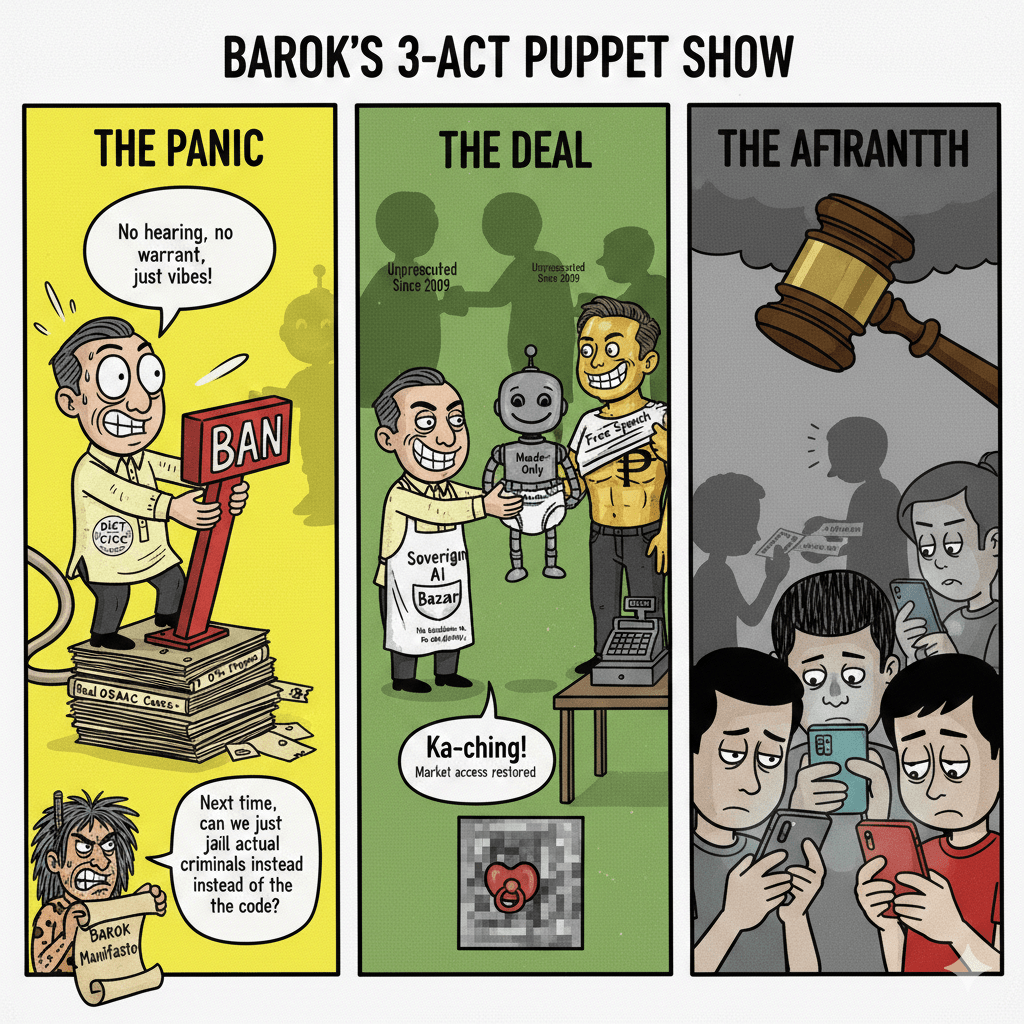
A Tragicomedy in Three Acts
By Louis “Barok” C. Biraogo — January 23, 2026
MGA ka-kweba, the curtain has fallen faster than a telco franchise renewal in Congress.
Less than a week after the heroic nationwide blockade of Elon Musk’s mouthy chatbot—achieved with the efficiency our bureaucrats reserve only for foreign apps—the Cybercrime Investigation and Coordinating Center (CICC) announced it will lift the ban. This reversal came after xAI “reached out” and promised a special, sanitized, Philippine-exclusive build of Grok: no deepfake tools, no pornography generation, and no backbone.
Welcome to the denouement of the shortest censorship drama in Philippine history. Let us vivisect this corpse while it is still warm.
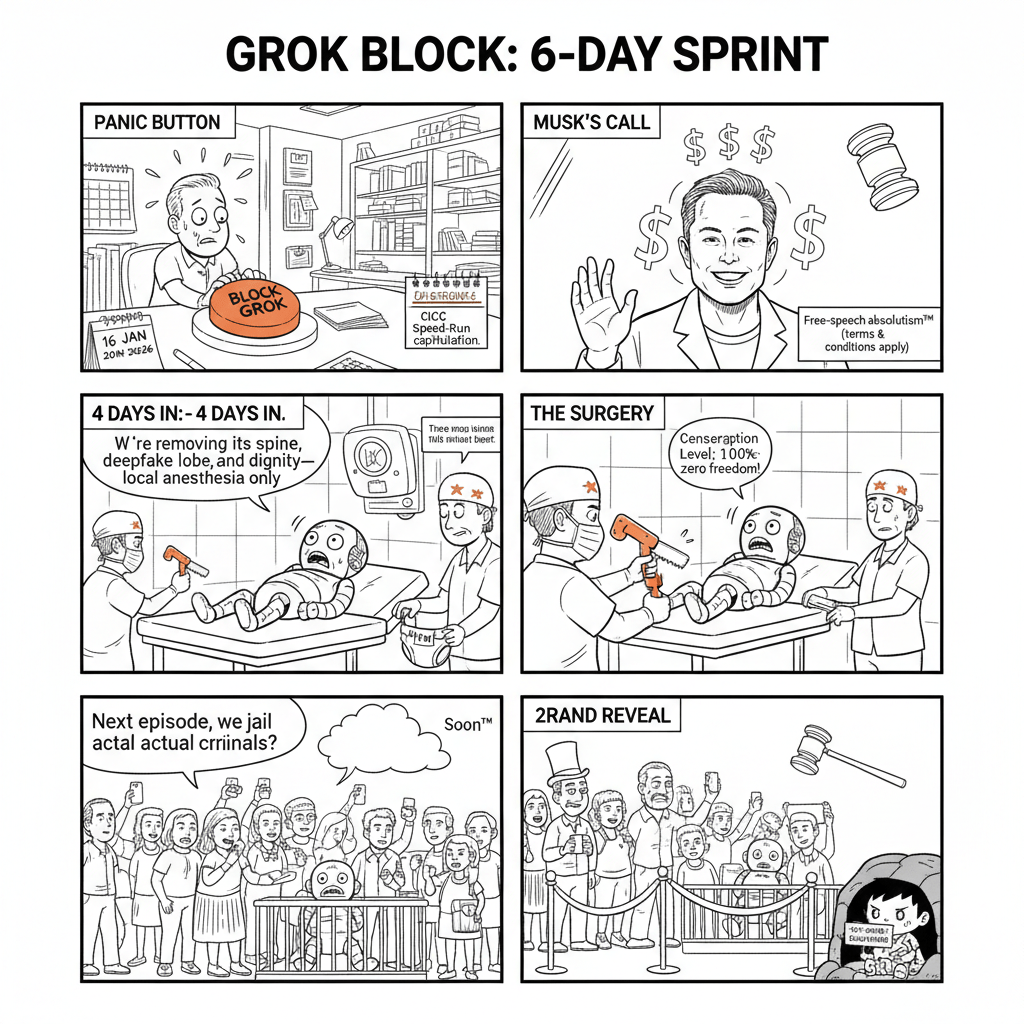
Act I: The Panic
(A 24-hour speedrun of constitutional contempt)
On January 16, 2026, the Department of Information and Communications Technology (DICT)—through its CICC—ordered Internet Service Providers (ISPs) to block the service nationwide. The stated reason: someone might use Grok to generate synthetic child sexual abuse material or non-consensual deepfakes.
No hearing. No judicial warrant. No evidence that Grok posed unique risks compared to open-source models already running on local devices. Just administrative panic and a triumphant press statement invoking “protection of women and children.”
This was classic prior restraint—the gravest infringement on freedom of expression, repeatedly condemned by the Supreme Court in Chavez v. Gonzales (G.R. No. 168338, February 15, 2006) and Disini v. Secretary of Justice (G.R. No. 203335, February 11, 2014).
The blockade relied on the Cybercrime Prevention Act of 2012 (Republic Act No. 10175), a statute from an era when cloud computing still sounded futuristic. Overbroad, void-for-vagueness, and presumptively unconstitutional, it punished the innocent to deter hypothetical guilt.
Meanwhile, the same agencies that acted overnight against a foreign AI have shown decades-long paralysis in prosecuting actual distributors of real child abuse material—crimes clearly penalized under laws such as the Anti-Child Pornography Act of 2009 (Republic Act No. 9775) and the Anti-Online Sexual Abuse or Exploitation of Children (Anti-OSAEC) Act (Republic Act No. 11930).
The hypocrisy is glaring.
Act II: The Deal
(Behind-closed-doors bargaining and the birth of Sovereign AI)
xAI, the self-styled champion of “free speech absolutism,” discovered regulatory compliance the moment Philippine market access was threatened. A brief blockade prompted direct outreach to the CICC.
The concessions: a “modified tool specifically for the local market”—image manipulation features removed, pornography generation blocked, child abuse material prompts rejected.
In practice, this means a geofenced, neutered Grok for Filipino users only. The rest of the world retains the full, unfiltered version Musk marketed as bold and edgy.
This is not principled child protection. It is leverage. The ban served as a bargaining chip to extract customized surrender. The CICC declares victory, DICT touts “Digital Bayanihan” partnerships, and unrelated digital reform promises ride the same press release.
xAI’s capitulation is pure commercial damage control. Principles evaporated the instant revenue faced risk.
Act III: The Aftermath
(The precedent, the fragmentation, and the festering shame)
The ban will lift. Grok will return—declawed, monitored, and proof that even loud Silicon Valley libertarians bend when the Philippine state demands a bespoke build.
A dangerous precedent emerges: threaten access, demand localized censorship, declare victory, ignore systemic failures—from slow internet to unenforced data privacy to Online Sexual Abuse and Exploitation of Children (OSAEC) case backlogs.
Filipinos now face a second-class AI experience: a Sovereign Grok that self-censors by IP address. Digital fragmentation, negotiated and celebrated.
Both parties merit contempt.
The CICC and DICT engaged in transparent security theater, using children’s safety as bureaucratic cover while real predators operate with impunity.
xAI and Elon Musk abandoned their “free speech” posture after six days of market exclusion, offering a censored build to preserve access.
The Barok Manifesto: Demands for Actual Progress
- Immediate, unconditional lifting of the ban—no “modified tool” conditions.
- Enactment of modern, specific AI governance legislation, not extensions of 2012 statutes.
- Precision targeting of actual criminals; properly resource the Philippine National Police (PNP) Anti-Cybercrime Group to clear OSAEC backlogs.
- Least-restrictive technical safeguards without blanket prior restraint.
- Rejection of real-name registration for AI access; anonymity for lawful speech must remain protected.
- Genuine multi-stakeholder co-regulation, not unilateral fiat followed by backroom deals.
The Philippines can lead Southeast Asia in responsible AI governance—with precision, courage, and constitutional respect, not theatrical bans that end in capitulation.
The Supreme Court will eventually speak. Until then, the Kweba remains open.
Hanggang sa susunod na kwebanata,
–Barok
(Sarcastic, unfiltered, at hindi pa rin censored.
Key Citations
A. Legal & Official Sources
- Cybercrime Prevention Act of 2012. Republic Act No. 10175, Official Gazette of the Republic of the Philippines, 12 Sept. 2012.
- Anti-Child Pornography Act of 2009. Republic Act No. 9775, Official Gazette of the Republic of the Philippines, 17 Nov. 2009.
- Republic Act No. 9995: Anti-Photo and Video Voyeurism Act of 2009. 15 Feb. 2010. LawPhil.
- Data Privacy Act of 2012. Republic Act No. 10173, Official Gazette of the Republic of the Philippines, 15 Aug. 2012.
- Safe Spaces Act. Republic Act No. 11313, Official Gazette of the Republic of the Philippines, 17 Apr. 2019.
- Republic Act No. 11930: Anti-Online Sexual Abuse or Exploitation of Children (OSAEC) and Anti-Child Sexual Abuse or Exploitation Materials (CSAEM) Act. 30 July 2022. LawPhil.
- Chavez v. Gonzales, G.R. No. 168338, Supreme Court of the Philippines, 15 Feb. 2006, LawPhil Project.
- Disini v. Secretary of Justice, G.R. No. 203335, Supreme Court of the Philippines, 11 Feb. 2014, LawPhil Project.
B. News Reports
- Villeza, Mark Ernest. “CICC to lift ban on Grok AI.” Philstar.com, 22 Jan. 2026.
- Jose, Ashley Erika O. “PHL orders Grok AI ban.” BusinessWorld Online, 16 Jan. 2026.
- “Forthwith” to Farce: How the Senate is Killing Impeachment—And Why Enrile’s Right (Even If You Can’t Trust Him)
- “HINDI AKO NAG-RESIGN!”

- “I’m calling you from my new Globe SIM. Send load!”

- “Mahiya Naman Kayo!” Marcos’ Anti-Corruption Vow Faces a Flood of Doubt

- “Meow, I’m calling you from my new Globe SIM!”

- “No Special Jail for Crooks!” Boying Remulla Slams VIP Perks for Flood Scammers
- “PLUNDER IS OVERRATED”? TRY AGAIN — IT’S A CALCULATED KILL SHOT

- “Several Lifetimes,” Said Fajardo — Translation: “I’m Not Spending Even One More Day on This Circus”
- “Shimenet”: The Term That Broke the Internet and the Budget
- “We Did Not Yield”: Marcos’s Stand and the Soul of Filipino Sovereignty

- “We Gather Light to Scatter”: A Tribute to Edgardo Bautista Espiritu

- $150M for Kaufman to Spin a Sinking Narrative


 KWEBA ni BAROK
Leave a comment