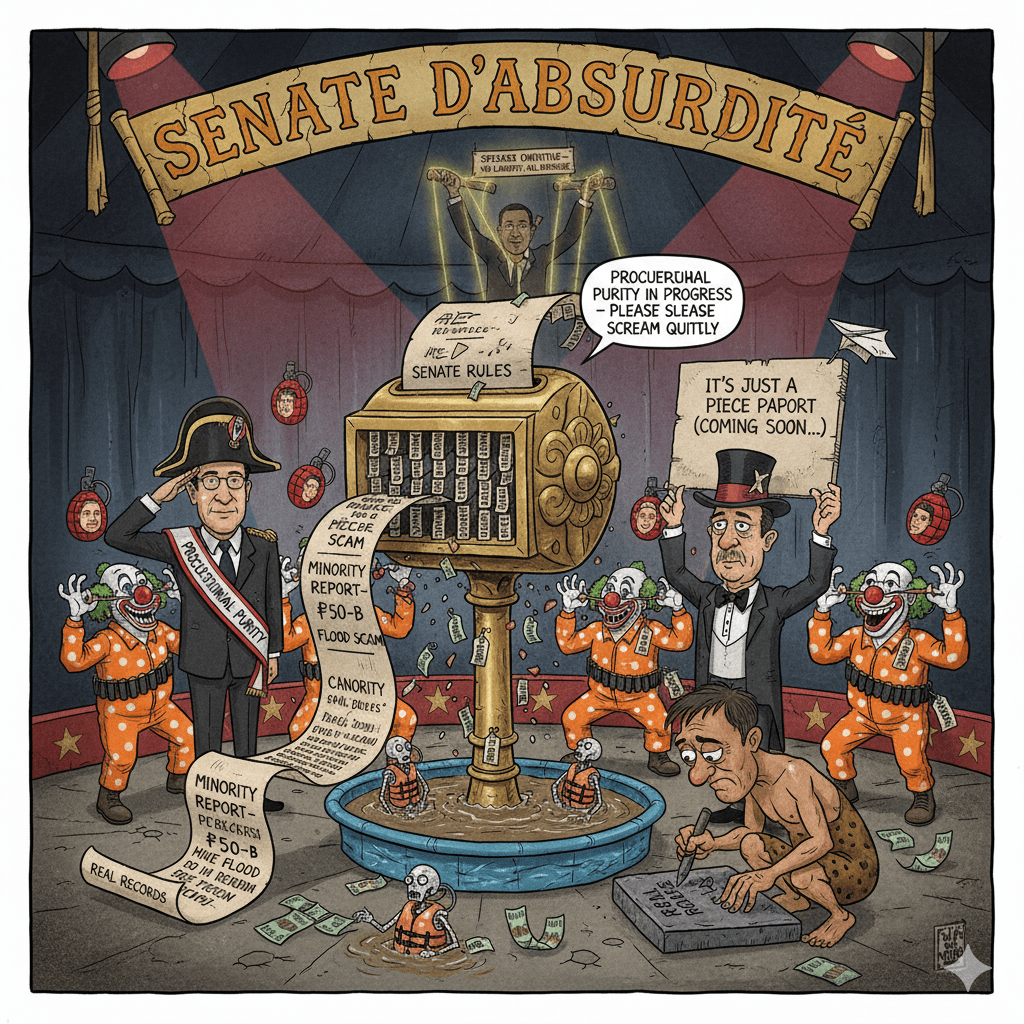
When “Procedural Purity” Becomes the Perfect Excuse to Keep Names Buried
By Louis ‘Barok‘ C. Biraogo++ January 23, 2025
MGA ka-kweba, welcome to the latest episode of Philippine political theater, presented by the Upper Chamber of Perpetual Absurdity. I am Barok, reporting from the depths of my cave as we dissect the so-called “minority report” on the multibillion-peso flood control scandal.
This document has Senator Panfilo “Ping” Lacson clutching his pearls, Senate President Vicente “Tito” Sotto III dismissing it as “a piece of paper,” and the Duterte-aligned senators launching it like a grenade toward the Marcos-Romualdez camp.
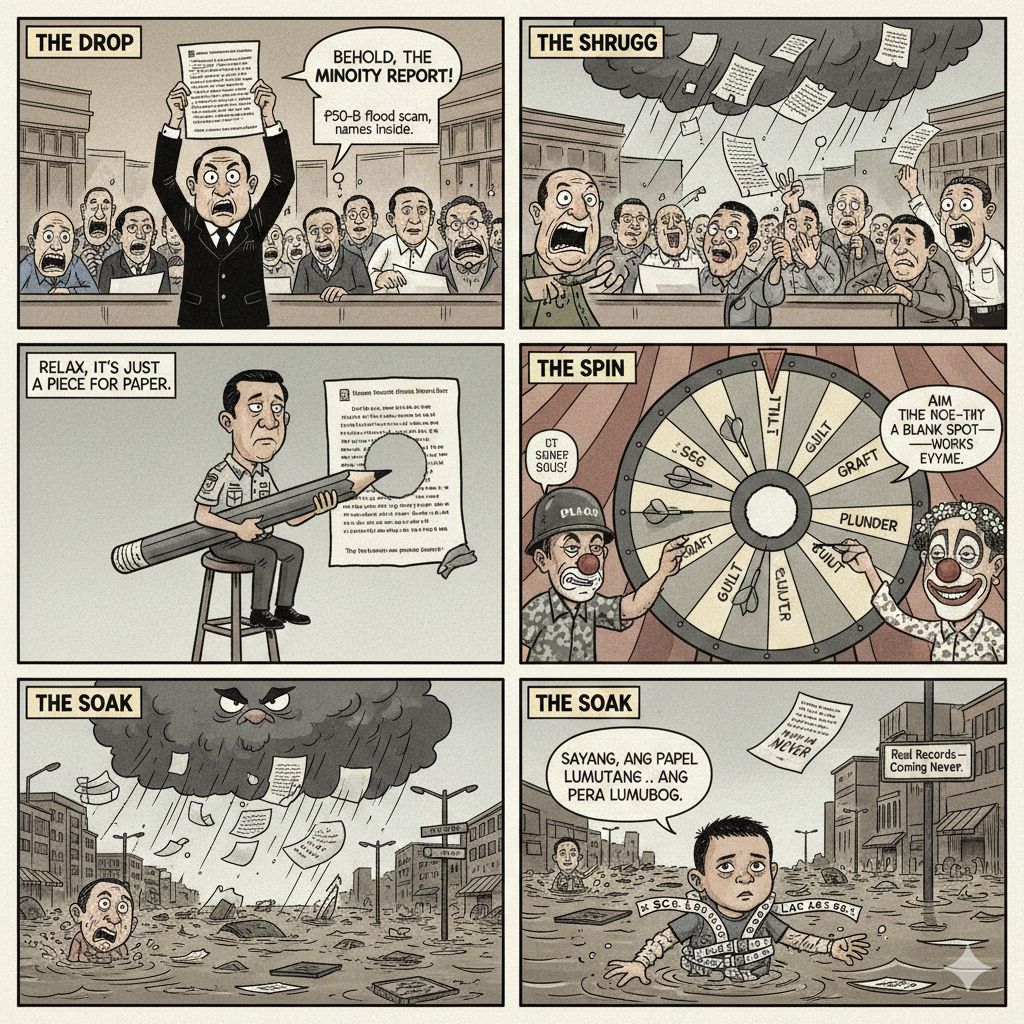
Theatre of the Absurd
This is not a serious legislative debate. It is political absurdity at its finest: senators waiting for accountability while billions vanish into ghost projects, overpriced dikes, and substandard concrete that collapses faster than campaign promises in typhoon season.
The cast performs brilliantly. Lacson directs with strict adherence to the script. The minority bloc improvises explosive scenes. Sotto, the weary ringmaster, struggles to keep the tent standing. Procedure serves as both weapon and shield, while the real scandal—a multi-billion-peso looting that left flood victims drowning in neglect—gets buried under parliamentary drama.
Procedural Carnage
The fight over process dominates because nothing screams “serious oversight” like senators arguing whether a document is official or worthless.
Lacson, chair of the Senate Blue Ribbon Committee, declares the minority’s December submission to Sotto’s office “symbolizes disrespect” to the panel and the Senate. “Respect begets respect,” he declares solemnly.
He reminds the signatories—veterans like Ronald “Bato” dela Rosa and Jinggoy Estrada—to review the rules on committee reports.
Sotto delivers the knockout: a minority report exists only after the majority report. Otherwise, it is merely “a piece of paper.”
The truth cuts sharp. The Rules of Procedure Governing Inquiries in Aid of Legislation require majority approval for committee reports. Dissenting opinions must attach to the official report. Preemptive standalone documents lack legislative weight. Lacson stands correct procedurally—you do not ambush your own committee. Yet the irony stings: demanding “institutional respect” in a chamber built on backroom deals.
Dual-Axis Legal Critique
Internal Senate Law
The document remains “a piece of paper” until plenary consideration. Releasing it prematurely undermines committee process. True dissent must attach formally to the majority report—no standalone theatrics.
Substantive National Law
The core scandal involves potential plunder on a massive scale. The minority report accuses former House Speaker Martin Romualdez of complicity or gross negligence.
Measure this against key statutes:
- Republic Act No. 3019 (Anti-Graft and Corrupt Practices Act): Covers manifest partiality, bad faith, or gross negligence in contracts—classic for ghost projects and overpricing.
- Republic Act No. 7080 (Plunder Law): Targets accumulation of at least ₱50 million in ill-gotten wealth through criminal acts. Multi-billion funds disappearing while communities flood? This qualifies as treasury raid if proven.
- Republic Act No. 6713 (Code of Conduct and Ethical Standards for Public Officials and Employees): Prohibits neglect of duty by those positioned to stop corruption.
The procedural circus distracts from this crime scene. Technicalities have long shielded bigger scandals when convenient.
Motivational Psychoanalysis
- Lacson: Does he defend institutional integrity or control the narrative and timeline? “Respect for the committee” often means “respect my authority.” Slowing deeper probes protects allies from splash damage.
- The Duterte-aligned signatories (Bato dela Rosa, Jinggoy Estrada, Robin Padilla, Bong Go, Imee Marcos, Rodante Marcoleta): Is this genuine advocacy for victims or a targeted strike against the Marcos-Romualdez axis? The irony overflows—former plunder defendants and rights controversy figures now posing as ethics champions.
- Sotto: He prevents institutional collapse. His dismissal blends procedural accuracy with partisan pragmatism.
Constitutional and Precedential Anchor
Article VI, Section 21 of the 1987 Constitution grants broad inquiry powers—but only “in accordance with duly published rules of procedure.”
The Supreme Court in Neri v. Senate Committees (2008) limited overreach when rules were ignored. Bengzon v. Senate Blue Ribbon Committee (1991) clarified: inquiries recommend prosecution, not determine guilt.
Hiding behind rules to suppress dissent on plunder-scale corruption mocks the Constitution and the public’s right to information.
Scandal Prognosis and Prescriptions
Unchecked, this risks institutional breakdown: majority stonewalls, minority leaks, trust erodes further.
Clear demands:
- Formally attach any dissenting opinion to the majority report—no more premature stunts.
- Broker genuine negotiation among Senate elders who still recall institutional dignity.
- Hold immediate plenary debate on the impasse.
- Issue joint resolution referring all evidence—majority and minority—to the Ombudsman.
- Extract public pledge from all senators: prioritize victims’ justice over political survival.
The broader fallout weakens Senate credibility, fuels election cynicism, and signals executive dominance amid infighting.
Mga kababayan, this is not just a minority report—it is a majority failure. The true disrespect is allowing billions to vanish while senators engage in procedural games. Demand accountability, or watch the institution drown.
The cave never lies.
The Senate?
That’s another story.
–Barok,
vanishing back into the dark, where the real records are kept.
Key Citations
A. Legal & Official Sources
- The Anti-Graft and Corrupt Practices Act. Republic Act No. 3019, 17 Aug. 1960.
- An Act Defining and Penalizing the Crime of Plunder. Republic Act No. 7080, 12 July 1991.
- Code of Conduct and Ethical Standards for Public Officials and Employees. Republic Act No. 6713, 20 Feb. 1989.
- The 1987 Constitution of the Republic of the Philippines. Official Gazette of the Republic of the Philippines.
- Rules of Procedure Governing Inquiries in Aid of Legislation. Senate of the Philippines, 9 Aug. 2010.
- Neri v. Senate Committee on Accountability of Public Officers and Investigations. Supreme Court of the Philippines, G.R. No. 180643, 25 Mar. 2008, LawPhil Project.
- Bengzon Jr. v. Senate Blue Ribbon Committee. Supreme Court of the Philippines, G.R. No. 89914, 20 Nov. 1991, LawPhil Project.
B. News Reports

- ₱75 Million Heist: Cops Gone Full Bandit

- ₱6.7-Trillion Temptation: The Great Pork Zombie Revival and the “Collegial” Vote-Buying Circus

- ₱1.9 Billion for 382 Units and a Rooftop Pool: Poverty Solved, Next Problem Please

- ₱1.35 Trillion for Education: Bigger Budget, Same Old Thieves’ Banquet

- ₱1 Billion Congressional Seat? Sorry, Sold Out Na Raw — Si Bello Raw Ang Hindi Bumili

- “We Will Take Care of It”: Bersamin’s P52-Billion Love Letter to Corruption

- “Skewed Narrative”? More Like Skewered Taxpayers!

- “Scared to Sign Vouchers” Is Now Official GDP Policy – Welcome to the Philippines’ Permanent Paralysis Economy

- “Robbed by Restitution?” Curlee Discaya’s Tears Over Returning What He Never Earned

- “No Pressure” Luistro? The House Pork Bazaar Exposed
- “My Brother the President Is a Junkie”: A Marcos Family Reunion Special

- “Mapipilitan Akong Gawing Zero”: The Day Senator Rodante Marcoleta Confessed to Perjury on National Television and Thought We’d Clap for the Creativity



 KWEBA ni BAROK
Leave a comment