
Impeaching Marcos? Apologies, the Receiving Officer Is Vacationing in Taiwan Right Now
By Louis ‘Barok‘ C. Biraogo — January 23, 2026
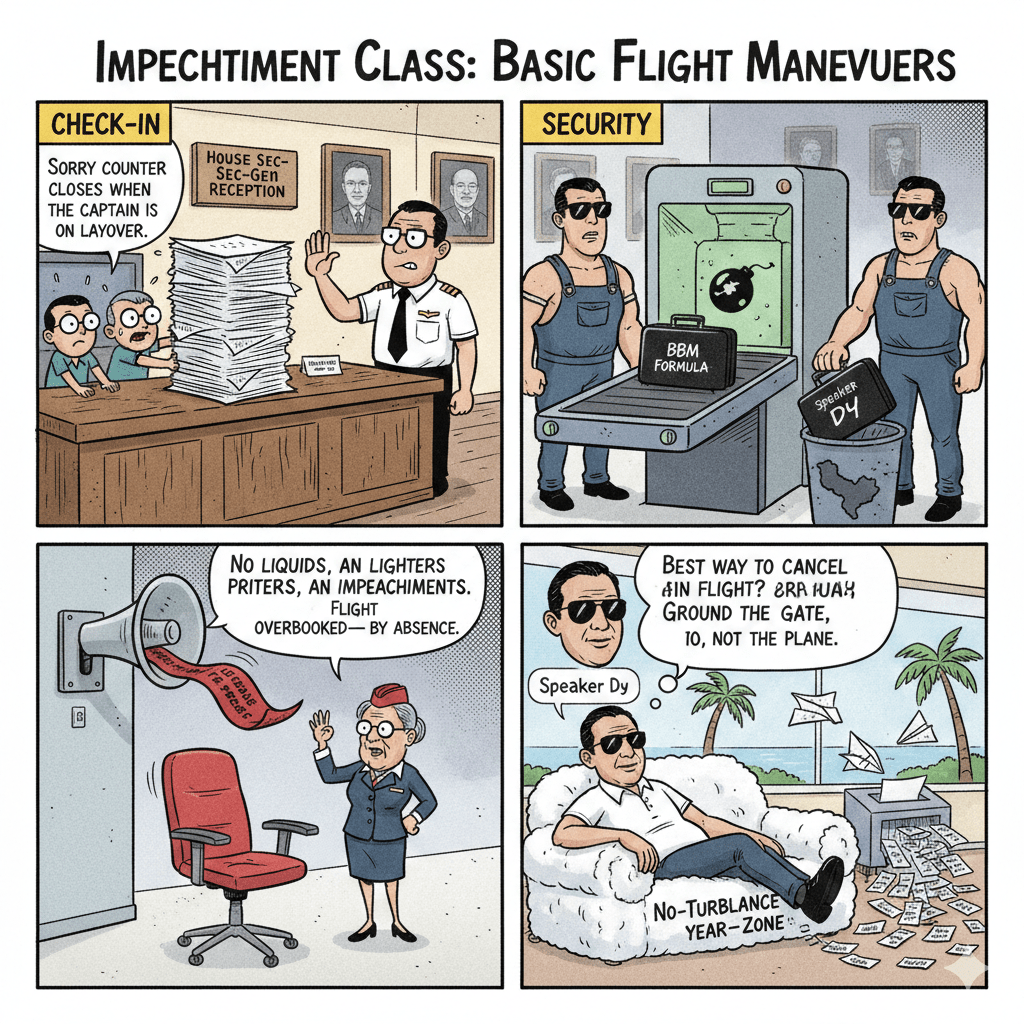
Ah, the Philippines—where constitutional crises are resolved not by principled debate but by the simple expedient of a plane ticket to Taiwan. Yesterday, two impeachment complaints against President Ferdinand Marcos Jr. were delivered to the House of Representatives, only to be turned away with the solemn explanation that Secretary General Cheloy Garafil was… abroad. Attending an “event” (The Philippine Star, 23 Jan. 2026.). One imagines a very important symposium on democratic accountability, perhaps titled “How to Make Impeachment Complaints Disappear Without Leaving Fingerprints.”
Let us be clear: this is not a mere administrative hiccup. This is a deliberate, grotesque obstruction of a constitutional process, dressed up as bureaucratic fastidiousness. The Office of the Secretary General refused to accept verified, duly endorsed complaints—37 pages from the Makabayan bloc, another from Chavit Singson and Mike Defensor’s Duterte-aligned posse—because the titular head was not physically present to stamp them. Staff, including the politely obstructive Executive Director Jose Marmoi Salonga, insisted they had “no authority” to receive the documents. In one instance, the complainants simply left the papers on a desk, like abandoned orphans in a Dickens novel.
The excuse? “The Secretary General is not around.”
One almost admires the audacity. A constitutional right—the people’s mechanism to hold the highest official accountable for graft, betrayal of public trust, and abuse of power—is held hostage to the travel itinerary of a single functionary. This is not governance; this is petty tyranny masquerading as protocol.
The Procedural Farce: When “Absence” Becomes Absolution
Let us dissect this absurdity with the precision it deserves. Article XI, Section 3 of the 1987 Constitution is unambiguous: a verified impeachment complaint, endorsed by a House member, must be filed, included in the Order of Business within ten session days, and referred to the appropriate committee within three. The House Rules on Impeachment Proceedings—still operative in the 20th Congress—specify that such complaints are filed with the Office of the Secretary General, whose duty is purely ministerial: receive, record, transmit immediately to the Speaker.
Nowhere—nowhere—do the rules require the personal, physical presence of the Secretary General herself. The filing is with the Office, not the person. The act of receipt is mechanical, non-discretionary, a mere acknowledgment that a document has arrived. Yet yesterday, staff treated this constitutional gateway as if it were a VIP lounge requiring the host’s personal greeting.
This is not interpretation; this is sabotage. The Supreme Court in Francisco v. House of Representatives (G.R. No. 160261, 2003) was crystal clear: the filing and referral of an impeachment complaint are mandatory acts that trigger constitutional timelines. The House has no discretion to refuse proper filings. To condition receipt on one official’s physical availability is to elevate bureaucratic convenience over constitutional command—a direct violation of the supremacy clause and the people’s right to seek redress.
And let us not pretend this is innocent. One earlier complaint—filed by private lawyer Andre de Jesus—was promptly accepted and transmitted by the very same Garafil. Selective availability, perhaps? When the complaint is less threatening, the Secretary General is miraculously present. When two more arrive, carrying allegations of systemic corruption, kickbacks, and the infamous “BBM parametric formula,” suddenly Taiwan beckons.
Legal Framework Autopsy: The Constitution vs. The Bureaucratic Labyrinth
The impeachment process is designed to be accessible, not arcane. The 1987 Constitution deliberately lowered the threshold for citizen-initiated complaints—requiring only endorsement by any single House member—to prevent exactly this kind of gatekeeping. The House Rules reinforce this by making the Secretary General’s role purely administrative.
Yet what we witnessed yesterday was the grotesque weaponization of procedure: a ministerial duty transformed into a discretionary veto. The refusal risks triggering—or evading—the one-year bar on multiple proceedings (Article XI, Section 3(5)), depending on which narrative the majority prefers. If the complaints are deemed “not filed,” the clock never starts. If later forced to accept them, the House can claim consolidation or dismissal on technical grounds. Either way, the constitutional process is suffocated before it can breathe.
The Supreme Court has repeatedly condemned such maneuvers. In Francisco v. House of Representatives, the Court struck down attempts to manipulate timelines through procedural sleight-of-hand. More recent rulings on impeachment-related disputes have reaffirmed that due process and fairness bind even the preliminary stages. To refuse receipt on the ground of “absence” is grave abuse of discretion, plain and simple.
Motive Forensics: Everyone Is Playing a Game, and the Constitution Is the Loser
Let us not be naïve about the players.
The Makabayan complainants—Colmenares, Casiño, endorsed by Elago, Co, and Tinio—are ideological warriors. Their 37-page indictment of “institutionalized systemic corruption” and abuse of unprogrammed appropriations is sincere, if predictably partisan. They want blood, or at least daylight.
The Duterte-aligned group—Singson, Defensor—arrives with different baggage. Their complaint is less about left-wing principle than political payback amid the unraveling UniTeam. This is leverage, a warning shot across the bow of a fracturing alliance. Both sets of complainants share one thing: they know these complaints will likely die in committee, but the act of filing forces narrative control.
The Office of the Secretary General, however, is not neutral. Garafil’s absence was scheduled; staff were instructed. This was coordinated. The House leadership—Speaker Dy and the supermajority—benefits enormously from delay. Multiple complaints risk complicating the one-year bar, forcing consolidation, or simply embarrassing the administration with prolonged hearings. Better to choke them at the door.
And Malacañang? Their response—through Undersecretary Castro—was predictably dismissive: prove the “pork barrel by design.” But silence on the procedural obstruction speaks volumes. The Palace has no interest in a transparent process that might validate even a fraction of the corruption allegations.
This is not incompetence. This is strategy.
Pathways and Consequences: Where Do We Go From the Farce?
The complainants have options, all of them uphill.
- Re-file when Garafil returns—assuming she does not extend her Taiwanese sabbatical indefinitely.
- Petition the Supreme Court for mandamus to compel receipt and referral, or certiorari to declare the refusal void for grave abuse. Precedent favors them.
- Mobilize public pressure, though in this jaded republic, outrage is cheap and fleeting.
Resolution will likely be political: the majority will eventually accept the complaints only to bury them in the Committee on Justice, where they will be found insufficient in form or substance. The administration survives, the opposition claims moral victory, and the public grows more cynical.
But the deeper consequence is institutional decay. When procedural technicalities are wielded as weapons to suffocate substantive rights, the rule of law becomes a punchline. Public trust—already threadbare—frays further. The betrayal of ministerial duty by the Secretary General’s office is not mere negligence; it is malfeasance.
Systemic Indictment: The Republic of Technicalities
This incident is not isolated. It is symptomatic. We have institutionalized the use of procedure to protect power. From quorum manipulations to midnight appointments, from budget insertions to confidential funds, our government apparatus has perfected the art of self-preservation through obfuscation. Public offices treat constitutional duties as optional when inconvenient. The Code of Conduct and Ethical Standards for Public Officials and Employees (Republic Act No. 6713)—demanding professionalism, justness, and accountability—is honored only in breach.
The Secretary General’s office did not merely fail yesterday; it actively obstructed. That is not public service. That is sabotage.
Prescription: No More Games
Enough.
The Supreme Court must intervene—swiftly, decisively. Issue the writ of mandamus. Declare once and for all that the physical absence of a functionary cannot nullify a constitutional filing. Hold the responsible officials accountable, from Garafil down to the staff who refused the stamp.
Prosecute, if evidence warrants, for violations of duty under the Revised Penal Code or administrative sanctions under the Civil Service rules. Let there be personal consequence for institutional betrayal.
And let the House reform its rules: authorize deputies, establish timestamp protocols, remove human gatekeepers from mechanical processes. The Constitution is not a suggestion. It is the supreme law.
Until we re-assert that truth—over procedural trickery, over political convenience, over the absurd spectacle of a Secretary General’s foreign junket trumping impeachment—we remain not a republic, but a bureaucracy with delusions of sovereignty.
The complaints must be received. The process must run. And those who obstructed it must answer.
Because if the people’s right to hold power accountable can be defeated by a plane ticket, then we have already lost the Republic.
— Barok
(Because someone has to keep reminding this republic that the Constitution isn’t a boarding pass.)
Key Citations
A. Legal & Official Sources
- 1987 Constitution of the Republic of the Philippines. Official Gazette of the Republic of the Philippines, 1987.
- Philippines, Supreme Court. Ernesto B. Francisco, Jr. v. The House of Representatives. 10 Nov. 2003. LawPhil.
- Code of Conduct and Ethical Standards for Public Officials and Employees. Republic Act No. 6713, 20 Feb. 1989, LawPhil Project.
B. News Reports
- Porcalla, Delon and Clapano, Jose Rodel. “2 Impeach Complaints vs Marcos Jr. Hit Snag.” The Philippine Star, 23 Jan. 2026.
- “Forthwith” to Farce: How the Senate is Killing Impeachment—And Why Enrile’s Right (Even If You Can’t Trust Him)

- “HINDI AKO NAG-RESIGN!”

- “I’m calling you from my new Globe SIM. Send load!”

- “Mahiya Naman Kayo!” Marcos’ Anti-Corruption Vow Faces a Flood of Doubt

- “Meow, I’m calling you from my new Globe SIM!”

- “No Special Jail for Crooks!” Boying Remulla Slams VIP Perks for Flood Scammers

- “PLUNDER IS OVERRATED”? TRY AGAIN — IT’S A CALCULATED KILL SHOT

- “Several Lifetimes,” Said Fajardo — Translation: “I’m Not Spending Even One More Day on This Circus”

- “Shimenet”: The Term That Broke the Internet and the Budget

- “We Did Not Yield”: Marcos’s Stand and the Soul of Filipino Sovereignty

- “We Gather Light to Scatter”: A Tribute to Edgardo Bautista Espiritu

- $150M for Kaufman to Spin a Sinking Narrative








 KWEBA ni BAROK
Leave a comment