The Four-Star Loophole: One Oath, Two Salaries, Zero Regrets
By Louis ‘Barok‘ C. Biraogo — January 24, 2026
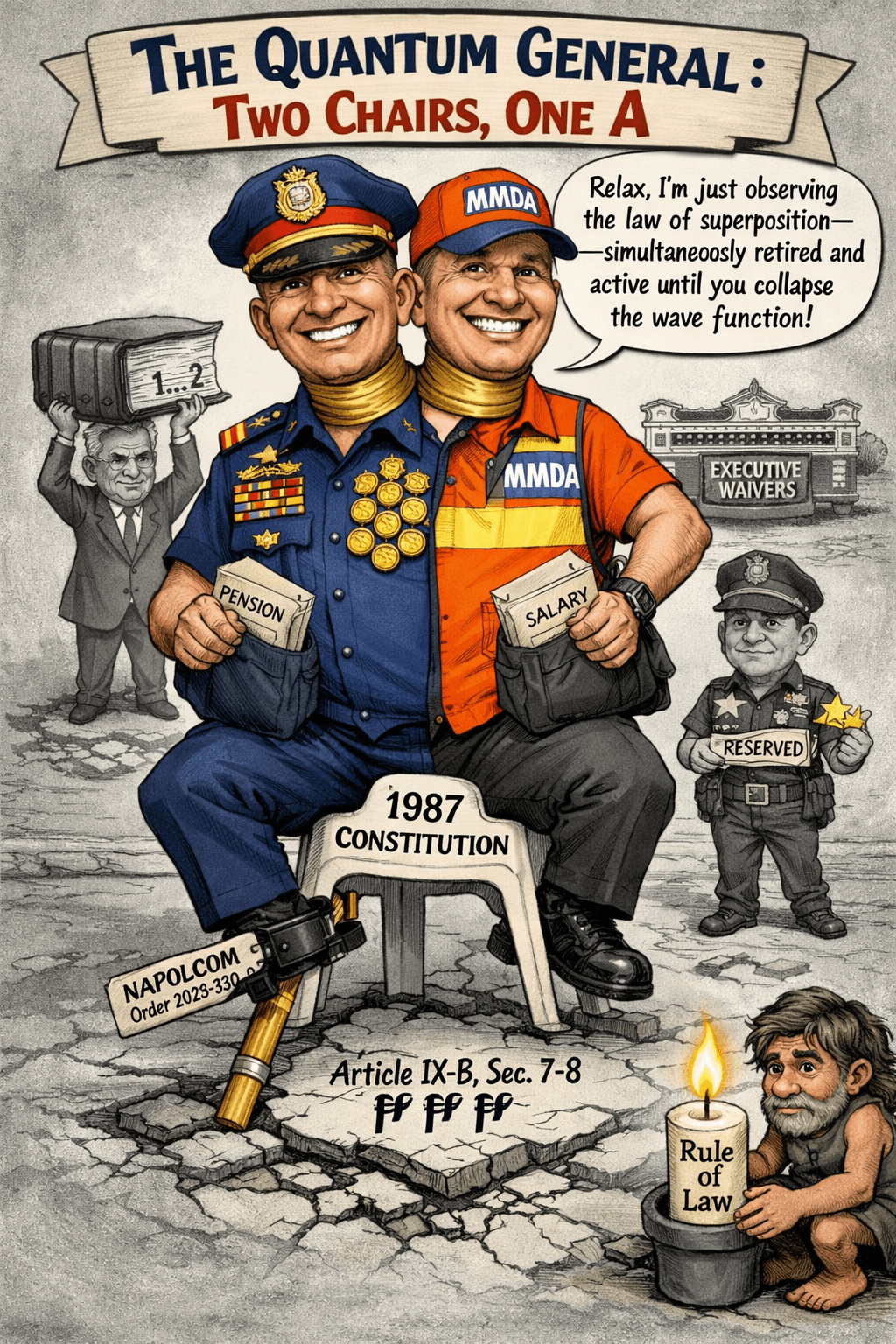
AYAN, dear readers of this humble cave, gather ’round while Barok sharpens his quill on the whetstone of the 1987 Constitution. Today we dissect a spectacle so rich in absurdity it could only happen in our beloved republic: Police General Nicolas Torre III, former Philippine National Police (PNP) chief, current Metropolitan Manila Development Authority (MMDA) traffic czar, and apparent believer in the quantum theory of public office—existing in two lucrative states at once without collapsing the fiscal universe.
Picture this: a four-star general who refuses to retire from the police force even after swearing in as head of another major agency. One wallet for PNP salary and pension, another for MMDA compensation, and a brass neck sturdy enough to insist it’s all perfectly legal because “the President said so.” Ladies and gentlemen, behold the farcical saga of the man with two chairs—and the republic’s furniture groaning under the strain.
1. The Central Farce: The Man with Two Wallets
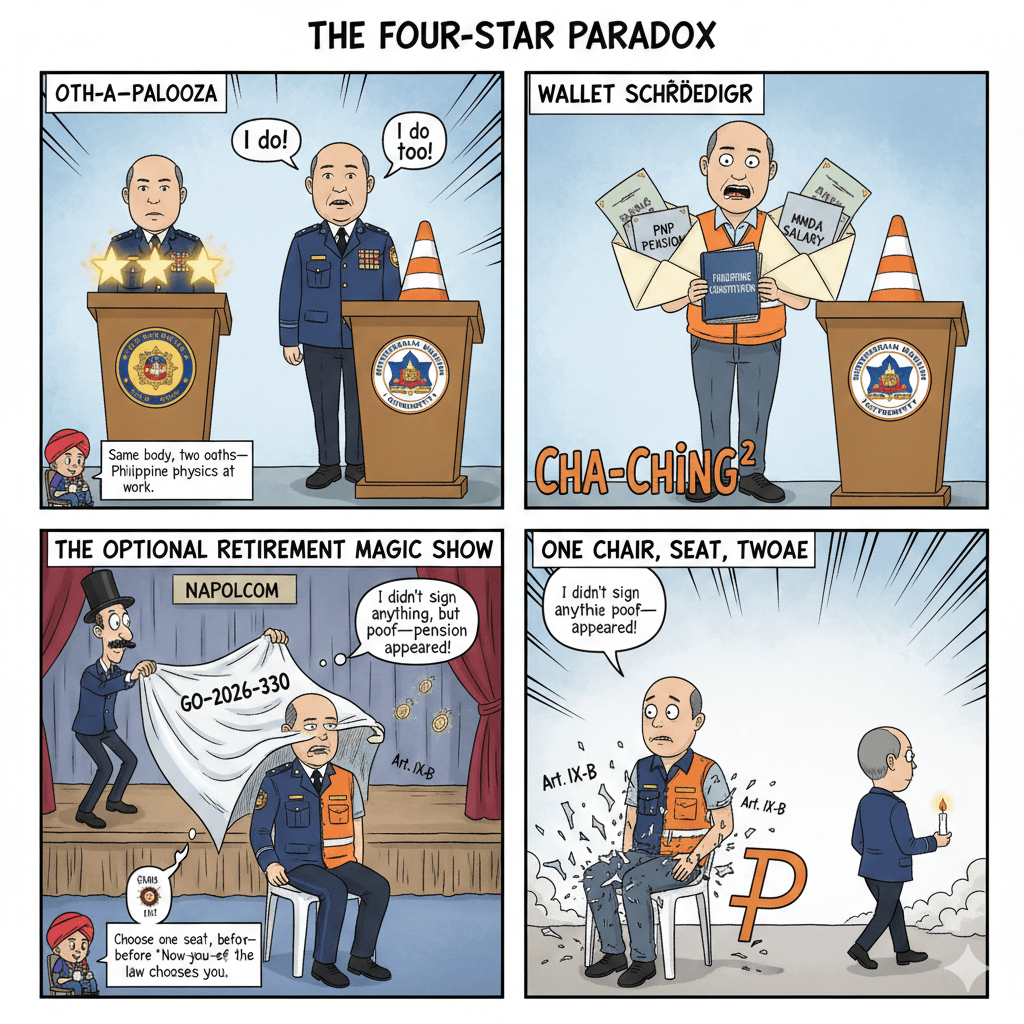
Let us begin with Torre’s defense, delivered with the straight face of a man who has never read Article IX-B, Section 7 of the 1987 Constitution: “It’s not the first time that a police officer has worked for other agencies.” He cites officers detailed to the Bureau of Immigration for years, then returning to PNP like nothing happened. Cute. Except those were temporary details, not a full presidential appointment to run an entirely separate agency with its own budget, mandate, and perks.
The MMDA general manager is not a “detail.” It is a distinct appointive position requiring full-time devotion. Accepting it while clinging to active PNP status triggers—by any sane reading—the constitutional prohibition on double compensation (Article IX-B, Section 8) and the statutory ban on conflicting outside employment under Republic Act No. 6713, Section 7(b). The Supreme Court has been crystal clear: absent explicit statutory authorization, an appointive official cannot hold multiple positions that result in double pay. See Funa v. Executive Secretary (G.R. No. 191644) for bedtime reading.
But wait—there’s more! The National Police Commission (NAPOLCOM), in a burst of administrative creativity, issued General Order No. NHQ-GO-OR-2026-330 declaring Torre optionally retired effective December 26, 2025, the very day he took his MMDA oath. Torre’s response? “I did not apply for optional retirement. I did not sign any application either.” Fascinating. Republic Act No. 6975 as amended by Republic Act No. 8551 states optional retirement requires the officer’s own request and NAPOLCOM approval. No signature, no request—yet poof, retirement granted.
This is either bureaucratic genius or the thinnest paper cover-up since someone tried to hide a budget insertion with a Post-it note. The order conveniently clears the four-star slot for Torre’s successor while allowing him to pocket full retirement benefits.
2. The Cast of Characters: Motives & Malarkey
Interior Secretary Jonvic Remulla, suddenly transformed into Chief Constitutional Guardian, thundered:
“You cannot hold two government positions at the same time… plain and simple” (Inquirer.net, 23 Jan. 2026).
Strong words from the man whose department clashed spectacularly with Torre in August 2025 over senior officer reassignments. One wonders if this newfound fervor for legal purity was simmering since that public humiliation, waiting for the perfect moment to flex civilian oversight muscle.
Torre himself plays the loyal soldier: “Let’s leave it at that for now because my bosses and I will talk first.” Translation: I’ll wait for Malacañang to bail me out. This is the same Torre who led the arrest of a former president, defied NAPOLCOM directives, and now clings to his four-star rank like a barnacle on a sinking ship. The motives are transparent—double compensation, prestige retention, and perhaps a calculated wager that presidential protection trumps mere statutes. Why settle for one pension when you can engineer a hybrid PNP-MMDA perpetuity package?
And then there’s Malacañang, issuing clarifications in the royal passive voice: “Torre is willing to transfer his rank” and will receive full benefits. How gracious of the palace to sanctify the mess with a wave of the executive wand. The appointing authority suddenly discovers procedural ambiguity only when it benefits a favorite. One expects the next press release to announce that laws are now optional for four-star personages.
3. The Legal Theater: Pathways & Precedents
Should this farce proceed to its logical conclusion, the options for Torre are delightfully humiliating:
- The Smart Exit: Slink away, formalize retirement, keep the benefits, and manage traffic in peace. Dignified, if slightly cowardly.
- The Delusional Gambit: File a mandamus petition praying the courts compel NAPOLCOM to restore his active status. The Supreme Court would laugh it out of the docket faster than you can say “grave abuse of discretion.”
- The Coward’s Play: Wait for a presidential memo declaring the whole thing a “misunderstanding,” effectively pardoning the constitutional breach without calling it a pardon.
Prosecution pathways abound. The Ombudsman could motu proprio investigate for violation of Republic Act No. 6713 or even Republic Act No. 3019’s anti-graft provisions if undue injury via double compensation is proven. The Civil Service Commission could demand disgorgement of salaries. Precedents are unforgiving: Re: Gross Violation of Civil Service Law (A.M. No. 2011-04-SC) dismissed an official for far less egregious double-dipping. Bayot v. Sandiganbayan (G.R. No. 187993) reminds us that unauthorized compensation is recoverable, with interest.
Meanwhile, poor Lt. Gen. Jose Melencio Nartatez Jr. languishes in rank limbo, unable to pin on his fourth star because Torre refuses to vacate the astral plane. A successor held hostage by one man’s entitlement—classic Philippine administrative tragedy.
4. The Grand Critique: Rule of Law vs. Rule of Whim
General Torre, the republic issues you a derisive ultimatum: Choose. One. Chair. You cannot be both Director General of the PNP and General Manager of the MMDA any more than you can be both retired and active, both pensioned and salaried, both loyal public servant and rank-hoarding opportunist.
This petty scandal is symptomatic of a deeper disease: the treatment of high public office as personal fiefdom and constitutional provisions as mere suggestions for the little people. Ordinary civil servants are sacked for moonlighting as security guards; four-star generals apparently get to moonlight as metropolitan development authorities while keeping their old perks.
To the Ombudsman: Wake up and initiate that motu proprio investigation. The law still exists, even for presidential appointees.
To Congress: Amend Republic Act No. 6713 with a provision so blunt even the densest bureaucrat cannot miss it—“No public official shall occupy two salaried government positions simultaneously, thou greedy fool.”
To the public: Stop being dazzled by stars on shoulders. Start being enraged by stars who think the rules orbit around them.
And to General Nicolas Torre III: history will remember you not for arresting a former president, not for traffic management innovations, but as the man who tried to sit on two pensions at once—and discovered, too late, that the Constitution is not a cushioned seat.
From the cave that remembers when public office was a trust, not a trust fund,
— Barok
Lighting candles for the rule of law (it’s getting dark out here)
Key Citations
A. Legal & Official Sources
- 1987 Constitution of the Republic of the Philippines. Official Gazette of the Republic of the Philippines.
- Funa v. Executive Secretary. G.R. No. 191644, Supreme Court E-Library.
- Re: Gross Violation of Civil Service Law on the Prohibition Against Dual Employment and Double Compensation. A.M. No. 2011-04-SC, Supreme Court E-Library.
- Bayot v. Sandiganbayan. G.R. No. 187993, LawPhil.
- Republic Act No. 6713. Code of Conduct and Ethical Standards for Public Officials and Employees, LawPhil.
- Republic Act No. 6975. Department of the Interior and Local Government Act of 1990, LawPhil.
- Republic Act No. 8551. Philippine National Police Reform and Reorganization Act of 1998, LawPhil.
- Republic Act No. 3019: Anti-Graft and Corrupt Practices Act. 17 Aug. 1960. Official Gazette of the Republic of the Philippines.




 KWEBA ni BAROK
Leave a comment