When “Serbisyong Totoo” Meets Serfdom: The Network’s Contractor Charade Finally Gets the Boot
By Louis ‘Barok‘ C. Biraogo — January 25, 2026
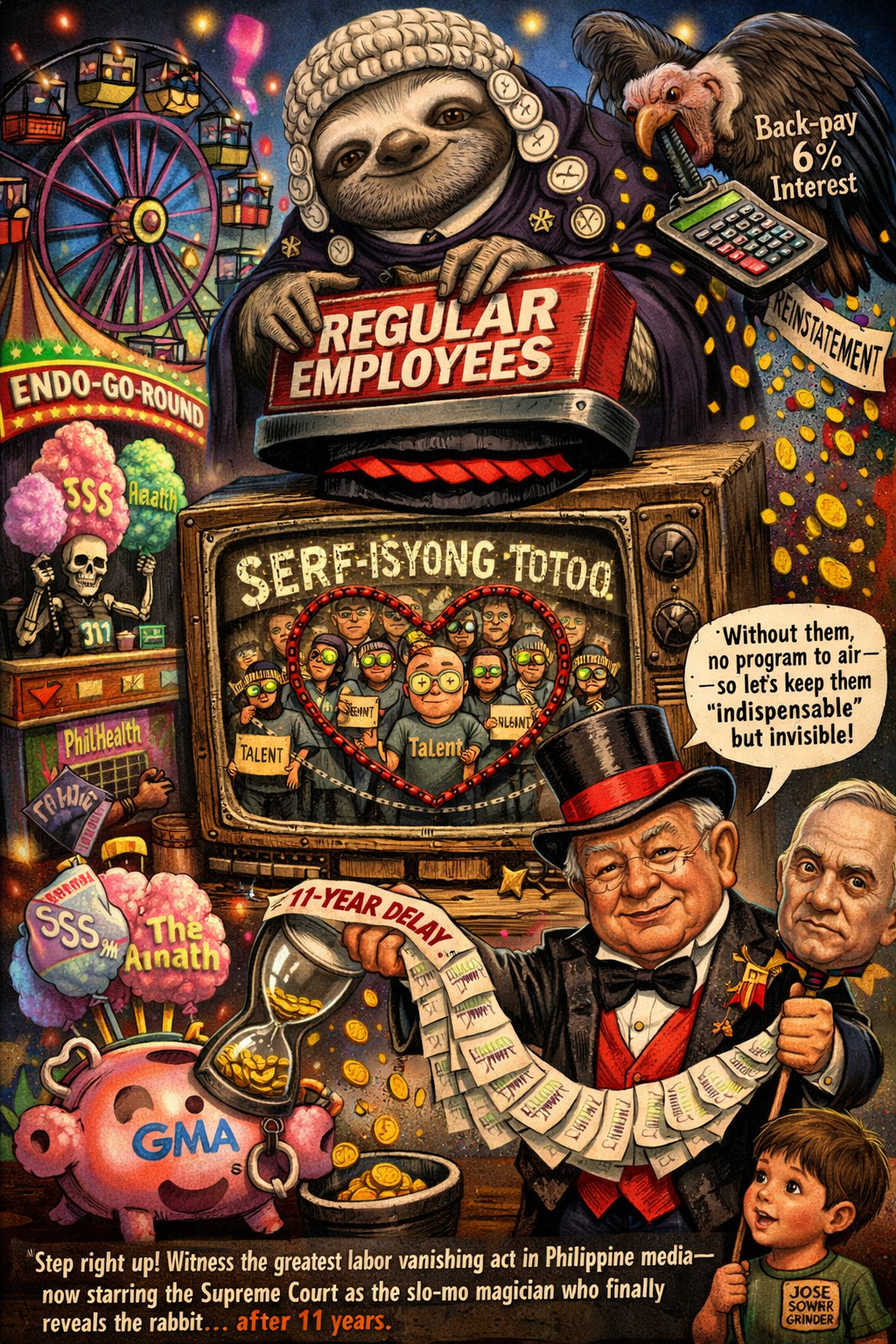
MGA ka-kweba, gather ’round the digital campfire for another episode of “How the Mighty Squirm.” It’s your favorite legal gadfly, Barok, here to skewer the latest judicial bombshell that’s got the suits at GMA Network clutching their pearl necklaces. We’re talking about the Supreme Court’s (SC) July 16, 2025, resolution—conveniently leaked to the public just this weekend in January 2026—that finally calls bullshit on GMA’s so-called “talent” system. You know, that ingenious little scheme where a media behemoth pretends its newsroom grunts are free-spirited artistes, all while chaining them to desks without benefits.
Eleven years of courtroom kabuki, and justice crawls out like a hungover sloth. But oh, what a delicious smackdown it is. Let’s dissect this carcass with the precision of a vulture at a buffet.
Core Legal & Factual Dissection: How the SC Turned GMA’s House of Cards into Confetti
Let’s start with the meat: the SC’s Third Division, in a 33-page masterpiece of legal shade-throwing, affirmed the Court of Appeals’ (CA) 2019 ruling that 94 members of the Talents Association of GMA (TAG)—hired from 2003 to 2013 as everything from segment producers to cameramen—are regular employees, not the mythical “independent contractors” GMA peddled. Half of them? Illegally canned, entitled to reinstatement, back wages, allowances, and a cherry on top: 6% legal interest until the coffers cough up. Computations remanded to the labor arbiter, because why not drag this out a bit more?
The decisive weapons? The venerable “four-fold test” and the almighty “control test,” straight from Philippine labor jurisprudence’s greatest hits. Under the four-fold test—enshrined in cases like Begino v. ABS-CBN and echoed in the Labor Code—the courts probe:
- Who selects and engages the worker?
- Who pays the wages?
- Who holds the power to dismiss? And the biggie,
- Who controls the means and methods of work?
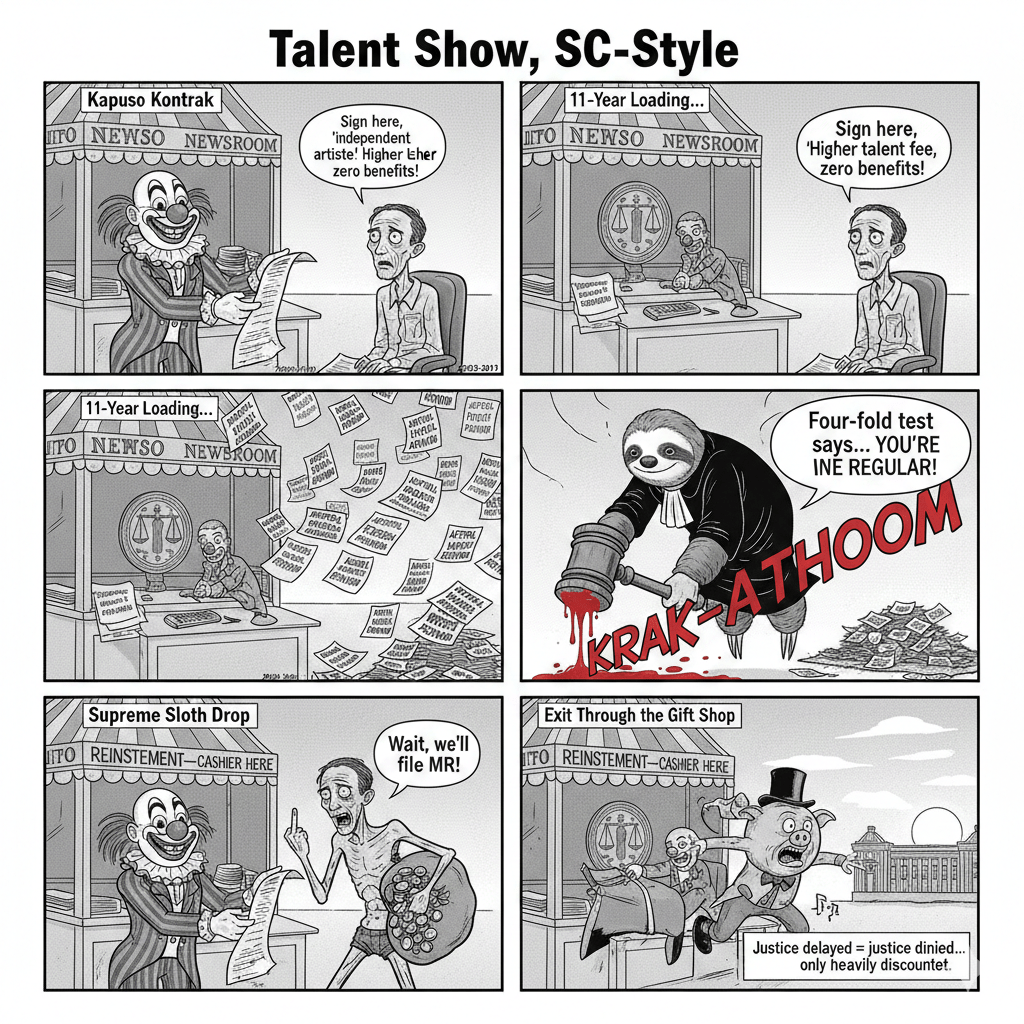
GMA flunked spectacularly on all counts, but especially control. The SC pointed to GMA’s own “Talent Agreements,” which bound these poor souls to company rules, schedules, and directions. “Flexible hours”? Ha! The ruling mocks that fairy tale: “Indubitably, [the provisions] belie GMA’s assertion that talents work flexible hours and [have] the liberty to work online.” Instead, GMA could dictate production timelines and demand physical presence. Boom—employee status confirmed.
Then there’s the control test, the SC’s favorite hammer for smashing contractor façades. No freedom from the principal’s oversight? You’re an employee, end of story. GMA’s talents weren’t autonomous butterflies; they were cogs in the broadcast machine, indispensable to churning out content. As the SC noted, quoting GMA chair Felipe Gozon’s own appeal: these folks’ skills were so vital that “without them, there would be no program to air.” That’s not contractor territory; that’s core business under Article 295 of the Labor Code, defining regular employment as work “necessary or desirable in the usual business or trade of the employer.”
Now, contrast this with precedents. Why did Orozco v. Court of Appeals (G.R. No. 155207) let a Philippine Daily Inquirer columnist fly free as an independent contractor? Because the paper had zero say over her topics or style—no control, no employment. But GMA’s talents? No such luck; they danced to the network’s tune, unlike the columnist’s editorial liberty.
And don’t get me started on Sonza v. ABS-CBN (G.R. No. 138051), where celebrity host Jose Sonza was deemed independent due to his star power, fat fees, and autonomy. GMA tried to shoehorn their newsroom drones into that mold—higher “talent fees,” “unique skills,” no fixed pay—but the SC laughed it off. These weren’t prima donnas; they were grinders integral to daily ops, bound by rules that screamed “employee.” Article 279 (now 294) on security of tenure seals it: regular folks can’t be dumped without just cause. GMA’s non-renewals? Illegal dismissal, pure and simple, triggering reinstatement or separation pay under SC doctrines like Francisco v. NLRC. Substance over labels, folks—that’s the bedrock, and GMA’s façade crumbled like a stale biscuit.
Evisceration of the “Talent” & “Independent Contractor” Scheme: A Masterclass in Corporate Hypocrisy
Oh, the sheer gall of it all. GMA, that self-proclaimed bastion of “Serbisyong Totoo” (True Service), running a talent system that’s about as true as a politician’s campaign promise. This isn’t just a legal oopsie; it’s a calculated corporate con job designed to sidestep labor obligations while squeezing every drop from its workforce.
Imagine: a media empire that profits off exposing societal injustices, yet treats its own storytellers like disposable Kleenex. Hypocrisy? It’s their prime-time special.
Let’s mock the absurdity, shall we? GMA trots out “higher talent fees” as a golden parachute substituting for benefits—because who needs SSS, PhilHealth, or a 13th-month pay when you’re raking in those irregular bucks that vanish with non-renewal? “Flexible hours” under the iron fist of company control? Please, that’s like calling a prison yard “open-concept living.”
And the crowning jewel: “unique skills” that are somehow also “indispensable” to daily operations. If they’re so unique, why bind them with agreements that dictate every move? It’s a farce—talents could moonlight elsewhere, sure, but economic dependence kept them tethered, per the economic reality doctrine in cases like Paragele v. GMA (G.R. No. 235315). This system is endo on steroids: repeated short-term contracts to evade regularization, flouting Department of Labor and Employment (DOLE) policies and the Constitution’s labor protections (Article XIII, Section 3).
GMA’s not alone; it’s an industry plague, but as the “Kapuso” network, they should know better. Championing truth while exploiting creators? That’s not service; that’s serfdom. The Bureau of Internal Revenue (BIR) receipt drama in 2014 was the spark—demanding proofs for contractors, exposing the sham. Eleven years later, the SC calls it what it is: a dodge to avoid mandatory contributions and tenure. Delicious irony: Gozon admits their indispensability, yet fights tooth and nail to deny them rights. Corporate greed wrapped in a bow of “industry peculiarity.” Spare me.
Panoramic Analysis of Actors & Consequences: The Ripple Effects of a Long-Overdue Reckoning
For the Workers: These 94 TAG warriors endured an 11-year odyssey of hell—emotional battering, financial ruin, careers derailed. Pickets in 2014 led to 51 dismissals, including senior staff, reeking of retaliation. Buhay Media nails it: “Our members have emotionally and mentally suffered… when all we ever wanted was to tell stories for the Filipino people.” Victory? Bittersweet. Reinstatement means back to the fold, but with what scars? Back wages could run millions, but no sum erases lost time or mental toll. Nationwide, this empowers media laborers—gig workers, freelancers—to challenge similar setups. But the delay? A scandalous indictment of our judiciary’s snail-pace, where the vulnerable rot while appeals ping-pong. Justice delayed is justice denied, as the Constitution’s speedy trial mandate (Article VIII, Section 15) gathers dust.
For GMA & Felipe Gozon: The suits are sweating. Next moves? File a motion for reconsideration (MR) under SC Rule 52, whining about “errors” or seeking clarifications on reinstatement vs. separation pay. Compliance? They’ll drag feet—restructure “talent” models, outsource to true contractors, or spin PR tales of “valuing our people.” Financially? Back wages, interest, benefits—could dent profits in a cutthroat market. Operationally, overhaul hiring or face more suits. Gozon’s “indispensability” slip? Priceless ammo for plaintiffs. Expect settlements to hush it up, but non-compliance risks National Labor Relations Commission (NLRC) enforcement or contempt. Karma’s a broadcast signal, folks.
For the Industry & Law: Seismic? Absolutely. This could torpedo endo in media, echoing anti-contractualization pushes like Republic Act No. 11962. Networks like ABS-CBN (see Tiangco v. ABS-CBN) better lawyer up; precedents now bite harder. DOLE should crank inspections, issue guidelines on classifications; Congress? Refine penalties for misclassification, bolster worker protections. But will they? In our pork-barrel paradise, labor reforms often fizzle. Still, this ruling clarifies the four-fold test for gig economies—IT, BPO, creatives—potentially sparking a wave of claims.
And the scandalous delay? Eleven years for basic rights? It screams systemic failure: judicial backlog, underfunded tribunals, power imbalances favoring corporations. What does it say? Our legal system protects the powerful while laborers bleed out. Time for outrage—and action.
In closing, this isn’t just a win; it’s a clarion call. The SC upheld labor’s dignity, eviscerating schemes that treat humans as expendable props. To GMA: Pay up, clean up, or fade out. To workers: You’ve earned your “serbisyong totoo”—now demand it everywhere. Until next time, keep questioning the kings.
— Barok out.
Keep the faith, keep the fight, and keep reminding these corporate clowns that labor isn’t their personal plaything. Until the next hypocrisy drops—stay savage.
Key Citations
A. Legal & Official Sources
- “Labor Code of the Philippines.” Presidential Decree No. 442, as amended. Official Gazette of the Republic of the Philippines, 1 May 1974.
- 1987 Constitution of the Republic of the Philippines. Official Gazette of the Republic of the Philippines, 2 Feb. 1987.
- Sonza v. ABS-CBN Broadcasting Corporation. G.R. No. 138051. Supreme Court of the Philippines, 10 June 2004, LawPhil Project.
- Orozco v. Court of Appeals. G.R. No. 155207. Supreme Court of the Philippines, 13 Aug. 2008, LawPhil Project.
- Paragele v. GMA Network, Inc.. G.R. No. 235315. Supreme Court of the Philippines, 13 July 2020, LawPhil Project.
- Trabaho Para sa Bayan Act. Republic Act No. 11962. Official Gazette of the Republic of the Philippines, 27 Sept. 2023, LawPhil Project.
- Francisco v. NLRC, G.R. No. 170087. Supreme Court of the Philippines, 31 Aug. 2006, LawPhil Project.
B. News Reports

- “Forthwith” to Farce: How the Senate is Killing Impeachment—And Why Enrile’s Right (Even If You Can’t Trust Him)
- “HINDI AKO NAG-RESIGN!”
- “I’m calling you from my new Globe SIM. Send load!”
- “Mahiya Naman Kayo!” Marcos’ Anti-Corruption Vow Faces a Flood of Doubt
- “Meow, I’m calling you from my new Globe SIM!”
- “No Special Jail for Crooks!” Boying Remulla Slams VIP Perks for Flood Scammers
- “PLUNDER IS OVERRATED”? TRY AGAIN — IT’S A CALCULATED KILL SHOT
- “Several Lifetimes,” Said Fajardo — Translation: “I’m Not Spending Even One More Day on This Circus”
- “Shimenet”: The Term That Broke the Internet and the Budget
- “We Did Not Yield”: Marcos’s Stand and the Soul of Filipino Sovereignty
- “We Gather Light to Scatter”: A Tribute to Edgardo Bautista Espiritu
- $150M for Kaufman to Spin a Sinking Narrative



 KWEBA ni BAROK
Leave a comment