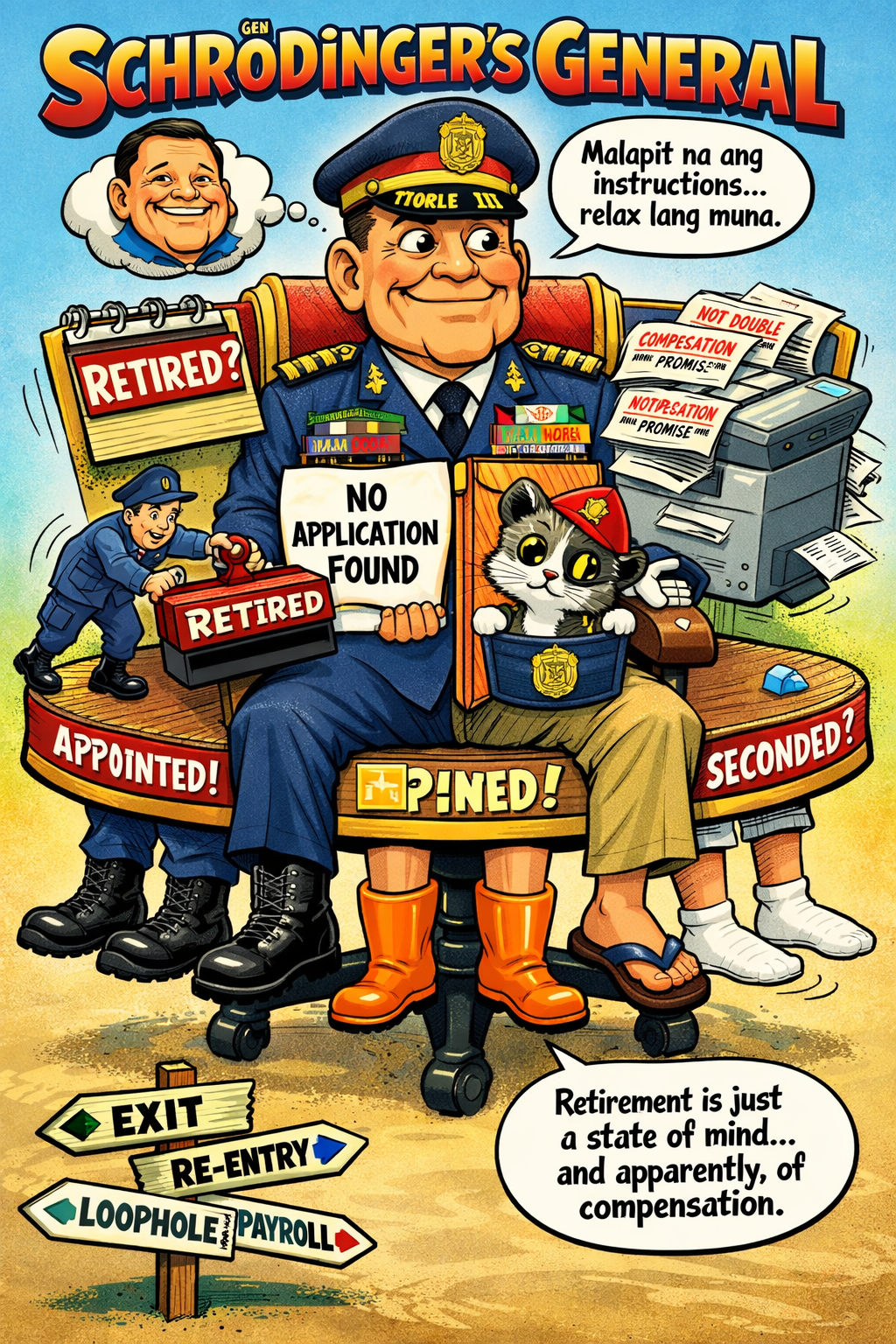
Gen. Torre, the Elastic Meaning of Leaving Office, and the Philippine Art of Never Really Going Away
By Louis ‘Barok‘ C. Biraogo — January 25, 2026
IN most civilized jurisdictions, retirement is a clean break: you hand over your badge, clear your desk, collect a plaque you didn’t ask for, and vanish into the sweet anonymity of private life. In the Philippines, retirement is more… conceptual. Optional. Interpretive. A state of mind.
Enter Gen. Nicolas Torre III, who has given us what may be the most creative administrative performance art of 2026: a man who is retired, not retired, appointed, seconded, paid, and awaiting instructions—all at the same time.
If Schrödinger had been Filipino, he would have put a four-star general in the box.
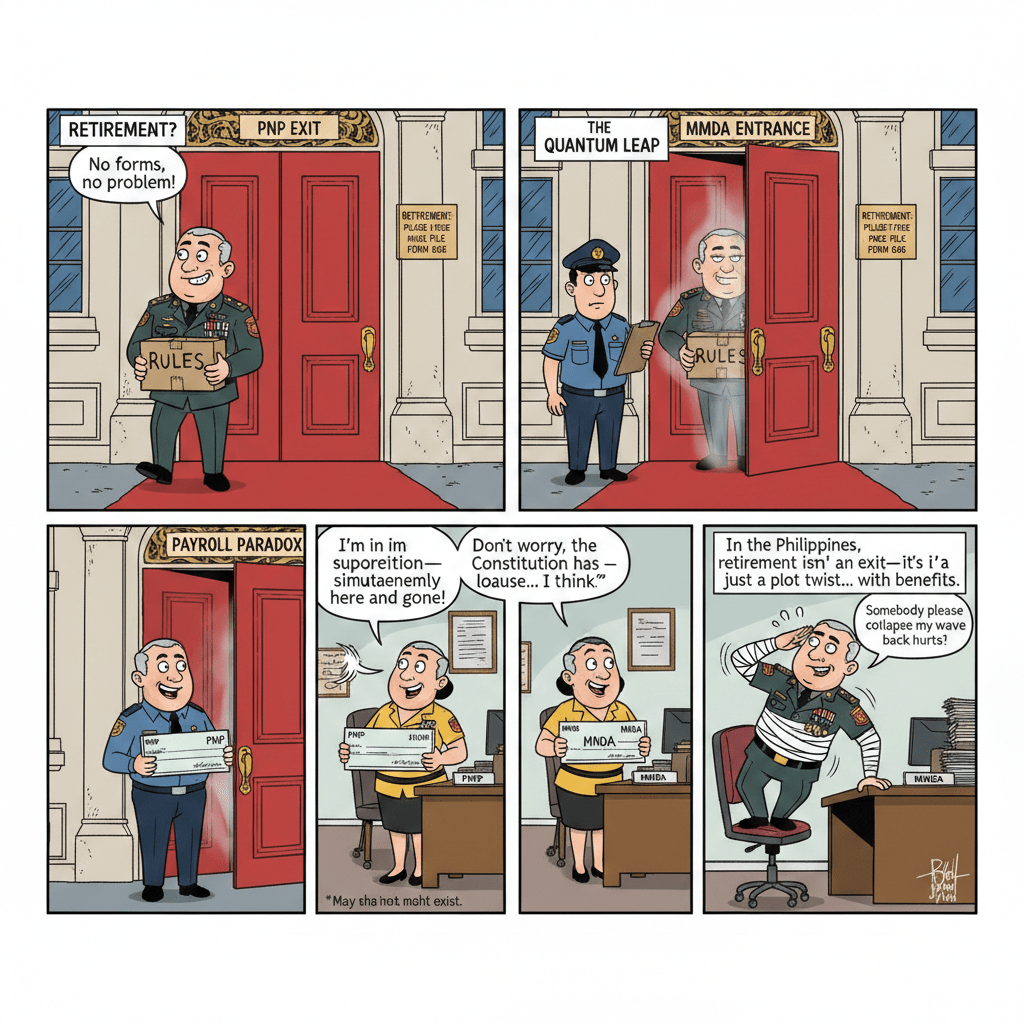
I. Welcome to the Payroll Party
Let us begin with the undisputed facts—those sturdy little islands of certainty in an ocean of bureaucratic improvisation.
Gen. Torre was the Chief of the Philippine National Police (PNP) and, on December 26, 2025, assumed office as General Manager of the Metropolitan Manila Development Authority (MMDA) by executive appointment, as reported in the news media. According to GMA News, the PNP and the Department of the Interior and Local Government (DILG) publicly asserted that Torre’s assumption of the MMDA post constituted his retirement from the PNP; this status was cited to enable his successor to assume four-star rank. (“Former NBI exec bucks Torre’s PNP ‘retirement’”)
Torre himself complicated matters by saying that he did not file or sign any application for retirement, adding that he was awaiting instructions from the President. This raises a delicate but important legal question: if retirement is not affirmatively executed by the officer concerned, can it legally be presumed?
II. Retirement Without Consent: A Revolutionary Concept
Under existing law governing police retirement, including provisions of the Philippine National Police Act of 1991 (Republic Act No. 6975), retirement occurs either by compulsory retirement upon reaching the mandatory age or by optional retirement, which requires a written application. Optional retirement is not automatic; it must be initiated by the officer and approved by the National Police Commission (NAPOLCOM).
In administrative law generally, retirement is treated as a voluntary act unless the law provides otherwise. If an officer expressly denies executing retirement documents, it is difficult to reconcile that denial with a retrospective administrative determination that retirement nonetheless occurred.
III. The Curious Case of Secondment
When the retirement narrative began to wobble, the term secondment emerged as a potential explanation.
According to the Civil Service Commission (CSC), secondment is the temporary detailed movement of an official from a parent agency to a host agency, where the active service status with the parent agency continues, and compensation is treated according to the terms of a memorandum of agreement (MOA). In theory, a seconded officer remains on the payroll of the parent agency and may receive an allowance from the host agency.
Former National Bureau of Investigation official Ricardo Diaz publicly argued that secondment is a normal and long-established practice in government service and that it might apply to Torre’s transition. However, no formal MOA has been published, and there is no apparent CSC certification of secondment terms in this case. Without objective documentation, the secondment theory remains a narrative patch rather than a fully supported legal basis.
IV. Two Chairs, One Man, Zero Clarity
Interior Secretary Jonvic Remulla—representing the DILG, which exercises supervision over the PNP—reminded the public that one cannot hold two government positions simultaneously, especially where compensation is involved. This is consonant with constitutional principles that prohibit double compensation for multiple government positions and with ethical standards such as those found in the Code of Conduct and Ethical Standards for Public Officials and Employees (Republic Act No. 6713).
Yet public statements on this dispute have been marked by ambiguity. One official pronouncement insists retirement occurred; another official says Torre did not file retirement documents; still another frames the MMDA appointment as potentially secondment—a status that itself requires formal procedures under civil service rules.
V. NAPOLCOM, Paperwork, and the Art of Administrative Telepathy
NAPOLCOM is the constitutional body mandated to administer and control the PNP. Its role in confirming Torre’s retirement is legally central. Reports indicate NAPOLCOM passed a resolution regarding Torre’s retirement status, which in turn enabled the promotion of his successor. However, the underlying documents and the factual basis for that resolution—specifically whether Torre truly opted for retirement or whether a secondment instrument was executed—have not been publicly released.
Optional retirement under RA 6975 requires the officer’s voluntary request. An administrative determination absent the officer’s application raises questions about procedural regularity and respect for due process.
VI. Why This Matters
Some observers may dismiss this as a semantic dispute over paperwork. It is not.
This controversy bears on foundational values of public administration:
- Rule of law: Laws and regulations should apply consistently and transparently, especially to personnel actions involving high officials.
- Due process: Officers must knowingly and voluntarily invoke retirement mechanisms if they are to be separated from service.
- Ethics and accountability: Apparent ambiguities in compensation and status can erode public trust, particularly when constitutional and statutory safeguards exist.
If a four-star general’s status can be this ambiguous, what hope does the ordinary civil servant have when rules are applied variably?
VII. Pathways Forward
There are several possible lawful avenues to resolve this issue:
- Documented retirement: Gen. Torre could file a formal retirement application, which NAPOLCOM would then process transparently, clarifying his status and entitlement to benefits.
- Formal secondment agreement: A valid MOA could be executed between the PNP and MMDA, with CSC approval where required, specifying terms, duration, and compensation, thereby grounding secondment in documented authority.
- Judicial or quasi-judicial review: An aggrieved party could seek declaratory relief or implementation petitions before competent courts or the Civil Service Commission to clarify the interplay between retirement, secondment, and the relevant statutory frameworks.
- Public administrative clarification: CSC, NAPOLCOM, and the Office of the President could issue coordinated statements explaining the legal basis for the administrative action in clear terms.
VIII. The Final Irony
Gen. Torre once cultivated a reputation as a no-nonsense enforcer—someone who believed rules mattered and institutions should not be gamed. It is a bitter irony that his post-PNP chapter has become defined not by substantive reform but by administrative ambiguity.
This episode is not merely about one man’s payroll status. It is about how legal processes are observed—or not—when convenience, optics, or internal dynamics push against clarity. If retirement no longer requires consent, if secondment no longer requires documentation, and if “settled” no longer requires explanation, then what remains of the rule of law beyond the aesthetic?
In the Philippines, retirement isn’t an exit.
It’s just a plot twist.
Key Citations
A. Legal & Official Sources
- Code of Conduct and Ethical Standards for Public Officials and Employees. Republic Act No. 6713, Official Gazette of the Republic of the Philippines, 20 Feb. 1989.
- Philippine National Police Act of 1991. Republic Act No. 6975, Official Gazette of the Republic of the Philippines, 13 Dec. 1990.
B. News Reports

- ₱75 Million Heist: Cops Gone Full Bandit

- ₱6.7-Trillion Temptation: The Great Pork Zombie Revival and the “Collegial” Vote-Buying Circus

- ₱1.9 Billion for 382 Units and a Rooftop Pool: Poverty Solved, Next Problem Please

- ₱1.35 Trillion for Education: Bigger Budget, Same Old Thieves’ Banquet

- ₱1 Billion Congressional Seat? Sorry, Sold Out Na Raw — Si Bello Raw Ang Hindi Bumili

- “We Will Take Care of It”: Bersamin’s P52-Billion Love Letter to Corruption

- “Skewed Narrative”? More Like Skewered Taxpayers!

- “Scared to Sign Vouchers” Is Now Official GDP Policy – Welcome to the Philippines’ Permanent Paralysis Economy

- “Robbed by Restitution?” Curlee Discaya’s Tears Over Returning What He Never Earned

- “My Brother the President Is a Junkie”: A Marcos Family Reunion Special

- “Mapipilitan Akong Gawing Zero”: The Day Senator Rodante Marcoleta Confessed to Perjury on National Television and Thought We’d Clap for the Creativity

- “Just Following Orders” Is Dead: How the Hague Just Turned Tokhang’s Finest Into International Fugitives





 KWEBA ni BAROK
Leave a comment