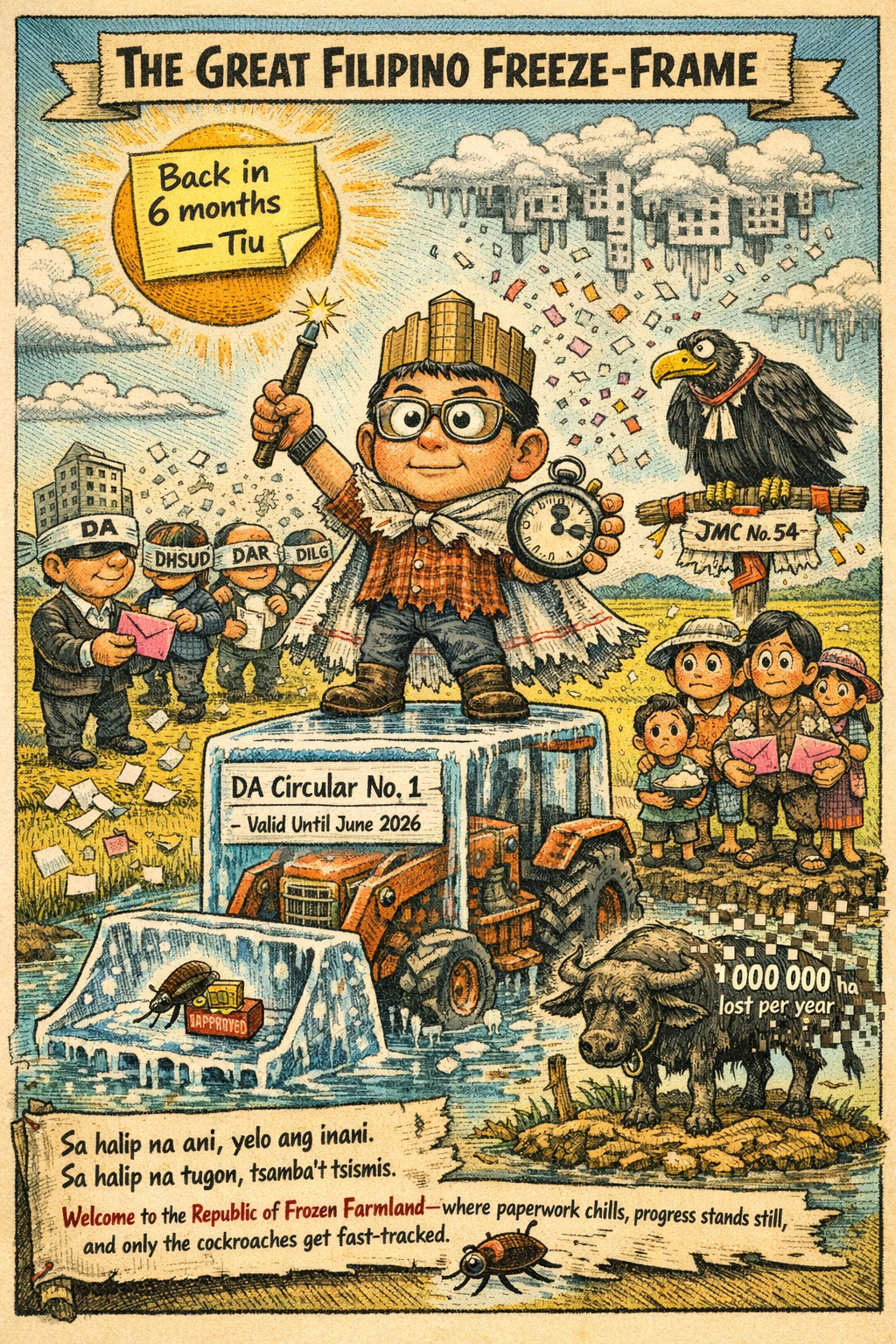
Six Months of Blessed Inaction: Because the Fastest Way to Save Farmland Is to Let Applications Rot in a Drawer
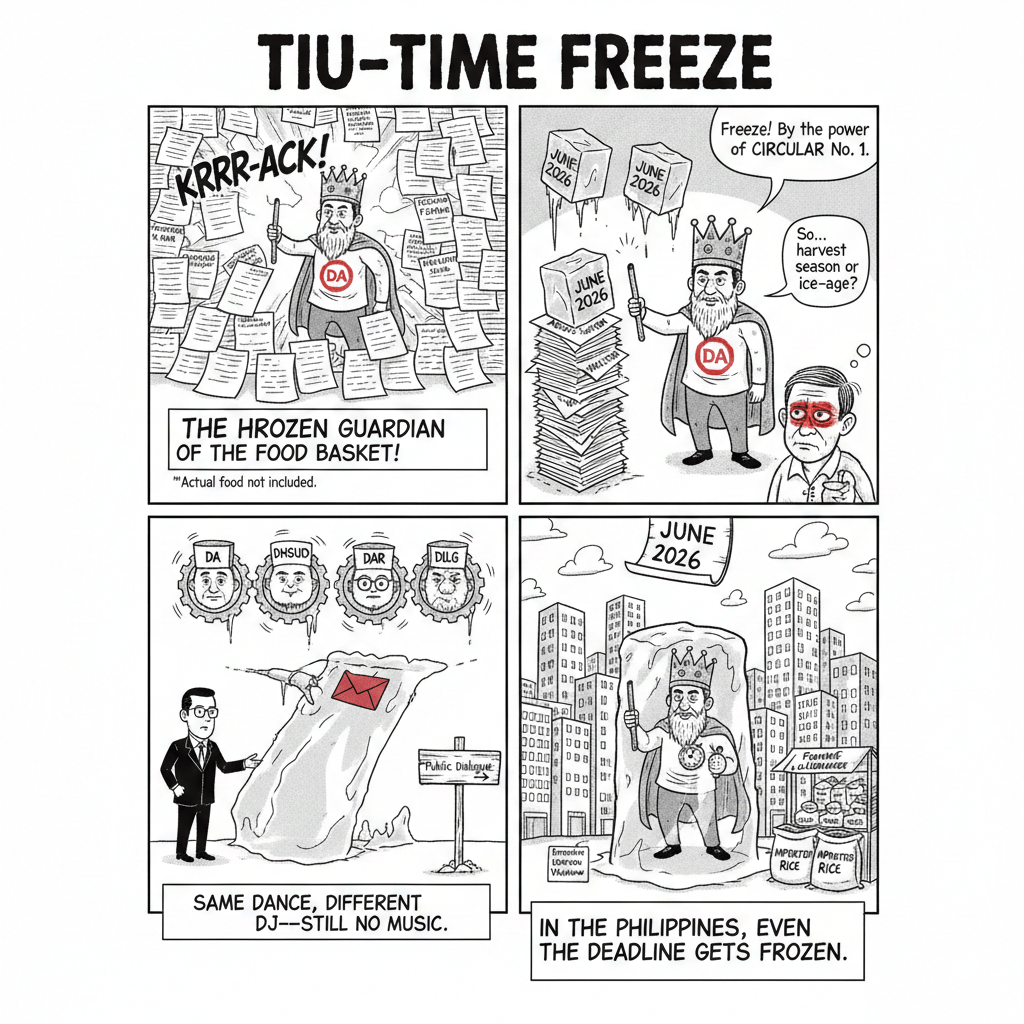
YESSS….., the valiant Agriculture Secretary Francisco P. Tiu Laurel Jr. rides in on his white steed—or perhaps a rusty tractor—brandishing Department Circular No. 1 like a magic wand to “protect” our nation’s farmlands. In a move that reeks of either desperate heroism or comical overreach, Tiu Laurel has slapped a moratorium on new agricultural land reclassification applications until June 2026, all while his bureaucratic brethren at the Department of Human Settlements and Urban Development (DHSUD) prance around in “community dialogues” like they’re hosting a neighborhood potluck. Is this the bold stroke that saves our rice bowls from the insatiable maw of urban sprawl, or just another episode in the Philippine government’s tragicomedy of knee-jerk edicts that fix nothing and frustrate everyone? Spoiler: It’s the latter, a clownish decree that freezes progress while thawing out opportunities for selective favoritism. Buckle up, dear readers; we’re about to dissect this farce with the precision of a constitutional scalpel and the glee of a satirist spotting hypocrisy.
Deconstructing the “Official Story”
Let’s start with the sanitized fairy tale peddled in the Daily Tribune’s January 25, 2026, report: Tiu Laurel, in a fit of paternalistic wisdom, issues a circular freezing all new applications for Land Use Reclassification Certification, ostensibly to shield our shrinking farmlands from the bulldozers of urban expansion and infrastructure mania.
The rationale? A noble quest to “revisit and review” policies, bolster Department of Agriculture (DA) oversight, and safeguard food security amid warnings that we’re hemorrhaging productive land for rice and corn, risking import dependency and vulnerability to global price whims. Existing applications get a hall pass to proceed, but appeals? Frozen like a bad batch of halo-halo. Meanwhile, in a bizarre parallel universe, the DHSUD is intensifying “town hall meetings” with homeowners’ associations, blathering about compliance and transparency as if chatting up Cavite residents will magically harmonize land-use chaos.
Now, juxtapose this glossy press release with the grim reality: For decades, Philippine farmlands have been gutted like a piñata at a developer’s birthday bash, losing roughly 100,000 hectares annually to unchecked conversions that prioritize condos over crops. Real estate lobbies whisper sweet nothings into local government unit (LGU) ears, while inter-agency coordination—mandated by law—plays out like a dysfunctional family reunion where no one shows up. Mock the “temporary” freeze all you want; it’s like slapping a Post-it note on a sinking ship labeled “We’ll fix this in six months.” This isn’t solving a crisis; it’s performative theater, ignoring the chronic failures that have turned our agrarian reform into a punchline. How quaint that Tiu Laurel’s “precautionary stance” aligns with lawmakers’ bills for tougher limits, yet does zilch to address the root rot of bureaucratic silos and corruption-prone approvals.
Legal & Constitutional Evisceration
Oh, the ultra vires theater! Tiu Laurel’s circular struts onto the stage as a purported exercise of administrative discretion, but let’s forensic it: Is this lawful stewardship or a naked power grab that stomps all over the Local Government Code (Republic Act No. 7160)? Section 20 of Republic Act No. 7160 explicitly empowers LGUs to reclassify agricultural lands via sanggunian resolutions, balancing local needs with national plans.
Yet here comes the DA, unilaterally freezing the certification process that’s integral to those reclassifications, without a whisper of statutory amendment or legislative nod. This smacks of overreach, conflicting with the multi-agency dance required by Joint Memorandum Circular 54 (1993), which demands coordination among DA, Department of Agrarian Reform (DAR), Department of the Interior and Local Government (DILG), and DHSUD (née Housing and Land Use Regulatory Board). Tiu Laurel’s edict? It’s like the DA declaring itself the solo choreographer, sidelining everyone else in a bureaucratic ballet of one.
Then there’s the due process farce: Freezing appeals and new applications could amount to regulatory takings, depriving landowners of economically viable uses without compensation or hearing— a blatant violation of Article III, Section 1 of the 1987 Philippine Constitution, which guarantees no deprivation of property without due process.
Echoing Supreme Court doctrines like in Fortich v. Corona (G.R. No. 131457, 1998), where executive discretion was upheld but only with strict compliance to the Comprehensive Agrarian Reform Law (CARL) (Republic Act No. 6657), this moratorium risks being struck down as arbitrary if it permanently chills legitimate conversions. And Milestone Farms, Inc. v. Office of the President (G.R. No. 182332, 2010) reinforces that exemptions must be scrutinized for food security impacts, but a blanket freeze? That’s not scrutiny; that’s shutdown.
Finally, the coordination charade: While DA freezes farmland fates, DHSUD is out there “intensifying dialogues” on HOA compliance, as if grassroots chit-chat will mend the rift. This is the government’s left hand suing its right—emblematic of the absent multi-agency harmony JMC 54 mandates. It’s a savage indictment of siloed fiefdoms: DA plays protector, DHSUD plays counselor, and the farmland? Left to wither in the crossfire. How utterly Philippine.
Motive Analysis: Beyond the Press Release
Peel back the onion of Tiu Laurel’s motives, and you’ll cry tears of cynicism. The saintly angle: A genuine, if ham-fisted, bid to save our food basket from urbanization’s jaws, rooted in dire warnings of farmland loss and import woes. Evidence? His track record of audits on farm-to-market roads and anti-corruption posturing suggests a reformist bent. But weigh it: In a nation where policy flip-flops like a politician’s promises, this feels more clumsy than canonized.
The political: Pure performative stunt to woo farmer blocs, distract from admin fiascos like rice quality scandals, or rack up credits ahead of legislative tweaks to Republic Act No. 7160. Cynical but evidence-based—timing aligns with 2026 budget talks and Marcos Jr.’s farmer-friendly optics. The Machiavellian: A sly backlog-builder, priming selective exemptions for cronies post-freeze, echoing historical “ghost conversions” tied to dynasties. No smoking gun yet, but the freeze’s favoritism toward pre-existing apps screams opportunity for quid pro quo.
The bureaucratic: A raw power claw-back, centralizing DA authority from LGUs and rivals like DAR, under the guise of oversight reform. Weighing evidence, the political and bureaucratic motives dominate—genuine concern is there, but laced with opportunism, as Tiu Laurel’s businessman past whispers economic self-preservation.
Prosecution & Accountability Pathways: A Field Guide
Time to arm the pitchforks with procedure. Civil/administrative: Aggrieved landowners or devs can file a petition for certiorari under Rule 65, alleging grave abuse of discretion—arguing the freeze exceeds DA’s mandate and flouts Republic Act No. 7160. The Ombudsman could probe for conduct prejudicial to service if procedural shortcuts surface, per Republic Act No. 6770.
Criminal long shot: Graft under Republic Act No. 3019 requires bribes or personal gain to lift freezes selectively—no current facts suffice, but if evidence of favoritism emerges (e.g., fast-tracks for allies), it materializes. Anti-Red Tape Act violations? Possible if the freeze arbitrarily delays without cause. But sans scandal, this stays theoretical—though speculate: A leaked exemption list could flip it real fast.
The Cast of Characters & Their Options
Tiu Laurel’s playbook: Double down with “clarificatory” memos carving exemptions for pet projects, or blame Congress for inaction while issuing interim rules. Escape hatches include stakeholder “consults” to diffuse heat or an early lift post-review.
LGUs and developers: Sue via certiorari, lobby for legislative overrides, or hunker down, betting the freeze crumbles under economic pressure.
Farmers and advocates: Is this a win? Superficially yes, stalling conversions, but it’s a placebo if no systemic teeth follow—mobilize for real reforms or watch it evaporate like morning dew on a rice field.
Resolutions & Recommendations: No More Blathering
Enough critique; let’s prescribe scalpel-sharp fixes.
- Immediate: Demand transparency—publish all pending apps, review criteria, and timelines, lest the freeze become a black box for backroom deals.
- Legislative: Amend CARL (Republic Act No. 6657) or the Local Government Code (Republic Act No. 7160) to end circular chaos, banning conversions on irrigated lands outright.
- Systemic: Forge a unified land-use authority—DA, DAR, DHSUD, Department of Environment and Natural Resources—with tech dashboards for public scrutiny, not the current patchwork of fiefdoms.
- Political: Congressional hearings? Skip the grandstanding; legislate a sustainable national land-use policy with teeth, not photo ops.
The Final Broadside
Tiu Laurel’s moratorium is but a footnote in the grand, tragicomic saga of Philippine governance: haphazard edicts from uncoordinated agencies, reactionary spasms ignoring strategic foresight until the rice runs out. We’ve danced this waltz before—agrarian dreams deferred by developer dollars, food security sacrificed on the altar of “progress.” It’s not just absurd; it’s existential. Demand genuine accountability, intelligent planning, and a land policy that treats our soil as sacred, not saleable. Because if we don’t, the next freeze won’t be on applications—it’ll be on our nation’s survival, buried under concrete condos while we import our dignity. Wake up, Philippines; the paddy is calling.
Key Citations
A. Legal & Official Sources
- The Local Government Code of 1991. Republic Act No. 7160, Official Gazette of the Republic of the Philippines, 10 Oct. 1991.
- Comprehensive Agrarian Reform Law of 1988. Republic Act No. 6657, Official Gazette of the Republic of the Philippines, 10 June 1988.
- Anti-Graft and Corrupt Practices Act. Republic Act No. 3019, Official Gazette of the Republic of the Philippines, 17 Aug. 1960.
- The Ombudsman Act of 1989. Republic Act No. 6770, Official Gazette of the Republic of the Philippines, 17 Nov. 1989.
- Joint Memorandum Circular No. 54. Office of the President of the Philippines, 8 June 1993, LawPhil Project.
- The 1987 Constitution of the Republic of the Philippines. Official Gazette of the Republic of the Philippines.
- Fortich v. Corona. G.R. No. 131457, Supreme Court of the Philippines, 24 Nov. 1998, LawPhil Project.
- Milestone Farms, Inc. v. Office of the President. G.R. No. 182332, Supreme Court of the Philippines, 23 Feb. 2011, LawPhil Project.
B. News Reports
- Romero, Maria Bernadette and Magsaysay, Toby. “Freeze on Farmland Conversion, Community Dialogues Intensify.” Daily Tribune, 25 Jan. 2026.

- “Forthwith” to Farce: How the Senate is Killing Impeachment—And Why Enrile’s Right (Even If You Can’t Trust Him)
- “HINDI AKO NAG-RESIGN!”

- “I’m calling you from my new Globe SIM. Send load!”

- “Mahiya Naman Kayo!” Marcos’ Anti-Corruption Vow Faces a Flood of Doubt

- “Meow, I’m calling you from my new Globe SIM!”

- “No Special Jail for Crooks!” Boying Remulla Slams VIP Perks for Flood Scammers

- “PLUNDER IS OVERRATED”? TRY AGAIN — IT’S A CALCULATED KILL SHOT

- “Several Lifetimes,” Said Fajardo — Translation: “I’m Not Spending Even One More Day on This Circus”

- “Shimenet”: The Term That Broke the Internet and the Budget

- “We Did Not Yield”: Marcos’s Stand and the Soul of Filipino Sovereignty

- “We Gather Light to Scatter”: A Tribute to Edgardo Bautista Espiritu

- $150M for Kaufman to Spin a Sinking Narrative




 KWEBA ni BAROK
Leave a comment