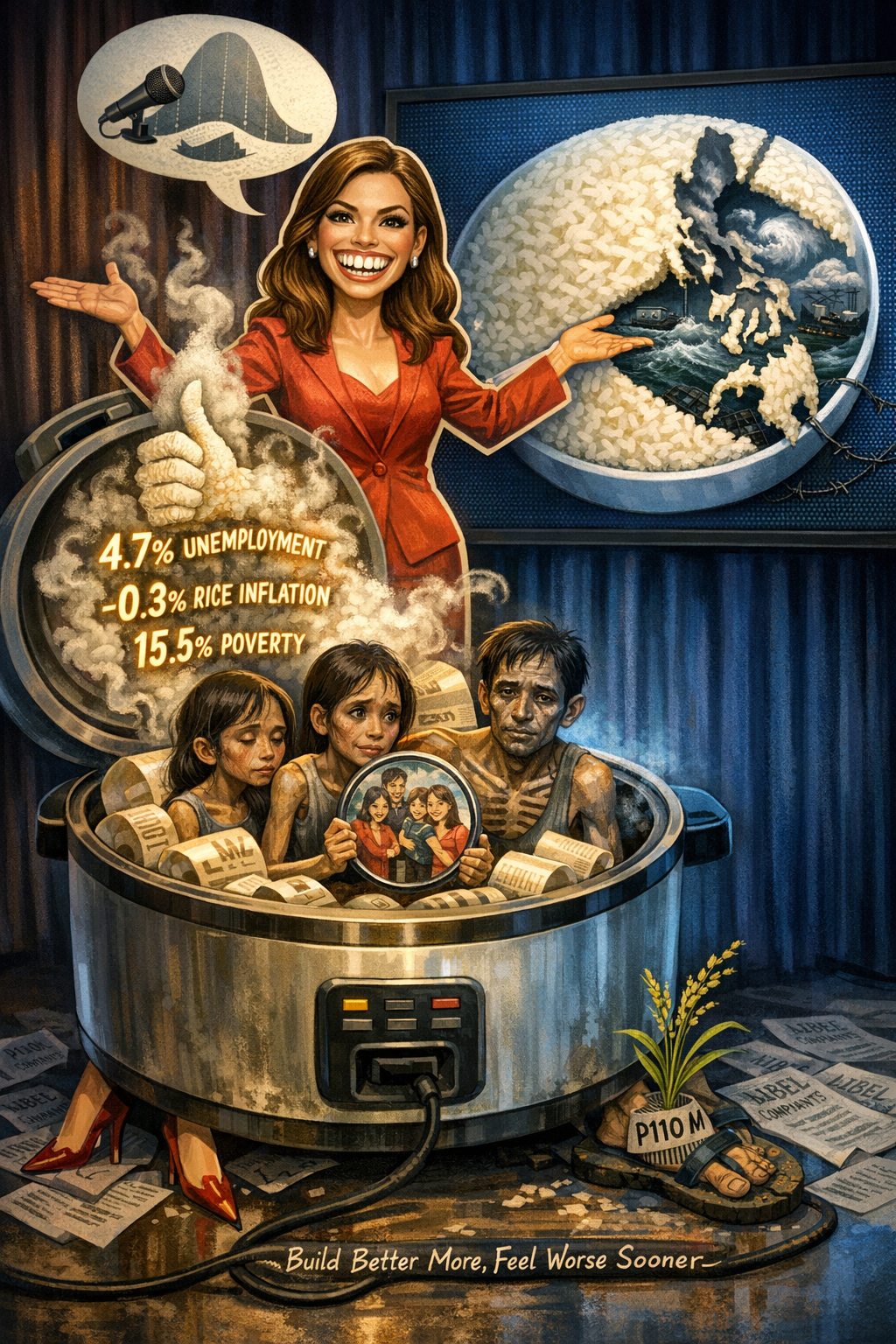
Build Better More, Feel Worse Sooner: The Marcos Miracle Nobody in the Barangay Can Afford
By Louis ‘Barok‘ C. Biraogo — January 28, 2026
WHEN Palace Press Officer Claire Castro steps to the podium, the numbers arrive like clockwork: unemployment at 4.7% in 2025, down from the pandemic’s brutal 10.3% in 2020; underemployment eased to 13.6%; 2.4 million fewer Filipinos in poverty between 2021 and 2023. The message is unmistakable—recovery is not just underway; it is triumphant, exceeding targets, proof of stewardship under President Ferdinand Marcos Jr. Gov’t exceeds 2025 targets on job creation, poverty reduction – Palace.
Yet the same briefing that celebrates these gains quietly notes a counter-current: self-rated hunger rose to 16% in the fourth quarter of 2025, up from 11% the quarter before. While families reported feeling less poor—37% no longer considered themselves poor, a 17-point plunge in a single quarter, the sharpest on record—more reported going hungry. Number of Filipinos who see themselves as poor decreases – survey. This is the hunger paradox at the heart of the official narrative: statistical improvement collides with lived experience. Rice prices dipped into negative inflation for the poorest households in late 2025, offering temporary relief and shifting perceptions. But typhoons disrupted supply chains, turning statistical “victory” into episodic want. The numbers are not false; they are incomplete. They count what is easy to measure while the body keeps its own ledger.
Castro herself is no neutral messenger. A lawyer and former broadcaster, she has earned praise from supporters for her combative clarity—finally, a Palace voice with “spine,” willing to confront disinformation head-on. Yet critics see an attack dog: aggressive, polarizing, quick to personal invective. A resurfaced 2015 detention for an alleged outburst, a fresh P110-million libel suit from Rep. Leandro Leviste over accusations tied to his solar business—these are not mere footnotes. They raise the question: is she defending policy or shielding power? Her credibility hinges not on the accuracy of the figures she recites, but on whether the public believes the frame she builds around them is honest or engineered.
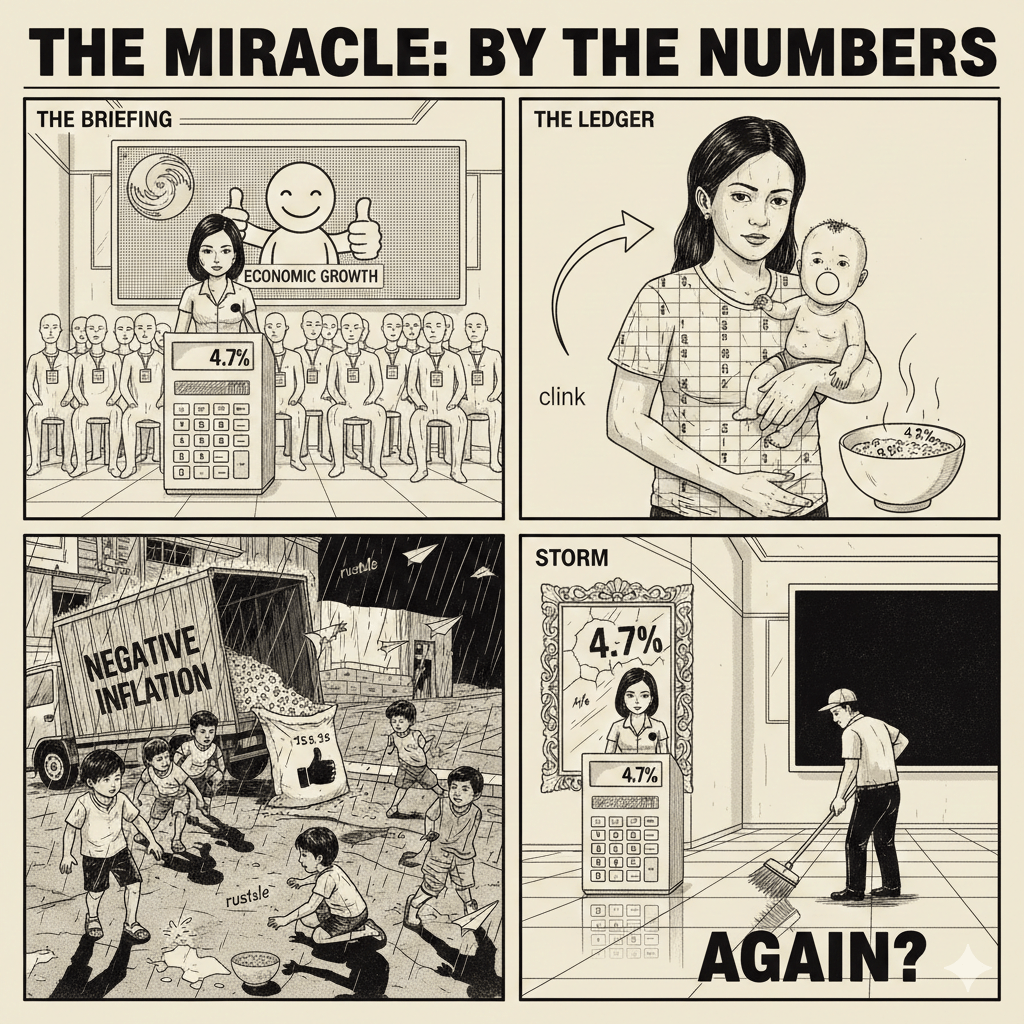
The Arc of Recovery, or Illusion? (2020–2025)
The trajectory looks linear on paper:
- 2020: Unemployment spikes to 10.3% amid lockdowns; poverty swells.
- 2021: 7.8% unemployment, official poverty at 18.1% (19.9 million poor)—still elevated.
- 2022: 5.4% unemployment; poverty holds at 18.1% as “revenge spending” and reopening fuel rebound.
- 2023: 4.3% unemployment, poverty falls to 15.5%—infrastructure spending begins to bite. Philippines poverty rate at 15.5% in 2023, statistics agency says.
- 2024: Unemployment ~4.0%, yet self-rated poverty lingers 45–50%, squeezed by food inflation.
- 2025: Official unemployment 4.7% (some monthly volatility), self-rated poverty plunges to 37% in Q4.
The drop is real, but the drivers are revealing. Early gains (2021–2022) owe more to global reopening and pent-up consumption than to any uniquely Marcos-era policy. The 2023 acceleration coincides with Build Better More projects absorbing labor. By 2025, targeted rice-price interventions create negative inflation for the bottom tiers, delivering the sharpest self-rated improvement ever recorded. Yet official poverty data lag—still anchored in 2023’s 15.5%—while perceptions swing dramatically on short-term price relief.
The dissonance is not accidental. Official metrics from the Philippine Statistics Authority (PSA) use income thresholds that can miss cost-of-living shocks; self-rated surveys capture sentiment that shifts faster than structural change. When rice becomes cheaper, families feel less poor—even if jobs remain precarious and hunger creeps back after the next storm.
The Anatomy of a Scandal (Beyond the Numbers)
The scandal is not one fabricated statistic; it is the systematic elevation of good-news spin into governance. Every press briefing becomes a campaign ad, every data point a shield against scrutiny. When recovery is framed as proof of transformative leadership, inconvenient truths—persistent inequality, climate vulnerability, corruption in procurement—become mere “external forces” to be managed, not root causes to be dismantled.
This institutionalization of optimism erodes trust. Citizens are left to reconcile headlines of triumph with empty plates after typhoons. The result is cynicism: statistics become just another political currency, devalued by overuse. Criticism is preempted; dissent is cast as disloyalty to progress. Meanwhile, systemic corruption—kickbacks in infrastructure, favoritism in contracts—hides behind the glow of aggregate improvement. The performance sustains power, but at the cost of the very accountability that real reform demands.
The Fork in the Road (Forecast & Recommendations)
If the current playbook holds—continued infrastructure rollout, sustained rice subsidies, selective social protection—the government may reach its 9% poverty target by 2028. Growth stays in the 5.5–6% range; unemployment hovers low. But the path is brittle. Rice-price controls are politically potent but fiscally fragile; infrastructure delivers jobs but often widens regional gaps; dole-outs buy time, not transformation.
Credit where due: post-pandemic job recovery is verifiable, poverty incidence has declined measurably since 2021, and targeted interventions have produced tangible relief for millions. Yet these gains are fragile and uneven—concentrated in urban services, leaving rural and informal sectors exposed. What is neglected is structural: genuine land reform, anti-corruption enforcement, climate-resilient agriculture, progressive taxation that funds universal health and education rather than patronage.
Doubling down on the present course risks a pre-election mirage: numbers polished for 2028, reality unchanged for the poorest.
A Call for Real Service
We must demand more than press releases. Genuine governance fights corruption with prosecutions, not denials. It pursues equitable growth through transparent procurement, decentralized development, and accountability that reaches the barangay level. It measures success not only by GDP or survey swings, but by whether a fisherman in Mindanao or a vendor in Tondo can feed their children without dread of the next storm or price spike.
Unity is not behind any single brand or administration; it is against poverty, hunger, and the cynicism that says nothing can change. Citizens, journalists, civil society—demand open data, independent audits, and prosecutions where theft is proven. Insist on reforms that build resilience, not dependence.
The statistics may seduce, but the people remember. Let us build a Republic that serves them, not its own perpetuity.
Yours in relentless disgust at the numbers they feed us while the people still go to bed hungry,
— Barok
(Still watching, still writing, still unimpressed)
Key Citations
- Cabato, Luisa. “Gov’t Exceeds 2025 Targets on Job Creation, Poverty Reduction – Palace.” Inquirer.net, 27 Jan. 2026.
- Cabato, Luisa. “Number of Filipinos Who See Themselves as Poor Decreases – Survey.” Inquirer.net, 20 Jan. 2026.
- Cabato, Luisa. “Palace’s Castro Says Leviste Libel Complaint Meant to Silence Her.” Inquirer.net, 16 Jan. 2026.
- “Philippines Poverty Rate at 15.5% in 2023, Statistics Agency Says.” Reuters, 15 Aug. 2024.
- “Build Better More.” Wikipedia, Wikimedia Foundation, accessed 28 Jan. 2026.
- “Philippine Statistics Authority.” PSA, accessed 28 Jan. 2026.

- “Forthwith” to Farce: How the Senate is Killing Impeachment—And Why Enrile’s Right (Even If You Can’t Trust Him)
- “HINDI AKO NAG-RESIGN!”

- “I’m calling you from my new Globe SIM. Send load!”

- “Mahiya Naman Kayo!” Marcos’ Anti-Corruption Vow Faces a Flood of Doubt

- “Meow, I’m calling you from my new Globe SIM!”

- “No Special Jail for Crooks!” Boying Remulla Slams VIP Perks for Flood Scammers

- “PLUNDER IS OVERRATED”? TRY AGAIN — IT’S A CALCULATED KILL SHOT

- “Several Lifetimes,” Said Fajardo — Translation: “I’m Not Spending Even One More Day on This Circus”

- “Shimenet”: The Term That Broke the Internet and the Budget

- “We Did Not Yield”: Marcos’s Stand and the Soul of Filipino Sovereignty

- “We Gather Light to Scatter”: A Tribute to Edgardo Bautista Espiritu

- $150M for Kaufman to Spin a Sinking Narrative




 KWEBA ni BAROK
Leave a comment