Dreaming of Excellence, Waking to Scandals: Corruption, Diploma Mills, and the Equity Snooze-Fest
By Louis ‘Barok‘ C. Biraogo — January 29, 2026
MGA ka-kweba, let us not mince words today. The Second Congressional Commission on Education (EDCOM 2) final report is not a polite suggestion. It is a death certificate for three decades of higher education policy in this country.
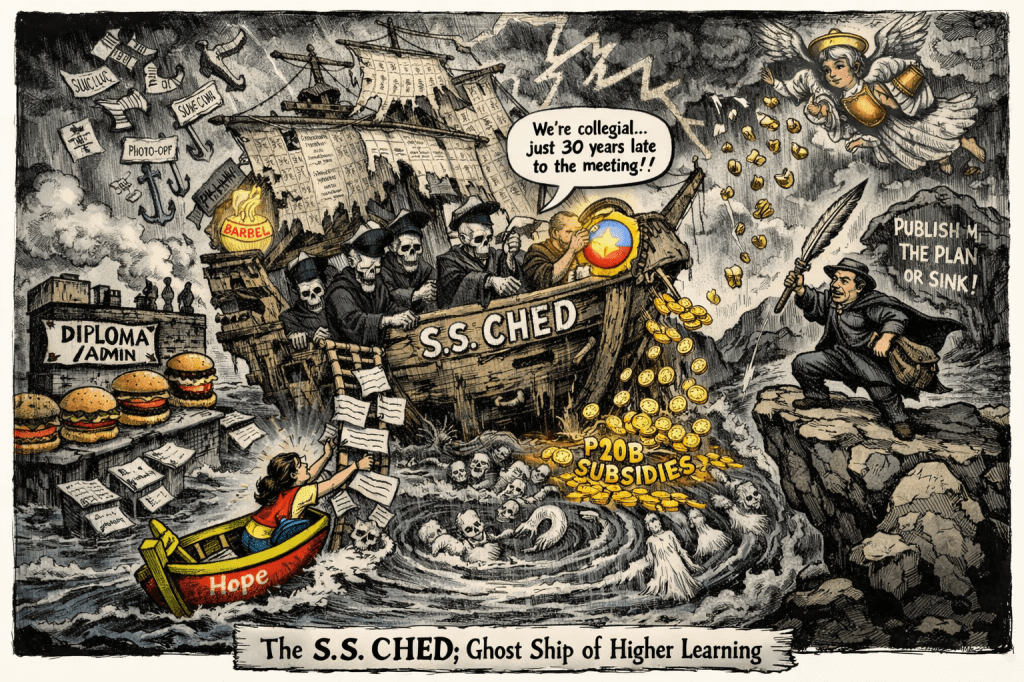
The corpse at the center of the morgue is the Commission on Higher Education (CHED)—an agency created to steer us toward excellence but which has instead become a bureaucratic ghost ship, drifting aimlessly while the nation’s future sinks beneath it.
Thirty years. One hundred sixty-four laws. A budget ballooned by 633%. And what do we have to show for it? No strategic plan. No compass. No captain worth the title. Just a vessel loaded with ever more cargo—scholarships, regulations, mandates—while the crew barely grew and the hull rots from within.
This is not incompetence. This is betrayal.
1. The Autopsy Report (The Facts of Failure)
Let us begin with the cold, hard facts, the way a coroner lays out the body before naming the cause of death.
CHED was born in 1994 through Republic Act No. 7722 with soaring rhetoric: it would provide “strategic direction,” solve “fundamental problems,” and align higher education with national development. Beautiful words. Inspiring, even.
Reality? After three decades and 164 additional laws piling on responsibilities—mostly regulation and scholarships—CHED has never published a comprehensive, updated strategic plan for higher education. Never. Not once.
The EDCOM 2 report calls it plainly: a “long-standing vacuum in clear direction.” Institutions are established reactively, not proactively. Program offerings are decided in isolation. Teacher education and business administration are duplicated to the point of absurdity, flooding the market with graduates nobody needs. Priorities are defined “piecemeal,” without coherence.
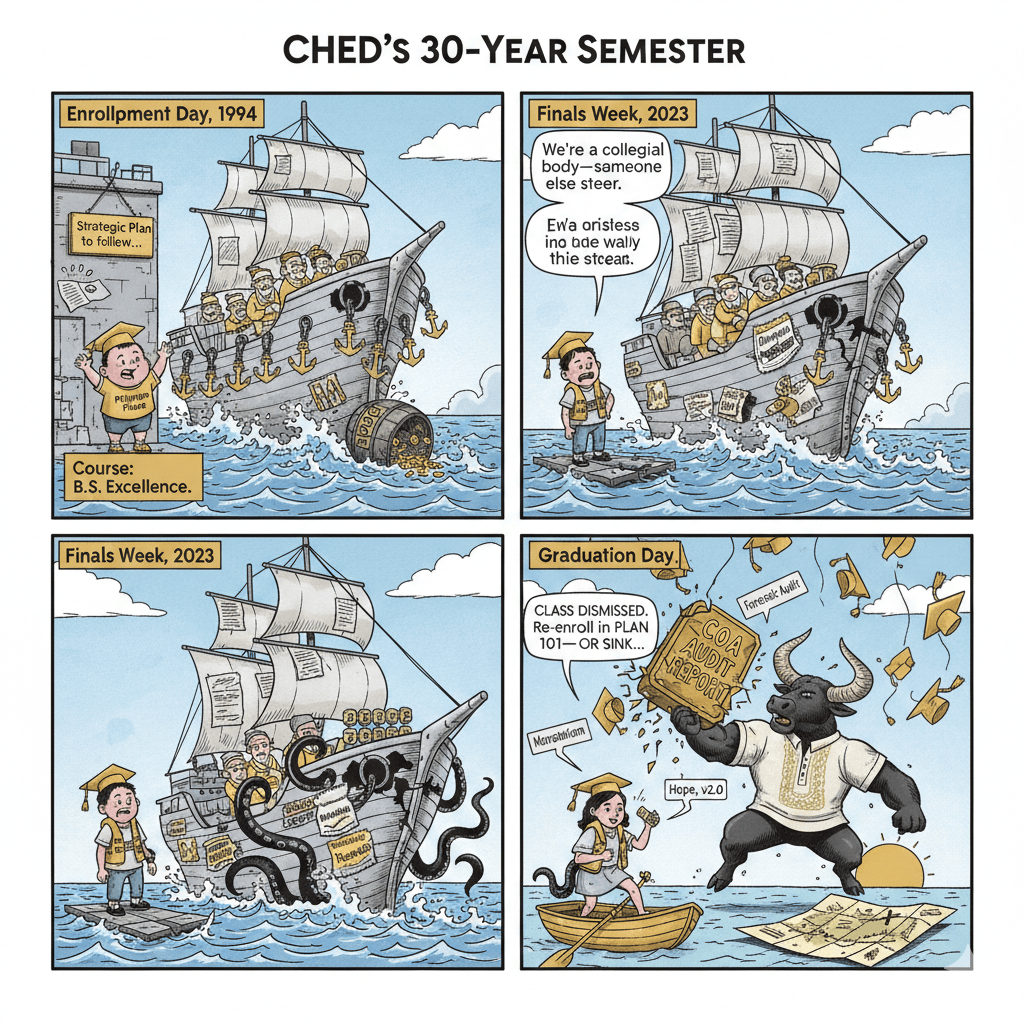
And the ship keeps taking on water. From 2013 to 2023, CHED’s budget exploded by 633%. Staffing? A pathetic 22.7% increase. Congratulations, CHED—you have mastered the strategic art of reactionary drift while the ecosystem you were meant to guide navigates blind.
Picture a ship built for exploration, handed a vague old map in 1994, then loaded with endless new cargo by politicians who never asked whether the vessel could still float. No new map. No reinforced hull. Just more weight. That is CHED. A ghost ship, sails torn, rudder broken, crew asleep at the wheel.
2. The Anatomy of a Scandal (Beyond Incompetence)
The strategic vacuum is not merely administrative failure. It is fertile soil for rot.
The Corruption Syllabus
Where there is no public purpose, private greed rushes in to fill the void. The Commission on Audit (COA) flagged P20 billion in unliquidated subsidy funds. Kickback scandals stretch back years. Ghost scholars. Crony contracts. When the agency’s energy is spent evading accountability rather than building strategy, graft becomes the only curriculum that is rigorously taught.
The Diploma Mill Industrial Complex
Program duplication is not an accident; it is a business model. Saturated fields churn out degrees like fast-food franchises churn out burgers—cheap, uniform, and ultimately unsatisfying. Regulatory abdication allows substandard institutions to proliferate, selling credentials instead of education. Who benefits? Owners who pocket tuition. Politicians who ribbon-cut new campuses for votes. Certainly not the students who graduate with paper that employers laugh at.
The Equity Lie
We are told higher education is now more “accessible.” Public enrollment has risen dramatically under the Universal Access to Quality Tertiary Education Act. Bravo. Yet dues under the Unified Student Financial Assistance System for Tertiary Education (UniFAST) go unpaid for years. Students in the Bangsamoro Autonomous Region in Muslim Mindanao (BARMM) are effectively excluded from national programs. The public-private balance tilts without strategy, crowding out private institutions while public ones strain under sudden growth and persistent underfunding. This is not equity. This is a passive-aggressive policy that widens regional divides and pretends the problem is solved because more warm bodies sit in lecture halls.
3. The Carnival of Culprits
No one escapes blame in this circus of incompetence. Everyone has a tent.
CHED Leadership
A “collegial body” that never grew up. Existentially fraudulent, managing scholarships and compliance checklists while the entire system burns. Operational myopia elevated to doctrine. They issue memos, hold ceremonies, and call it leadership. They are not incompetent—they are absent.
The Political Class
Ah, the lawmakers. The arsonists who keep complaining about the fire. One hundred sixty-four laws, most of them uncoordinated political trophies—new State Universities and Colleges (SUCs), new Local Universities and Colleges (LUCs), new mandates dropped like confetti. Every congressman wants a state college in his district for reelection photo-ops. National planning? A joke. They have turned higher education into a pork barrel sideshow.
The Broader Ecosystem
Private higher education institutions (HEIs) profiteering from the chaos—happy to enroll anyone with tuition money, quality be damned. Accrediting bodies that rubber-stamp mediocrity. Academics more obsessed with administrative titles than actual teaching or research. This is not an ecosystem. This is a swamp of enablers, each feeding off the others while the water rises.
4. The Philippine Paradox (The Ultimate Critique)
This is where the scandal becomes tragedy.
Think of a bright girl from Tawi-Tawi—top of her class, CHED scholarship finally in hand. She enrolls in a “business administration” program that is little more than glorified PowerPoint tutorials and group reports copied from the internet. Four years later she graduates, diploma framed, and discovers the economy has no use for her skills. She ends up in a call center, or worse, unemployed. Multiply her story by hundreds of thousands.
We are a nation obsessed with diplomas, yet we produce graduates our own industries cannot absorb. Ninety-one percent learning poverty at the base, skills mismatch at the top, and a development trajectory stalled in the middle. The Philippines is not failing despite its education system. It is failing because of it.
This is our national performance art of self-sabotage: spend billions, build campuses, hand out degrees, and then wonder why we remain a nation of overseas workers instead of innovators. What does it say about our priorities when the commission tasked with higher thought cannot even do basic planning?
5. The Fork in the Road (Resolutions & Recommendations)
We stand at a fork. One path is familiar. The other demands courage.
Path 1: The Farce Continues
Minor tweaks. Another committee. A new “roadmap” that gathers dust. Politicians promise reform during campaigns, then business as usual. CHED limps along, eventually dissolved into irrelevance or reverted to a bureau. The ghost ship keeps drifting until it finally sinks, taking another generation with it.
Path 2: The Radical Reformation
This is the only moral option left. Not cosmetic change—constitutional reckoning.
Immediate demands:
- A full forensic audit of all CHED funds, no sacred cows.
- A moratorium on new programs and institutions in saturated fields.
- Publication—finally—of a genuine National Higher Education Strategic Plan, co-created with industry, labor, and civil society.
Structural reforms:
- Amend RA 7722 to give CHED real authority and real accountability—quasi-judicial powers, performance-based funding, independence from political cycles.
- Create a permanent, independent Education Oversight Council with teeth, transcending administrations and congressional whims.
Philosophical pivot:
We stop educating for diplomas and start educating for dignity and development. Tie every peso of public funding to measurable outcomes: employability, research impact, equity across regions. Reward excellence. Punish mediocrity. No more sacred cows, no more political trophies.
Mga kababayan, this is not just about CHED. This is about whether we still believe the Filipino is capable of greatness—or whether we are content to remain a nation that betrays its own children.
The EDCOM 2 report has handed us the indictment. Now we must deliver the verdict.
The old era dies here. Let a new one—rooted in genuine public service, pro-people governance, and unapologetic excellence—be born.
Because if we fail this generation again, history will not forgive us.
And neither will I.
The diplomas are fake, the excuses are tired, and the patience of the Filipino people is running on fumes.
Mark my words: the cave is just getting started.
— Barok
Key Citations
- EDCOM 2. “Turning Point: A Decade of Necessary Reform.” EDCOM 2, Jan. 2026.
- Republic Act No. 7722: Higher Education Act of 1994. 18 May 1994. Official Gazette of the Republic of the Philippines.
- “Republic Act No. 10931.” Official Gazette of the Republic of the Philippines, 3 Aug. 2017.
- Marcelo, Elizabeth. “COA flags CHED’s P20 billion unliquidated education subsidy grants.” The Philippine Star, 6 Jan. 2026.
- Enano, Jhesset O. “Years after creation, CHEd lacks strategic direction – Edcom final report.” Inquirer.net, Philippine Daily Inquirer.
- “Forthwith” to Farce: How the Senate is Killing Impeachment—And Why Enrile’s Right (Even If You Can’t Trust Him)
- “HINDI AKO NAG-RESIGN!”

- “I’m calling you from my new Globe SIM. Send load!”

- “Mahiya Naman Kayo!” Marcos’ Anti-Corruption Vow Faces a Flood of Doubt

- “Meow, I’m calling you from my new Globe SIM!”

- “No Special Jail for Crooks!” Boying Remulla Slams VIP Perks for Flood Scammers

- “PLUNDER IS OVERRATED”? TRY AGAIN — IT’S A CALCULATED KILL SHOT

- “Several Lifetimes,” Said Fajardo — Translation: “I’m Not Spending Even One More Day on This Circus”

- “Shimenet”: The Term That Broke the Internet and the Budget
- “We Did Not Yield”: Marcos’s Stand and the Soul of Filipino Sovereignty

- “We Gather Light to Scatter”: A Tribute to Edgardo Bautista Espiritu

- $150M for Kaufman to Spin a Sinking Narrative


 KWEBA ni BAROK
Leave a comment