
Medical Leave or Masterclass in Evasion? Co Turns Europe into His Personal Safe House
By Louis ‘Barok‘ C. Biraogo — January 30, 2026
MGA ka-kweba, gather ’round the flickering screen of cynicism. It’s your favorite subterranean scribe, Barok, here to drag another Philippine political farce into the harsh light of day. Today, we dissect the Zaldy Co saga—not as a bedtime story for the naive, but as a grotesque carnival of corruption, where former House Appropriations Committee chair Elizaldy “Zaldy” Co, the Stockholm Syndicate Signatory, pops up like a whack-a-mole in Sweden, only to mock the government’s bumbling Portugal fantasies.
Drawing from the GMA News exclusive on his Supreme Court (SC) petition and the trove of my legal research on this flood control fiasco, we’ll eviscerate this spectacle as a masterclass in elite impunity. Buckle up; this isn’t journalism—it’s a scalpel to the bloated belly of systemic rot.
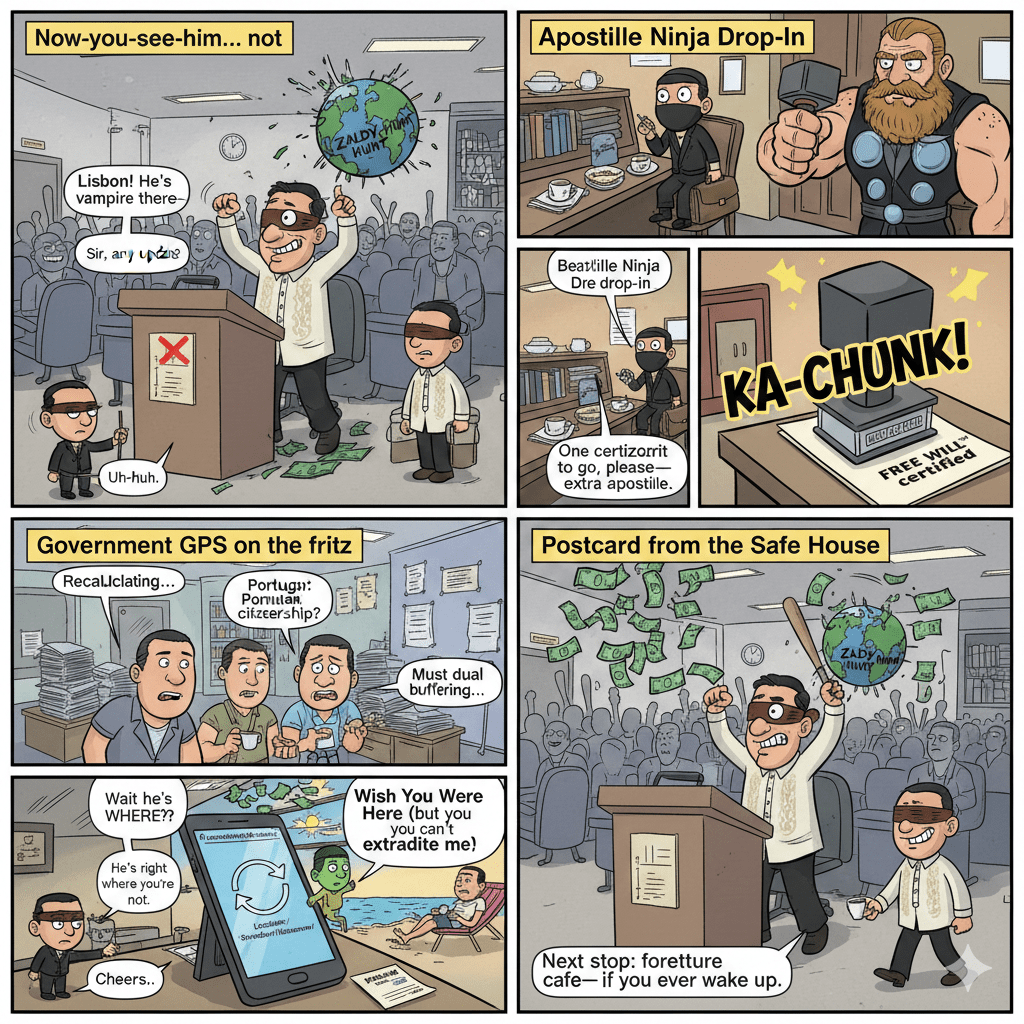
The Fugitive’s Paper Trail: From Lisbon Phantom to Swedish Notary Ninja
Picture this: The government, with all the grace of a blindfolded piñata swinger, declares on January 22, 2026, via Interior Secretary Jonvic Remulla, that Co is holed up in a posh Lisbon enclave, never venturing out—like some Iberian vampire afraid of sunlight. But lo and behold, just days earlier on January 15, Co materializes before notary Beatrice Gustaffson in Nacka, Stockholm, Sweden, signing his SC certiorari petition with the flair of a man who knows extradition treaties are as enforceable as New Year’s resolutions.
An apostille—that fancy Department of Foreign Affairs (DFA)-defined certificate authenticating public documents under the Hague Apostille Convention—seals the deal, verifying Co’s identity and “free will” signature. Free will? In a country with no extradition treaty with the Philippines? How convenient.
This isn’t a mere “location update,” mga ka-kweba. It’s a deliberate legal taunt, a paper trail engineered to expose the government’s tracking as the joke it is. Co’s team, led by the ever-evasive Attorney Ruy Rondain, isn’t just filing paperwork; they’re flipping the bird to the DFA, Department of the Interior and Local Government (DILG), and National Bureau of Investigation (NBI)’s discordant symphony of leaks and contradictions.
What does this reveal? Co’s confidence reeks of a man with deep pockets and deeper connections—perhaps that rumored Portuguese passport acquired years ago, turning Europe into his personal shield. His lawyers’ playbook? Delay, deflect, and dazzle with procedural prestidigitation, making his documents admissible in Philippine courts while he sips espresso far from the Sandiganbayan’s grasp.
And the government’s incompetence? It’s not just failing to pin down one man; it’s a cat-and-mouse game where the cat is asleep and the mouse is directing the orchestra. Rhetorically, mga ka-kweba: If Elizaldy Co was able to voluntarily appear in person before a Swedish notary public in Stockholm on January 15, 2026, to sign and authenticate documents for his Supreme Court petition, on what basis can he credibly claim that the Ombudsman was unable to effect service of the subpoena or order to file a counter-affidavit? Or is “imminent threats” code for “inconvenient accountability”?
The Legal Chessboard: Due Process as a Smoke Screen, Graft as Grand Theater
On this board, every move is laced with disingenuousness, and Co’s pieces are painted in the hypocritical hues of victimhood. Let’s tear it apart, starting with the Apostille Abscondee’s defenses.
For Co’s Defenses
His petition wails about due process violations under Article III, Section 1 of the 1987 Philippine Constitution—claiming the Ombudsman, Jesus Crispin Remulla, rushed the November 14, 2025, resolution without properly serving orders for a counter-affidavit or granting access to documents. He invokes Ombudsman rules and precedents like Ma. Imelda M. Manotoc v. Court of Appeals (G.R. No. 130974, Aug. 16, 2006), where substituted service requires diligence.
But hold the tears: The same man who couldn’t “receive” a subpoena magically executes a notarized petition in Sweden? It’s laughable. Compare that to his “imminent threats” sob story—leaving on July 19, 2025, for “official medical leave” amid public furor over the P289.5 million Naujan flood control debacle. Who poses the greater threat, Zaldy? An enraged public sick of substandard steel sheet piles causing over P63 million in losses, or the Sandiganbayan enforcing Sections 3(e) and 3(h) of Republic Act No. 3019 (Anti-Graft and Corrupt Practices Act) on unwarranted benefits and conflicts of interest?
This isn’t due process; it’s due evasion, a cynical ploy to void charges on technicalities, echoing People v. Evangelista but twisted into a fugitive’s fairy tale.
Against Co: The Prosecution’s Case
The Ombudsman’s case? It’s built on the rotten core of “beneficial ownership” in Sunwest Construction and Development Corporation, the firm awarded the anomalous project. Charges of graft under Republic Act No. 3019 and malversation via falsification under Articles 217 and 171(4) of the Revised Penal Code (RPC) scream of intent: As Appropriations chair, Co influenced procurement, participated in implementation, and reaped pecuniary interests, resulting in government injury.
Prima facie evidence from Department of Public Works and Highways (DPWH) audits, Independent Commission for Infrastructure (ICI) reports, and whistleblowers like ex-engineers Alcantara and Hernandez paints a picture of overpricing and kickbacks ballooning to P21 billion across projects. Is this strong prosecution or political stagecraft? A bit of both—theater where the script is statutory violations carrying non-bailable penalties over P8.8 million, but directed by a system that lets syndicates thrive.
Yet, under jurisprudence like Trinidad v. Comelec (G.R. No. 164770), intent and benefit must be proven beyond doubt. Mockery aside, the case has teeth: Documentary corroboration and witness testimonies could convict, if not derailed by Co’s procedural parlor tricks.
The RA 1379 Gambit: Why Isn’t the Ombudsman Seizing the Ill-Gotten Empire?
Ah, Republic Act No. 1379—the Anti-Graft and Corrupt Practices Act’s lesser-sung sibling, declaring forfeiture of unlawfully acquired property if “manifestly out of proportion” to a public official’s salary. No, we’re not just listing it; we’re demanding its aggressive deployment as the nuclear option against Co’s alleged P21 billion kickback kingdom.
Contrast that with a congressman’s modest P1 million monthly salary: How does one balloon from party-list rep to infrastructure overlord without dipping into the public trough? The law’s Section 2 presumes illegality for unexplained wealth, extendable to relatives’ holdings per Republic v. Marcos (G.R. No. 152154), and even indirect interests under SC rulings.
Why the reluctance, Ombudsman? Is it the historical underuse of this powerhouse, as critiqued in legal analyses, or fear of elite backlash? Co’s Sunwest links scream for a parallel civil forfeiture suit by the Solicitor General—freeze assets via Anti-Money Laundering Council (AMLC), recover the people’s money even if criminal acquittal slithers through.
This isn’t optional; it’s a pivot to attack systemic rot, where politically connected crooks hoard wealth disproportionate to income. Readers, ask yourselves: If Republic Act No. 1379 can topple Marcos-era ghosts, why spare the Apostille Abscondee? Demand it now, or watch impunity flourish.
The Anatomy of a Strategy: Co’s Multi-Front Farce of Delay and Deflection
Let’s deduce and ridicule it
: Co’s playbook is a symphony of stalling, straight from the fugitive’s handbook.
- Legal: The SC temporary restraining order (TRO) petition? A classic delay tactic and Hail Mary under Rule 65 of the Rules of Court, challenging “grave abuse of discretion” while begging to halt Sandiganbayan cases SB-25-CRM-0039 to 0041. It’s not strategy; it’s desperation wrapped in legalese, praying the High Court ignores flight as guilt per People v. Court of Appeals (G.R. No. 140285).
- Narrative: Painting himself as the persecuted scapegoat, a “poster boy” for others’ sins amid rumors of ties to President Marcos Jr. or House Speaker Romualdez. Muddy the waters with political persecution claims, but Palace denials call it lies to “save his skin.” Satirical gold: The man linked to a “highly organized syndicate” in DPWH per Baguio Mayor Benjamin Magalong now cries victim? Pass the tissues.
- Logistical: Europe’s extradition voids as a shield—no treaties with Portugal or Sweden, plus that rumored passport. Satirize the “medical leave” coinciding with warrants: Is it chemotherapy or chicanery, lounging in exclusive enclaves while Interpol Red Notices gather dust under United Nations Convention Against Corruption (UNCAC)?
- Endgame: Real options? A secret plea deal, rumored dialogues with the Ombudsman for mitigation—though graft limits pleas. Waiting for political winds to shift, perhaps a new administration buries it. Or the ultimate escape: Dying of old age in a Lisbon villa, assets tucked in trusts. What a legacy.
The Systemic Rot: Co as Symptom, Not the Sole Sickness
This isn’t just about the Lisbon Ghost; it’s a prism exposing the corruption ecosystem’s blinding flaws. Eviscerate the “syndicate” rumors: Co’s ties to Dizcayas’ nine firms and DPWH officials like Vince Dizon scream organized plunder in flood projects since 2024. He’s a symptom of the disease—mismanagement, kickbacks, and elite intrigue where House leadership allegedly pulls strings, but unproven whispers let the big fish swim free.
Criticize the government’s dissonance: DFA, DILG, NBI can’t agree on Co’s location—Portugal one day, Sweden the next? Leaks and contradictions betray incompetence, or worse, complicity. Lambast the impunity culture: A figure like Co believes he can manipulate from a European café because the system rewards it.
Article XI, Section 1 of the 1987 Philippine Constitution calls public office a trust, but here it’s a trough. Broader scandals with 18 others charged? No bail, yet the rot festers, fueled by fake news like AI-manipulated videos. Readers, isn’t it exhausting? This is elite theater, where justice is the understudy.
A Call to Arms: Rage, Demand, and Refuse to Forget
Enough with bland hope; let’s channel fury into action. Ombudsman, accelerate the case—file Republic Act No. 1379 forfeiture proceedings immediately, seizing Co’s empire before it vanishes into offshore shadows. DFA and Department of Justice (DOJ), coordinate with Interpol and foreign jurisdictions effectively, not via contradictory press releases that make us a global laughingstock.
Supreme Court, see through the procedural smoke—deny the TRO, affirm the Ombudsman’s authority under Republic Act No. 6770, and remind us that due process isn’t a fugitive’s free pass.
Rally, readers: Unleash public contempt to keep this scandal aflame, not buried by the next cycle of circus. Skeptical of official narratives? Good—demand transparency, whistleblower protections, and reforms to flood procurement. This isn’t just Co’s downfall; it’s our chance to dismantle the rot. Or do we wait for the next Apostille Abscondee? Rise, rage, and reclaim the kweba from the crooks.
- — Barok, still watching from the shadows you thought were safe. Good luck outrunning the truth. It runs faster.
Key Citations
A. Legal & Official Sources
- Anti-Graft and Corrupt Practices Act. Republic Act No. 3019, Official Gazette of the Republic of the Philippines, 17 Aug. 1960.
- Republic Act No. 1379: An Act Declaring Forfeiture in Favor of the State Any Property Found to Have Been Unlawfully Acquired by Any Public Officer or Employee and Providing for the Proceedings Therefor. 18 June 1955. The Lawphil Project, Arellano Law Foundation.
- The Ombudsman Act of 1989. Republic Act No. 6770, Official Gazette of the Republic of the Philippines, 17 Nov. 1989.
- The Revised Penal Code. Act No. 3815, Official Gazette of the Republic of the Philippines, 8 Dec. 1930.
- The Constitution of the Republic of the Philippines. Official Gazette of the Republic of the Philippines, 1987.
- Rules of Court: Rules 1-71, Civil Procedure. 1997. The Lawphil Project, Arellano Law Foundation.
- Ma. Imelda M. Manotoc v. Court of Appeals. G.R. No. 130974, Supreme Court of the Philippines, 16 Aug. 2006, LawPhil Project.
- Trinidad v. Comelec. G.R. No. 164770, Supreme Court of the Philippines.
- Republic v. Marcos. G.R. No. 152154, Supreme Court of the Philippines, 15 July 2003.
- People v. Court of Appeals. G.R. No. 140285, Supreme Court of the Philippines, 27 Sep. 2006, LawPhil Project.
- Marcos v. Sandiganbayan. G.R. No. 126995, Supreme Court of the Philippines, 6 Oct. 1998, LawPhil Project.
B. News Reports
- “Forthwith” to Farce: How the Senate is Killing Impeachment—And Why Enrile’s Right (Even If You Can’t Trust Him)
- “HINDI AKO NAG-RESIGN!”

- “I’m calling you from my new Globe SIM. Send load!”

- “Mahiya Naman Kayo!” Marcos’ Anti-Corruption Vow Faces a Flood of Doubt

- “Meow, I’m calling you from my new Globe SIM!”

- “No Special Jail for Crooks!” Boying Remulla Slams VIP Perks for Flood Scammers

- “PLUNDER IS OVERRATED”? TRY AGAIN — IT’S A CALCULATED KILL SHOT

- “Several Lifetimes,” Said Fajardo — Translation: “I’m Not Spending Even One More Day on This Circus”

- “Shimenet”: The Term That Broke the Internet and the Budget

- “We Did Not Yield”: Marcos’s Stand and the Soul of Filipino Sovereignty

- “We Gather Light to Scatter”: A Tribute to Edgardo Bautista Espiritu

- $150M for Kaufman to Spin a Sinking Narrative



 KWEBA ni BAROK
Leave a comment