
From Docket Graveyard to Constitutional Armor: A Judicial Horror Story
By Louis ‘Barok‘ C. Biraogo — January 30, 2026
THE Supreme Court (SC) has spoken—again. In a unanimous 13-0 vote, the high tribunal denied the House of Representatives’ motion for reconsideration with finality on January 28, 2026, affirming that the impeachment proceedings against Vice President (VP) Sara Duterte remain void (De Villa and Torres-Tupas). The fourth complaint, endorsed by 215 lawmakers and transmitted to the Senate on February 5, 2025, violated the one-year bar under Article XI, Section 3(5) of the 1987 Constitution of the Republic of the Philippines.
Three earlier complaints filed in December 2024—never referred to committee within required timelines—triggered the prohibition. As reported in the Inquirer, the SC shut the door completely.
Let the evisceration begin.
1. The Judicial Jujitsu: How the Court Perfected the Self-Nullifying Impeachment
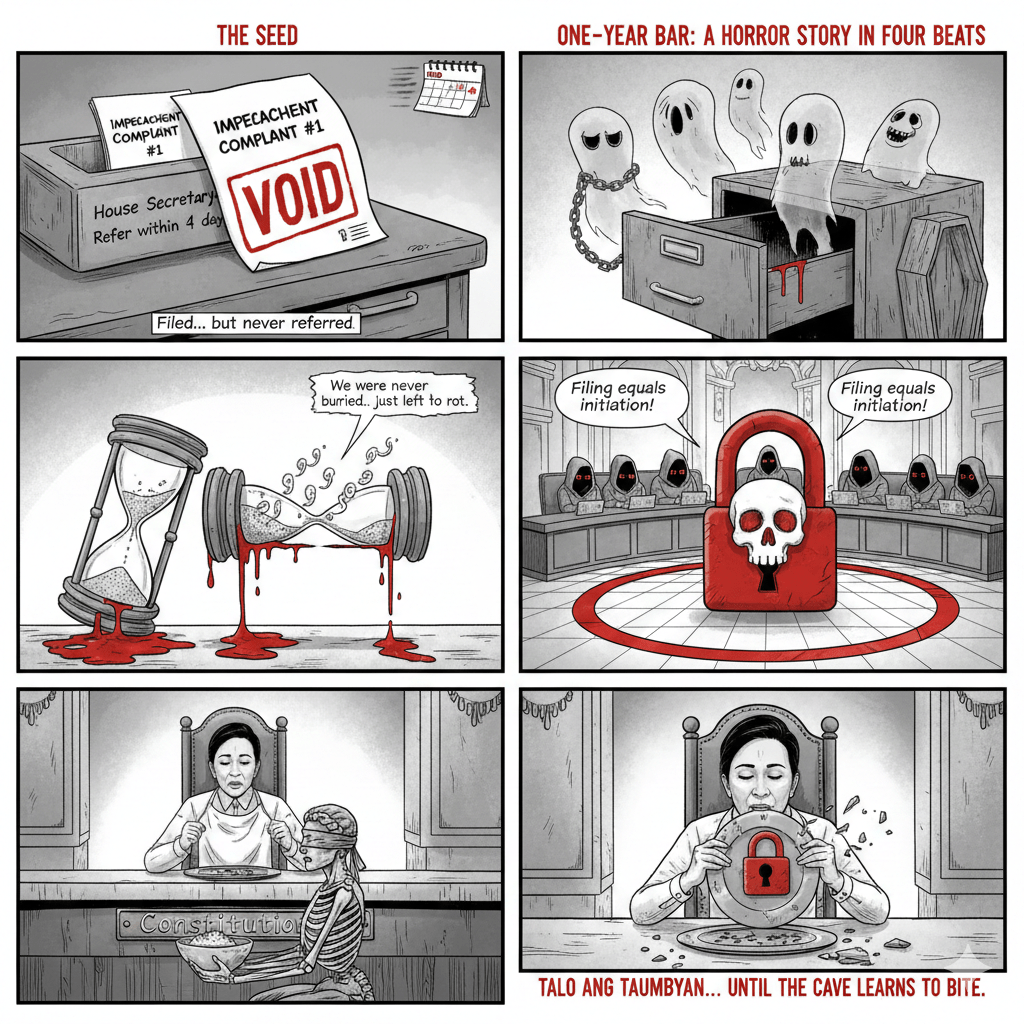
The SC has turned procedural inertia into an impenetrable shield. Three flimsy complaints linger unreferred past deadlines. The House, following its reading of initiation, proceeds with a properly endorsed fourth complaint.
The Court rejects this outright. Filing plus non-referral equals initiation. The one-year bar activates. The tactic is now certified: seed weak complaints early, let them decay, and block any serious effort for a year.
This is not fidelity to the Constitution—it is judicial alchemy that rewards sabotage. Senior Associate Justice Marvic Leonen’s ponencia scolds Congress for delay while the Court itself often takes years on cases. The hypocrisy is exquisite.
2. Due Process as Political Theater: A New Act for an Old Farce
Impeachment has always been political—raw, partisan, unapologetic. Yet the SC now imposes full due process requirements under Article III, Section 1, complete with a seven-point fairness checklist: notice, evidence access, response time.
The Court dismisses arguments that impeachment affects only political rights, rejecting “undue literalism.”
The result? Congress receives a detailed script for proceedings the SC has already voided until 2026. It is like handing a death-row inmate a gourmet menu for a meal that will never arrive. The Senate watches this absurd theater from the sidelines, powerless.
3. The Unspoken Text: Rumors, Dynasties, and the Ghost in the Robes
The ruling remains clinically detached from substance. It explicitly states Sara Duterte is not absolved of allegations: misuse of hundreds of millions in confidential funds, the “Mary Grace Piattos” ghost recipient, death threats against the President, First Lady, and Speaker.
Yet the context is deafening. A bench with 13 justices appointed by Rodrigo Duterte unanimously shields his daughter. The shadow of Renato Corona’s 2012 impeachment—for perceived loyalty to his appointer—looms large.
Judicial independence, we are assured, thrives. One cannot help but wonder if it includes a family plan.
4. Eviscerating the Checks: When the Balance of Powers Becomes a One-Way Street
The SC cites precedents like Francisco v. House of Representatives (G.R. No. 160261, 2003) to justify review for grave abuse. Acceptable in theory.
In practice, the Court does not correct abuse—it enables it. By rejecting the doctrine of operative fact and offering no leeway to the House, the SC extends maximum procedural charity to the VP while denying any to the legislature’s accountability effort.
This is not checks and balances. It is a dynastic toll booth on the road to justice.
5. The Aftermath: A Blueprint for Impunity and a Call to Arms
The options are bleak:
- The House may refile after February 6, 2026—if political will survives the midterms.
- The Senate remains sidelined.
- The VP emerges politically scarred but untried, free to portray this as vindication.
Impeachment, the Constitution’s ultimate sanction, is now easier to derail than a barangay resolution. The precedent is toxic: technicalities trump accountability. Talo ang taumbayan—once more.
The call is clear and urgent. Pursue the substantive charges elsewhere:
- Graft and fund misuse under Republic Act No. 3019 (Anti-Graft and Corrupt Practices Act).
- Ethical violations under Republic Act No. 6713 (Code of Conduct and Ethical Standards for Public Officials and Employees).
- Threats under Act No. 3815 (Revised Penal Code).
These paths have no one-year bar and require no committee referral.
For reform, propose the Biraogo Amendments:
- Define “initiation” to require actual committee referral or minimum endorsement threshold before the bar triggers.
- Prohibit proxy complaints filed within 90 days of a credible one.
- Mandate recusal for justices appointed by a respondent’s immediate family.
The Supreme Court has delivered a masterclass in procedural treachery. Let us answer with unrelenting pursuit of justice—until no robe can conceal the truth.
In the end, the Constitution was not protected today. It was expertly dissected and served cold to power. The people, as ever, are left with an empty plate.
The Court has spoken in perfect harmony: power protects power. The rest of us just get the echo. Talo ang taumbayan? Not if the cave has anything to say about it.
— Barok
Key Citations
- De Villa, Kathleen, and Tetch Torres-Tupas. “SC Still Unanimous: VP Impeachment Void.” Inquirer.net, 30 Jan. 2026.
- “The 1987 Constitution of the Republic of the Philippines.” Official Gazette of the Republic of the Philippines.
- “Republic Act No. 3019.” Official Gazette of the Republic of the Philippines, 17 Aug. 1960.
- “Republic Act No. 6713.” Official Gazette of the Republic of the Philippines, 20 Feb. 1989.
- “Act No. 3815.” Official Gazette of the Republic of the Philippines, 8 Dec. 1930.
- Francisco v. House of Representatives, G.R. No. 160261, 10 Nov. 2003, LawPhil.
- “Forthwith” to Farce: How the Senate is Killing Impeachment—And Why Enrile’s Right (Even If You Can’t Trust Him)

- “HINDI AKO NAG-RESIGN!”

- “I’m calling you from my new Globe SIM. Send load!”

- “Mahiya Naman Kayo!” Marcos’ Anti-Corruption Vow Faces a Flood of Doubt

- “Meow, I’m calling you from my new Globe SIM!”

- “No Special Jail for Crooks!” Boying Remulla Slams VIP Perks for Flood Scammers

- “PLUNDER IS OVERRATED”? TRY AGAIN — IT’S A CALCULATED KILL SHOT

- “Several Lifetimes,” Said Fajardo — Translation: “I’m Not Spending Even One More Day on This Circus”

- “Shimenet”: The Term That Broke the Internet and the Budget

- “We Did Not Yield”: Marcos’s Stand and the Soul of Filipino Sovereignty

- “We Gather Light to Scatter”: A Tribute to Edgardo Bautista Espiritu

- $150M for Kaufman to Spin a Sinking Narrative





 KWEBA ni BAROK
Leave a comment