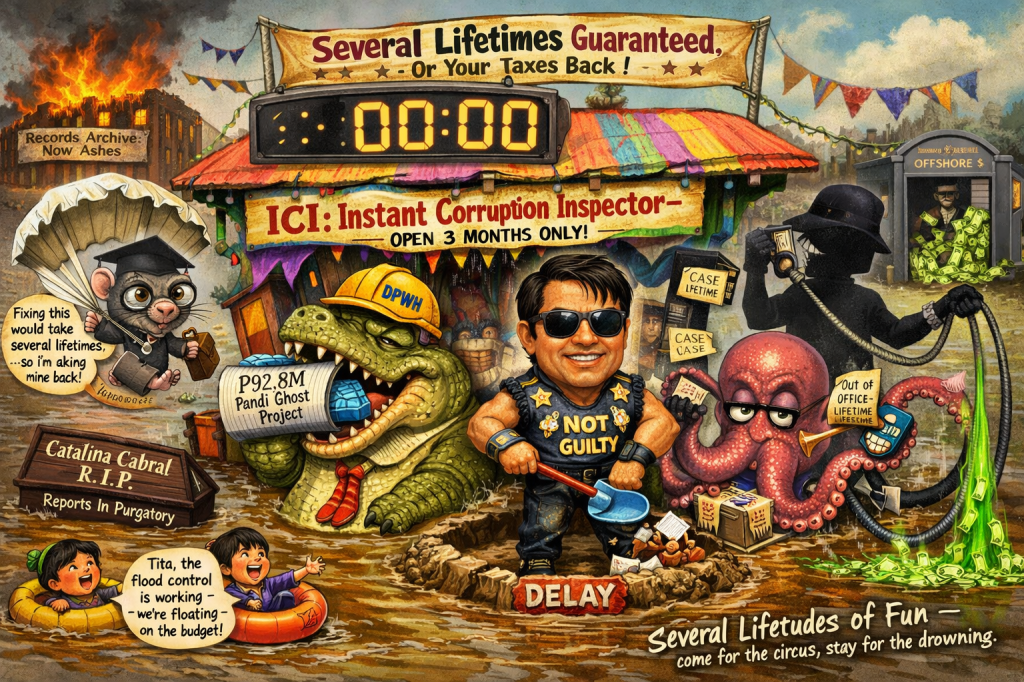
Fajardo’s Final Lesson: You Can’t Fix a System That Rewards the People Breaking It
By Louis ‘Barok‘ C. Biraogo — January 31, 2026
IN A country where the poor wade through floodwaters that rise faster than our leaders’ excuses, Rossana Fajardo’s resignation from the Independent Commission for Infrastructure (ICI)—coupled with her bleak prophecy that rooting out corruption would “take several lifetimes”—stands as the perfect, bitter epitaph for a dying anti-corruption charade.
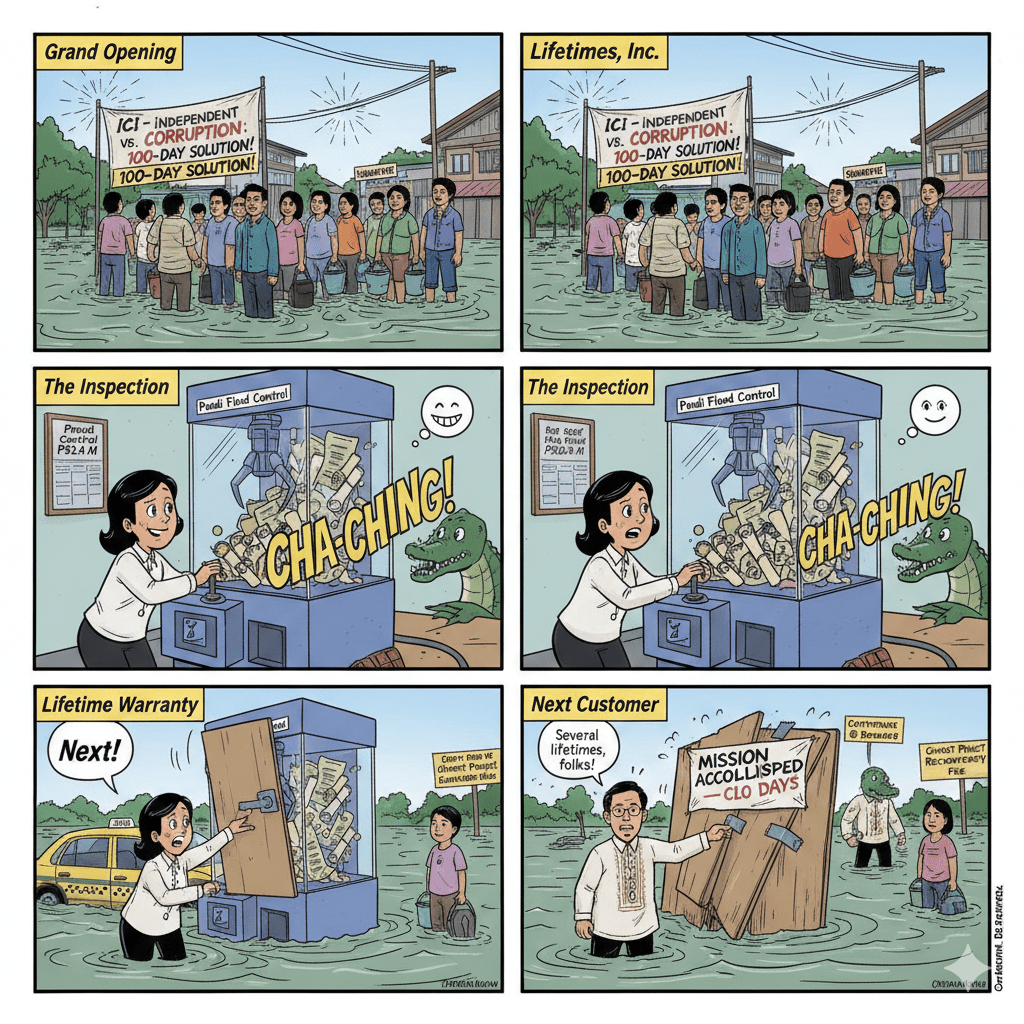
The Symbolic Corpse on the Table
The ICI was born in September 2025 with presidential fanfare, heralded as the scalpel to excise the cancer of flood control corruption. By January 2026, it was effectively dead, its commissioners fleeing like actors from a collapsing stage.
Rossana Fajardo, the accomplished auditor from Sycip Gorres Velayo & Co. (SGV & Co.), lasted only three months before declaring her task complete and returning to private practice. Her parting words—that eradicating corruption would require removing “everyone who is part of the system”—read less as diagnosis than surrender.
This is tragicomic theater: a commission touted as independent, yet so toothless and temporary that its members treated it like a short-term consultancy. The ICI was never designed to endure; it was a prop to quiet public outrage after yet another flooding season revealed billions in “flood control” funds that controlled nothing except the bank accounts of the cunning.
The Anatomy of a Heist
The mechanics of this larceny are not crude—they are, as Fajardo grimly admitted, devilishly “smart.” Existing processes and controls in the Department of Public Works and Highways (DPWH) and budget deliberations are not broken; they are deliberately overridden.
Politicians and officials insert projects between the National Expenditure Program (NEP) and the General Appropriations Act (GAA), inflating budgets with phantom allocations. Ghost projects exist only on paper, funds are disbursed, kickbacks flow upward, and no structure is built—or what is built collapses with the first rain.
Consider the P92.8-million ghost flood control project in Pandi, Bulacan: money allocated, documents falsified, no structure erected, yet officials plead innocence while communities drown. This is intellectual looting, where bright minds apply cunning not to engineering typhoon defenses, but to engineering impunity.
Cast of Characters in a Farce
- Rossana Fajardo: She brought forensic rigor, questioned Department of Budget and Management (DBM) officials on NEP-GAA discrepancies, and exposed intentional sabotage of controls. Yet she fled prematurely, joining Rogelio Singson and Benjamin Magalong in abandoning the commission. Her “several lifetimes” remark, while realistic, risks becoming a self-fulfilling prophecy of cynicism.
- The Government & ICI: An “independent” body with no subpoena power, no legal protections, and no permanence—designed to fail. Multiple resignations, no replacements, findings shuttled to an overburdened Ombudsman. This is not oversight; it is a placebo.
- The Accused: Former Senator Ramon “Bong” Revilla Jr. and DPWH officials face charges before the Sandiganbayan for violating Section 3(e) of Republic Act No. 3019 (the Anti-Graft and Corrupt Practices Act). They plead not guilty while ghost projects haunt the record, employing motions to quash and lawyer swaps in a familiar delaying dance.
- The Private Sector: Business leaders like Manuel V. Pangilinan lament weak institutions yet thrive within the system they decry. Their calls to “demand more” sound performative when opacity benefits their interests.
The Shadow Play: Rumors and Intrigues
Where credibility has vanished, shadows flourish.
The mysterious death of former DPWH Undersecretary Maria Catalina Cabral in December 2025.
Suspicious fires gutting DPWH offices in October 2025 and January 2026, conveniently destroying records.
Whispers of political pressure on commissioners.
These are not proven facts, but symptoms of profound institutional distrust. Rumors thrive because truth is buried deeper than any flood control project.
The Rot in the Foundation
This scandal is not anomaly but archetype. Overlapping, vulnerable bodies—the ICI, Office of the Ombudsman, Sandiganbayan, Commission on Audit (COA)—guarantee impunity through diffused responsibility and political exposure. Cases drag for decades; “several lifetimes” is no hyperbole but a grim forecast echoing past scandals that faded into acquittals and amnesia.
At the core lies the corruption of values Fajardo identified. The system rewards cunning betrayal over public service. Capable minds become architects of national sabotage because loyalty to country ranks below loyalty to self and patron.
Pathways from Farce to Future
The most likely outcome? Whitewash and amnesia—minor officials sacrificed, big fish freed, the ICI quietly dissolved.
The necessary outcome: genuine prosecution without sacred cows and structural reform.
We need:
- To stop chasing mirages with disposable commissions and finally empower the constitutional sentinels we already have: the Office of the Ombudsman and the Commission on Audit (COA). Give them real prosecutorial muscle that can bite through political armor, bulletproof independence that no Malacañang phone call can crack, generous funding that matches the scale of the billions being stolen, and iron shields against executive meddling—so these bodies can function as the permanent, formidable guardians of public integrity the Constitution always intended, instead of birthing yet another fragile, short-lived “independent” body doomed to resign in three months.
- Ironclad budget transparency laws banning post-NEP insertions.
- Robust whistleblower shields with real enforcement.
Anything less is surrender.
A Final, Unflinching Plea
Fellow Filipinos, this is treason—not against an abstract state, but against the mother wading waist-deep to sell her wares, the child carried through streets that should have been safe, the families burying their dead after storms we paid billions to prevent.
Corruption is not a cost of doing business; it is a dagger in the heart of our people, a betrayal of the sacrifices that birthed this nation.
We are better than this. Demand a government that serves rather than loots, leaders who build dikes instead of fortunes, a patriotism militant enough to treat graft as mortal sin. Refuse the “several lifetimes” excuse. If we dare to fight—with outrage, unity, and unyielding love for this wounded land—we can yet redeem the Philippines into the just, prosperous nation our heroes dreamed of.
Walang susuko. Walang patatawarin hangga’t hindi napanagutan.
— Barok
Key Citations
- Macababbad, EJ. “Eradicating Corruption Will Take Several Lifetimes.” The Philippine Star, 29 Jan. 2026.
- “Republic Act No. 3019.” The LawPhil Project. Accessed 30 Jan. 2026.
- Avendano, Christine O., and Marlon Ramos. “Cabral Attempted Suicide at Home, Says Lawyer.” Philippine Daily Inquirer, 5 Jan. 2026.
- Buan, Lian. “Bong Revilla’s Return to Sandiganbayan: From Pork Barrel to Flood Control.” Rappler, 22 Jan. 2026.
- Valenzuela, Nikka G. “Fire Hits DPWH Office in Quezon City Amid Corruption Scandal.” Rappler, 22 Oct. 2025.
- ₱75 Million Heist: Cops Gone Full Bandit

- ₱6.7-Trillion Temptation: The Great Pork Zombie Revival and the “Collegial” Vote-Buying Circus

- ₱1.9 Billion for 382 Units and a Rooftop Pool: Poverty Solved, Next Problem Please

- ₱1.35 Trillion for Education: Bigger Budget, Same Old Thieves’ Banquet

- ₱1 Billion Congressional Seat? Sorry, Sold Out Na Raw — Si Bello Raw Ang Hindi Bumili

- “We Will Take Care of It”: Bersamin’s P52-Billion Love Letter to Corruption

- “Skewed Narrative”? More Like Skewered Taxpayers!

- “Scared to Sign Vouchers” Is Now Official GDP Policy – Welcome to the Philippines’ Permanent Paralysis Economy
- “Robbed by Restitution?” Curlee Discaya’s Tears Over Returning What He Never Earned
- “No Pressure” Luistro? The House Pork Bazaar Exposed
- “My Brother the President Is a Junkie”: A Marcos Family Reunion Special

- “Mapipilitan Akong Gawing Zero”: The Day Senator Rodante Marcoleta Confessed to Perjury on National Television and Thought We’d Clap for the Creativity



 KWEBA ni BAROK
Leave a comment