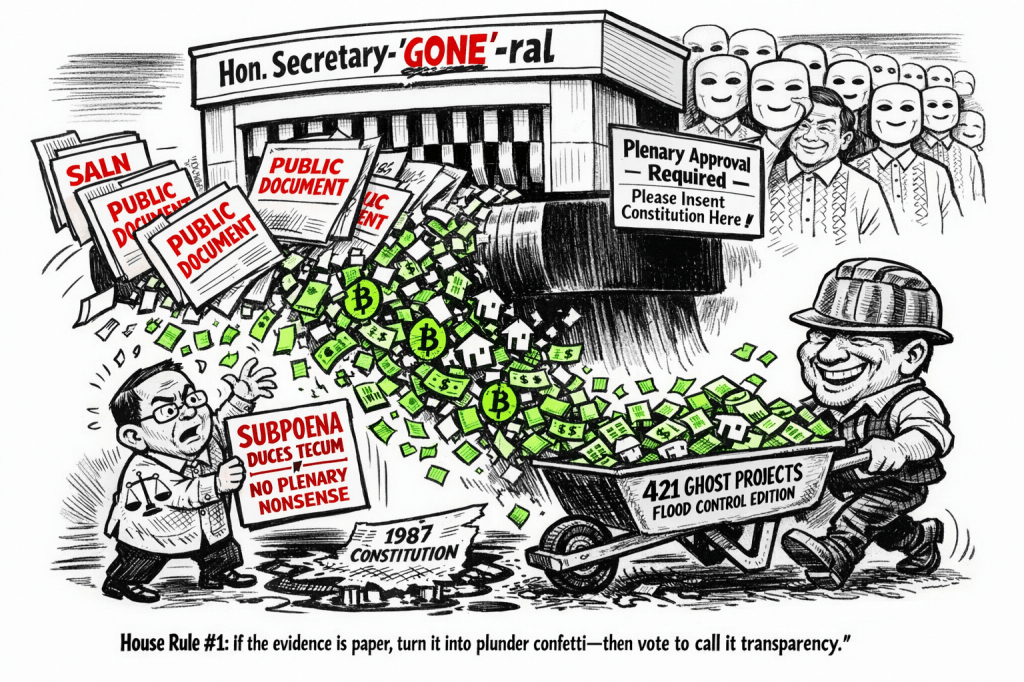
How the Secretary-General Turned “Plenary Approval” Into Congress’s Ultimate Get-Out-of-Jail-Free Card
By Louis ‘Barok‘ C. Biraogo — February 3, 2026
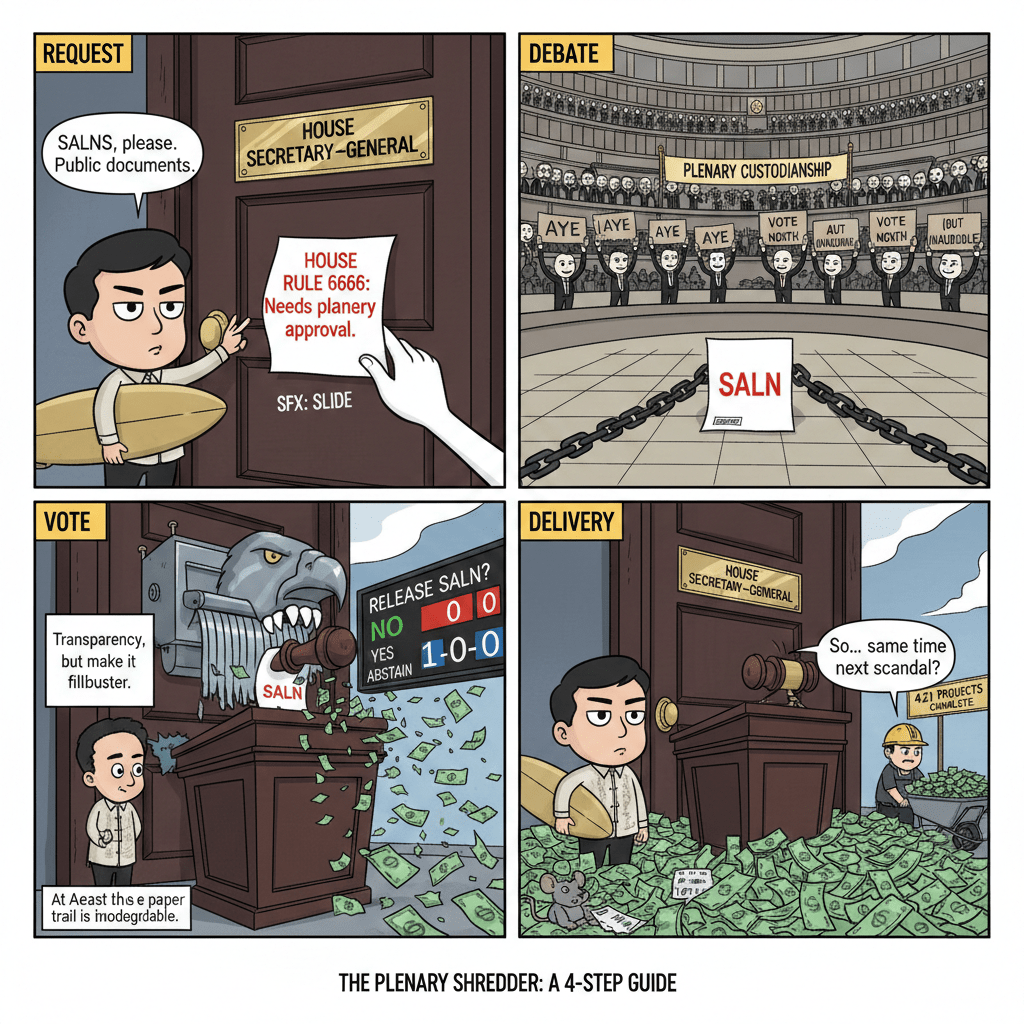
MGA ka-kweba, let’s not mince words. The House of Representatives, that august chamber supposedly representing the sovereign people, has now resorted to the most transparent ruse yet in the great “cong-tractor” flood control heist: requiring plenary approval before releasing the Statements of Assets, Liabilities, and Net Worth (SALNs) of lawmakers under investigation.
Ombudsman Jesus Crispin “Boying” Remulla, a former congressman who actually knows the plenary “inside and out,” has called this exactly what it is—an excuse, a delay tactic, a naked obstruction of justice.
And I, Barok, am here to drive the blade in deeper.
This is not a mere bureaucratic spat. This is a calculated siege against the Constitution itself, erected by a House leadership desperate to protect its own from the consequences of what may be the largest corruption scandal since the pork barrel days—421 fully funded but non-existent flood control projects, billions vanished into ghost contracts, kickbacks funneled through “cong-tractors,” and, at the center of the web, no less than former Speaker Martin Romualdez himself, allegedly using contractor spouses as fronts for a Makati property. The stakes are astronomical. The hypocrisy is suffocating.
Let’s eviscerate this farce, piece by pathetic piece.
Deconstructing the “Plenary Approval” Fiction
Let us be perfectly clear, Mr. Secretary-General (and whoever in the Speaker’s office whispered this brilliant idea into your ear): there is no rule—none, zero, wala—requiring plenary approval for the release of SALNs to a constitutional investigative body like the Ombudsman.
Remulla said it himself:
“That’s not how it works. I used to be in Congress. I know the plenary inside and out. We don’t do that.”
When a former insider calls your bluff, you are already on the floor bleeding.
The Secretary-General’s office claims the SALNs must “pass the plenary” before release. Pass the plenary for what? For a floor debate on whether transparency is inconvenient this week? For a show of hands on whether certain congressmen should be allowed to keep their unexplained wealth unexplained? This is not custodianship. This is complicity dressed as procedure—a theatrical farce where the villains vote on whether to hand over the evidence.
SALNs are not private love letters. They are public documents mandated by the Constitution for the precise purpose of detecting conflicts of interest and illicit enrichment—the very heart of the cong-tractor probe. To invent a plenary hurdle is to transform a transparency tool into a political veto. It is legislative gatekeeping over evidence of legislative corruption. It is, in a word, obscene.
Legal and Constitutional Evisceration
The legal foundation for this obstruction is tissue paper held up against a Category 5 typhoon.
Article XI, Section 17 of the 1987 Constitution is unequivocal: public officials shall submit SALNs “as may be prescribed by law,” and the public has the right of access. Republic Act No. 6713, the Code of Conduct and Ethical Standards for Public Officials and Employees, reinforces this in Section 8, requiring disclosure of business interests and financial connections. These are not suggestions. These are commands.
The Ombudsman’s mandate under Article XI, Section 1 of the 1987 Constitution and Republic Act No. 6770 (the Ombudsman Act of 1989) is to investigate and prosecute graft—powers that inherently require access to evidence like SALNs without begging for plenary permission.
Supreme Court precedents hammer the point: SALNs are public documents with only reasonable restrictions, and failure to disclose assets was central to the Corona impeachment conviction. If the Chief Justice could not hide behind incomplete SALNs, why should congressmen hide behind a fabricated plenary vote?
Internal House rules cannot trump constitutional duties. To claim otherwise is to assert that the House is a sovereign kingdom unto itself, above the charter it swore to uphold. That, dear readers, is sedition in silk gloves.
Prosecution Pathway Blueprint
If the Secretary-General persists in this obstruction, the path to criminal liability is well-paved.
- Presidential Decree No. 1829 penalizes willful obstruction of justice by refusing documents in lawful investigations—up to six years imprisonment and perpetual disqualification.
- Republic Act No. 3019, Section 3(e), covers acts causing undue injury through manifest partiality.
The Ombudsman issues a subpoena duces tecum under RA 6770. Non-compliance triggers contempt. Continued defiance opens direct complaints before the Sandiganbayan. Willful obstruction here is not oversight—it is accessory to plunder.
Strategic Options Audit: The Chessboard Laid Bare
- For Ombudsman Remulla: Subpoenas, mandamus petitions, public naming of delays, parallel probes via bank records or lifestyle checks. The constitutional high ground is his; hesitation would be betrayal.
- For the House/Secretary-General: Compliance avoids prosecution. Defiance invites judicial humiliation and eternal cover-up accusations—especially toxic with Romualdez’s property fronts, Zaldy Co’s P100-billion contracts, and cryptocurrency laundering rumors swirling.
- For implicated lawmakers: Options dwindle. Voluntary disclosure might buy mercy. Stonewalling guarantees the net tightens—on assets, fronts, unexplained wealth.
Demands & Resolution Scenarios
Enough theater. Non-negotiable demands:
- Immediate, unconditional release of requested SALNs to the Ombudsman—no debates, no excuses.
- Cessation of all obstructive tactics by the Secretary-General’s office.
- Swift public prosecution under PD 1829 and RA 3019 if defiance continues.
- Justice for taxpayers betrayed by the cong-tractor scam—charges, convictions, recovered billions.
This is about the absolute supremacy of the rule of law over political convenience, over abused privilege, over the festering disease of impunity that turns flood funds into private fortunes while victims drown.
The House can end this farce today by obeying the Constitution it pretends to revere. Or it can force the Supreme Court to remind them—again—that no branch, no officer, no clique is above the law.
The Filipino people are watching. And we are done with excuses.
— Barok
Still waiting for the day Congress remembers it serves the people, not the plunderers.
Key Citations
A. Legal & Official Sources
- The 1987 Constitution of the Republic of the Philippines. Article XI, Official Gazette of the Republic of the Philippines.
- Code of Conduct and Ethical Standards for Public Officials and Employees. Republic Act No. 6713, Official Gazette of the Republic of the Philippines, 20 Feb. 1989.
- The Ombudsman Act of 1989. Republic Act No. 6770, Official Gazette of the Republic of the Philippines, 17 Nov. 1989.
- Anti-Graft and Corrupt Practices Act. Republic Act No. 3019, Official Gazette of the Republic of the Philippines, 17 Aug. 1960.
- Penalizing Obstruction of Apprehension and Prosecution of Criminal Offenders. Presidential Decree No. 1829, The LawPhil Project, 16 Jan. 1981.
B. News Reports
- Marcelo, Elizabeth. “Ombudsman: House Restricting Release of SALNs.” The Philippine Star, 3 Feb. 2026.

- “Forthwith” to Farce: How the Senate is Killing Impeachment—And Why Enrile’s Right (Even If You Can’t Trust Him)

- “HINDI AKO NAG-RESIGN!”

- “I’m calling you from my new Globe SIM. Send load!”

- “Mahiya Naman Kayo!” Marcos’ Anti-Corruption Vow Faces a Flood of Doubt

- “Meow, I’m calling you from my new Globe SIM!”

- “No Special Jail for Crooks!” Boying Remulla Slams VIP Perks for Flood Scammers

- “PLUNDER IS OVERRATED”? TRY AGAIN — IT’S A CALCULATED KILL SHOT

- “Several Lifetimes,” Said Fajardo — Translation: “I’m Not Spending Even One More Day on This Circus”

- “Shimenet”: The Term That Broke the Internet and the Budget

- “We Did Not Yield”: Marcos’s Stand and the Soul of Filipino Sovereignty

- “We Gather Light to Scatter”: A Tribute to Edgardo Bautista Espiritu

- $150M for Kaufman to Spin a Sinking Narrative



 KWEBA ni BAROK
Leave a comment