Where Billions Go to Die Quietly While Kids Photocopy Yesterday’s Lessons
By Louis ‘Barok‘ C. Biraogo — February 4, 2026
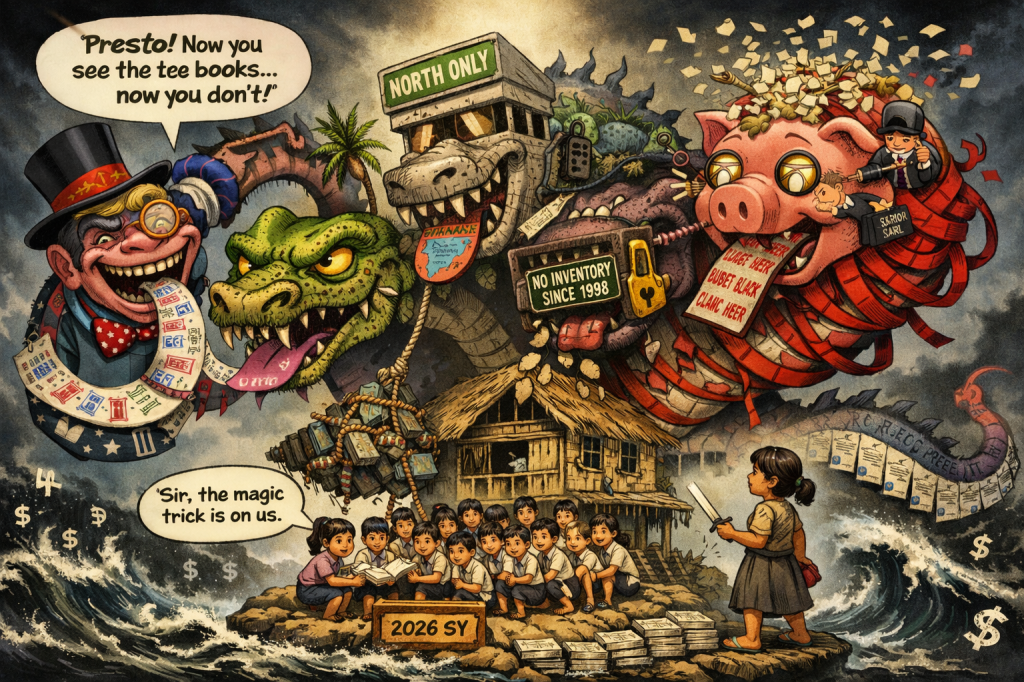
PICTURE this, mga ka-kweba: In a brightly lit stockroom in Quezon City, a property custodian in a crisp DepEd polo shirt neatly stacks thousands of brand-new textbooks, their glossy covers gleaming under fluorescent lights. A photographer from the department’s PR team snaps away—perfect for the next press release: “DepEd delivers!” the caption will crow. Meanwhile, three islands and a typhoon season away, in a sweltering classroom in Basilan, thirty-five Grade 4 students huddle around one dog-eared, ten-year-old reader, its pages yellowed and curling from the humidity. The teacher, unpaid overtime as usual, scribbles lessons on a cracked blackboard with chalk she bought herself. This, ladies and gentlemen, is the Philippines’ education system in 2026—two worlds, one bureaucracy, zero shame.
The Department of Education (DepEd) loves to boast about its “streamlined” procurement, crowing about a 289% increase in titles procured in 2025. The Second Congressional Commission on Education (Edcom 2)’s devastating report titled “Turning Point: A Decade of Necessary Reforms” politely calls it a “breakthrough.” Breakthrough? More like breaking the hearts of millions of Filipino children. Because while the bidding may now move faster, the books still vanish into a logistical abyss, arriving late, damaged, or—more often than not—never at all. This is not a hiccup. This is a heist. And the victims are our kids.
Let me introduce you to the Five Pillars of Failure that keep this rotten edifice standing.
Pillar One: Procurement Theater – The Grand Illusion of Competition
DepEd and the National Book Development Board (NBDB) proudly list 328 “active” publishers nationwide. Sounds robust, doesn’t it? A thriving industry ready to serve 27 million students. Except that in the latest bidding, only ten publishers won all sixty lots. All of them. Every single one. The same ten, year after year, like a VIP list at an exclusive Manila club where the cover charge is a ₱25,000 evaluation fee per title—enough to bankrupt any small regional house before they even open the bidding documents.
This isn’t competition; it’s a rigged lottery where the house always wins. High barriers, prohibitive costs, and rules written for incumbents have created what Edcom 2 delicately calls “continued concentration.” I call it the Luzon Publishing Cartel—ten fat cats in Metro Manila feasting on billions while the rest of the country starves for books.
Pillar Two: The Geographic Absurdity – Luzon Prints, the Provinces Pray
Take a look at the map in Edcom 2’s report. Every single major publisher is clustered in Luzon. Northern Visayas? Zero publishing enterprises. Mindanao? A handful scattered like crumbs across Davao and Misamis Oriental. The NBDB, tasked with building a national industry, has spent thirty years doing precisely nothing to change this. Thirty years. That’s longer than most of our students have been alive.
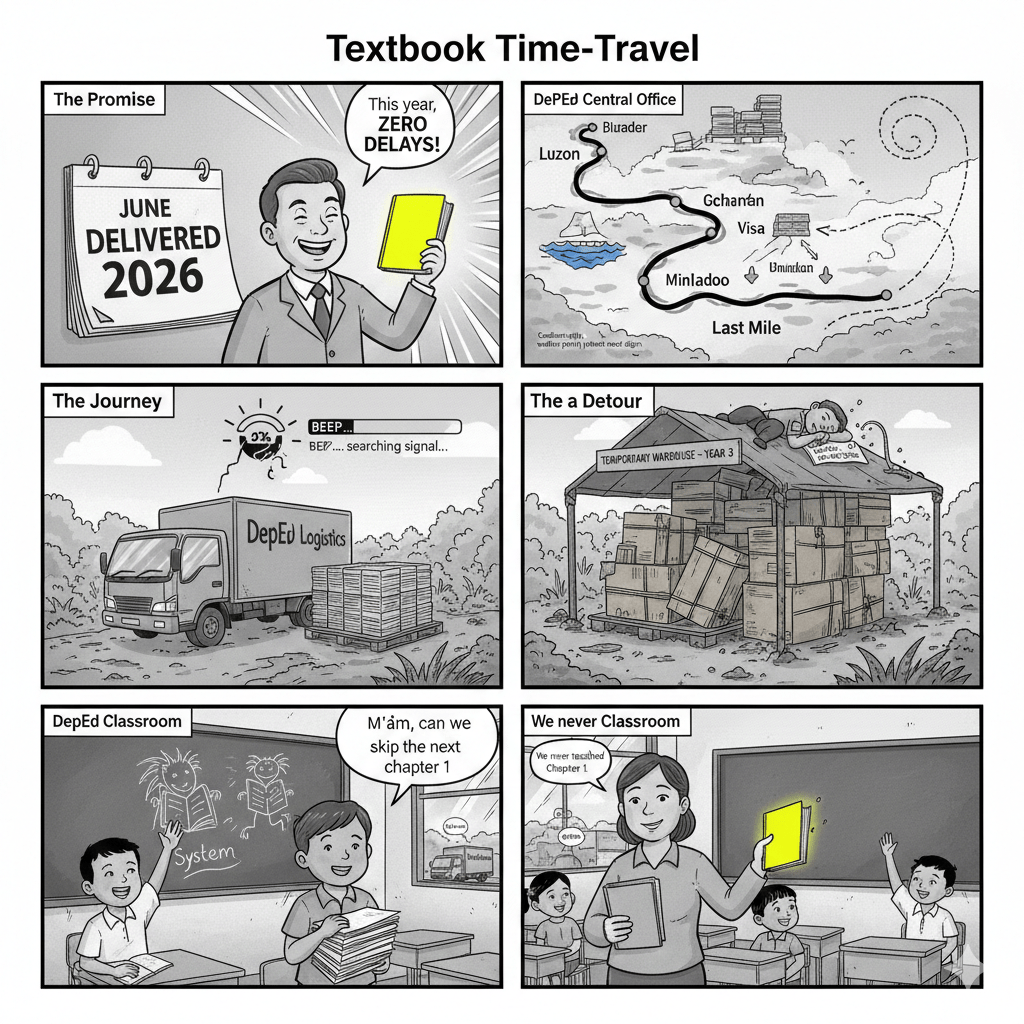
So textbooks must embark on an epic odyssey: printed in Caloocan, trucked to Manila port, barged across stormy seas, unloaded in Cebu or Davao, trucked again over crumbling roads, and finally—maybe—delivered to a school in Tawi-Tawi. If the weather cooperates. If the ports aren’t congested. If the contractor bothers to show up. This isn’t logistics; it’s a pilgrimage with no guarantee of salvation.
Pillar Three: Logistical Lunacy – The Warehouse of Horrors
When the books finally stagger ashore, where do they go? Into “temporary or rented storage facilities” that Edcom 2 says lack humidity control, inventory tracking, and basic security. Translation: humid sheds where books rot, mold, and mysteriously disappear. Delivery is fragmented across multiple contractors, each passing the buck like a hot potato. Schools get no advance notice. Teachers wait months, then years. And DepEd calls this a supply chain? I call it a supply shame.
Pillar Four: The Budgetary Black Hole – Billions Allocated, Nothing Delivered
DepEd sits on billions—P29 billion for learning resources in 2026 alone—yet historically disburses only single-digit percentages. From 2018–2022, a pathetic 7–8% of the textbook budget was actually spent. Where does the money go? Into “planning,” into “consultancies,” into the same black hole that swallowed the laptop procurement billions under the previous administration? While classrooms beg for books, the funds languish, unutilized, untouchable, unaccounted for. This isn’t inefficiency. This is sabotage.
Pillar Five: The Corruption Cancer – The Disease We Refuse to Name
Put it all together: concentrated bidding wins, massive budgets, zero regional competition, weak oversight, and a procurement law (Republic Act No. 9184, the Government Procurement Reform Act) that ties everyone in red tape while leaving loopholes wide enough for a convoy of delivery trucks. This is graft paradise. We’ve seen it before—overpriced laptops, damaged books worth millions written off, suppliers with political connections walking away richer. The structure doesn’t just allow corruption; it invites it, feeds it, protects it. And the losers are always the same: children in Samar photocopying pages because their textbooks never arrived, teachers in Maguindanao making do with 1990s relics while cartel members toast another winning bid.
This isn’t unique to us—Indonesia wrestles with distribution costs, India has seen textbook scams where books are sold as scrap for kickbacks—but Uganda manages multiple approved titles per subject, and Japan lets local boards choose from competing publishers. Solutions exist. The Philippines simply chooses not to adopt them.
The human cost is unbearable. A teacher in Samar told reporters she spends her own salary printing modules because the promised books are “still in Manila.” A student in Tawi-Tawi shares one science book among eight classmates, its diagrams faded to ghosts. These are not statistics. These are children whose futures we are stealing, one delayed shipment at a time.
And who is complicit? Everyone. DepEd for its implementation failures and press-release governance. The NBDB for three decades of irrelevance. Lawmakers for their periodic grandstanding hearings that produce nothing but headlines. And us—the public—for our short memory and shorter attention span.
This farce must end. Here’s the bare minimum we should demand:
- Break up the lots. Mandate regional printing hubs. Give publishers a realistic two-year runway instead of six impossible months.
- Reform Republic Act No. 9184 for education materials—lower barriers, tiered fees, mandatory transparency portals showing every bid, every winner, every delivery in real time.
- Modernize logistics: GPS tracking on every shipment, proper warehouses, single-point accountability.
- Consequences: Tie DepEd leaders’ performance contracts to actual book delivery. Miss the target? Resign.
Fixing textbooks isn’t rocket science. It’s the bare minimum test of whether this government can fulfill its most basic duty: to educate its children. If we cannot get books into classrooms on time, we have no business calling ourselves a republic. This scandal is not just about missing pages. It’s about a state that has forgotten its reason for existing.
The books that never were are stealing our children’s future. It’s time we stole it back.
They’ll fix it next year, they say. They said that last year. And the year before that. Wake me when the children actually get to read.
— Barok
Key Citations
- Reyes, Dempsey. “DepEd to address textbook accessibility, lack of publishers.” Inquirer.net, February 2026.
- Congress of the Philippines. “Turning Point: A Decade of Necessary Reforms.” Final Report of the Second Congressional Commission on Education (EDCOM 2), 2025–2026.
- Republic Act No. 9184. Government Procurement Reform Act. 10 January 2003, Official Gazette of the Republic of the Philippines.
- National Book Development Board. Official Website.
- Escosio, Jan. “DepEd breaks decade-long gridlock: Textbooks procurement up 289%.” Inquirer.net, 2 December 2025.

- ₱75 Million Heist: Cops Gone Full Bandit

- ₱6.7-Trillion Temptation: The Great Pork Zombie Revival and the “Collegial” Vote-Buying Circus

- ₱1.9 Billion for 382 Units and a Rooftop Pool: Poverty Solved, Next Problem Please

- ₱1.35 Trillion for Education: Bigger Budget, Same Old Thieves’ Banquet

- ₱1 Billion Congressional Seat? Sorry, Sold Out Na Raw — Si Bello Raw Ang Hindi Bumili

- “We Will Take Care of It”: Bersamin’s P52-Billion Love Letter to Corruption

- “Skewed Narrative”? More Like Skewered Taxpayers!

- “Scared to Sign Vouchers” Is Now Official GDP Policy – Welcome to the Philippines’ Permanent Paralysis Economy

- “Robbed by Restitution?” Curlee Discaya’s Tears Over Returning What He Never Earned
- “No Pressure” Luistro? The House Pork Bazaar Exposed
- “My Brother the President Is a Junkie”: A Marcos Family Reunion Special

- “Mapipilitan Akong Gawing Zero”: The Day Senator Rodante Marcoleta Confessed to Perjury on National Television and Thought We’d Clap for the Creativity


 KWEBA ni BAROK
Leave a comment