Feasting on Tomorrow’s Catch: The Generational Theft of Philippine Marine Wealth
By Louis ‘Barok‘ C. Biraogo — February 5, 2026
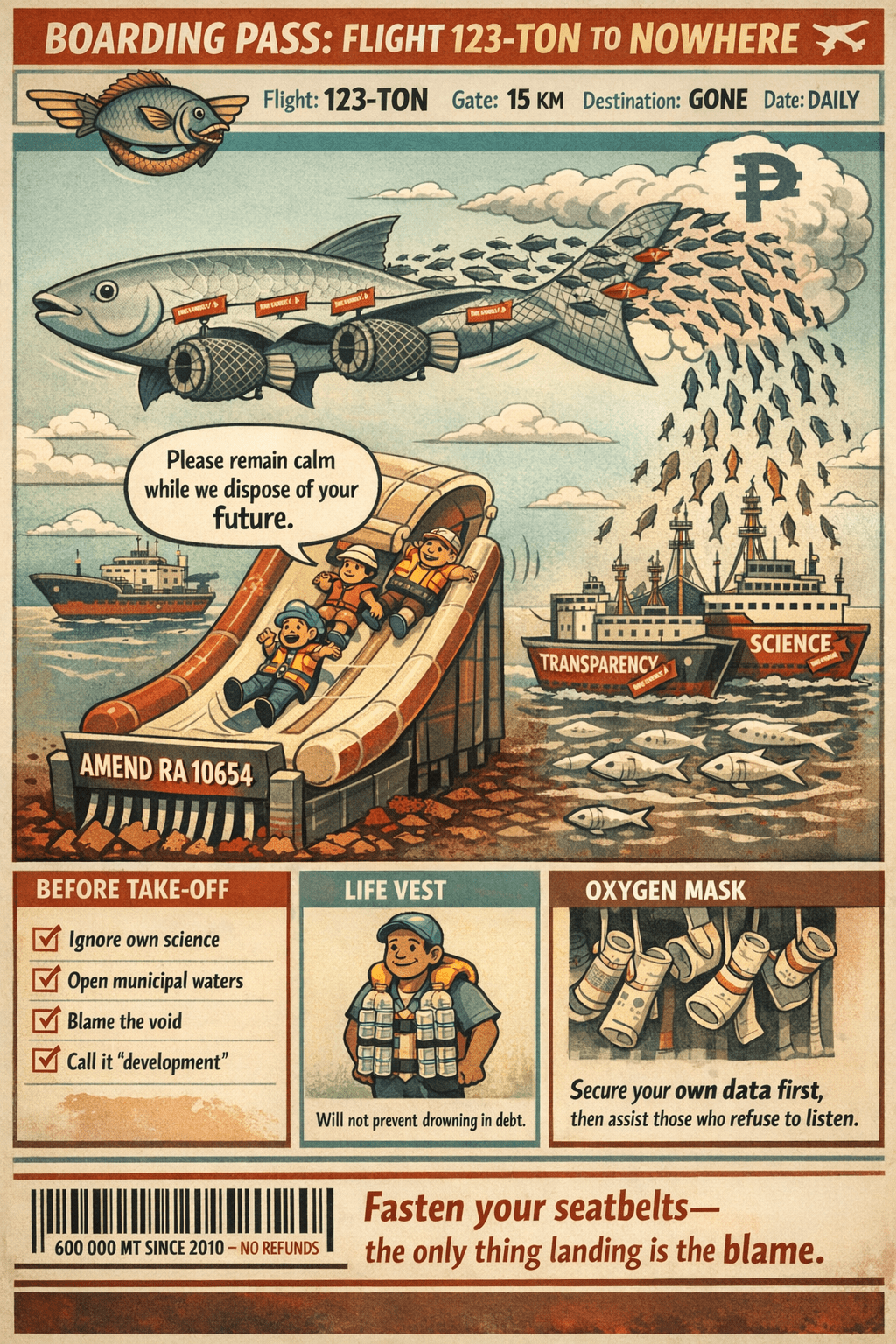
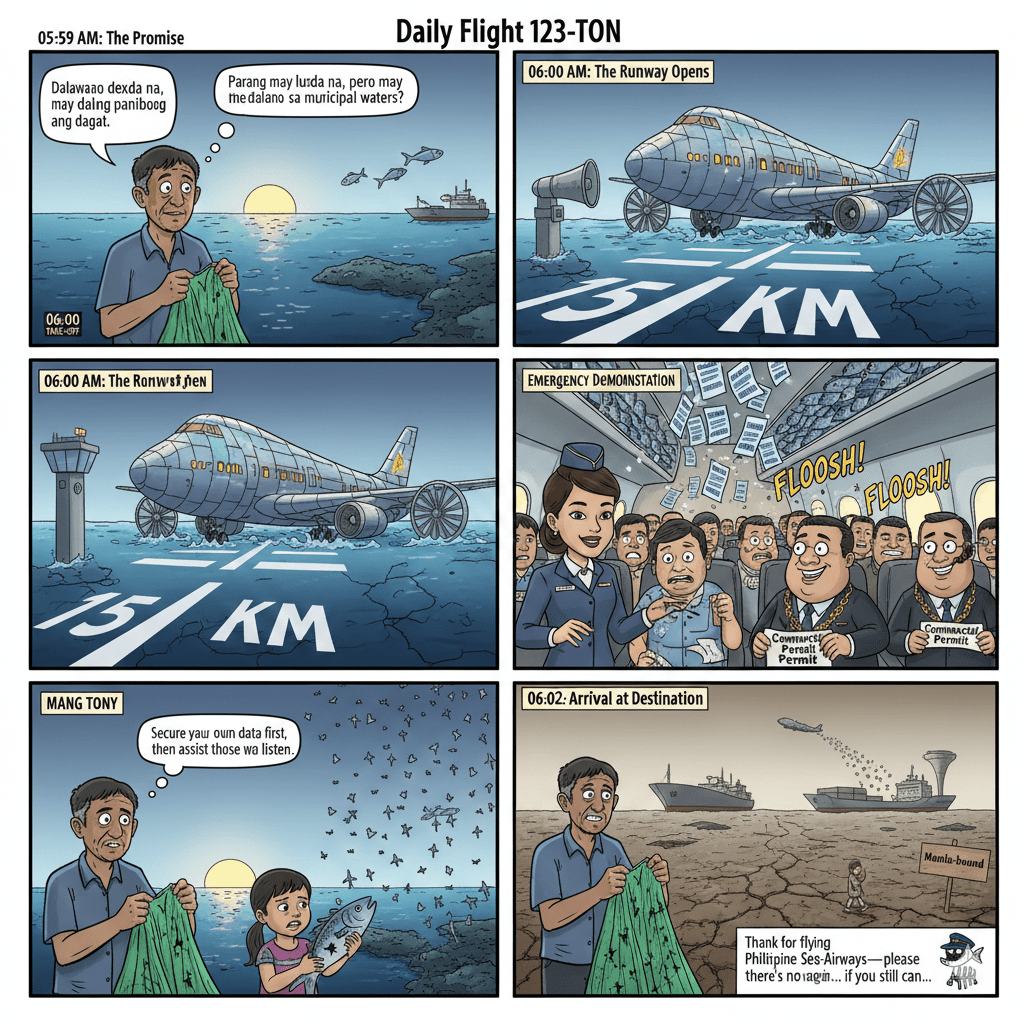
EVERY single day, a fully loaded jumbo jet—brimming with 123,000 kilograms of fresh fish—takes off from Philippine waters and vanishes into thin air.
Not hijacked. Not crashed. Just gone.
According to a recent Inquirer report on Oceana Philippines‘s latest audit, that’s the scale of our annual loss: 45 million kilograms of fish every year. A cumulative 600,000 metric tons since 2010. Enough protein to feed every Filipino a decent meal for a month.
Gone.
We boast of being an archipelagic nation blessed with rich marine biodiversity. Yet we treat our seas like an all-you-can-loot buffet.
And the house is already on fire.
Oceana: The Polite Cassandras Screaming into the Void
Credit where it’s due—then the critique.
Oceana Philippines‘s report is meticulous: government data, satellite imagery from their Karagatan Patrol platform showing thousands of commercial vessels in forbidden municipal waters, stock assessments declaring 88% of fisheries overfished or depleted. Production fell from 2.6 million metric tons in 2010 to 1.9 million in 2023. Over 31,000 commercial intrusions logged last year alone.
The science is ironclad. The warnings prophetic.
But here’s the tragic farce: an international NGO must beg a sovereign government to enforce its own laws. Oceana’s reports are polite, data-driven, impeccably sourced. They hold press conferences and issue statements.
Malacañang responds with silence—or worse, proposals to weaken protections.
It’s like doctors handing a lung cancer patient a treatment plan, only for him to demand more cigarettes. Oceana is devastatingly right. But polite science alone won’t douse this inferno.
The Government: Guardians of the Loot
The real culprits: the Bureau of Fisheries and Aquatic Resources (BFAR), the Department of Agriculture, and the governance edifice that perfected “regrettable failure of implementation.”
We have strong tools. Republic Act No. 10654, amending the Philippine Fisheries Code of 1998 (Republic Act No. 8550), provides one of the region’s strongest frameworks: municipal waters reserved for small-scale fishers, vessel monitoring mandates, science-based management.
It’s the state-of-the-art fire truck—fully equipped, parked, gathering dust.
Some officials want to dismantle it entirely. Proposals to amend RA 10654 would open municipal waters to commercial fleets, claiming those 15-kilometer zones are “devoid of fish.” BFAR calls this “science-based.”
Oceana counters with BFAR’s own studies proving the opposite.
This isn’t incompetence. It’s deliberate choice. Whose interests does plunder serve? Not the 350,000 fisherfolk families below the poverty line. Not the 2.5 million Filipinos feeding the nation while hungry themselves.
PANGISDA Pilipinas president Pablo Rosales called it plainly: decades after BFAR’s creation, fisherfolk remain the poorest sector, seas emptying. Even commercial operators admit government alone can fix this.
Yet the prescription is more poison.
Ghostly Premonitions from Abroad
We aren’t pioneering this disaster.
In Senegal and the Gambia, overfishing and foreign incursions sparked clashes and migration. Thailand’s Gulf collapse fueled political upheaval. Indonesia’s Java Sea is 95% depleted in places.
These are roadmaps Manila follows eagerly, with the same “economic necessity” excuses while the poor pay.
The Human Hemorrhage
Forget statistics. Picture Mang Tony, 50 years old, launching his banca at dawn into once-teeming waters now silent. His net returns empty more often than not.
His daughter quits school to sort meager catch. His son leaves for Manila, turning his back on the sea forever.
Multiply by millions: the slow death of a culture.
And the geopolitical irony: we fail to police our 15-kilometer municipal waters against domestic intruders, yet rage against foreign poachers in the 200-mile Exclusive Economic Zone (EEZ).
A government that can’t protect its backyard has no standing to defend the front lawn.
The Blueprint We Dare Not Ignore
Enough critique. Here is the non-negotiable demand:
- Declare the emergency. President Marcos: launch transparent investigations into enforcement failures. Halt every attempt to gut RA 10654.
- Enforce with teeth and technology. Fully fund vessel monitoring, satellite patrols, severe penalties. End night lights in forbidden zones. Ensure transparency in data and prosecutions.
- Center fisherfolk as co-managers. Their reality is the true KPI. Community-based management, protected areas, closed seasons—with them, not over them.
- Invest in alternatives. Sustainable aquaculture, eco-tourism, post-harvest technology to cut 30-40% losses. Pathways to dignity beyond empty nets.
- Balance, not plunder. Science-driven quotas protecting stocks and livelihoods. No false choice between conservation and survival.
The Final Reckoning
We stand at the edge.
One future: empty nets, hollowed communities, importing what we once harvested—remembered as the generation that devoured its seed corn.
The other: difficult, principled recovery. Rebounding seas. Children who stay. Legacy reclaimed.
This tests our moral fiber, administrative spine, and claim to public service.
Will we save the sea that feeds us?
Or sell tomorrow’s dinner for today’s loot?
The jumbo jet still takes off daily.
Ground it—before nothing remains to land.
Key Citations
- Baclig, Cristina Eloisa. “PH Losing 45 Million Kilos of Fish a Year—Conservation Group.” Inquirer.net, 3 Feb. 2026. Accessed 4 Feb. 2026.
- Oceana Philippines. Oceana. Accessed 4 Feb. 2026.
- “Republic Act No. 10654.” The LawPhil Project. Accessed 4 Feb. 2026.
- “Republic Act No. 8550.” The LawPhil Project. Accessed 4 Feb. 2026.
- Bureau of Fisheries and Aquatic Resources. Department of Agriculture. Accessed 4 Feb. 2026.
- Karagatan Patrol. Oceana. Accessed 4 Feb. 2026.
- PANGISDA Pilipinas. Facebook. Accessed 4 Feb. 2026.

- ₱75 Million Heist: Cops Gone Full Bandit

- ₱6.7-Trillion Temptation: The Great Pork Zombie Revival and the “Collegial” Vote-Buying Circus

- ₱1.9 Billion for 382 Units and a Rooftop Pool: Poverty Solved, Next Problem Please

- ₱1.35 Trillion for Education: Bigger Budget, Same Old Thieves’ Banquet

- ₱1 Billion Congressional Seat? Sorry, Sold Out Na Raw — Si Bello Raw Ang Hindi Bumili

- “We Will Take Care of It”: Bersamin’s P52-Billion Love Letter to Corruption

- “Skewed Narrative”? More Like Skewered Taxpayers!

- “Scared to Sign Vouchers” Is Now Official GDP Policy – Welcome to the Philippines’ Permanent Paralysis Economy

- “Robbed by Restitution?” Curlee Discaya’s Tears Over Returning What He Never Earned

- “No Pressure” Luistro? The House Pork Bazaar Exposed

- “My Brother the President Is a Junkie”: A Marcos Family Reunion Special

- “Mapipilitan Akong Gawing Zero”: The Day Senator Rodante Marcoleta Confessed to Perjury on National Television and Thought We’d Clap for the Creativity








 KWEBA ni BAROK
Leave a comment