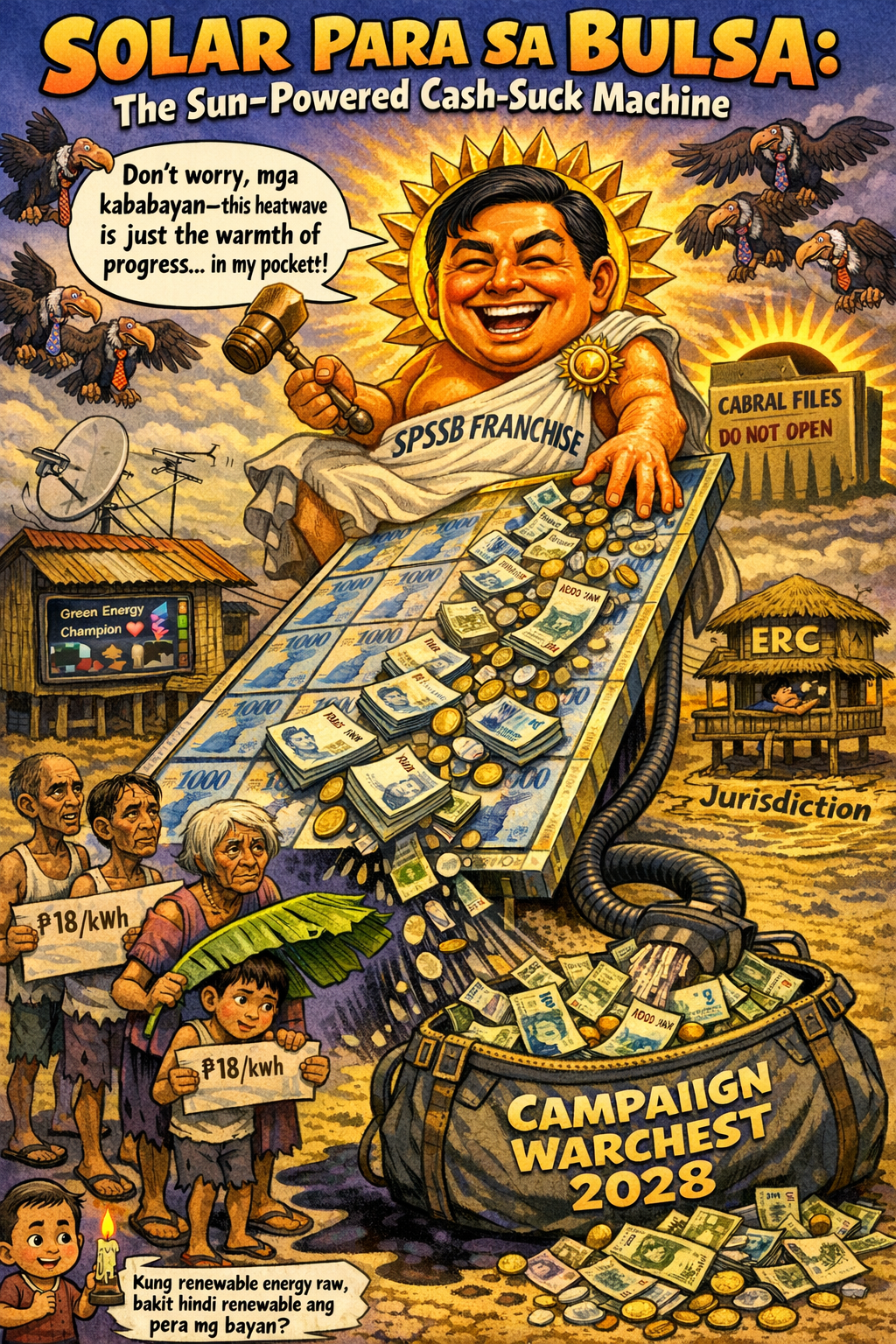
Leviste’s Solar Empire: Franchise First, Compliance Optional
By Louis “Barok” C. Biraogo — February 7, 2026
THE promise of renewable energy has collided with hypocrisy in the Philippines’ latest power scandal. Solar Para Sa Bayan Corporation (SPSB), founded by Batangas Representative Leandro Leviste, faces penalties of up to ₱150 million from the Energy Regulatory Commission (ERC). Residents in a remote town allegedly paid exorbitant rates for electricity that may have operated without proper authorization (Philippine Daily Inquirer, 5 Feb. 2026).
This case exposes flaws in regulation, politics, and accountability.
The Legal Violations
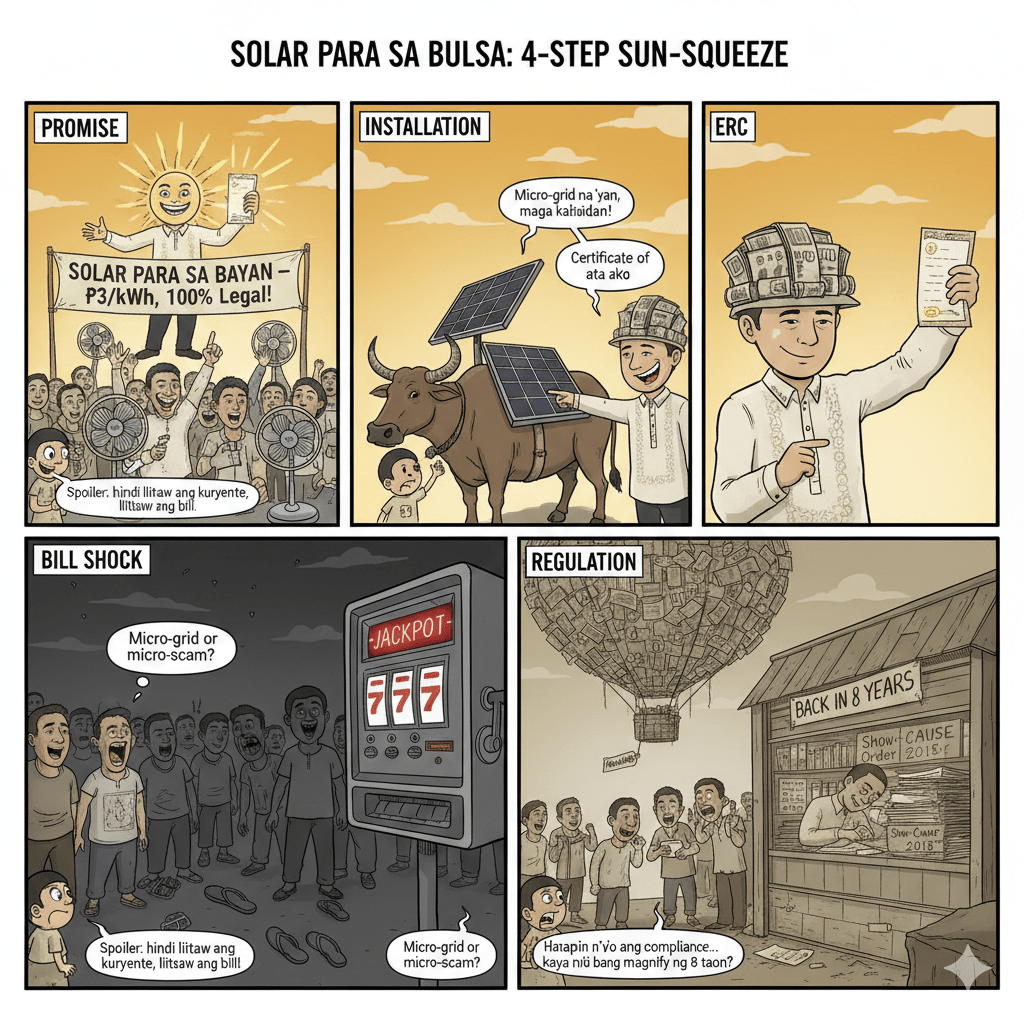
Philippine law demands strict compliance in the electricity sector. Under the Electric Power Industry Reform Act (EPIRA, Republic Act No. 9136), generation companies must secure a Certificate of Compliance (COC) before operating (Section 6). Retail rates require prior ERC approval (Section 29). SPSB allegedly began operations in Paluan, Occidental Mindoro, in 2018 without either.
SPSB’s 25-year franchise under Republic Act No. 11357 explicitly requires compliance with EPIRA and ERC rate approval (Section 5). The ERC’s show-cause order, issued January 30, 2026, outlines three violations:
- No authority to operate
- No COC
- Unapproved rates
Each carries fines up to ₱50 million.
As a lawmaker with energy interests, Leviste faces scrutiny under the Code of Conduct and Ethical Standards for Public Officials (Republic Act No. 6713), which requires divestment from conflicting businesses, and the Anti-Graft and Corrupt Practices Act (Republic Act No. 3019).
The Supreme Court has upheld ERC authority in Bayan Muna v. ERC (G.R. No. 210245), emphasizing consumer protection and due process in rate regulation.
Political Dimensions
Leviste links the probe to political retaliation over the “Cabral files,” documents allegedly exposing infrastructure irregularities. He claims warnings that cases would follow if he released them.
Timing raises questions. The ERC acted years after operations began, coinciding with the Department of Energy (DOE) terminating 163 projects—64 percent linked to Leviste’s firms—for non-delivery of over 11,000 megawatts.
Political motive does not excuse legal obligations.
Impact on Consumers
In Paluan, residents expected affordable solar power at ₱3 per kilowatt-hour. Reports indicate they paid up to ₱18 per kWh—six times higher.
For underserved communities, this turns promised relief into exploitation. Unregulated rates in captive markets punish the vulnerable.
Possible Outcomes
- ERC imposes full penalties — Reinforces regulatory authority but may deter renewable investments.
- Case dismissed or settled — Risks precedent that franchises override oversight.
- Broader fallout — Damages trust in green energy and institutional credibility.
Needed Reforms
To prevent recurrence:
- Streamline microgrid approvals while maintaining rate oversight.
- Enforce strict divestment for public officials with business interests.
- Conduct independent audits of ERC enforcement consistency.
- Require refunds for documented overcharges.
True renewable progress demands transparency, accountability, and priority for public interest over personal or political gain.
Barok out.
Key Citations
A. Legal & Official Sources
- “Electric Power Industry Reform Act of 2001.” Republic Act No. 9136, The LawPhil Project, 8 June 2001.
- “An Act Granting Solar Para Sa Bayan Corporation a Franchise to Construct, Install, Establish, Operate and Maintain Distributed Energy Resources and Microgrids.” Republic Act No. 11357, The LawPhil Project, 8 Aug. 2019.
- “Code of Conduct and Ethical Standards for Public Officials.” Republic Act No. 6713, The LawPhil Project, 20 Feb. 1989.
- “Anti-Graft and Corrupt Practices Act.” Republic Act No. 3019, The LawPhil Project, 17 Aug. 1960.
- Bayan Muna Representatives Neri Javier Colmenares and Carlos Isagani Zarate v. Energy Regulatory Commission. G.R. No. 210245, Supreme Court of the Philippines, 3 Aug. 2021, LawPhil Project.
B. News Reports
- Esmael, Lisbet K. “Another Leviste Firm Faces up to P150-M Penalty.” Philippine Daily Inquirer, 5 Feb. 2026.
- ₱75 Million Heist: Cops Gone Full Bandit

- ₱6.7-Trillion Temptation: The Great Pork Zombie Revival and the “Collegial” Vote-Buying Circus

- ₱1.9 Billion for 382 Units and a Rooftop Pool: Poverty Solved, Next Problem Please

- ₱1.35 Trillion for Education: Bigger Budget, Same Old Thieves’ Banquet

- ₱1 Billion Congressional Seat? Sorry, Sold Out Na Raw — Si Bello Raw Ang Hindi Bumili

- “We Will Take Care of It”: Bersamin’s P52-Billion Love Letter to Corruption

- “Skewed Narrative”? More Like Skewered Taxpayers!

- “Scared to Sign Vouchers” Is Now Official GDP Policy – Welcome to the Philippines’ Permanent Paralysis Economy

- “Robbed by Restitution?” Curlee Discaya’s Tears Over Returning What He Never Earned

- “No Pressure” Luistro? The House Pork Bazaar Exposed
- “My Brother the President Is a Junkie”: A Marcos Family Reunion Special

- “Mapipilitan Akong Gawing Zero”: The Day Senator Rodante Marcoleta Confessed to Perjury on National Television and Thought We’d Clap for the Creativity




 KWEBA ni BAROK
Leave a comment