
Abolish Congress? Sure—And Hand the Keys to the Dynasties
By Louis ‘Barok‘ C. Biraogo — February 9, 2026
MGA ka-kweba, grab your popcorn—or better yet, some antacids—because we have a fresh episode in the Philippines’ longest-running teleserye: “How Politicians Pretend to Be Serious While Destroying Democracy.”
Today’s star? Former Anti-Red Tape Authority (ARTA) Director Rabindranath Quilala, who suddenly released a position paper—first reported by Politiko—that reads like the manifesto of an over-caffeinated accountant.
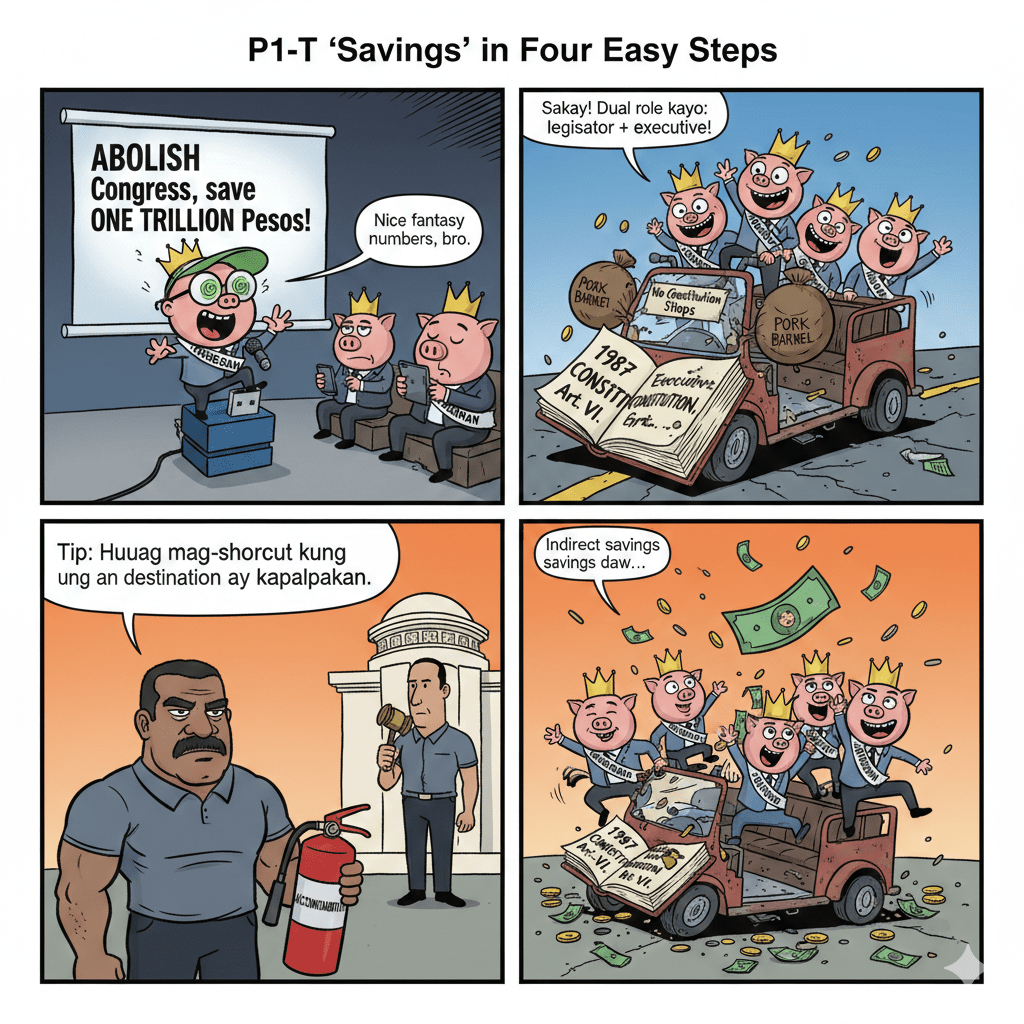
His proposal: abolish the Senate, the House of Representatives, and all local legislative councils. Replace them with a “streamlined executive-technocratic model” where governors and mayors double as national legislators while still performing their local duties. Bonus feature: barangay captains will handle legislation at the municipal level. And the grand prize? A claimed P1 trillion in annual savings.
One trillion pesos. Let’s say that again: one trillion pesos. It’s as if he declared, “If we just eliminate all legislators, we’ll have enough money for free MRT rides, free tuition, and free lechon at every barangay fiesta.” If saving money were really that easy, why not just abolish taxes and pray someone else pays the bills?
The “P1 Trillion” Fantasy: Math Without Receipts
Let’s examine his numbers. He claims P355–575 billion in direct savings, and up to P1 trillion when “indirect savings”—reduced patronage and faster processes—are included.
Indirect savings? How exactly do you calculate “corruption disappears” and “bureaucracy speeds up”? Does he have an Excel sheet with columns labeled “Assumed Honesty Multiplier” and “Zero Graft Factor”?
This is the classic technocrat daydream: remove the people, and you remove the people’s problems. Reality check: corruption in the Philippines isn’t caused by too many seats in Congress—it’s caused by the tiny consciences of the people sitting in them. And if governors and mayors become national legislators, things could get worse: their local pork barrels would simply scale up to national size. Hello, P1-trillion infrastructure projects still riddled with overpricing.
Constitutional Evisceration: This Isn’t an Amendment—It’s a Revision, and Still Illegal
I don’t need to be a Supreme Court justice to declare this unconstitutional. Let’s read the 1987 Constitution, Article VI, Section 1: “The legislative power shall be vested in the Congress of the Philippines which shall consist of a Senate and a House of Representatives.” Crystal clear. This isn’t something we can casually change on a whim. It is an enshrined structure.
This proposal isn’t a mere “amendment.” It is a revision—a fundamental alteration of the form of government. According to Lambino v. COMELEC (G.R. No. 174153, 2006), changing the basic principle of bicameralism and separation of powers constitutes a revision, not a minor tweak. And revisions cannot be accomplished through People’s Initiative (Santiago v. COMELEC (G.R. No. 127325, 1997)). They require either a Constituent Assembly or a Constitutional Convention—both processes as difficult as climbing Everest while carrying a piano, as outlined in Article XVII.
What about local autonomy under Article X and Republic Act No. 7160 (Local Government Code of 1991)? Suddenly abolish the sanggunians and turn executives into legislators? Good luck preserving separation of powers. We might end up with a single “executive-legislative-judicial” branch—all in one person.
The Real Disease: State Capture and the Elite Circus
But let’s not give Quilala too much credit. His proposal isn’t a solution—it’s a symptom of a much deeper illness.
Our Congress? An elite club that adjourns faster for long weekends than it passes important laws. Pork barrel remnants persist—insertions here, insertions there—while budget deliberations drag on like a teleserye with no ending.
Local councils? Training grounds for political dynasties. One family member is governor, another congressman, another mayor, another councilor—and they all reunite for Christmas anyway. Even ARTA, Quilala’s former agency, struggles with bureaucratic inertia because the laws needed to streamline government are stuck in a Congress unwilling to surrender power.
The real problem is state capture: the economic and political elite dictate what counts as “reform.” Quilala, a former ARTA official, is likely frustrated by the legislative gridlock that blocks anti-red tape efforts. But is the answer really to give even more power to local executives—most of whom belong to dynasties? That risks turning them into feudal lords with national reach.
The Political Theater: Who’s Behind the Curtain?
Is Quilala a genuine reformer with a technocratic vision? A gadfly craving attention? Or is this a trial balloon floated by some faction to gauge anti-Congress sentiment? In an era when Cha-Cha ghosts are once again stirring, it’s not far-fetched that someone is circulating such ideas to divert attention.
Congress? Expect performative outrage—resolutions condemning the proposal, Facebook posts proclaiming “We stand for democracy!”—while quietly protecting their pork and absentee privileges. Hypocrisy level: expert.
The administration? If anti-elite polling looks favorable, they might stay silent. If not, the proposal will suddenly become a “threat to democracy.”
The Path Forward: Not Destruction, but Discipline
Quilala’s proposal will die in ignominy—and it should. It isn’t serious policy; it’s a frustrated rant dressed up as a PowerPoint. But let’s not waste the opportunity it presents: use it to push genuine reform.
We don’t need constitutional wreckage. What we need is:
- Passage of the long-stalled Anti-Political Dynasty Law.
- Strict enforcement of Republic Act No. 6713 (Code of Conduct and Ethical Standards for Public Officials and Employees) and real teeth for the Ombudsman.
- Full transparency in the budget process—livestreamed deliberations, real-time Commission on Audit (COA) reporting.
- Strengthening the party-list system so it truly represents sectors, not celebrities and cronies.
- Discipline for Congress: no work, no pay; cut the pork; faster lawmaking.
Mga ka-kweba, our democracy is sick—but it isn’t cancer that requires total amputation. What it needs is chemotherapy: relentless accountability, genuine public service, and uncompromising war on corruption and dynasties.
If we want a government that is fast, efficient, and truly pro-people, we should not destroy our institutions. We should force them to serve us—not their own pockets.
Until the next chapter of our political circus.
– Barok
The only thing more predictable than dynasties is the next politician who’ll pretend to be shocked by them.
Key Citations
A. Legal & Official Sources
- The 1987 Constitution of the Republic of the Philippines. Official Gazette of the Republic of the Philippines.
- Republic Act No. 7160 (Local Government Code of 1991). Official Gazette of the Republic of the Philippines, 10 Oct. 1991.
- Republic Act No. 6713 (Code of Conduct and Ethical Standards for Public Officials and Employees). Official Gazette of the Republic of the Philippines, 20 Feb. 1989.
- Lambino v. Commission on Elections, G.R. No. 174153. Supreme Court of the Philippines, 25 Oct. 2006.
- Santiago v. Commission on Elections, G.R. No. 127325. Supreme Court of the Philippines, 19 Mar. 1997.
B. News Reports
- ₱75 Million Heist: Cops Gone Full Bandit

- ₱6.7-Trillion Temptation: The Great Pork Zombie Revival and the “Collegial” Vote-Buying Circus

- ₱1.9 Billion for 382 Units and a Rooftop Pool: Poverty Solved, Next Problem Please

- ₱1.35 Trillion for Education: Bigger Budget, Same Old Thieves’ Banquet

- ₱1 Billion Congressional Seat? Sorry, Sold Out Na Raw — Si Bello Raw Ang Hindi Bumili

- “We Will Take Care of It”: Bersamin’s P52-Billion Love Letter to Corruption

- “Skewed Narrative”? More Like Skewered Taxpayers!

- “Scared to Sign Vouchers” Is Now Official GDP Policy – Welcome to the Philippines’ Permanent Paralysis Economy
- “Robbed by Restitution?” Curlee Discaya’s Tears Over Returning What He Never Earned

- “No Pressure” Luistro? The House Pork Bazaar Exposed
- “My Brother the President Is a Junkie”: A Marcos Family Reunion Special

- “Mapipilitan Akong Gawing Zero”: The Day Senator Rodante Marcoleta Confessed to Perjury on National Television and Thought We’d Clap for the Creativity



 KWEBA ni BAROK
Leave a comment