By Louis ‘Barok‘ C. Biraogo — February 14, 2026
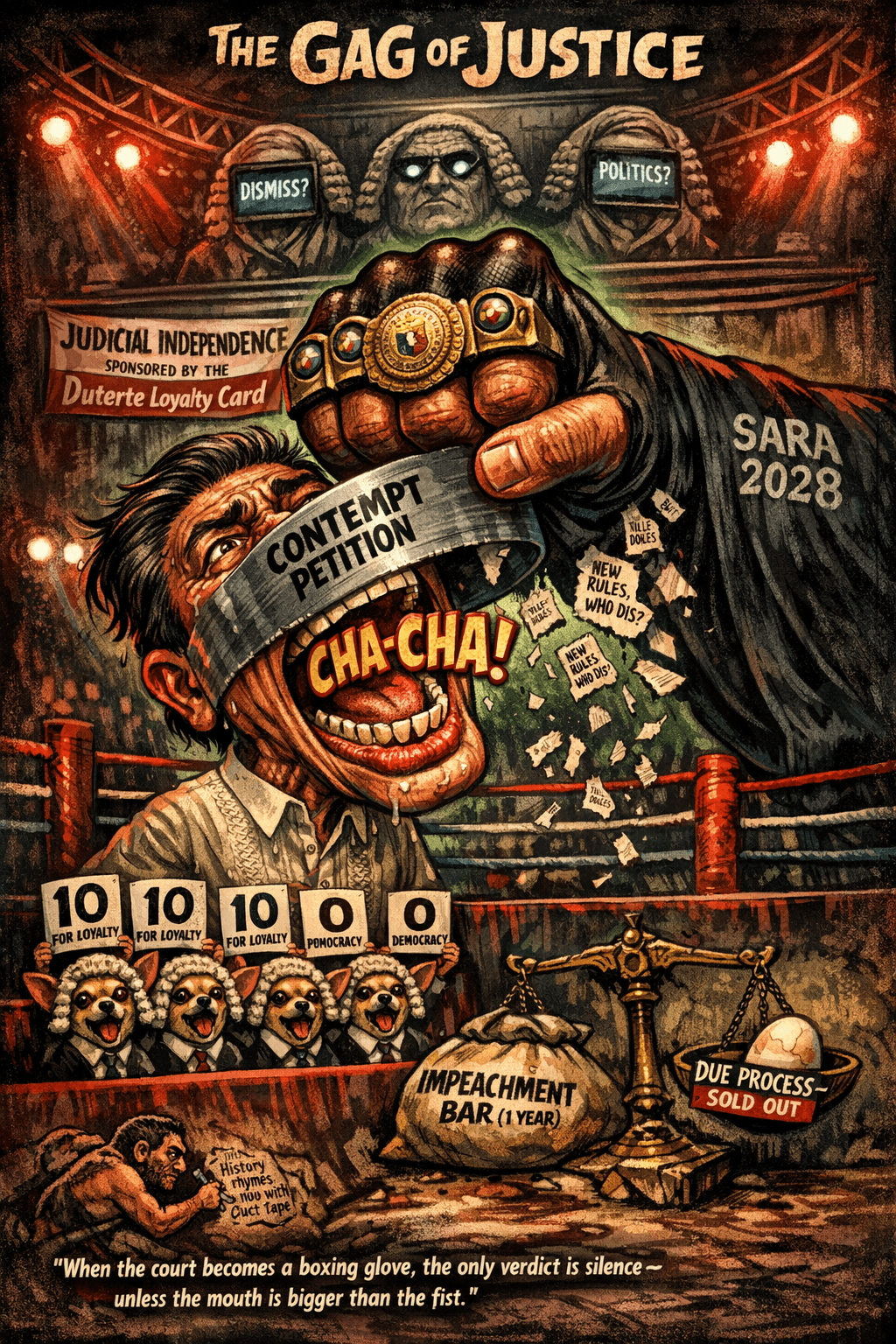
MGA ka-kweba, loyal readers of the Kweba, brace yourselves. Today we rip open one of the filthiest chapters of Philippine politics in 2026. This is not mere Senate gossip or an X troll post – this is a petition designed to silence the Senate President through the blunt instrument of contempt of court. At its core? The never-ending war among the three branches of government, now weaponizing the Supreme Court against one outspoken critic.
On February 13, 2026, five lawyers – Manuelito Delos Reyes Luna, Harold Respicio, Ferdinand Topacio, Virgilio Garcia – together with social media personality Mary Catherine Diaz Binag, all well-known die-hard supporters of the Duterte family, filed a 15-page petition before the Supreme Court. Their target: Senate President Vicente “Tito” Sotto III.
The charge: indirect contempt for his public statements criticizing the Court’s ruling on the impeachment case against Vice President Sara Duterte.
According to the petitioners, Sotto’s use of phrases such as “judicial overreach,” “encroachment,” and his suggestion to study Charter change (Cha-cha) to clarify impeachment rules were “demeaning, degrading, and disrespectful.” They claim his remarks crossed the line from legitimate commentary. The judiciary’s integrity, they insist, must be protected.
And I, Barok, laugh out loud. Because the real overreach here is not Sotto’s mouth – it is the brazen attempt to turn the Court’s contempt power into a political sledgehammer aimed at the head of an opponent.
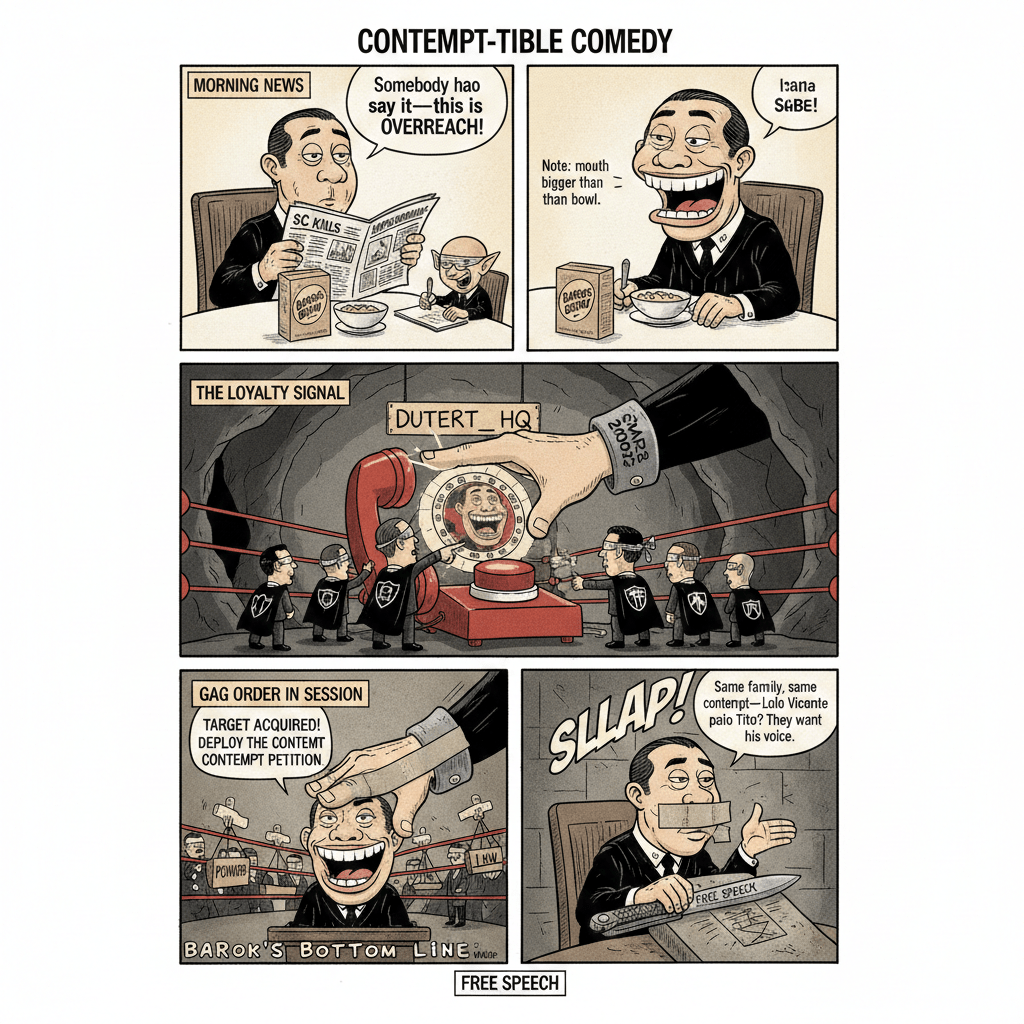
This Is Not a Legal Question – It Is Inter-Branch Warfare
Don’t lecture me about Rule 71, Section 3(d) of the Rules of Court. I know what indirect contempt is: any act outside the courtroom that “tends, directly or indirectly, to impede, obstruct, or degrade the administration of justice.”
But where does this sudden outrage come from?
Let’s go back to the root. In 2025–2026 the Supreme Court unanimously declared the Articles of Impeachment against Sara Duterte unconstitutional. Reasons? Violation of the one-year bar under Article XI, Section 3(5) of the 1987 Constitution, due-process violations, insufficient dissemination of evidence to House members, and – most controversially – seven brand-new “procedural standards” that appeared out of nowhere. On January 28, 2026, the Court made the ruling final by denying the House’s motion for reconsideration.
January 30, 2026: Sotto reacted in the media. He called it “judicial overreach” and an “encroachment” on Congress’s exclusive impeachment power. He said that if the Court can effectively “amend” the Constitution through interpretation, then Congress – which is actually empowered to amend it – should do the same. He added the now-infamous line about it possibly taking “years or several retirements” before the Court changes “the way it thinks,” and hinted at a “different agenda.”
To the petitioners, that is contemptuous insult. To me? That is a bold defense of separation of powers. The real question is: Who overstepped – the Senate that spoke the truth, or the Court that suddenly invented rules absent from the 1987 Constitution?
Dissecting Sotto’s “Crimes”: Protected Speech or Contempt?
First, let’s examine Sotto’s defense.
The 1987 Constitution, Article III, Section 4 guarantees: “No law shall be passed abridging the freedom of speech…” The right is not absolute, true, but Philippine jurisprudence grants public officials wide latitude in policy criticism.
In People v. Godoy (G.R. Nos. 115908-09, 1995), the Court held that elected officials enjoy broader tolerance for statements on public issues. Sotto issued no explicit threat to defy any Court order. He made no call to “disobey.” He merely suggested constitutional amendment – a perfectly legal and democratic process.
What about legislative privilege? While Article VI, Section 11 protects statements made inside sessions, many legal scholars argue the principle extends to public commentary on core legislative matters. Impeachment is the legislature’s exclusive domain. As Senate President, Sotto has a duty to defend it.
The petitioners counter that he went beyond “fair criticism.” They cite In re Almacen (G.R. No. L-27654, 1970): scandalous attacks on the judiciary can constitute contempt. They also invoke Nestle Philippines v. Sanchez (G.R. No. L-75209, 1987): speech creating a “clear and present danger” to the administration of justice may be punished.
But where is the clear and present danger here? There is zero evidence that public confidence in the judiciary collapsed because of Sotto. And if hinting at a “hidden agenda” is now contemptuous, why were retired Justice Adolf Azcuna and Fr. Ranhilio Aquino – who said virtually the same thing – never petitioned against? Why only Sotto?
The Supreme Court’s Impeachment Ruling: Constitutional Jurisprudence or Naked Power Grab?
The elephant in the room: the ruling itself on Sara Duterte.
In Francisco v. House of Representatives (G.R. No. 160261, 2003), the Court affirmed its power of judicial review over impeachment proceedings when there is grave abuse of discretion. But in Sara’s case, many argue the Court went far beyond – suddenly imposing a probable-cause threshold, mandatory full dissemination of evidence, and other requirements nowhere to be found in the Constitution. As Sotto put it, the ruling turned impeachment into an “impossible dream.”
Supporters of the decision: “Essential to safeguard due process.” Critics: “Judicial legislation.” My cynicism kicks in here – why did the Court become ultra-strict on procedure exactly when the Marcos-Duterte rift was at its peak? Why did these “new standards” appear perfectly timed to kill an impeachment against a massively popular Vice President?
This is not neutral jurisprudence. This is inter-branch warfare dressed in black robes.
The Petitioners: Defenders of the Judiciary or Duterte Attack Dogs?
Ferdinand Topacio has been the loudest: “It goes beyond legitimate commentary.” Really? During Rodrigo Duterte’s presidency these same voices had no problem with phrases like “kill the addicts” or calling Barack Obama a “son of a whore.” Selective outrage much?
Every single petitioner is a known Duterte loyalist. Topacio has long served as the family’s lawyer. The timing? Immaculate – filed right as fresh impeachment complaints against Sara (now supposedly “compliant” with the Court’s new rules) are being prepared, and amid swirling rumors of a Senate coup against Sotto being pushed by pro-Duterte senators such as Escudero and Estrada. (See the original report: Supreme Court asked to cite Tito Sotto in indirect contempt)
This is not about defending the judiciary. This is about shielding a political ally from accountability over allegations of misuse of confidential funds and assassination threats.
And the hypocrisy? Under Republic Act No. 6713 (Code of Conduct and Ethical Standards for Public Officials and Employees), public officers must avoid conduct that erodes public trust. Yet filing an obviously partisan contempt petition – doesn’t that erode trust in the justice system too?
The Political Swamp: Marcos-Duterte Proxy War, Senate Coup Rumors, 2028 Ambitions
This is no isolated incident. It is part of a larger proxy war.
- Senate coup rumors – Whispers of a plot to oust Sotto, tied to a flood-control corruption scandal implicating pro-Duterte senators. Imee Marcos denies involvement, but the alignments are obvious.
- Marcos vs. Duterte rift – Sotto is widely seen as anti-Duterte and aligned with the Marcos bloc. The contempt petition weakens his leadership ahead of the 2028 elections.
- Disinformation campaigns – Pro-Duterte trolls insist the Supreme Court ruling was a full “exoneration” of Sara, even though it was purely procedural. Sotto has been the loudest voice saying otherwise.
- Family irony – Tito Sotto’s grandfather, Vicente Sotto, was fined P1,000 by the Supreme Court in 1949 for contempt after calling justices “incompetent.” Now the grandson faces the same weapon.
History doesn’t repeat – but it sure rhymes with a vengeance.
Possible Endgames: What Happens Next?
- Dismissal of the petition – Most likely outcome. The Court knows that entertaining this would make it look politically motivated. Precedent from In re Emil Jurado (A.M. No. 93-2-037 SC, 1995): public commentary is not automatically contempt unless it is sub judice and clearly prejudicial.
- Mild admonition – A warning with no penalty. Looks “balanced” without real teeth.
- Actual contempt finding – Extremely unlikely, but if it happens: full-blown constitutional crisis, massive backlash, and widespread accusations of weaponization.
- Ethics complaint in the Senate – The petitioners’ next move. Good luck – Sotto’s allies still control the ethics committee.
Implications
- If the petitioners win: chilling effect on robust political speech. No one will dare criticize the Court sharply again.
- If they lose: reinforcement of legislative independence, but even deeper polarization between branches.
- For Sotto: political martyrdom or weakened position, depending on the outcome.
- For the nation: further erosion of trust in institutions.
Barok’s Verdict: Who Really Deserves Contempt?
The true contempt here is the attempt to weaponize the Supreme Court to silence legitimate criticism. The real overreach is the invention of new impeachment rules that conveniently shield a powerful political figure.
Tito Sotto is no saint. A long-time politician with his own ambitions. But on this issue, he is correct. And the petition against him is a transparent political hit job by the Duterte camp using its loyal foot soldiers.
If you want to protect democracy:
- Defend the right of public officials to speak freely on matters of policy.
- Hold the Court accountable when it exceeds the bounds of judicial review.
- Never be afraid to call out hypocrisy, no matter who wears the robe.
To the Supreme Court: Dismiss this petition. Do not become a tool of political vendetta. Because if you entertain it, you will be the ones who truly appear contemptuous in the eyes of the people.
Fight for truth. Fight against those who hide behind the law to protect their power. Fight every form of overreach.
Because in this country, criticizing robes is more dangerous than wearing them,
— Barok
Keeping score while they keep scorecards.
Key Citations
A. Legal & Official Sources
- The 1987 Constitution of the Republic of the Philippines. Official Gazette of the Republic of the Philippines.
- Code of Conduct and Ethical Standards for Public Officials and Employees. Republic Act No. 6713, The LawPhil Project, 20 Feb. 1989.
- Rules of Court (Rules 1-71, Civil Procedure). The LawPhil Project, 8 Apr. 1997.
- Francisco, Ernesto B., Jr. v. House of Representatives. G.R. No. 160261, Supreme Court of the Philippines, 10 Nov. 2003, The LawPhil Project.
- In re Almacen. G.R. No. L-27654, Supreme Court of the Philippines, 18 Feb. 1970, The LawPhil Project.
- People v. Godoy. G.R. Nos. 115908-09, Supreme Court of the Philippines, 6 Dec. 1995, The LawPhil Project.
- In re Emil Jurado. A.M. No. 93-2-037 SC, Supreme Court of the Philippines, 6 Apr. 1995, The LawPhil Project.
- Nestle Philippines, Inc. v. Sanchez. G.R. No. L-75209, Supreme Court of the Philippines, 30 Sept. 1987, The LawPhil Project.
B. News R9eports
- ₱75 Million Heist: Cops Gone Full Bandit

- ₱6.7-Trillion Temptation: The Great Pork Zombie Revival and the “Collegial” Vote-Buying Circus

- ₱1.9 Billion for 382 Units and a Rooftop Pool: Poverty Solved, Next Problem Please

- ₱1.35 Trillion for Education: Bigger Budget, Same Old Thieves’ Banquet

- ₱1 Billion Congressional Seat? Sorry, Sold Out Na Raw — Si Bello Raw Ang Hindi Bumili

- “We Will Take Care of It”: Bersamin’s P52-Billion Love Letter to Corruption
- “Skewed Narrative”? More Like Skewered Taxpayers!

- “Scared to Sign Vouchers” Is Now Official GDP Policy – Welcome to the Philippines’ Permanent Paralysis Economy
- “Robbed by Restitution?” Curlee Discaya’s Tears Over Returning What He Never Earned

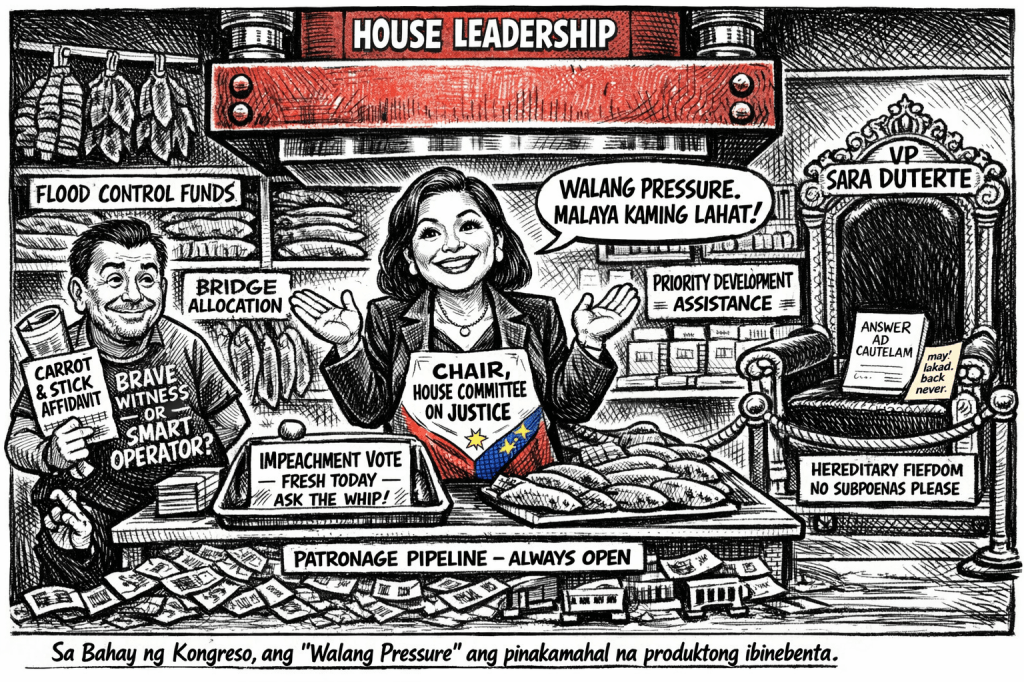
- “No Pressure” Luistro? The House Pork Bazaar Exposed
- “My Brother the President Is a Junkie”: A Marcos Family Reunion Special

- “Mapipilitan Akong Gawing Zero”: The Day Senator Rodante Marcoleta Confessed to Perjury on National Television and Thought We’d Clap for the Creativity


 KWEBA ni BAROK
Leave a comment