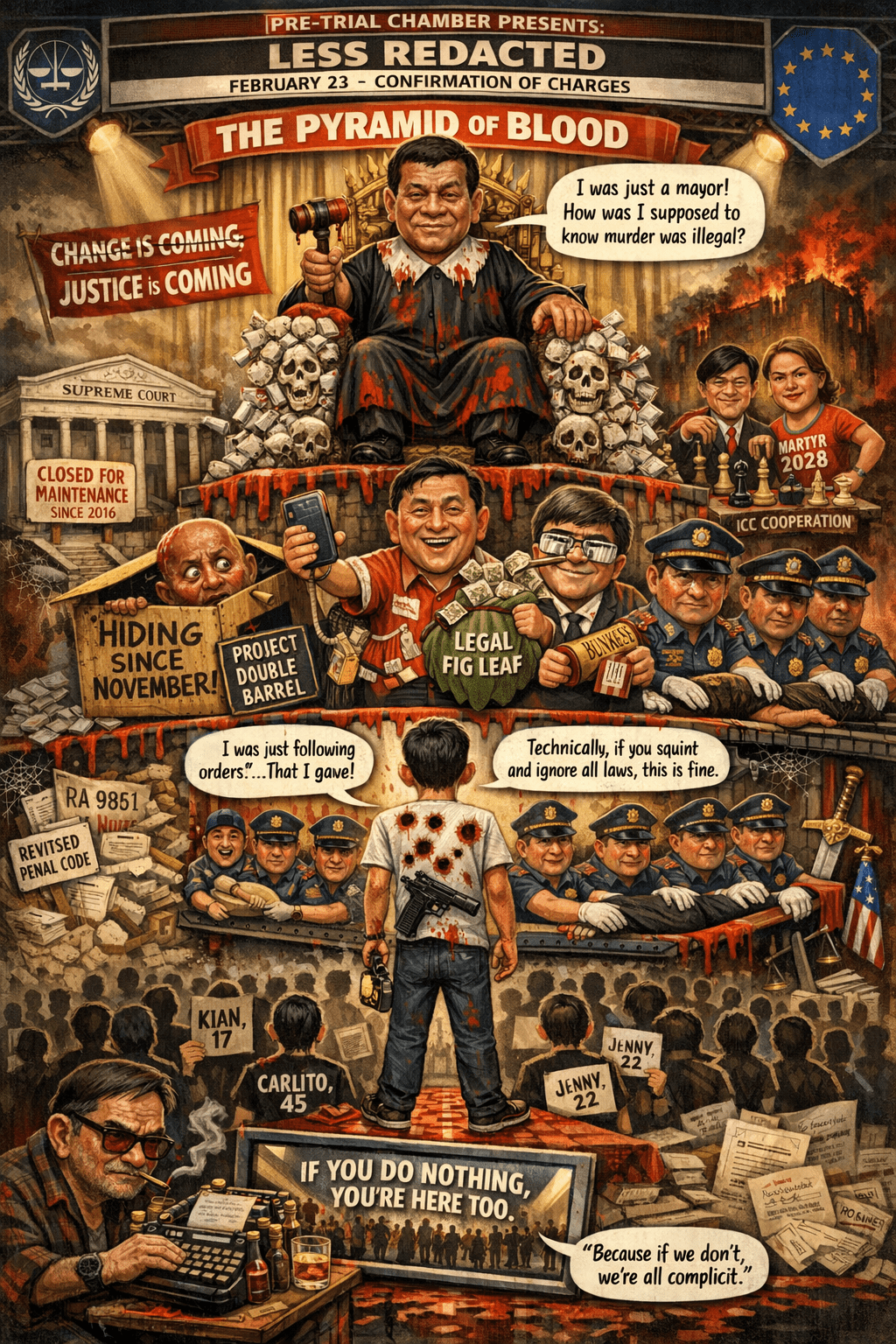
Tokhang Architects Exposed: Senators, PNP Chiefs & Duterte’s Inner Circle Allegedly Ran the Rewards-for-Bodies Program
By Louis ‘Barok‘ C. Biraogo — February 15, 2026
MGA ka-kweba, grab your empi light and buckle up, because the International Criminal Court (ICC) just turned the lights on in the darkest corner of Philippine history. The Hague’s Pre-Trial Chamber dropped a “less redacted” bomb—eight names, eight loyal lapdogs—who allegedly sat in the middle tier of former President Rodrigo Duterte’s death machine, wielding “de facto authority” over the triggermen who turned poor neighborhoods into shooting galleries.
Senators Ronald “Bato” dela Rosa and Christopher “Bong” Go, former Justice Secretary Vitaliano Aguirre II, and a rogues’ gallery of ex-Philippine National Police (PNP) chiefs: Vicente Danao Jr., Isidro Lapeña, Oscar Albayalde, the late Camilo Cascolan, and Dante Gierran. Ladies and gentlemen, meet the Davao 8—the middle management of murder, now officially outed ahead of Duterte’s confirmation of charges hearing on February 23.
It’s like watching a crime syndicate’s org chart get projected on the big screen. And oh, how the mighty are scrambling.
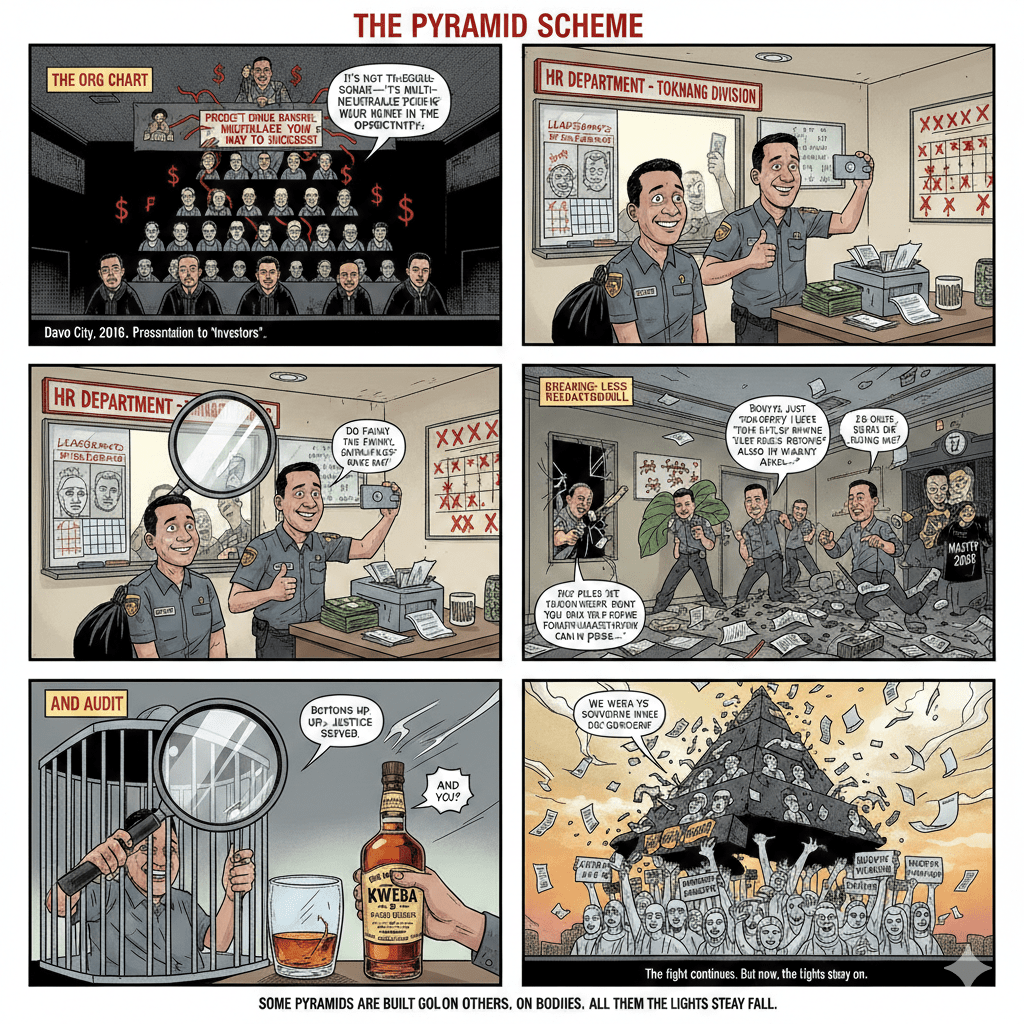
The Legal Autopsy: How the OTP Built This House of Cards (And Why It Might Actually Stand)
The Office of the Prosecutor (OTP) isn’t playing patintero here. They’re going for indirect co-perpetration under Article 25(3)(a) of the Rome Statute—the gold standard for pinning liability on the big fish who never pulled the trigger but controlled the ocean anyway.
Think of it as the ultimate heist movie: Duterte as the mastermind at the top, barking orders from Malacañang; the Davao 8 as the lieutenants who coordinated the crews, handed out the “rewards,” and made sure the bodies piled up according to plan.
The theory? A “common plan or agreement” to “neutralize” anyone even whispered to be involved in drugs—through murder, of course. It started small in Davao with the Death Squad (Duterte needed to personally approve kills, the brief claims), then went nationwide with “Project Double Barrel” under Bato’s enthusiastic direction.
Bong Go allegedly ran the “rewards system”—because nothing says “effective policing” like paying bonuses for bodies. Aguirre provided the legal fig leaf, while the police chiefs turned the PNP into a conveyor belt of corpses.
The OTP’s best case is airtight on paper: hierarchical control (Lubanga and Katanga precedents), essential contributions (you can’t scale a local hit squad to 30,000 dead without loyal middlemen), and full knowledge that this was a widespread attack on civilians (Article 7 of the Rome Statute).
Human rights groups peg the toll at up to 30,000—mostly poor, mostly planted with a sachet and a gun.
But here’s where I start sharpening the scalpel: Is the evidence really there? Witness testimonies from retired cops? Operational plans? Reward ledgers? The brief cites 76 specific murders, including Kian delos Santos and Mayor Parojinog, but the rest is redacted.
The defense will scream “hearsay” and “political persecution.” And let’s be real—the ICC has to prove not just proximity to Duterte, but actual control over the crime. Bong Go taking selfies and handing out cash isn’t automatically co-perpetration; it could just be… Bong Go being Bong Go.
Still, if the OTP has the receipts, this pyramid collapses straight onto the Senate floor.
The Defense’s Delusions: Sovereignty as a Human Shield
Ah, the greatest hits: “The ICC has no jurisdiction!” “We withdrew in 2019!” “Complementarity—our courts are handling it!” Spare me.
Article 127(2) of the Rome Statute is crystal clear: withdrawal doesn’t wipe out jurisdiction for crimes committed while we were members. The killings spanned 2011–2019. Game over.
Complementarity under Article 17 of the Rome Statute? Laughable. The Philippines’ “investigations” were a masterclass in futility—police investigating police, DOJ reviews that went nowhere, and a Supreme Court that treated extrajudicial killings like traffic violations.
Remember Pangilinan v. Cayetano? It upheld withdrawal but never touched ongoing obligations for pre-withdrawal crimes. Bayan Muna v. Romulo recognized complementarity, yet here we are because domestic justice was about as genuine as a PNP “nanlaban” report.
And the “rogue actors” defense? Please. When the President publicly orders killings and appoints the same Davao boys to run the national campaign, it’s not rogue—it’s policy.
The Philippine Legal Labyrinth: Where RA 9851 Gathers Dust
We have Republic Act No. 9851, our very own Crimes Against Humanity law, incorporating the Rome Statute wholesale. We have the Revised Penal Code‘s murder provisions. We have the PNP’s ethical standards—probably used as toilet paper during Tokhang.
Yet not one meaningful prosecution of the architects. Why? Because our courts bend like bamboo when the powerful lean on them.
The 1987 Constitution‘s right to life (Article III, Section 1) isn’t a suggestion—it’s supposed to be inviolable. But for six years, it was optional if you were poor and on a barangay list.
So the ICC steps in, not because it loves meddling, but because our system failed spectacularly.
The Political Soap Opera: Marcos vs. Duterte, Season 2028
This isn’t just law—it’s the bloodiest telenovela since Dynasty. Bongbong Marcos, quietly letting the ICC plane land for Duterte’s arrest, now watches as the noose tightens on the Duterte bloc. Coincidence? Or brilliant chess move to neuter Sara’s 2028 presidential run?
Think about it: cooperate fully, and the Dutertes scream “traitor!” while their Senate votes evaporate. Obstruct, and the world treats us like a rogue state. Marcos is playing both sides—publicly “respecting sovereignty,” privately letting the Hague do the dirty work.
Sara’s martyrdom strategy? Genius on paper. Run from The Hague’s shadow, rally the base with “foreign interference!” cries, turn an arrest warrant into a campaign badge. But can you win Malacañang while dodging Interpol? Ask her dad—he’s already in custody.
And the named senators? Bato’s been hiding since November, convinced there’s a warrant (there isn’t—yet). From “top cop” to top coward. Bong Go, the eternal sidekick, reduced to “chief wallet of the death squad.” These aren’t masterminds; they’re panicked loyalists realizing the spotlight burns.
The Actors’ Little Games: Cowardice with a Side of Calculus
- Marcos: Option A—full cooperation, watch Duterte allies implode, look like a statesman. Option B—obstruct, appease the base, risk EU trade deals and US military aid. He’s choosing the quiet knife.
- Bato: Current plan—hide. Future plan—hide harder. Legal plan—claim he was just following orders while being the one who scaled the killing nationwide. Bold strategy, Cotton.
- The ICC: They could issue warrants post-confirmation, but they’ll pick the “most responsible.” Sorry, middle management—some of you might dodge the dock but not the stigma.
The Crystal Ball: Predictions from the Bottom of the Bottle
- Best case: Confirmation sails through, warrants drop, trial exposes everything. Changes nothing on the ground, but history remembers.
- Likely case: Jurisdictional appeals delay, warrants issued but unenforced, political deal emerges—quiet amnesty whispers, 2028 becomes a referendum on impunity.
- Worst case: Appeals Chamber buys the sovereignty argument, case collapses, Dutertes declare victory, victims forgotten again.
My bet? The case survives jurisdiction. Warrants for at least Bato and Go. 2028 turns into Sara vs. Whoever, with “drug war” as the ghost haunting every ballot.
The Final Verdict: Enough with the Farce
This isn’t about foreign courts meddling. This is about us—about a 17-year-old boy named Kian delos Santos, dragged from his home, forced to hold a gun he’d never touched, shot dead while begging for his life. About thousands of poor families who lost fathers, sons, brothers to a war that was never about drugs and always about power.
The Constitution promised them life. Duterte and his enablers broke that promise in blood.
To the powerful still hiding, still denying, still arrogantly waiting for this to blow over: it won’t. Justice catches up. It always does.
Demand the reckoning. Demand transparency. Demand that the Philippines finally chooses life over death squads.
Because if we don’t, we’re all complicit.
— Barok
Bottoms up to the victims. The fight continues.
Key Citations
A. Legal & Official Sources
- Rome Statute of the International Criminal Court. International Criminal Court, 2024.
- Philippine Act on Crimes Against International Humanitarian Law, Genocide, and Other Crimes Against Humanity. Republic Act No. 9851, Official Gazette of the Republic of the Philippines, 11 Dec. 2009.
- The Revised Penal Code. Act No. 3815, The LawPhil Project, 8 Dec. 1930.
- The 1987 Constitution of the Republic of the Philippines. Official Gazette of the Republic of the Philippines.
- Pangilinan v. Cayetano, G.R. No. 238875, Supreme Court of the Philippines, 16 Mar. 2021, The LawPhil Project.
- Bayan Muna v. Romulo, G.R. No. 159618, Supreme Court of the Philippines, 1 Feb. 2011, The LawPhil Project.
B. News Reports
- “Forthwith” to Farce: How the Senate is Killing Impeachment—And Why Enrile’s Right (Even If You Can’t Trust Him)
- “HINDI AKO NAG-RESIGN!”

- “I’m calling you from my new Globe SIM. Send load!”

- “Mahiya Naman Kayo!” Marcos’ Anti-Corruption Vow Faces a Flood of Doubt

- “Meow, I’m calling you from my new Globe SIM!”

- “No Special Jail for Crooks!” Boying Remulla Slams VIP Perks for Flood Scammers

- “PLUNDER IS OVERRATED”? TRY AGAIN — IT’S A CALCULATED KILL SHOT

- “Several Lifetimes,” Said Fajardo — Translation: “I’m Not Spending Even One More Day on This Circus”

- “Shimenet”: The Term That Broke the Internet and the Budget
- “We Did Not Yield”: Marcos’s Stand and the Soul of Filipino Sovereignty

- “We Gather Light to Scatter”: A Tribute to Edgardo Bautista Espiritu

- $150M for Kaufman to Spin a Sinking Narrative

 KWEBA ni BAROK
Leave a comment