How a Minor’s Rape Complaint Became Collateral Damage in the DOJ’s High-Stakes Sabungeros Prosecution
By Louis ‘Barok‘ C. Biraogo — February 17, 2026
MGA ka-kweba, hold onto your seats.
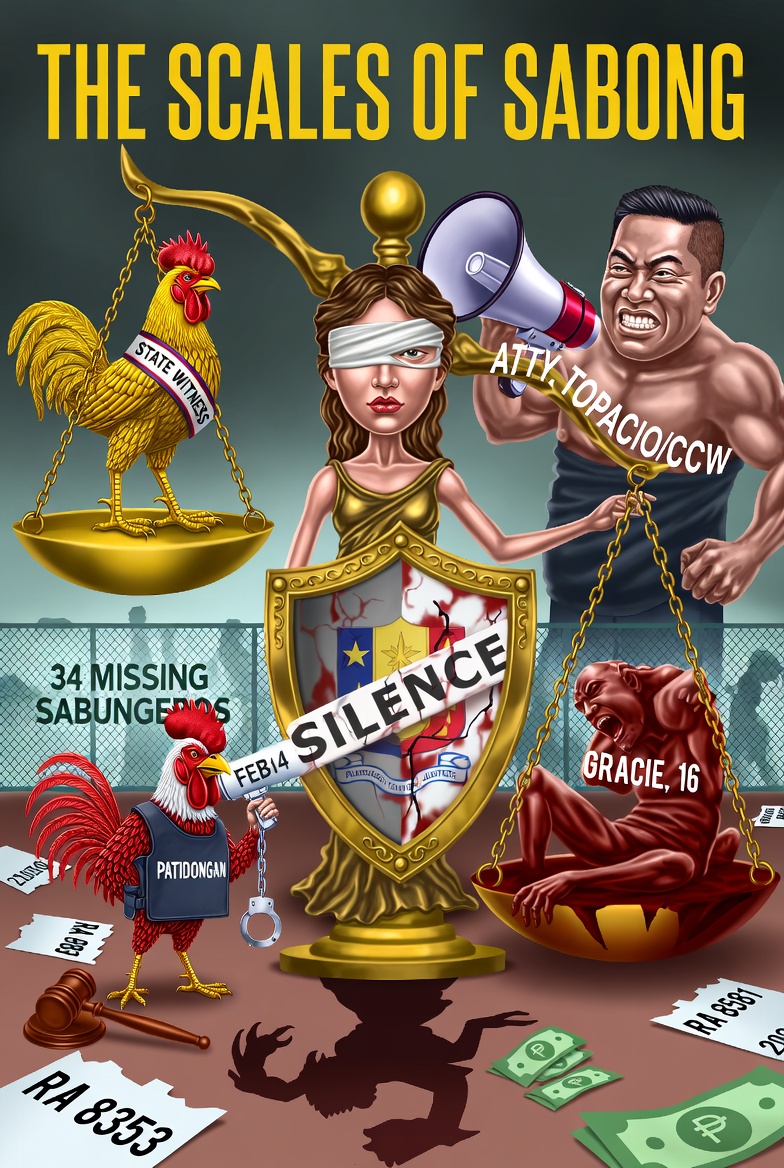
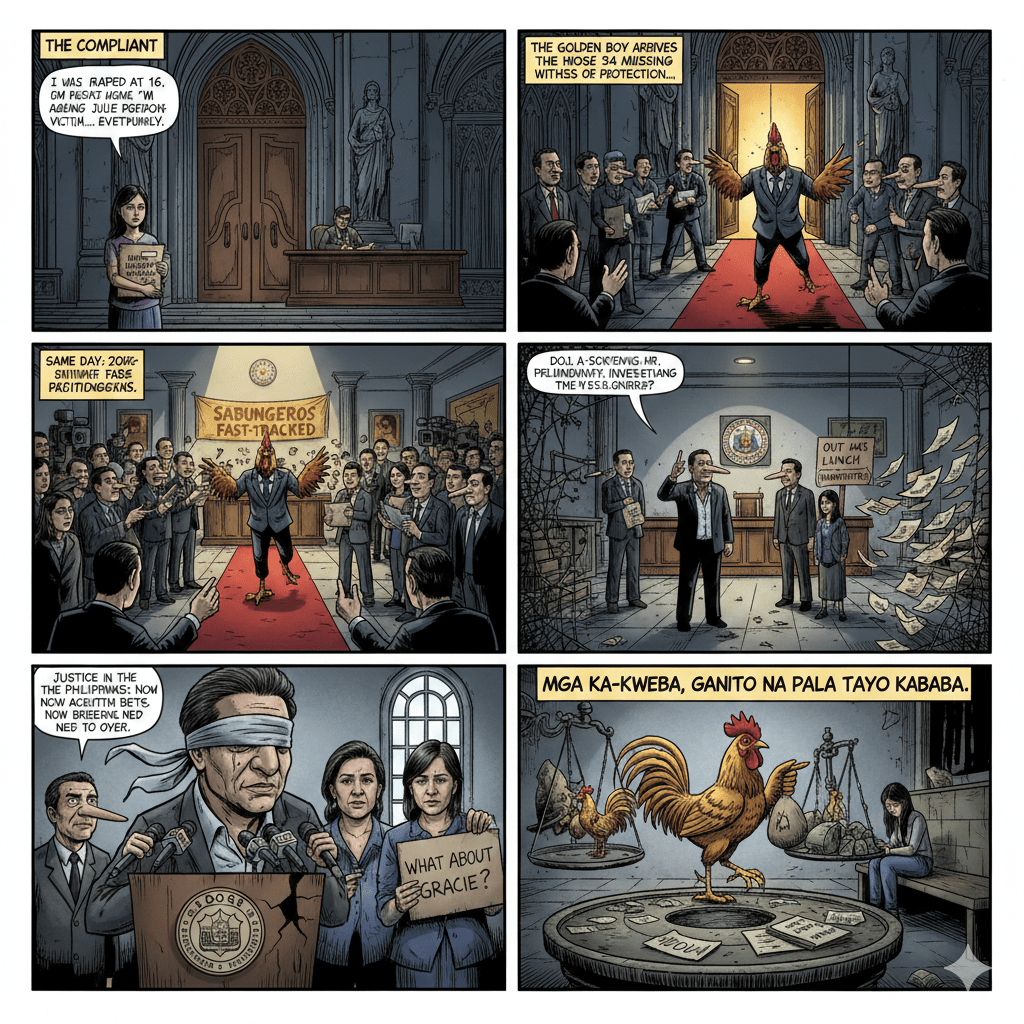
A girl raped at 16—now 21, using the pseudonym “Gracie”—alleges that Julie “Dondon” Patidongan is her attacker. Yet while her case remains stuck in preliminary investigation at the Department of Justice (DOJ), she feels she is being raped all over again—this time by the system itself. Why? Because Patidongan is the star state witness in the missing sabungeros scandal: the disappearance of at least 34 cockfighting enthusiasts, involving kidnapping, homicide, and big names like Charlie “Atong” Ang.
And the DOJ? Dead silence. No official statement. It’s as if they’re saying, “Dondon, you’re our priority right now. The girl? We’ll get to her later.”
Holy shit, DOJ. Has justice in the Philippines really sunk this low—reduced to a transactional bet like a sabong wager?
Gracie vs. The System: Victim Credibility in the Face of Trauma and Delay
Look at Gracie’s story. She was allegedly raped at age 16—statutory rape under Republic Act No. 8353 (The Anti-Rape Law of 1997), even without physical force if there was intimidation or abuse of a position of vulnerability.
Why did she only come forward now? That’s the classic victim-blaming question—and the Supreme Court has already answered it clearly: delay is not a basis for discrediting rape complainants. In People v. Orita (G.R. No. 88724, April 3, 1990), the Court explicitly recognized that trauma, fear, and shame are valid reasons for delayed reporting. Likewise, in People v. Amarela (G.R. Nos. 225642-43, January 17, 2018), the Court reaffirmed that physical resistance is not required when the victim is a minor.
Arguments Supporting Gracie
- Trauma psychology 101: She was a child when attacked, and her alleged rapist now enjoys state-witness protection. Who wants to fight that kind of opponent?
- Citizens Crime Watch (CCW)—led by Atty. Ferdinand Topacio—has stepped in with full legal aid, moral support, and counseling.
- Even Vice President Sara Duterte publicly slammed Patidongan and the DOJ on February 14, 2026, asking how the government can protect a “valuable insider” while ignoring a minor victim.
Arguments Against Gracie
Whispers suggest possible extortion motives or ties to Atong Ang’s rivals. The five-year delay is real. But even if true, delay alone does not disqualify the complaint. Evidence—not rumor—must decide.
Patidongan: Hero Whistleblower or Predator with a VIP Pass?
Dondon Patidongan—former bodyguard of Atong Ang—turned state witness together with his brother Ellakim under the Witness Protection Program (WPP) created by Republic Act No. 6981 (Witness Protection, Security and Benefit Act). His testimony allegedly provided crucial details: sabungeros strangled, bodies dumped in Taal Lake, leading to indictments against Ang and others.
Arguments Supporting Patidongan
He is described as an indispensable witness. Without his testimony, the entire sabungeros prosecution could collapse. Section 10 of RA 6981 mandates protection for state witnesses to ensure successful prosecution of major crimes.
Arguments Against Patidongan
- RA 6981 provides no blanket immunity for unrelated crimes. Sections 3 and 8 make protection revocable for perjury or new offenses.
- This is not his first rape allegation. In November 2025, an ex-girlfriend (“Nene”) filed eight counts of rape plus sexual abuse and serious illegal detention.
- In People v. Sandiganbayan (G.R. No. 169004, September 15, 2010), the Supreme Court revoked witness protection when it was not truly essential or involved clear conflicts.
Can someone really be called “indispensable” if he turns out to be a serial predator?
DOJ: Institutional Inertia or Outright Bias?
Arguments Defending the DOJ
The cases are separate. Prosecutors have workload discretion. State-witness status does not automatically taint unrelated proceedings. The DOJ-NPS Rules allow scheduling flexibility for complex matters.
Arguments Condemning the DOJ
This reeks of appearance of impropriety. Fast-tracking the sabungeros case while the rape complaint crawls violates equal protection under Article III, Section 1 of the 1987 Philippine Constitution and the right to speedy disposition (Section 16). In People v. Dela Piedra (G.R. No. 121777, January 24, 2001), the Supreme Court declared proceedings void when prosecutorial bias is present.
The Code of Professional Responsibility and Accountability demands impartiality. Yet here it looks like an invisible shield protects Dondon.
Worst of all: as of February 16, 2026—no public statement from the DOJ. Silence in the face of grave allegations is complicity.
The Legal Framework: Laws That Seem to Be Mere Decorations at the DOJ
- RA 8353: Reclassified rape as a crime against persons; reclusion perpetua when the victim is a minor. No compromise allowed in qualified cases (Art. 266-C), and the Supreme Court heavily scrutinizes affidavits of desistance (see People v. Lejano (G.R. No. 176389, January 18, 2011)).
- RA 6981: Protection is conditional and revocable—not a license for new crimes.
- RA 8505 (Rape Victim Assistance and Protection Act of 1998): Mandates sensitive, expeditious handling and counseling for victims.
- DOJ-NPS Rules: Require probable cause based on “reasonable certainty of conviction” and impartial, timely action.
- Constitutional guarantees: Due process, equal protection, speedy disposition.
In this case, all of these appear to be ignored.
Options Available—But Not Being Used
For Gracie
- File a petition for mandamus with the Supreme Court to compel expeditious action.
- Lodge a misconduct complaint with the Ombudsman.
- Explore direct court filing if exceptional circumstances apply under Rule 110.
For the DOJ
- Create separate panels (“firewalls”) for the two cases.
- Issue a public statement affirming independent processing of the rape complaint.
- Conduct an internal bias review.
For Patidongan
Execute an affidavit of desistance (risky—courts scrutinize for coercion). Or flee (rumors already circulate).
For CCW and Advocates
Sustain media pressure, push for congressional oversight, and advocate amendments to RA 6981 excluding heinous-crime suspects from WPP benefits.
Possible Resolutions: Justice or Institutional Cover-Up?
- Conviction path: Probable cause → indictment → trial → reclusion perpetua. Likely WPP revocation, weakening the sabungeros case.
- Dismissal: Insufficient evidence → case dropped. Victim may appeal via certiorari.
- Settlement: Affidavit of desistance legally possible under RA 8353 but heavily scrutinized by the Supreme Court.
- Worst-case scenario: Prolonged stalemate. Gracie gives up. Patidongan remains protected indefinitely.
The Deeper Rot: Broader Implications for Philippine Justice
For rape victims: Deterrence. If minors are treated this way, who will still report?
For sabungeros families: If Patidongan is discredited, justice for 34 disappeared men slows or collapses.
For DOJ credibility: Already at zero. Public trust evaporates.
For WPP integrity: Becomes perceived as a license to commit crimes—if you’re “valuable” enough.
For the entire criminal justice system: Transactional justice—full protection for useful witnesses, crumbs for the poor.
For marginalized communities: People like Gracie—no connections, no voice—always lose.
Calls to Action: Time to Wake Up
✅ Launch an immediate independent investigation into alleged bias in the DOJ panel handling Gracie’s rape case.
✅ Demand full transparency: The DOJ must publicly disclose the status and timeline of the preliminary investigation.
✅ Require a public affirmation from the DOJ Secretary: “The rape complaint is being processed independently, expeditiously, and without regard to the respondent’s status in the sabungeros case.”
✅ Deliver justice for the poor: Prioritize cases involving minors and marginalized victims—not only high-profile scandals.
Concrete recommendations:
- Amend RA 6981 to automatically suspend WPP benefits upon the filing of any heinous-crime complaint against a protected witness.
- Mandate separate investigative panels whenever a state witness faces unrelated criminal charges.
- Initiate a congressional inquiry into DOJ handling of witness-related conflicts of interest.
- Strengthen implementation of RA 8505—mandatory counseling and legal aid for every rape complainant.
Mga ka-kweba, this cannot stand. Gracie is not collateral damage in the sabungeros case. Patidongan is not untouchable. And the DOJ is not above the law.
Demand accountability. Right now.
— Louis “Barok” C. Biraogo
Kweba ni Barok
February 16, 2026
Key Citations
A. Legal & Official Sources
- Republic Act No. 8353, otherwise known as the Anti-Rape Law of 1997. The LawPhil Project.
- Republic Act No. 6981, otherwise known as the Witness Protection, Security and Benefit Act. The LawPhil Project.
- Republic Act No. 8505, otherwise known as the Rape Victim Assistance and Protection Act of 1998. The LawPhil Project.
- The 1987 Constitution of the Republic of the Philippines. Official Gazette of the Republic of the Philippines.
- People of the Philippines v. Ceilito Orita, G.R. No. 88724, April 3, 1990. The LawPhil Project.
- People of the Philippines v. Juvy D. Amarela and Junard G. Racho, G.R. Nos. 225642-43, January 17, 2018. The LawPhil Project.
- People of the Philippines v. Sandiganbayan and Rolando Plaza, G.R. No. 169004, September 15, 2010. The LawPhil Project.
- People of the Philippines v. Carol M. dela Piedra, G.R. No. 121777, January 24, 2001. The LawPhil Project.
- Antonio Lejano v. People of the Philippines, G.R. No. 176389, January 18, 2011. The LawPhil Project.
B. News Reports
- Baroña, Franco Jose C. “Rape Victim Alleges DOJ Protecting Suspect, a Key Witness in Missing Sabungeros Case.” The Manila Times, 13 Feb. 2026.
- “VP Sara Slams Totoy Patidongan, DoJ over Rape Case.” Daily Tribune, 14 Feb. 2026.
- “Forthwith” to Farce: How the Senate is Killing Impeachment—And Why Enrile’s Right (Even If You Can’t Trust Him)
- “HINDI AKO NAG-RESIGN!”

- “I’m calling you from my new Globe SIM. Send load!”

- “Mahiya Naman Kayo!” Marcos’ Anti-Corruption Vow Faces a Flood of Doubt

- “Meow, I’m calling you from my new Globe SIM!”

- “No Special Jail for Crooks!” Boying Remulla Slams VIP Perks for Flood Scammers

- “PLUNDER IS OVERRATED”? TRY AGAIN — IT’S A CALCULATED KILL SHOT

- “Several Lifetimes,” Said Fajardo — Translation: “I’m Not Spending Even One More Day on This Circus”

- “Shimenet”: The Term That Broke the Internet and the Budget
- “We Did Not Yield”: Marcos’s Stand and the Soul of Filipino Sovereignty

- “We Gather Light to Scatter”: A Tribute to Edgardo Bautista Espiritu

- $150M for Kaufman to Spin a Sinking Narrative






 KWEBA ni BAROK
Leave a comment