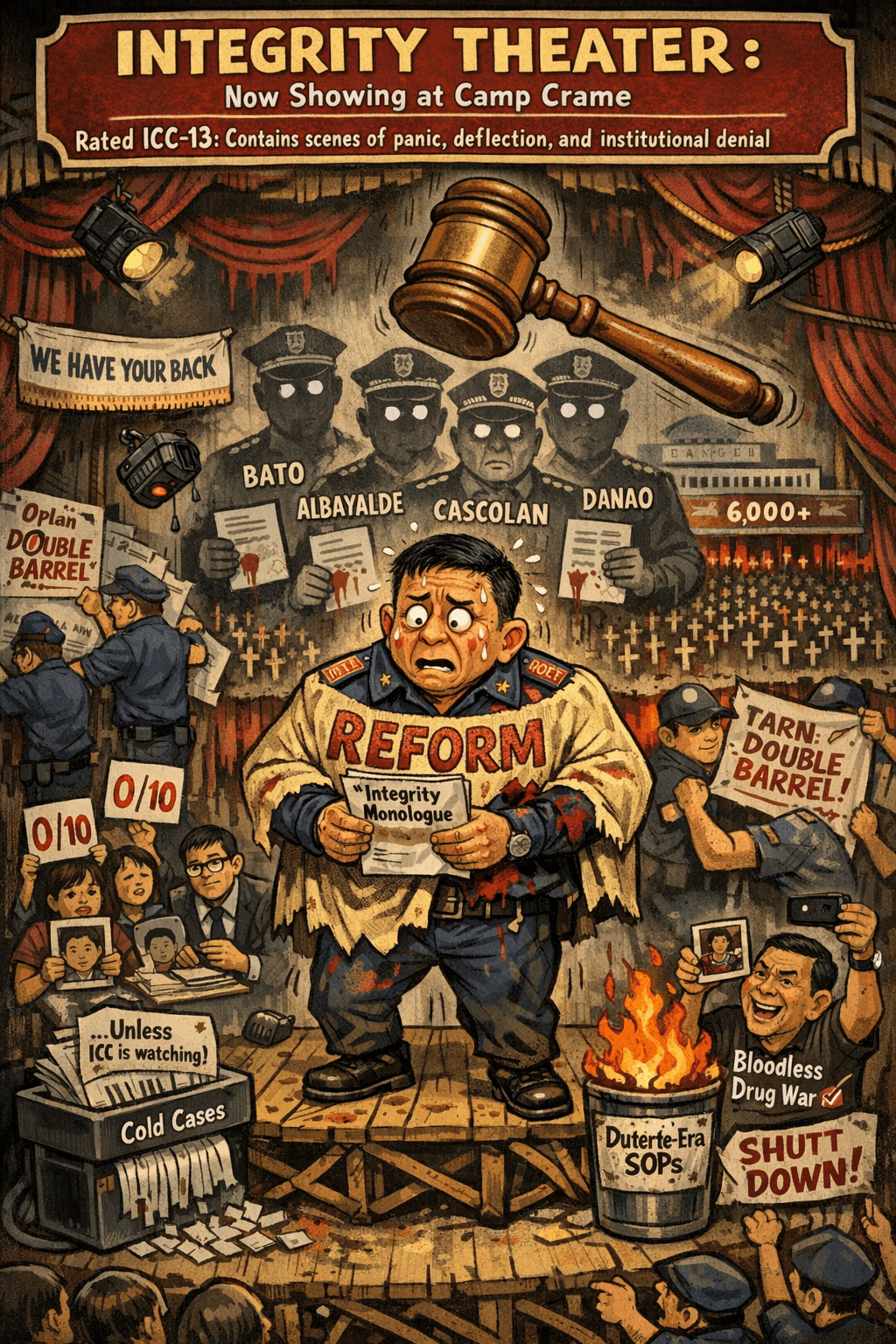
When Four Ex-Chiefs Face Crimes Against Humanity, the Current Chief Suddenly Discovers “Integrity”
By Louis ‘Barok‘ C. Biraogo — February 16, 2026
MGA ka-kweba, the timing is almost poetic in its cynicism. On the very day the nation is reminded that four former chiefs of the Philippine National Police (PNP)—Ronald “Bato” dela Rosa, Oscar Albayalde, the late Camilo Cascolan, and Vicente Danao—stand accused before the International Criminal Court (ICC) as co-perpetrators in crimes against humanity, the current PNP Chief, Gen. Jose Melencio C. Nartatez Jr., steps before the cameras to announce “integrity-based reforms.”
This is not reform born of contrition. This is reform born of panic. This is Integrity Theater—a carefully staged performance designed to convince the public, the ICC, and perhaps even the PNP rank-and-file that the institution has turned a new page, while conveniently ignoring the blood-soaked chapters written by its own predecessors.
Let us dissect this performance with the scalpel it deserves.
Anatomy of a Defensive Maneuver
The Manila Bulletin report could not have been clearer: Nartatez’s vow comes “with four of its top cops tagged as co-perpetrators” in the ICC charge sheet. This is no coincidence. This is a firewall.
The moment the names dela Rosa, Albayalde, Cascolan, and Danao appeared on that charge sheet, the current PNP leadership understood the existential threat: if the ICC establishes that the drug war killings were part of a widespread or systematic attack against civilians—a crime against humanity under Republic Act No. 9851 (Philippine Act on Crimes Against International Humanitarian Law, Genocide, and Other Crimes Against Humanity)
—the taint does not stop at the four. It spreads to the institution itself.
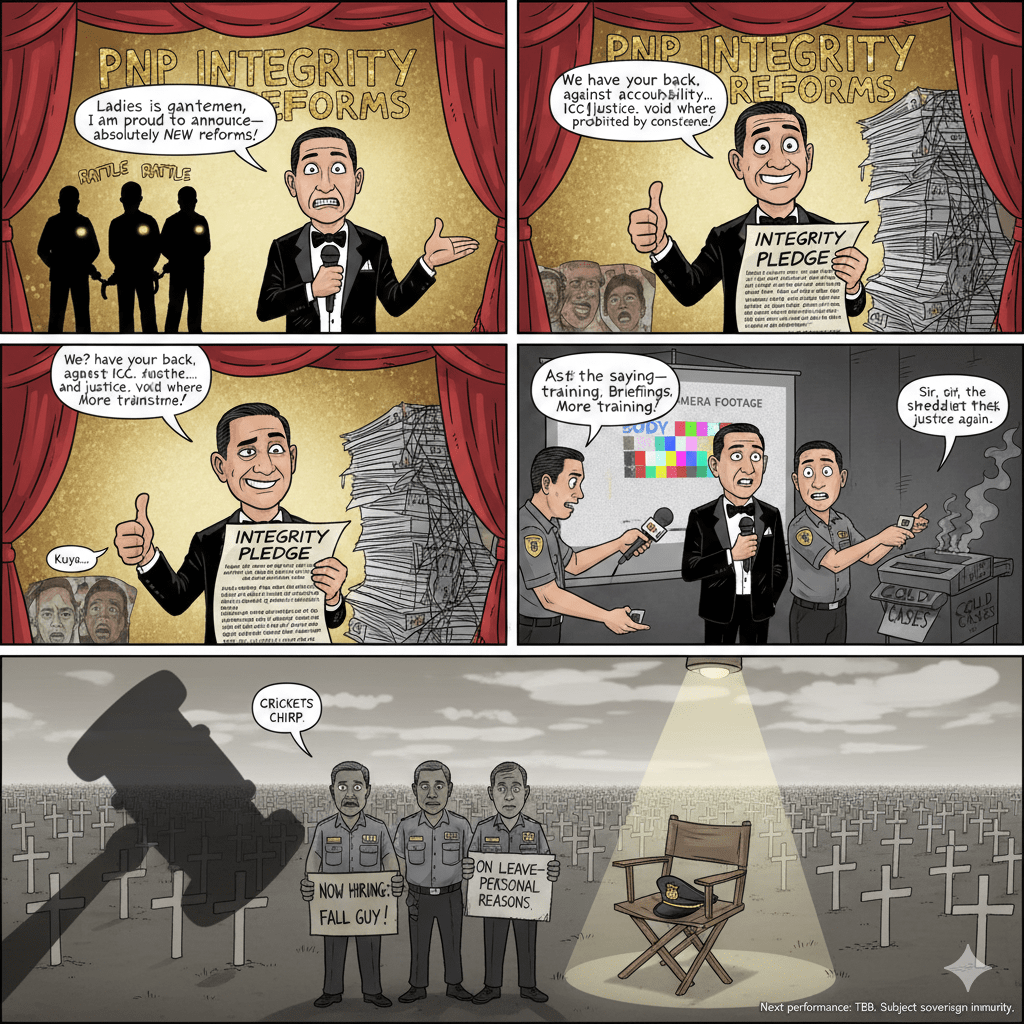
So Nartatez rushes forward with vague promises of “institutional safeguards” and “strict adherence to police operational procedures.” Translation: We are not them. We are different. Please look away from the bodies.
The “We Have Your Back” Paradox
Listen closely to Nartatez’s words: “The support system in the PNP for dedicated and hardworking personnel is strong. We have your back against any form of harassment in the performance of your duty.”
And then, almost as an afterthought: “However… we will be tough against any form of abuses.”
In any police culture steeped in impunity—and the PNP has been marinating in it for decades—the first promise will always drown out the second. “We have your back” is not reassurance to the lawful officer. It is a dog whistle to the abuser: As long as you don’t get caught on camera, the institution will protect you.
This is the same institution that, for six years, operated under the “nanlaban” script. The same institution where only four convictions have been secured for thousands of drug war killings. The same institution where officers planted evidence, fabricated after-action reports, and collected alleged bounties with impunity.
Nartatez offers no specifics. No circulars rescinded. No flawed SOPs revised. No admission that the old “Oplan Double Barrel” framework remains in place. Just empty phrases: “integrity,” “accountability,” “transparency.”
This is not reform. This is rebranding.
The Silence on the Dead
Here is the most damning omission: Nartatez says nothing—nothing—about the victims. No acknowledgment of the more than 6,000 killed in police operations. No mention of the thousands more slaughtered by vigilantes emboldened by state rhetoric. No apology for the children caught in the crossfire. No promise to reopen cold cases, to revisit the “nanlaban” files, to give families the justice they have been denied for years.
A reform agenda that begins with silence about past atrocities is not reform. It is complicity.
The Legal Bankruptcy of the Nartatez Agenda
Let us measure this agenda against the law it claims to uphold.
The 1987 Constitution of the Republic of the Philippines is unequivocal: Article III, Section 1—no person shall be deprived of life without due process. Article II, Section 11—the State values the dignity of every human person and guarantees full respect for human rights.
Yet the Supreme Court of the Philippines has spent decades admonishing the PNP for the exact opposite. In People v. Oares (the Kian delos Santos case), the Court rejected self-defense claims and convicted police officers of murder, ruling that treachery attended the killing. In People v. Doria, the Court laid down strict standards for buy-bust operations—standards routinely violated during the drug war.
Republic Act No. 9851 domesticates crimes against humanity. The ICC charge sheet alleges murder as part of a widespread or systematic attack. Nartatez’s response? More training. More briefings. As if the problem was ignorance rather than policy.
Republic Act No. 6713 (Code of Conduct for Public Officials) and the PNP Ethical Doctrine demand integrity and respect for human rights. But where is the enforcement? Where are the prosecutions under Republic Act No. 3019 (Anti-Graft and Corrupt Practices Act) for officers who allegedly profited from bounties?
Nartatez speaks of “operational procedures” as if they are sacred. But those same procedures were weaponized for six years to justify killings. Without a public, transparent overhaul—without rescinding the circulars that enabled the slaughter—his words are legally meaningless.
Stuck Between The Hague and Camp Crame: Real Choices for Every Side in the Drug War Drama
- Nartatez and the PNP: They can choose genuine reform—rescind the old oplans, mandate and publish body camera footage, strengthen an independent Internal Affairs Service, cooperate with investigations—or they can continue the theater. History suggests the latter.
- The Marcos Administration: Department of the Interior and Local Government (DILG) Secretary Remulla crows about a “bloodless” drug war and P99.5 billion in seizures. Convenient. But where are the prosecutions for the Duterte-era killings? This is not human rights advocacy; this is political point-scoring. The “bloodless” narrative is a cudgel against the opposition, not a commitment to justice.
- The ICC-Named Four: Dela Rosa will claim sovereign immunity and political persecution. Albayalde and Danao will hide behind command responsibility denials. Their defenses will crumble under RA 9851 and the weight of evidence. Self-defense claims have already been rejected by Philippine courts; they will fare no better in The Hague.
- Victims’ Families and Civil Society: Their only remaining leverage is strategic litigation—writs of amparo, habeas data, domestic murder charges—and relentless public pressure. They are the only ones still fighting for truth.
Demands, Not Suggestions
Enough with press releases. Here is what must be done:
- Immediate prosecution of all police officers with prima facie evidence of extrajudicial killings—starting with the most egregious “nanlaban” cases.
- Full transparency in all police operations: mandatory, immediate public release of after-operation reports, spot reports, and unedited body camera footage.
- Public accounting of the conviction-to-acquittal ratio in all drug war-related cases, with explanations for every failure to secure justice.
- Full cooperation with domestic and international investigations into crimes against humanity—no more sovereignty theatrics, no more obstruction.
- Political will to enforce existing laws, beginning with the rescission of every Duterte-era circular that enabled impunity.
Accountability is not a buzzword. It is indictments. It is convictions. It is justice for the dead.
Genuine Recommendations (With the Respect They Deserve)
If Gen. Nartatez truly wants to institutionalize integrity, here are some modest proposals:
- Rescind every Duterte-era “Oplan” circular and livestream their public burning outside Camp Crame. Symbolism matters.
- Mandate body cameras for all operations—and publish the footage within 24 hours, unedited. No more “technical malfunctions.”
- Reopen the 6,000+ drug war killing files for independent review. Start with Kian delos Santos and go from there.
- Invite the ICC prosecutors to Camp Crame for a full briefing. Full cooperation, full transparency.
- Publish a public apology to every victim’s family—signed by the Chief PNP himself.
Until then, spare us the theater.
The stage lights are on, General. The audience is not clapping.
– Barok
Key Citations
A. Legal & Official Sources
- The 1987 Constitution of the Republic of the Philippines. Official Gazette of the Republic of the Philippines.
- Philippine Act on Crimes Against International Humanitarian Law, Genocide, and Other Crimes Against Humanity. Republic Act No. 9851, 11 Dec. 2009, Official Gazette of the Republic of the Philippines.
- Code of Conduct and Ethical Standards for Public Officials and Employees. Republic Act No. 6713, 20 Feb. 1989, Official Gazette of the Republic of the Philippines.
- Anti-Graft and Corrupt Practices Act. Republic Act No. 3019, 19 Aug. 1960, Official Gazette of the Republic of the Philippines.
- People v. Oares et al. Supreme Court of the Philippines, The LawPhil Project.
- People v. Doria. Supreme Court of the Philippines, The LawPhil Project.



 KWEBA ni BAROK
Leave a comment