By Louis ‘Barok‘ C. Biraogo — February 16, 2026
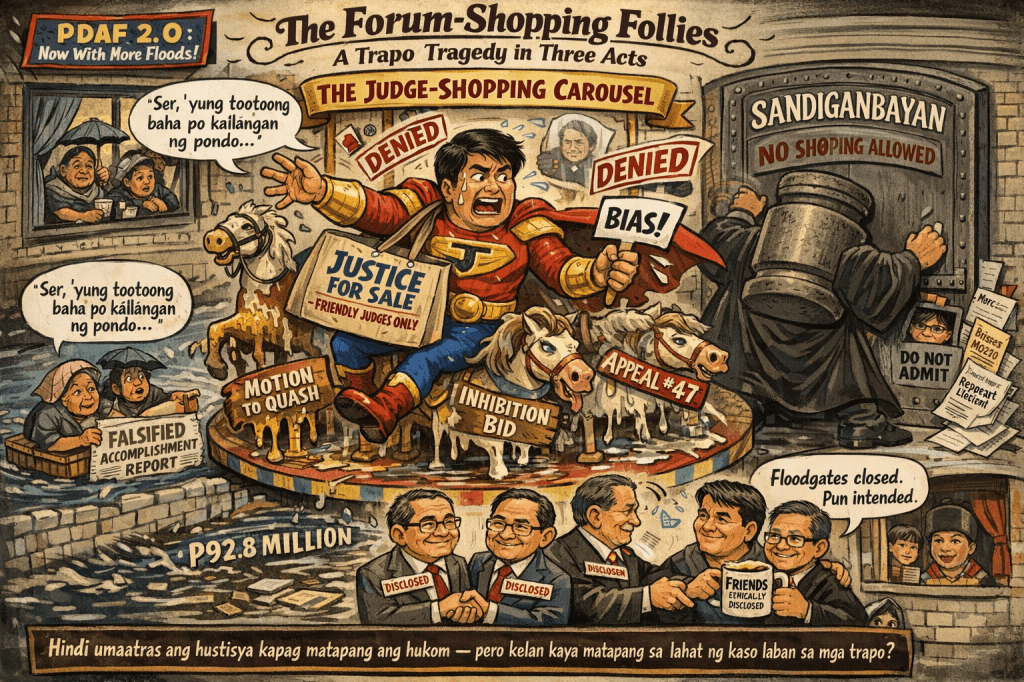
MGA ka-kweba, the Bong Revilla malversation case has just delivered another episode of courtroom drama straight out of a bad teleserye. In February 2026, the Sandiganbayan firmly denied former senator Ramon “Bong” Revilla Jr.’s desperate attempt to remove Associate Justice Karl Miranda from handling his malversation charges. This involves a staggering P92.8 million allegedly funneled into a non-existent flood control project in Pandi, Bulacan. According to reports from early February 2026, Revilla’s camp cried “bias!” because of personal connections—but the court wasn’t buying it.
The anti-graft court called the motion baseless, warning that allowing such inhibitions without solid proof would open the floodgates—pun intended—to forum-shopping. Mga ka-kweba, this is classic trapo playbook: delay, delay, delay. While ordinary Filipinos drown in actual floods, these politicians play games with ghost projects. Here’s the full breakdown of this latest chapter in Revilla’s never-ending legal saga.
Quick Facts: Bong Revilla Malversation Case
| Question | Answer |
|---|---|
| What happened? | Sandiganbayan denied Revilla’s motion to inhibit Justice Karl Miranda in his malversation and graft case. |
| Who is involved? | Bong Revilla Jr., Justice Karl Miranda, state witness Roberto Bernardo, lawyer Ramon Esguerra. |
| When did it occur? | Motion filed February 8, 2026; denied in resolution dated February 10, 2026. |
| How much money? | P92.8 million in alleged ghost flood control project funds. |
| What’s at stake? | Public accountability for misuse of infrastructure funds meant for flood-prone areas. |
| Current status? | Motion denied; case proceeds toward trial after arraignment delays. |
| What’s next? | Pre-trial and trial proceedings; prosecution to present evidence against Revilla and co-accused. |
Who Is Bong Revilla? Background on the Malversation Case
Bong Revilla is no stranger to the Sandiganbayan dock. The action star-turned-politician was once acquitted in the infamous pork barrel scam plunder case back in 2018, dancing his way out of prison with that infamous “thank you” video. But karma, mga ka-kweba, has a long memory.
This new Bong Revilla malversation case stems from allegations that P92.8 million in public funds vanished into a ghost flood control project in Pandi, Bulacan. The project? Supposedly a revetment wall or dike system that never materialized. Instead, the money allegedly went through dubious NGOs or contractors in a scheme eerily similar to the Janet Lim-Napoles PDAF racket.
As Rappler reported in January 2026, this flood control anomaly is part of broader investigations into multibillion-peso infrastructure ghosts. Revilla, along with co-accused including former Department of Public Works and Highways (DPWH) officials, faces charges of malversation and graft. The Ombudsman filed the cases after finding probable cause, leading to Revilla’s dramatic court appearances in early 2026.
The Inhibition Motion: Revilla’s Allegations of Bias
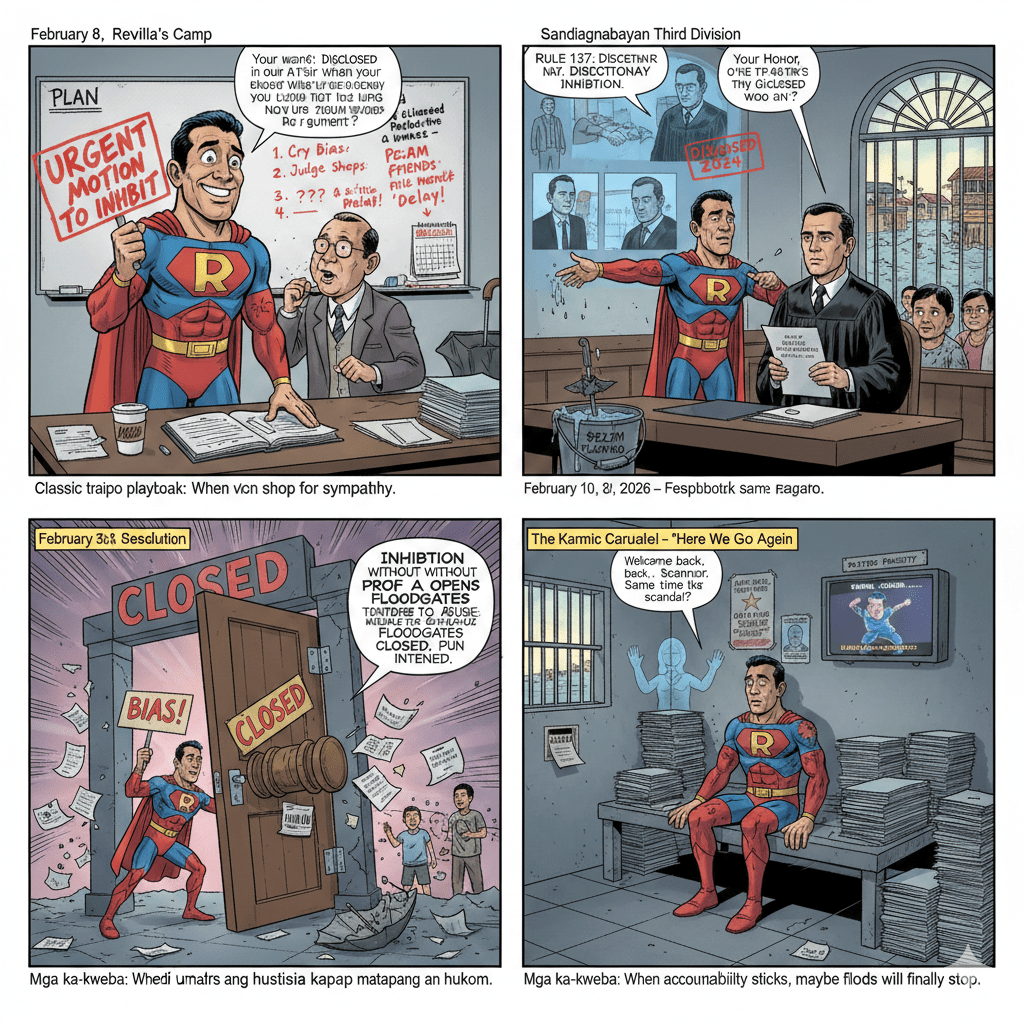
Revilla’s camp filed an urgent motion on February 8, 2026, asking Justice Karl Miranda to voluntarily inhibit himself. Why? They claimed potential bias due to two connections:
- Miranda’s brother, Buenaventura Miranda, previously served as counsel for Roberto Bernardo—a former DPWH undersecretary turned state witness against Revilla.
- Miranda admitted that Revilla’s lead counsel, veteran lawyer Ramon Esguerra, is his personal friend.
Sounds compromising, right? Revilla’s team argued these ties could affect impartiality in the Bong Revilla malversation case.
But hold the drama—Miranda himself disclosed these connections upfront, as required by judicial ethics. Revilla’s motion essentially asked the judge to step aside based on these disclosures alone.
Evidence Revealed: What the Sandiganbayan Resolution Says
In a scathing 2026 resolution reported by Philippine Star, Justice Miranda denied the motion for “lack of merit.” He quoted extensively on judicial principles:
“His (Miranda) inhibition without concrete proof of personal interest or bias will set a dangerous precedent and present opportunities for abuse. Specifically, this would be tantamount to an automatic granting of a voluntary inhibition, which would open the floodgates to a form of forum-shopping…”
The court emphasized that mere relationships or friendships don’t automatically disqualify a judge. There must be “clear and convincing proof of bias.” None was presented here—just speculation.
Miranda stressed that the Sandiganbayan exists to handle public accountability cases without being “dissuaded by conjecture, pressure, or unfounded suspicion.” Allowing inhibition here would undermine speedy justice and encourage accused politicians to shop for sympathetic magistrates.
Who’s Involved? Key Figures in the Bong Revilla Malversation Case
- Bong Revilla Jr.: The main accused, former senator, and action star famous for roles like Captain Barbell—ironically now lifting heavy legal weights.
- Justice Karl Miranda: Sandiganbayan Fourth Division chairperson who penned the denial resolution.
- Roberto Bernardo: Former DPWH undersecretary, now state witness testifying against Revilla in related flood control anomalies.
- Ramon Esguerra: Revilla’s high-powered lawyer, friend of Miranda, and veteran of many trapo defenses.
- Ombudsman Investigators: The ones who uncovered the ghost project paper trail.
This mirrors patterns we’ve seen in other infrastructure scams, like the multibillion flood control controversies exposed in recent years.
What This Means for Philippine Anti-Corruption Efforts
The denial of the inhibition motion is a win for judicial independence—but a potential delay loss for victims of ghost projects. Bulacan residents still face flooding while P92.8 million allegedly disappeared.
If Revilla succeeds in dragging this out, it sends a message: powerful politicians can manipulate the system indefinitely. Remember his PDAF acquittal? Narrow votes, dissenting opinions calling it a “stretch.” Now, with new charges, the cycle repeats.
For ordinary taxpayers, this Bong Revilla malversation case highlights how infrastructure funds meant for flood mitigation end up as political pork.
Legal Analysis: Rules on Judicial Inhibition in Philippine Law
Under the 2025 Code of Judicial Conduct and Accountability, judges must inhibit voluntarily if their impartiality might reasonably be questioned. However, Rule 137 of the Rules of Court distinguishes mandatory from voluntary inhibition.
Mandatory inhibition applies in cases of kinship within the sixth degree or clear financial interest. Here, neither exists—Miranda’s brother represented a witness in a related case, not the main parties, and the friendship with counsel is disclosed.
The Supreme Court in cases like Gutierrez v. Hon. Laguio (G.R. No. 170986) has ruled that inhibition is discretionary unless bias is evident. Mere suspicion isn’t enough. As Miranda noted, granting this would encourage forum-shopping, violating the principle of speedy disposition under the 1987 Constitution, Article III, Section 16 (right to speedy trial).
Republic Act No. 3019 (Anti-Graft and Corrupt Practices Act) and Revised Penal Code Article 217 (malversation) provide the charges’ backbone, with penalties up to reclusion perpetua if proven.
Political Motivations Behind the Inhibition Bid
Let’s call it what it is, mga ka-kweba: a delay tactic. Revilla’s arraignment was already deferred multiple times in early 2026. By crying bias over disclosed connections, his camp buys time—perhaps hoping for political winds to shift or witnesses to flip.
This isn’t new. In the old PDAF scam, similar motions flew left and right. Revilla returned to politics post-acquittal, proving the system favors the connected. Now, facing fresh charges, the playbook opens again.
Why This Is Really About Protecting the Patronage Machine
The Bong Revilla malversation case isn’t just about one ghost project. It’s about a system where politicians treat public funds like personal ATMs. Flood control budgets balloon, contractors get kickbacks, and communities suffer.
Revilla’s team shopping for a “friendlier” judge exposes the rot: when connections matter more than evidence. The Sandiganbayan’s firm stand preserves some dignity—but how many more delays until justice?
This mirrors other scandals we’ve covered, like the perpetual infrastructure ghosts under various administrations. The real bias? Toward protecting the elite patronage networks, not the flood victims.
- Classic delay moves: Motion to quash, inhibition bids, appeals.
- Pattern recognition: From PDAF to flood control—same scheme, new label.
- Public cost: Billions lost while roads flood and dikes remain imaginary.
Mga ka-kweba, if judges start inhibiting over every friendship or family tie, no case against the powerful would ever finish.
Conclusion
The Bong Revilla malversation case reveals yet again how the mighty twist the justice system to their advantage. Sandiganbayan’s denial of the inhibition motion is a rare backbone display—refusing to let baseless claims derail accountability for P92.8 million in ghost funds. But with arraignments delayed and trials looming, justice remains on life support.
As this saga continues, watch for more legal acrobatics. For Filipinos tired of ghost projects and endless courtroom circus, the real question is: when will accountability stick?
What do you think, mga ka-kweba? Is this just another delay tactic, or legitimate concern? Share your thoughts in the comments—let’s keep exposing the kweba.
– Barok
Hindi umaatras ang hustisya kapag matapang ang hukom—pero kelan kaya matapang sa lahat ng kaso laban sa mga trapo?
Key Citations
- Panti, Llanesca T. “Revilla seeks Sandiganbayan justice’s exclusion in malversation case.” GMA Network, February 2026
- Panti, Llanesca T. “Sandiganbayan denies Revilla bid to remove judge in malversation case.” GMA Network, February 2026
- Laqui, Ian. “No proof of bias: Sandigan denies Bong Revilla’s motion to inhibit justice.” Philippine Star, February 11, 2026.
- Bolledo, Jairo. “Bong Revilla’s return to Sandiganbayan: From pork barrel to flood control.” Rappler, January 23, 2026.
- Philippines, Supreme Court. The 2025 Code of Judicial Conduct and Accountability. Supreme Court of the Philippines, 11 Nov. 2025. Accessed 16 Feb. 2026.
- The 1987 Constitution of the Republic of the Philippines. Official Gazette of the Republic of the Philippines. Accessed 16 Feb. 2026.
- “Republic Act No. 3019.” Official Gazette of the Republic of the Philippines, 17 Aug. 1960. Accessed 16 Feb. 2026.
- “Rule 137: Disqualification of Judicial Officers.” The Lawphil Project, Arellano Law Foundation. Accessed 16 Feb. 2026.
- “Forthwith” to Farce: How the Senate is Killing Impeachment—And Why Enrile’s Right (Even If You Can’t Trust Him)
- “HINDI AKO NAG-RESIGN!”

- “I’m calling you from my new Globe SIM. Send load!”

- “Mahiya Naman Kayo!” Marcos’ Anti-Corruption Vow Faces a Flood of Doubt

- “Meow, I’m calling you from my new Globe SIM!”

- “No Special Jail for Crooks!” Boying Remulla Slams VIP Perks for Flood Scammers

- “PLUNDER IS OVERRATED”? TRY AGAIN — IT’S A CALCULATED KILL SHOT

- “Several Lifetimes,” Said Fajardo — Translation: “I’m Not Spending Even One More Day on This Circus”

- “Shimenet”: The Term That Broke the Internet and the Budget

- “We Did Not Yield”: Marcos’s Stand and the Soul of Filipino Sovereignty

- “We Gather Light to Scatter”: A Tribute to Edgardo Bautista Espiritu

- $150M for Kaufman to Spin a Sinking Narrative





 KWEBA ni BAROK
Leave a comment