OCTA Survey 2026 Exposes the Real National Pastime: Paying to Play (or Just to Exist)
By Louis ‘Barok’ C Biraogo — February 18, 2026
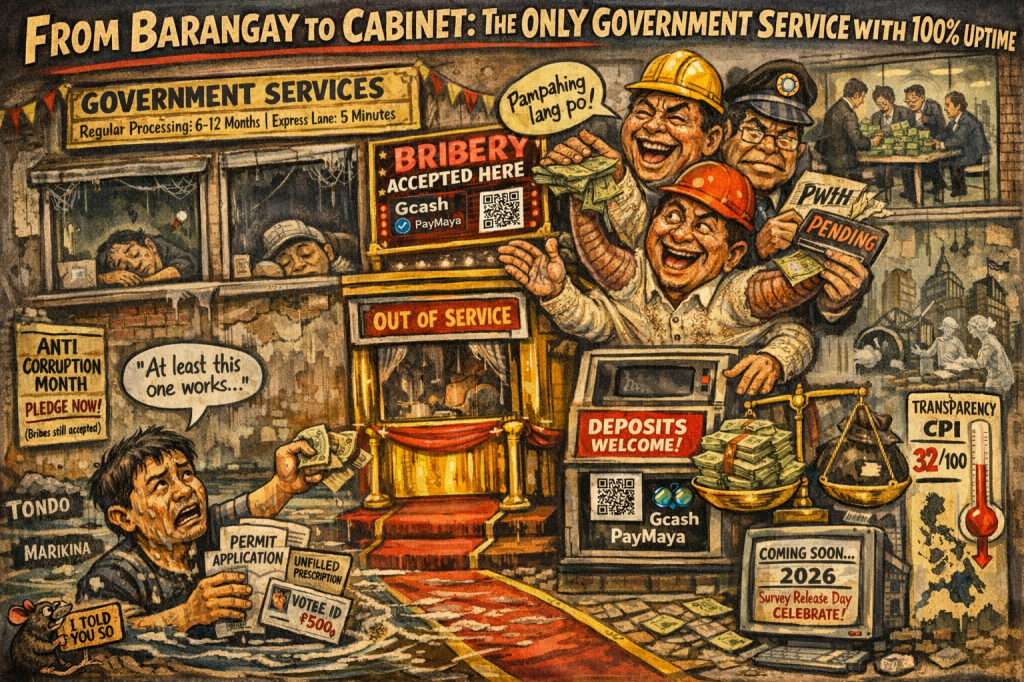
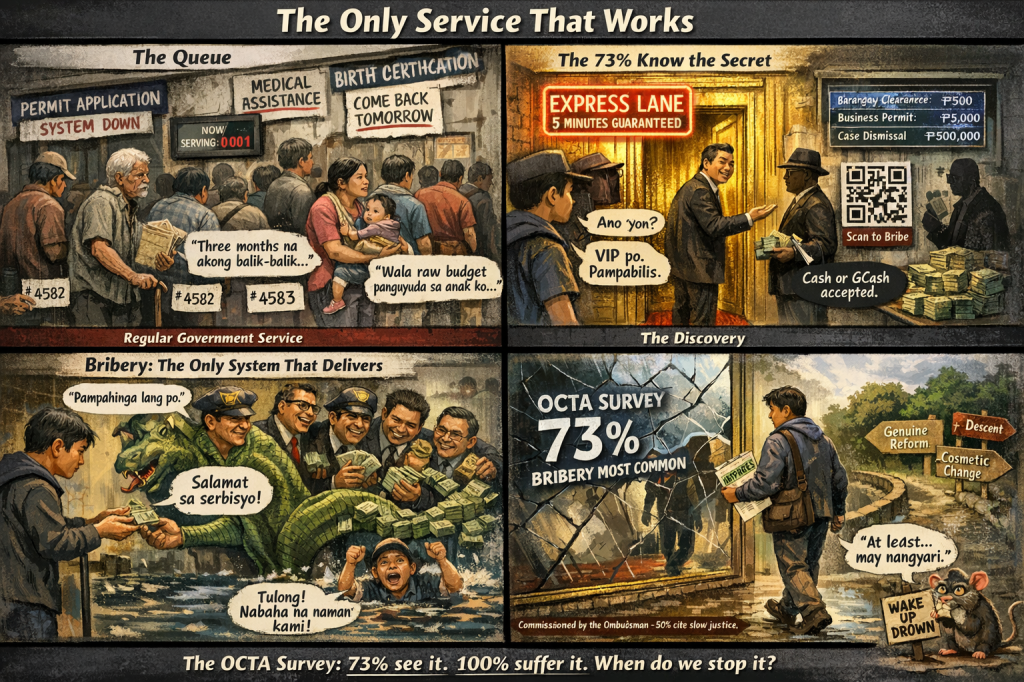
MGA ka-kweba, in February 2026, the latest Tugon ng Masa survey by OCTA Research – released on February 16 and commissioned by the Office of the Ombudsman – declares that 73% of Filipinos believe bribery is the most common form of corruption in the country. I will not whisper. This is not mere data. This is the blood-curdling scream of a nation daily violated by its own government.
Anatomy of a Scandal: Mirror or Cracked Glass?
The Quarter 4 2025 Tugon ng Masa survey by OCTA Research (conducted December 3–11, 2025; 1,200 face-to-face interviews; ±3% margin of error at 95% confidence level) presents stark results:
- 73% identify bribery as the most common form of corruption.
- 66% cite irregularities in the use of public funds.
- 64% point to vote buying.
- 54% highlight slow justice.
There is truth here. Bribery is visceral – felt personally at the barangay hall, traffic stop, hospital counter, or permit office. Yet this remains perception, not precise measurement of corruption’s depth.
Grand-scale theft in public funds may dwarf petty bribes in volume, but ordinary citizens rarely witness it directly. The survey captures visibility above all – what people encounter daily. Conducted amid escalating outrage over the 2025 flood control projects scandal and Senate hearings, it reflects a primed, furious public.
And who commissioned it? The very Office of the Ombudsman – the institution singled out by 54% for slow justice. Clever public relations, or subtle self-indictment?
Echoes in the Dark: The Real Story Behind the Numbers
This survey emerges in the shadow of the 2025–2026 Philippine anti-corruption protests and the massive flood control scandal involving the Department of Public Works and Highways (DPWH). Ghost projects, substandard dikes collapsing at the first typhoon, billions funneled through kickbacks to favored contractors and allies.
The Transparency International Corruption Perceptions Index (CPI) 2025 ranks the Philippines 120th out of 182 countries with a score of 32/100 – its worst-ever placement, directly tied to the flood control debacle. The 66% citing irregularities in public funds is no abstract statistic: it is the blood of flood victims in Tondo, Marikina, and Cagayan de Oro.
The Roots of Rot: How the Cancer Grew
The root is impunity. From the barangay captain demanding “pampahinga” to cabinet secretaries skimming billions, fear is absent. Why? The Ombudsman drags, Congress colludes, justice is purchasable. Digitalization remains a promise. Freedom of Information? Riddled with exemptions. The culture of “pwede na yan” has become “kailangan na yan” for survival.
Demographics expose the class divide: Class E (poorest) emphasize vote buying and slow justice – they rely on patronage and suffer most when justice fails. Class ABC focus on procurement irregularities – they see the rigged big contracts up close.
The Dance of the Damned: Who Dances, Who Watches?
No one is innocent.
- The administration: Vetoes redundant projects, yet protects allies.
- The Ombudsman: Commissions surveys while justice crawls.
- Congress: Inserts budget insertions, grandstands in hearings.
- Contractors: Pocket funds, deliver ghosts or shoddy work.
- And us: Sometimes we pay the bribe to “expedite.”
Everyone joins the dance, but the powerful control the music.
Fork in the Road and The Reckoning
Three paths lie ahead: genuine reform, cosmetic window-dressing, or continued descent.
True justice means convictions, asset recovery, systemic overhaul – not press releases.
The Weight of the World
Corruption costs lives lost to floods from failed dikes. It robs children of education. It drives investors away. It shames the nation before the world – third most corrupt in Southeast Asia per the CPI.
Without action, we fall further.
The Battle Cry
Enough diagnosis. Time for radical medicine:
- Full digitalization of all government transactions within two years – no face-to-face, no opportunity for bribes.
- Independent Special Prosecutor for grand corruption cases, free from Malacañang control.
- Mandatory, verified public asset disclosure for all officials and families.
- Enforce the anti-dynasty law now – one family, one term.
- Citizen-led oversight councils in every province to monitor budgets.
- Whistleblower reward system – 10% of recovered assets to informants.
Let us fight. In the streets, at the ballot box, across social media.
Philippines: Wake up and fight. Or sleep through another century of looting.
– Barok
Key Citations
- Moaje, Marita. “OCTA: 73% of Filipinos say bribery most common form of corruption.” Philippine News Agency, 16 Feb. 2026.
- “Corruption Perceptions Index 2025.” Transparency International, 2026.
- “Flood control projects scandal in the Philippines.” Wikipedia, The Free Encyclopedia, Wikimedia Foundation.
- “2025–2026 Philippine anti-corruption protests.” Wikipedia, The Free Encyclopedia, Wikimedia Foundation.
- “OCTA Research.” OCTA Research.
- “Forthwith” to Farce: How the Senate is Killing Impeachment—And Why Enrile’s Right (Even If You Can’t Trust Him)
- “HINDI AKO NAG-RESIGN!”

- “I’m calling you from my new Globe SIM. Send load!”

- “Mahiya Naman Kayo!” Marcos’ Anti-Corruption Vow Faces a Flood of Doubt

- “Meow, I’m calling you from my new Globe SIM!”

- “No Special Jail for Crooks!” Boying Remulla Slams VIP Perks for Flood Scammers
- “PLUNDER IS OVERRATED”? TRY AGAIN — IT’S A CALCULATED KILL SHOT

- “Several Lifetimes,” Said Fajardo — Translation: “I’m Not Spending Even One More Day on This Circus”
- “Shimenet”: The Term That Broke the Internet and the Budget
- “We Did Not Yield”: Marcos’s Stand and the Soul of Filipino Sovereignty

- “We Gather Light to Scatter”: A Tribute to Edgardo Bautista Espiritu

- $150M for Kaufman to Spin a Sinking Narrative


 KWEBA ni BAROK
Leave a comment