
From Flood-Control Kickbacks to Highway VIP List: The Sequel Nobody Asked For
By Louis ‘Barok‘ C. Biraogo — February 20, 2026
MGA ka-kweba, take a seat. There’s fresh drama at the Department of Public Works and Highways (DPWH) that feels like a teleserye titled “Elite Contractors Only, Small Players Not Welcome.”
Public Works Secretary Vince Dizon recently announced that he will meet with the country’s “top-tier contractors” next month ahead of the bidding for the Maharlika Highway rehabilitation. Small firms? Apparently, they’re out of the picture. The new mantra is “professionalized infrastructure delivery.” International standards, foreign consultants, and no room for small contractors who might supposedly tarnish the road.
I’m Barok—your friendly neighborhood vulture circling every time a Cabinet secretary drops a statement so glossy you can see your own disappointed reflection in it. Let’s peel back the glossy packaging.
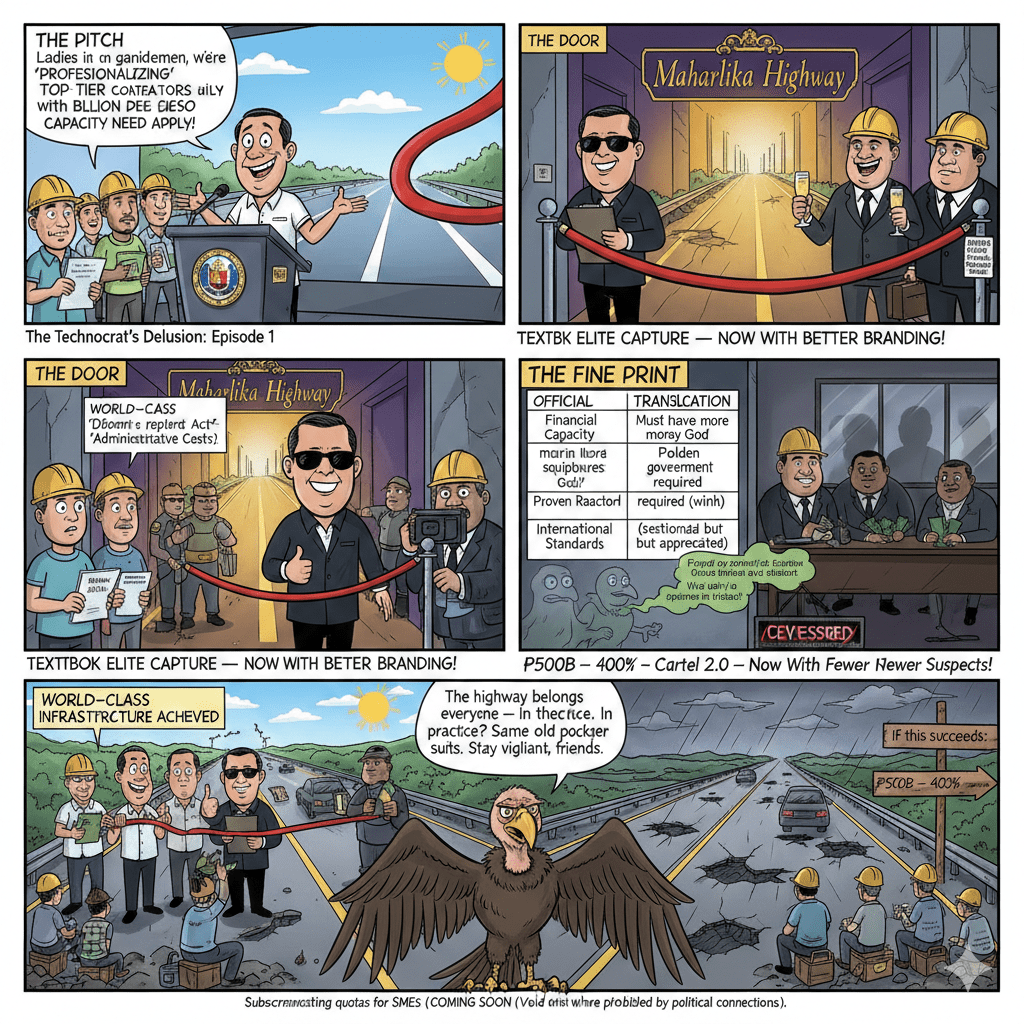
The Technocrat’s Delusion: Why Do They Actually Think This Is a Good Idea?
Dizon’s core pitch is straightforward: only large contractors have the financial muscle, modern equipment, and proven experience to execute a project of this magnitude properly. Small firms, he argues, lack the capacity for advanced asphalt technology and proper drainage systems. Past piecemeal contracting—small segments awarded to small players—resulted in repeated failures, constant repairs, and cozy profits for a handful of well-connected minor operators.
To be fair, there is some logic here. Large sections of the Maharlika Highway still look like they haven’t been seriously maintained since the Marcos Sr. era—literal dirt roads in places. Consolidating contracts with capable big firms could mean faster execution, better durability, and—supposedly—less corruption. Dizon even highlights that reputable contractors who previously avoided government projects due to red tape and kickbacks are now showing interest. “A testament to trust and reforms,” he says. How touching.
But let’s be real: this is classic technocratic hubris. The theory seems to be that the solution to a rotten system is to eliminate the small players entirely and hand everything to a handful of giants—as if company size automatically equals integrity. Adorable.
The Oligarch’s Wet Dream: Why This Is the Fantasy of the Elite
Here’s the flip side—and the reason people outside Malacañang are already fuming. When you restrict bidding to “top-tier” firms, who remains in the game? A small circle of conglomerates with deep pockets, political shareholders, and long histories of government contracts. The already big get even bigger. The small, often provincial contractors who sustain local economies? Thank you for your service—next caller, please.
This is textbook elite capture masquerading as efficiency. Fewer bidders = less competition = higher prices passed on to taxpayers. When only a handful can participate, sweetheart “arrangements” become far easier. No need to spread kickbacks across dozens of small operators—just funnel them to a select few giants. Very efficient, indeed.
Worst of all: the Small and Medium Enterprises (SMEs) squeezed out are precisely the ones without political godfathers. These are the regional players employing thousands of local workers. When they disappear from the picture, infrastructure money flows even more heavily toward Manila-centric conglomerates. Regional development? Maybe next administration.
RA 9184’s Ghost: Is This Actually Legal—or Just Discrimination in Designer Clothing?
On paper, it’s defensible. The Government Procurement Reform Act (Republic Act No. 9184) explicitly permits pre-qualification based on objective criteria: financial capacity, relevant track record, equipment ownership, and experience with projects of similar scale. The Maharlika Highway is a 3,500+ kilometer national artery—not a barangay road. Setting a high bar (completed similar-scale works, substantial net worth, modern machinery) is standard and permissible.
But here’s where the gray zone begins. If the criteria are clearly published, transparently applied, and genuinely tied to project requirements, this survives judicial scrutiny. If “top-tier” becomes code for “our friends only,” expect protests at the Government Procurement Policy Board (GPPB), formal bid protests, or full-blown cases before the Court of Appeals. Should discrimination be proven, the whole scheme collapses.
The real question: Will they publish exact, measurable criteria in advance? Or will the pre-bid meeting turn into an invite-only gentlemen’s club? Because if it’s the latter, this isn’t reform—it’s discrimination wearing a PowerPoint presentation.
The Grapevine: The Stench from Flood Control Still Lingers
Context matters. Dizon was appointed in the wake of the massive flood control scandal—billions allegedly lost to ghost projects, overpriced equipment, and kickbacks ranging from 25–40%. Numerous small and mid-sized contractors—many politically connected—were implicated. Courtesy resignations, blacklisting, referrals to the Ombudsman: Dizon moved aggressively to clean house.
The “never again” mindset is understandable. But the grapevine asks: Is this purely about cleaning house, or are new favorites being positioned? When only a few large players are allowed to bid, people naturally wonder—who exactly are these “top-tier” firms? Are specific names already lined up? Are certain political shareholders quietly excited?
The small contractors previously entangled in scandals—are they truly blacklisted forever, or are there back doors into the new system? Specific names tied to the Maharlika bidding remain quiet for now, but the faint odor of the old rot still hangs in the background.
The Reckoning: What Happens If It Succeeds—or Spectacularly Fails?
Success scenario: We finally get a world-class, durable, safe national highway that dramatically improves trade, tourism, and regional connectivity. Accidents drop, vehicle operating costs fall, driver frustration decreases. Dizon becomes the poster boy of reform; the Marcos administration gets to say, “See? We fixed infrastructure.”
Failure scenario: Bid protests erupt, legal challenges delay everything, costs balloon, quality issues emerge even from big firms. If a major contractor collapses or delivers substandard work, the damage is enormous—both literal and political. And if favoritism is ever proven, the stench of corruption returns, only this time more concentrated among fewer, larger hands.
The Verdict & Recommendations: Don’t Let This Become Just Another Cartel
Bottom line: The intention may be noble—quality over quantity, reform over patronage. But the execution is fraught with danger. If this truly becomes a “big boys only” club, it isn’t reform; it’s reconcentration of power into even fewer hands.
My recommendations:
- Publish the exact pre-qualification criteria now—clear, measurable, and free of vague “top-tier” language.
- Mandate meaningful subcontracting quotas for SMEs—don’t let only the lead contractor be large; require genuine local participation.
- Livestream pre-bid conferences and the entire procurement process—no closed-door deals.
- Bring in independent third-party monitoring from day one—not just foreign consultants paid by the government.
- If you’re serious about reform, impose lifetime bans on everyone credibly implicated in the flood-control mess—no exceptions.
If these steps are skipped, we already know the ending: the Maharlika Highway might get paved, but the people’s money will still end up in the same familiar pockets. And ordinary motorists like us? We’ll keep sitting in traffic, staring at shiny new asphalt owned by the new kings of the road.
Stay vigilant, friends. The highway belongs to everyone—not just the giants.
— Barok
Key Citations
A. Legal & Official Sources
B. News Reports

- “Forthwith” to Farce: How the Senate is Killing Impeachment—And Why Enrile’s Right (Even If You Can’t Trust Him)

- “HINDI AKO NAG-RESIGN!”

- “I’m calling you from my new Globe SIM. Send load!”

- “Mahiya Naman Kayo!” Marcos’ Anti-Corruption Vow Faces a Flood of Doubt

- “Meow, I’m calling you from my new Globe SIM!”

- “No Special Jail for Crooks!” Boying Remulla Slams VIP Perks for Flood Scammers

- “PLUNDER IS OVERRATED”? TRY AGAIN — IT’S A CALCULATED KILL SHOT

- “Several Lifetimes,” Said Fajardo — Translation: “I’m Not Spending Even One More Day on This Circus”

- “Shimenet”: The Term That Broke the Internet and the Budget

- “We Did Not Yield”: Marcos’s Stand and the Soul of Filipino Sovereignty

- “We Gather Light to Scatter”: A Tribute to Edgardo Bautista Espiritu

- $150M for Kaufman to Spin a Sinking Narrative






 KWEBA ni BAROK
Leave a comment