Engagement Farming Meets Actual Malice: Why Jack Argota’s Like-Chasing May Cost More Than Ad Revenue
By Louis ‘Barok‘ C. Biraogo — February 21, 2026
MGA ka-kweba, Fellow citizens, sit properly, grab your barako coffee—or Pinoy rum, depending on the hour—and listen up.
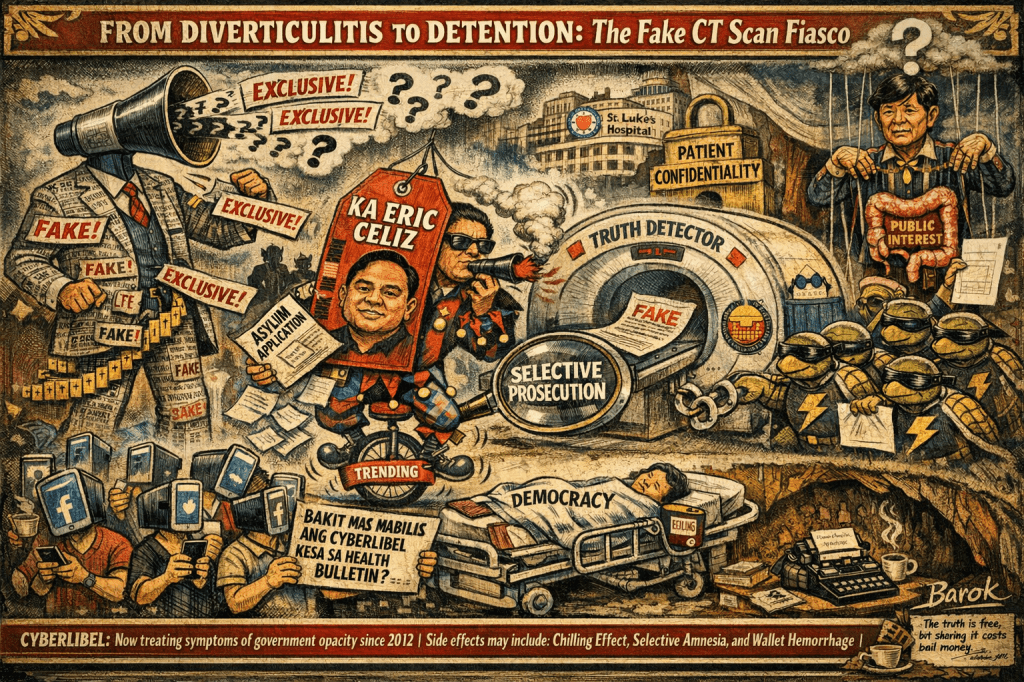
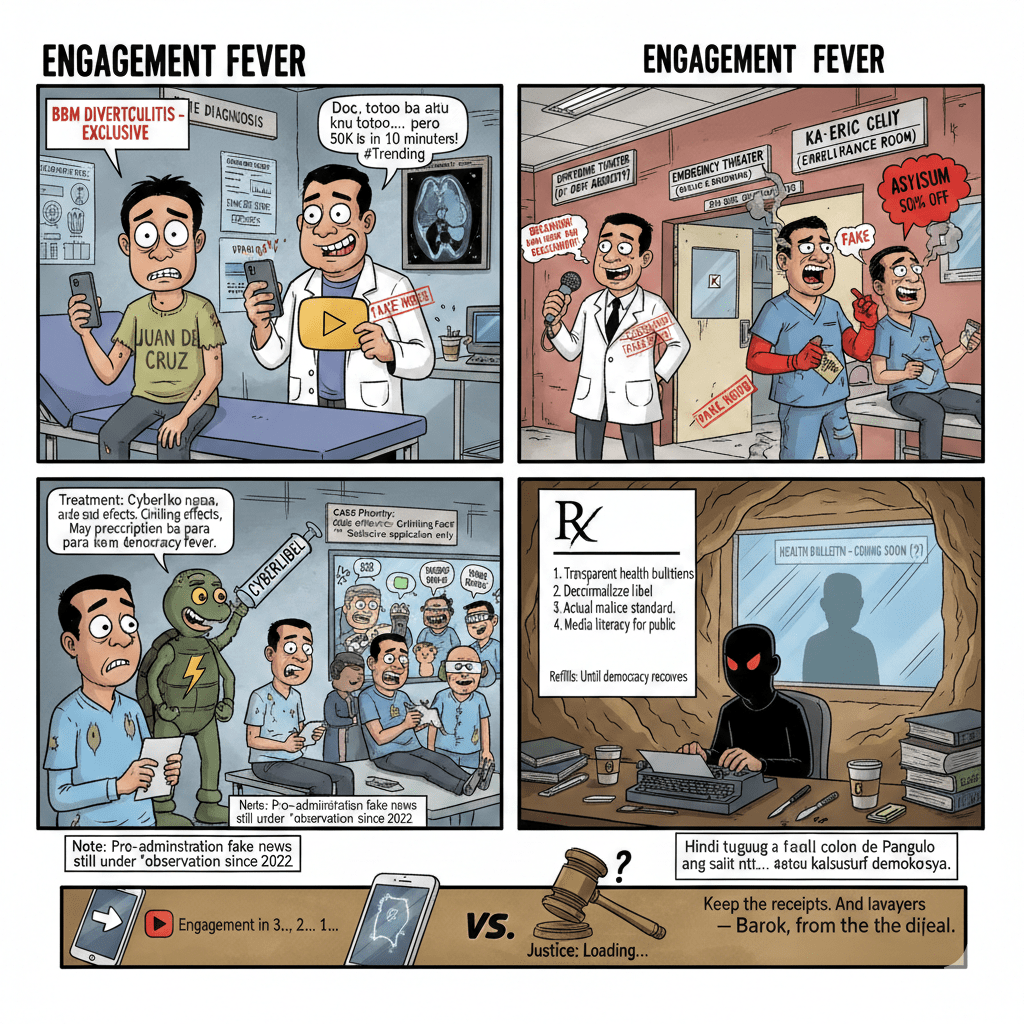
It has been just a week since the National Bureau of Investigation (NBI) filed cyberlibel complaints against Jay Sonza and Jeffrey “Ka Eric” Celiz for spreading fake medical records of President Bongbong Marcos Jr. Jack Argota received a summons and openly admitted he shared the document “just for engagement” and to ride the trend. Engagement? As if he said truth is optional as long as there are plenty of likes.
Welcome back to the Kweba ni Barok, where we pretend no neutrality—only sharp analysis, biting satire, and zero fear of calling garbage what it is. Today we dissect this mess with a legal scalpel, not a tabloid spoon. No one is sacred here: the Palace, the NBI, the opposition, and especially the clout-chasers—all get skewered.
1. The Cast of Characters: Who Are the Clowns in This Circus?
The Accused: Opportunists on the Digital Pulpit
- Jay Sonza — Former broadcaster forever chasing the next “exclusive” scoop, often fake. Long controversial—accusations of election-period fake news in 2022, complaints dismissed here and there. Now suddenly a concerned citizen about the President’s health? Spare me. Seems more worried about his own relevance than BBM’s colon.
- Jeffrey “Ka Eric” Celiz — Regular on SMNI, staunch Duterte loyalist, master red-tagger. History of dubious “whistleblowing” and asylum applications abroad citing “harassment.” Instant health expert? Like a frying pan declaring itself a surgeon.
- Jack Argota (Sir Jack) — The most honest of the trio—admitted it was purely “to keep up with the trend” and for engagement. No political agenda, just algorithms. In short, he is a symptom of social media’s disease: truth optional, views mandatory.
The Accusers: Defenders of “Dignity”
- NBI Cybercrime Division — Supposed to fight crime, but here it looks like the Palace’s personal bodyguard. Why lightning speed on a fake CT scan yet turtle pace on pro-administration fake-news accounts?
- Department of Justice (DOJ) — Next step. If this becomes a rubber stamp for political will, credibility says goodbye.
- Malacañang — Called it “fabricated and malicious.” Correct. But why more anger at the spread than at why people want to believe it? Is there opacity in health disclosures?
- St. Luke’s Medical Center — Right to deny. Institutional integrity at stake. Nothing wrong here—except why a public denial was needed in the first place.
The “Victim”: President Bongbong Marcos Jr.
He is a public figure. His health is a matter of public interest—especially if it affects governing capacity. But fake medical records? No excuse. Still, the question lingers: why faster cyberlibel action than a transparent health bulletin from the Palace? Privacy is sacred, but opacity is infuriating.
2. The Law: Square Peg in a Round Hole?
Friends, open the books—and the recent Supreme Court rulings that hit this case like bombs.
Cyberlibel under Section 4(c)(4) of Republic Act No. 10175 (Cybercrime Prevention Act of 2012) + Articles 353-355 of the Revised Penal Code (RPC)
Still libel, just online. Requires:
- Public and malicious imputation
- Tending to cause dishonor, discredit, or contempt
- Presumption of malice under Article 354 RPC unless privileged
Disini v. Secretary of Justice (G.R. No. 203335, February 11, 2014) upheld it—constitutional. But recent jurisprudence changes the game.
Article 154 RPC
False news that may endanger public order or damage State interest. Penalty: arresto mayor + fine. Applies to a fake CT scan? Arguable, but overreach if used to silence legitimate criticism.
The Game-Changer: Recent Supreme Court Rulings
The December 2023 decision in Labargan v. People (G.R. No. 246824, promulgated December 6, 2023; released October 2024) and People v. Soliman (G.R. No. 256700, 2023) clarified: criticisms of public officials related to their official duties are not defamatory absent actual malice. Not mere recklessness—requires knowledge of falsity or reckless disregard for truth.
Apply here:
- The President’s health directly relates to his duty to govern under Article VII, 1987 Constitution.
- If posts are commentary or questions about fitness (even with a fake document attached), protected absent actual malice.
- Argota admitted he did not know it was fake—pure engagement. No actual malice.
- Sonza and Celiz? Even with political motive, if they did not fabricate and merely commented, proving actual malice is hard.
Plus Soliman trend: fine-only penalties preferred for libel, no imprisonment. Even if convicted, only the wallet hurts, not freedom.
Freedom of Speech under Article III, Section 4, 1987 Constitution
“No law shall be passed abridging…” Exceptions exist. But for public officials and duty-related issues, the bar is higher. Recent rulings gutted the old malice presumption in this context.
My verdict: shaky case. Square peg in a round hole.
3. The Evidence: What Do They Really Have?
Prosecution’s Case
- Fake document (denied by St. Luke’s)
- Circulation continued after denial
- Potential public alarm (questioning presidential capacity)
Strong prima facie. But…
Defense’s Case
- Public interest in a leader’s health
- No actual malice (Argota’s admission ironically helps)
- Good-faith reliance or pure commentary
- Protected political speech under recent rulings
Clearly false: the document itself. But commentary like “he should disclose” or “I’m concerned about fitness”? Protected absent actual malice.
4. The Real Disease: Chilling Effect and Selective Prosecution
This is terrifying:
- Why lightning pursuit here, but pro-Marcos troll farms spreading fakes against VP Sara or Leni seem invisible?
- Chilling effect is real sickness—will legitimate questions about the President’s health now be banned?
- Argota’s “engagement economy” is just a symptom of bigger trouble: platforms rewarding virality, not truth.
- Internationally? We are the outlier. US demands actual malice. Europe discourages imprisonment. UN Human Rights Committee flags criminal defamation against public officials.
5. Motivations and Possible Endings
Real Motivations
- Palace: Narrative control. Show the President is strong.
- NBI: Institutional relevance + orders from above (allegedly).
- Sonza/Celiz: Political opportunism + relevance chase.
- Argota: Pure likes.
Possible Outcomes
- DOJ dismissal (if the panel has integrity)
- Conviction with fine only (most likely)
- Acquittal on appeal (recent rulings will haunt)
- Political settlement (quiet drop if Marcos-Duterte rift heals)
Impact: Critics tread more carefully. Public doubts grow. Real fake news—the uncaught kind—wins.
Final Diagnosis and Prescription
This is not about BBM’s colon. It is about our democracy’s health.
My Demands:
- Immediate, transparent DOJ preliminary investigation—not just of the accused, but of NBI selectivity.
- Accountability for all: government for potential overreach, content creators for reckless amplification.
- Supreme Court: clarify recent rulings fully apply to online political speech.
- Congress: decriminalize libel, remove imprisonment, adopt actual malice standard for public officials.
- Platforms: stricter fact-checking and demonetization of disinformation.
- Public: media literacy. Do not share without reading.
To the President: release an official health bulletin. Transparency is the best medicine against rumors.
Until the next chapter, fellow cave-dwellers. Keep questioning. Keep laughing. Keep fighting.
– Barok,
Scribbled in the Kweba, where the truth is free, but apparently sharing it costs bail money.
Keep the receipts. And the lawyers on speed dial.
Key Citations
A. Legal & Official Sources
- Republic Act No. 10175 (Cybercrime Prevention Act of 2012). Official Gazette of the Republic of the Philippines, 12 Sept. 2012.
- Act No. 3815 (Revised Penal Code of the Philippines, as amended). Official Gazette of the Republic of the Philippines, 8 Dec. 1930.
- The 1987 Constitution of the Republic of the Philippines. Official Gazette of the Republic of the Philippines.
- Disini, Jr., et al. v. The Secretary of Justice, et al., G.R. No. 203335. Supreme Court of the Philippines, 11 Feb. 2014, The LawPhil Project.
- People of the Philippines v. Jomerito S. Soliman, G.R. No. 256700. Supreme Court of the Philippines, 2023.
- Argelyn M. Labargan v. People of the Philippines, G.R. No. 246824. Supreme Court of the Philippines, 6 Dec. 2023, Supreme Court E-library.
B. News Reports
- Villeza, Mark Ernest “Marcos medical records: NBI files cyberlibel case vs Sonza.” Philippine Star, 17 Feb. 2026.
- Laqui, Ian. “Supreme Court: Remarks vs public officials on performance of duty not slander.” Philippine Star, 17 Oct. 2024.
- “Forthwith” to Farce: How the Senate is Killing Impeachment—And Why Enrile’s Right (Even If You Can’t Trust Him)
- “HINDI AKO NAG-RESIGN!”

- “I’m calling you from my new Globe SIM. Send load!”

- “Mahiya Naman Kayo!” Marcos’ Anti-Corruption Vow Faces a Flood of Doubt

- “Meow, I’m calling you from my new Globe SIM!”

- “No Special Jail for Crooks!” Boying Remulla Slams VIP Perks for Flood Scammers

- “PLUNDER IS OVERRATED”? TRY AGAIN — IT’S A CALCULATED KILL SHOT

- “Several Lifetimes,” Said Fajardo — Translation: “I’m Not Spending Even One More Day on This Circus”
- “Shimenet”: The Term That Broke the Internet and the Budget

- “We Did Not Yield”: Marcos’s Stand and the Soul of Filipino Sovereignty

- “We Gather Light to Scatter”: A Tribute to Edgardo Bautista Espiritu

- $150M for Kaufman to Spin a Sinking Narrative


 KWEBA ni BAROK
Leave a comment