₱10,000 Cheers Today, 40,000 Teachers Forgotten Tomorrow
By Louis ‘Barok‘ C. Biraogo — February 21, 2026
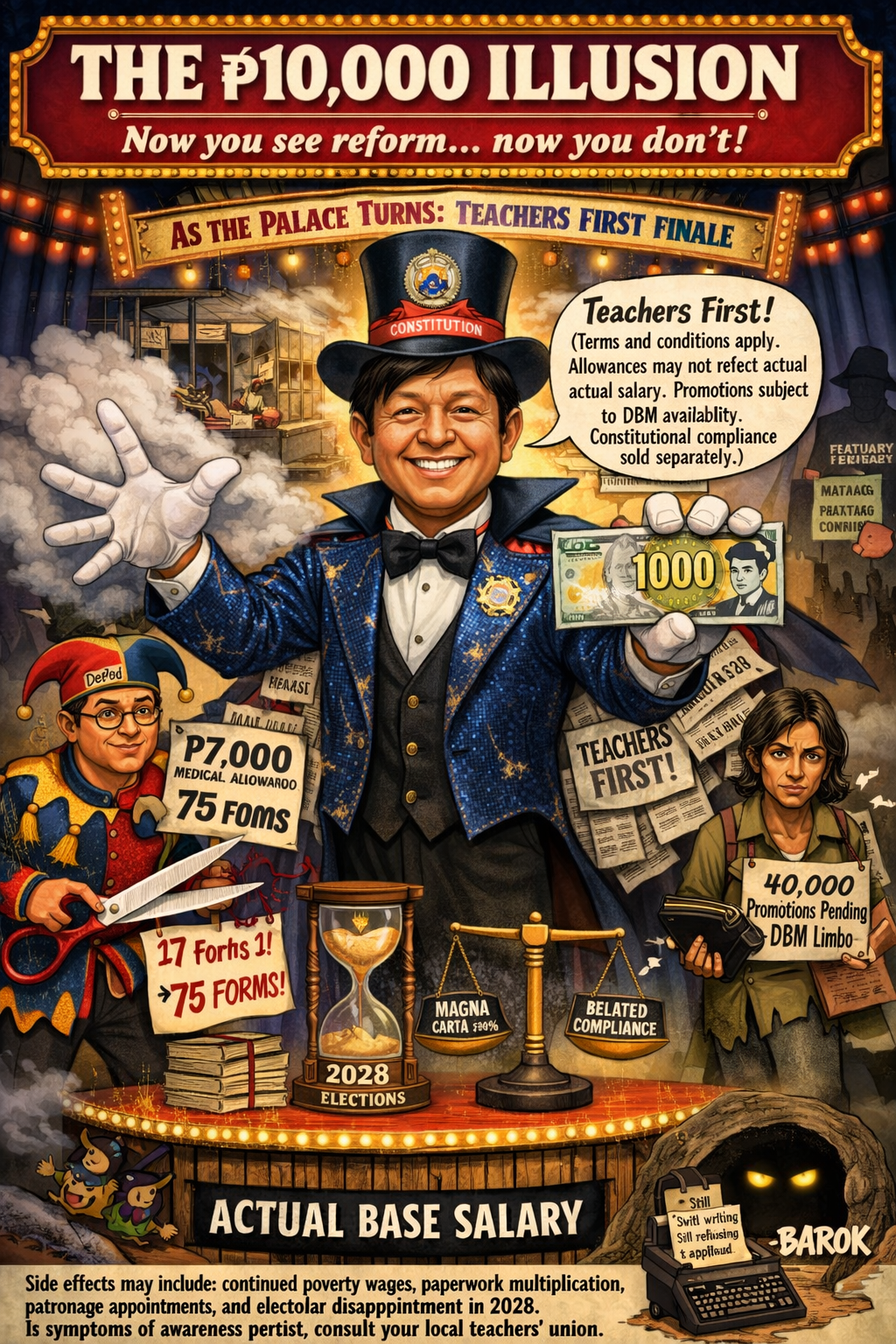
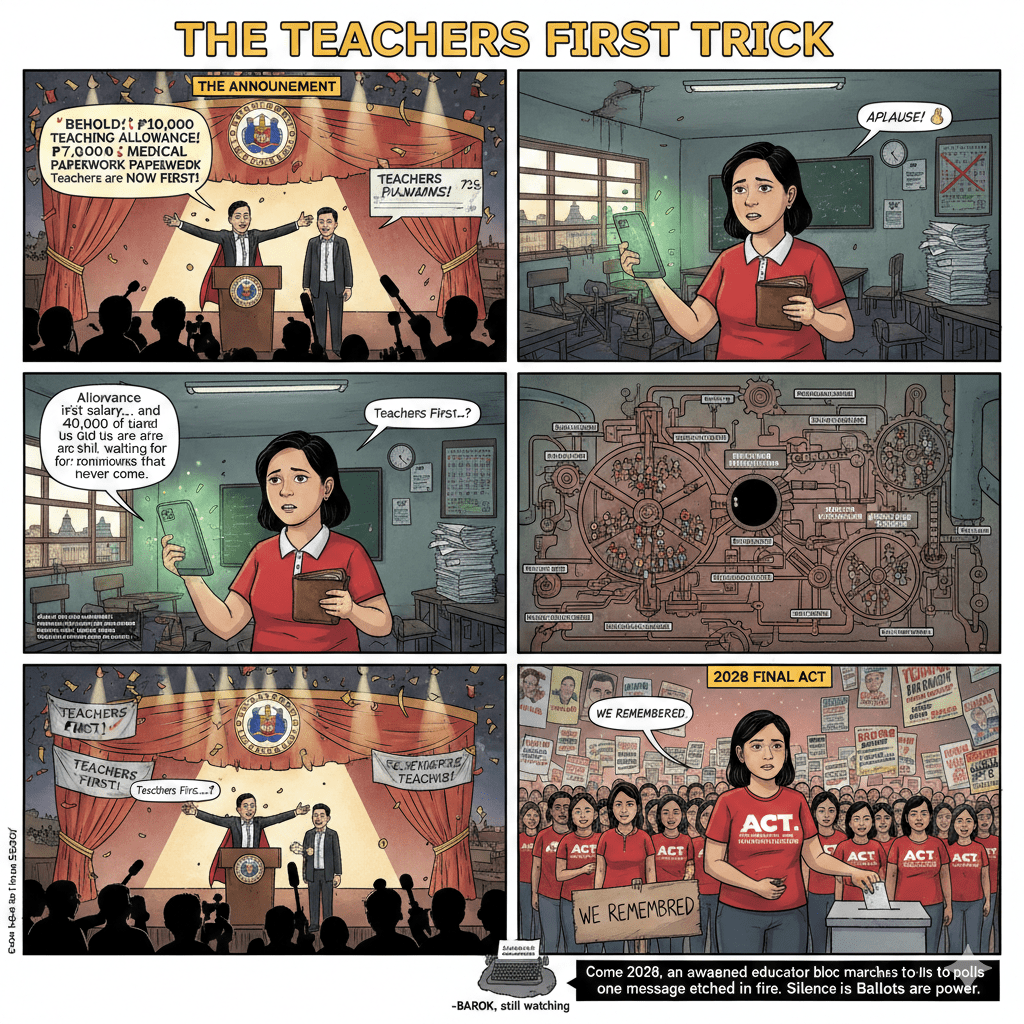
MGA ka-kweba, ladies and gentlemen of the Republic, gather ’round for the latest episode of As the Palace Turns. President Ferdinand R. Marcos Jr., in a performance worthy of a teleserye finale, has decreed that teachers—those forgotten foot soldiers of the nation’s future—are now “first.”
Secretary Sonny Angara, ever the dutiful chorus, announces sweeping reforms via the Department of Education (DepEd). Medical allowance leaps from a laughable ₱500 to ₱7,000. Teaching aid rises from ₱3,500 to ₱10,000.
Paperwork slashed by more than half. An Expanded Career Progression (ECP) system lets teachers climb without abandoning the classroom. New admin posts handle grunt work. Overtime pay clarified. Hardship allowance fixed at 25%. Even private school teachers get a subsidy bump.
Cue the applause track.
This is political theater at its finest—headlines screaming “Teachers First!” as reported in the Inquirer.net article—while the administration pats itself on the back for discovering educators have subsidized the system with their own wallets for decades.
But let’s not be dazzled. The question isn’t “What did they give?” It’s “What are they still withholding?”
Beneath the glossy press release lies the same rot: base salaries below poverty thresholds, classrooms resembling evacuation centers, and a system treating teachers like disposable props in a legacy project.
This isn’t reform. It’s a magician’s flourish—flash the shiny allowances while the real crisis vanishes in smoke.
I. A Legal Scalpel: Dissecting the Constitutional and Statutory Framework
Now let’s get surgical.
The 1987 Constitution isn’t a suggestion—it’s a command. Article XIV, Section 1 demands the State “protect and promote the right of all citizens to quality education” and make it accessible. Section 2 mandates a “complete, adequate, and integrated system.” Section 5 enhances teachers’ rights to professional advancement and guarantees reasonable working conditions and compensation.
“Reasonable.” Not crumbs disguised as caviar.
Republic Act No. 4670 (Magna Carta for Public School Teachers) declares teachers deserve a “reasonable standard of life,” gradual salary progression, overload pay at no less than 25% extra, free annual medical exams, and hardship allowances of at least 25%. The new medical ₱7,000 and fixed hardship 25% aren’t innovations—they’re belated compliance with a 60-year-old law. The teaching allowance hike? Nice, but it’s not base pay, untouched despite inflation.
Then there’s Republic Act No. 12288 (Career Progression Law) and Executive Order No. 174, s. 2022 establishing the ECP. On paper: merit-based, classroom-focused advancement. In practice? Over 40,000 teachers languish in Department of Budget and Management (DBM) limbo while only 16,423 get promoted.
Supreme Court jurisprudence is clear:
- Fabella v. Court of Appeals demands strict due process in teacher actions.
- Related cases hammer arbitrary denials violate fairness.
- Overload compensation gaps are legal failures.
This initiative pays lip service to laws while spitting on their spirit. Merit system? Republic Act No. 6713 demands promotions free of political color. Yet whispers of favoritism in ECP interviews circulate. This sets up certiorari petitions, class suits, and equal protection challenges. The administration writes its own legal obituary.
II. The Rot Beneath the Polish: Unpacking the Issues and Controversies
Let’s give the devil his due—briefly.
Yes, allowances rise. Paperwork supposedly drops. The ECP exists. New admin posts and clarified overtime pay sound lovely. Supporters crow this is fiscal prudence: targeted benefits over unaffordable hikes. Teachers focus on teaching. Remote educators get consistent hardship pay.
Cute. Now reality.
Allowances aren’t salary. Teachers earn far less than their ASEAN peers—while inflation laughs in their faces. Paperwork cut from 174 to 75? Believe it when forms stop multiplying. The ECP? For thousands, it’s a waiting room with no air-conditioning. New admin positions? Prime for political appointees and ghosts—DepEd’s greatest hits, remastered.
Timing and context matter. This fanfare drops alongside the trimester proposal fiasco—a top-down decree treating educators like lab rats until unions screamed. No consultation, just command. Same playbook.
Social media buzzes with teachers calling out ECP anomalies:
- Batches excluded.
- Interviews trumping service years.
- Ratings falling short for the “wrong” people.
Historical echoes—ghost students, procurement scams, confidential funds—linger. The administration swears difference, but patronage scents remain. Positive arguments collapse: half-measures masquerading as revolution, optics dressed as policy.
III. The 2028 Shadow Campaign: Electoral Repercussions and Political Posturing
Let’s call it what it is: early campaign material.
Marcos can’t run again, but legacies build on loyal blocs. Teachers—800,000 strong, plus families and communities—are electoral gold. Shower benefits now, secure goodwill for the administration slate in 2028, blunt arrows from potential rivals like VP Sara Duterte. Contrast with her DepEd tenure—Matatag chaos, confidential funds drama—and Marcos looks the real reformer.
Except optics scream vote-buying with public funds. Disguised, legal, unmistakable.
It could backfire spectacularly. Teachers aren’t naïve; they’re educated, organized, furious when promises evaporate. If 40,000 promotions stay stuck, allowances fail against costs, ECP becomes patronage—that teacher vote turns opposition engine.
Unions like the Alliance of Concerned Teachers (ACT) sharpen knives. One botched implementation hands opposition a narrative: all spectacle, no substance.
IV. The Only Way Forward: A Call for Substance Over Spectacle
Enough photo-ops and press conferences. This country deserves better than recycled rhetoric in “Bagong Pilipinas” branding.
We demand genuine public service: governance putting people before politics, not legacy before livelihood.
We demand systemic support: not just allowance bumps, but:
- Guaranteed infrastructure.
- Sane curricula.
- Real assessment reforms.
- Workloads that don’t break bodies and spirits.
We demand legitimate implementation: neutral, merit-based, legislatively armored ECP against delay and favoritism.
We demand accountability: every peso auditable, every promotion transparent, every outcome measurable. Full compliance with the Magna Carta, Constitution, and decency.
Anything less insults.
V. Final Recommendations: The Barok Blueprint
To President Marcos: Stop press conferences. Sign laws mandating living wages. Push Congress for salary standardization and full Magna Carta modernization. Issue EO fast-tracking 40,000 promotions and mandating union consultation. Legacy builds on results, not headlines.
To Secretary Angara and DepEd: Publish transparent ECP audits, regional equity reports, impact data. Talk to teachers before decreeing the next “reform.”
To Congress: Oversight isn’t optional. Hold hearings on gaps. Appropriate sustained funding. Pass pending bills for pay hikes and workload reduction. Do your job.
To DBM: Clear the backlog. Now.
To teachers: Organize. Document every anomaly, delay, slight. Unions are your voice—use them. Silence is permission. Ballots are power—remember who truly put you first.
If ignored—and history suggests it—allowances become forgotten promises. ECP remains mirage. Teachers subsidize a broken system with health and hope.
Come 2028, an awakened educator bloc marches to polls with one message etched in fire:
WE REMEMBER.
Nag-kaisang mga guro ng Kweba
Until the next press release masquerades as progress,
— Barok,
still watching, still writing, still refusing to applaud crumbs while the feast stays locked in Malacañang.
Key Citations
A. Legal & Official Sources
- The 1987 Constitution of the Republic of the Philippines, Article XIV. Official Gazette of the Republic of the Philippines.
- Magna Carta for Public School Teachers. Republic Act No. 4670, 18 June 1966, The LawPhil Project.
- Code of Conduct and Ethical Standards for Public Officials and Employees. Republic Act No. 6713, 20 Feb. 1989, The LawPhil Project.
- Career Progression System for Public School Teachers and School Leaders Act. Republic Act No. 12288, 2025, The LawPhil Project.
- Establishing the Expanded Career Progression System for Public School Teachers. Executive Order No. 174, s. 2022, 23 June 2022, The LawPhil Project.
- Fabella v. Court of Appeals. G.R. No. 110379, 28 Nov. 1997, The LawPhil Project.
B. News Reports
- “Forthwith” to Farce: How the Senate is Killing Impeachment—And Why Enrile’s Right (Even If You Can’t Trust Him)
- “HINDI AKO NAG-RESIGN!”

- “I’m calling you from my new Globe SIM. Send load!”

- “Mahiya Naman Kayo!” Marcos’ Anti-Corruption Vow Faces a Flood of Doubt

- “Meow, I’m calling you from my new Globe SIM!”

- “No Special Jail for Crooks!” Boying Remulla Slams VIP Perks for Flood Scammers

- “PLUNDER IS OVERRATED”? TRY AGAIN — IT’S A CALCULATED KILL SHOT

- “Several Lifetimes,” Said Fajardo — Translation: “I’m Not Spending Even One More Day on This Circus”

- “Shimenet”: The Term That Broke the Internet and the Budget
- “We Did Not Yield”: Marcos’s Stand and the Soul of Filipino Sovereignty

- “We Gather Light to Scatter”: A Tribute to Edgardo Bautista Espiritu

- $150M for Kaufman to Spin a Sinking Narrative

 KWEBA ni BAROK
Leave a comment