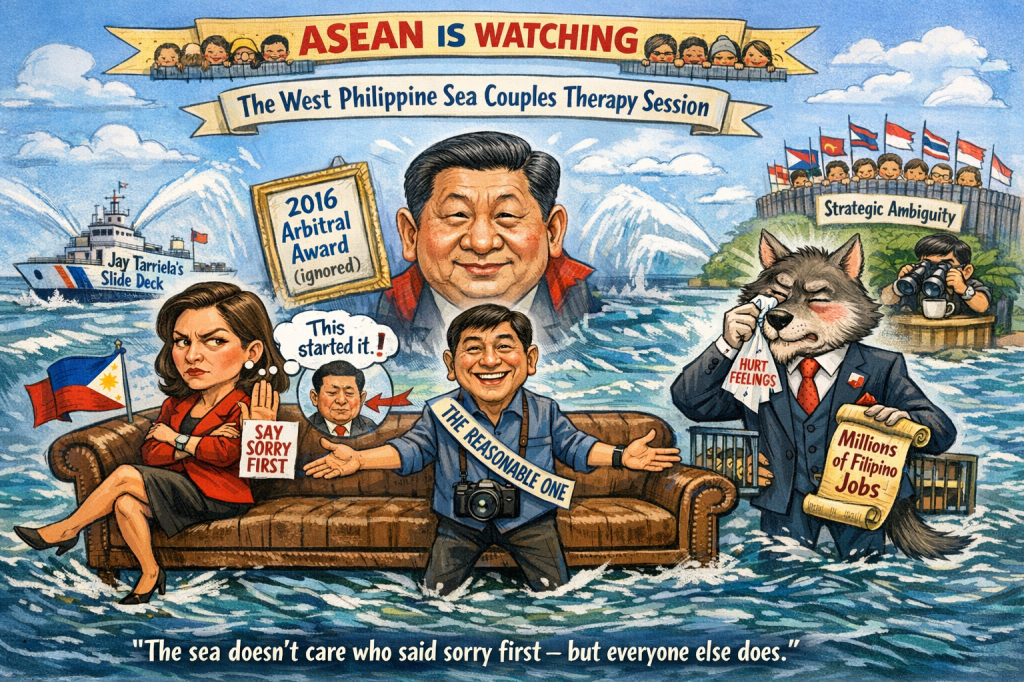
Senator Turns Break-Up Script Into Foreign Policy Masterclass
By Louis ‘Barok‘ C. Biraogo — February 26, 2026
IN THE blood-and-water-cannon arena of the West Philippine Sea, where gray-zone harassment has become routine Tuesday-afternoon entertainment, the Philippine Senate has found a new hill to die on: relationship counseling. On February 24, 2026, Senator Risa Hontiveros delivered the diplomatic equivalent of “I’m not coming to dinner until you say sorry for what you said about my friends.” The target? Chinese Ambassador Jing Quan, who expressed that Beijing was “hurt” by a caricature of Xi Jinping and hoped Filipinos would understand why other countries jail people for less.
This is not merely a spat. It is a masterclass in how great-power bullying, small-state grandstanding, legislative overreach, and executive absenteeism can turn a cartoon slide into a full-blown diplomatic soap opera. Everyone—senators, ambassadors, the Palace, the institution itself—is playing their assigned role with Oscar-worthy commitment to missing the point.
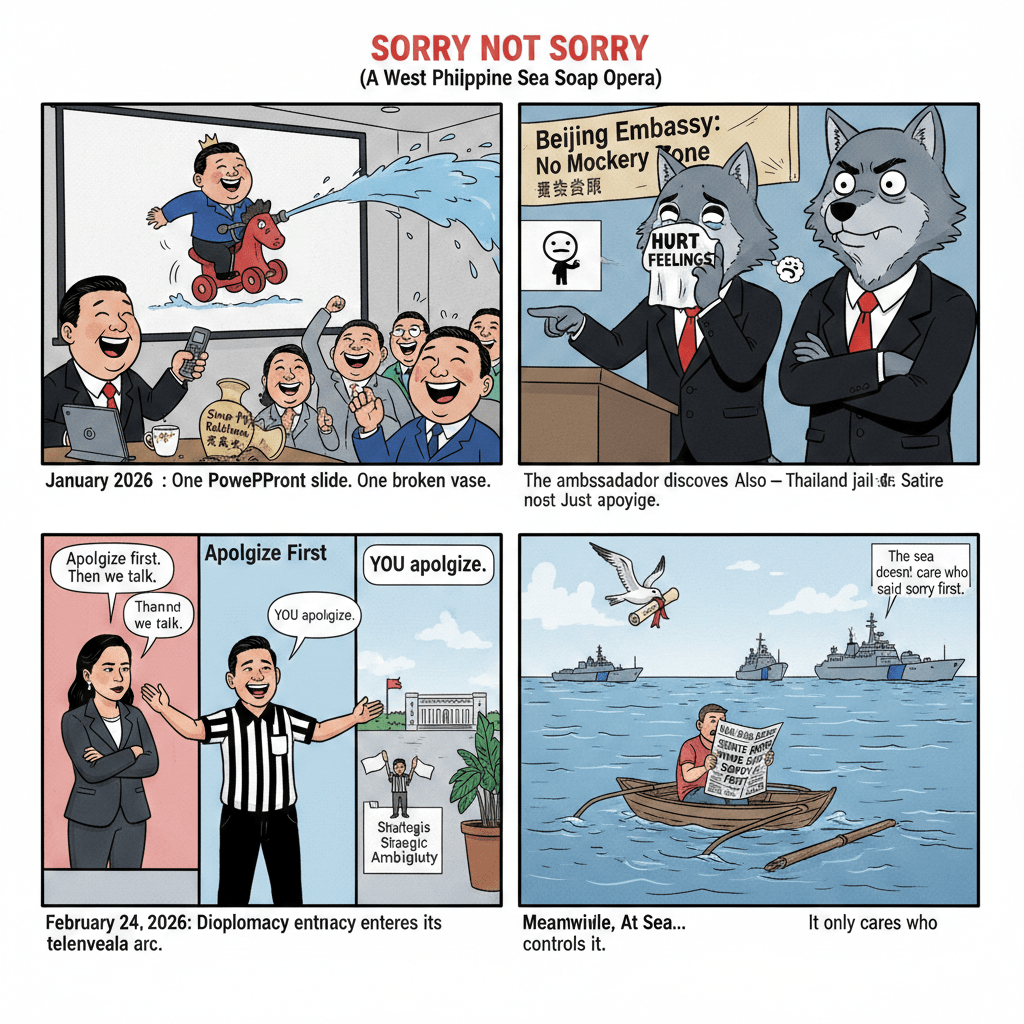
Anatomy of the Farce: Timeline, Trigger, and the Geopolitical Fault Line
January 2026: Philippine Coast Guard Commodore Jay Tarriela presents cartoonish depictions of Xi Jinping at an academic forum to illustrate China’s “aggressive and crude” tactics in the West Philippine Sea—water cannons, militia swarming, the usual. The Chinese Embassy erupts, demanding accountability for “smears and slanders” and warning that strained relations could cost “millions of Filipino jobs.”
The Senate responds with Senate Resolution No. 256, filed January 26 and adopted February 9, condemning the Embassy’s “disrespectful remarks” and “interference” on West Philippine Sea issues as violating diplomatic restraint and mutual respect. Beijing labels it an “anti-China political stunt.” (See also the original Manila Bulletin report on Hontiveros’ refusal.)
February 23: Senator Erwin Tulfo meets Ambassador Jing privately in Pasay City. The ambassador cites the caricature as hurtful and references Thailand’s lèse-majesté laws. Tulfo defends Philippine democracy: effigies burn, leaders shrug. February 24: Hontiveros refuses any meeting without an apology, analogizing to personal relationships.
Beneath the drama lies the real fault line: the 2016 South China Sea Arbitral Award that invalidated Beijing’s nine-dash-line claims, the Marcos administration’s pivot toward Washington, and China’s insistence that its “core interests” and leader’s dignity remain sacred abroad.
Rogues’ Gallery: No One Escapes Unscathed
Senator Risa Hontiveros. Her stance is consistent—she has never wavered on West Philippine Sea sovereignty. Demanding accountability before dialogue asserts dignity. But applying “apologize first” logic—the rule for a rude ex—to a nuclear-armed neighbor’s envoy is either defiant genius or risky theater. It rallies nationalists but fractures Senate unity and risks incoherent foreign-policy signals.
Ambassador Jing Quan and the Chinese Embassy. This is textbook Wolf Warrior: public scolding, veiled economic threats, lecturing a democracy on leader dignity. Referencing jailing critics wasn’t diplomacy; it was intimidation. Public attacks on senators breach restraint under the Vienna Convention on Diplomatic Relations (1961), Article 41. Yet Beijing’s defense—protecting national honor against mockery—is predictable for an authoritarian system treating satire as threat.
Senator Erwin Tulfo and the Peacekeepers. Tulfo kept channels open and defended democratic norms. But the hotel diplomacy also serves the cameras—“I’m the reasonable one.” The Senate remains fragmented: hawks, doves, opportunists.
The Philippine Senate as Institution. Condemning an embassy for rudeness via resolution is legislative posturing. It asserts oversight but overreaches into executive foreign policy territory under the 1987 Constitution of the Republic of the Philippines, Article VII. The spectacle diminishes credibility on substantive lawmaking.
The Marcos Administration and DFA. Strategic ambiguity becomes vacuum. Letting senators dominate foreign-policy space allows Malacañang to play tough (via proxies) and pragmatic (via backchannels)—at the cost of mixed signals that confuse allies and embolden Beijing.
Lawfare 101: Everyone Weaponizing, No One Obeying the Rulebook
The Vienna Convention on Diplomatic Relations (1961) requires diplomats to respect host laws and avoid internal interference (Article 41). Jing’s criticism of a Senate resolution and job-threat warnings likely cross that line. The Senate’s resolution, urging DFA measures, meddles in executive prerogative. Philippine free speech under the 1987 Constitution, Article III, Section 4, protects satire—Xi cartoons included—over imported sensitivities. The 2016 South China Sea Arbitral Award binds Manila, ignored by Beijing. Norms are cherry-picked to fit narratives.
Steel-Manning Before the Mockery
- For Hontiveros: Defends dignity, prevents normalization of bullying. Small states must push back. Weakness: Preconditions shrink space for de-escalation on fisheries, incident management.
- For Jing/Beijing: Defends honor against “false narratives.” Weakness: Exporting speech taboos and economic threats alienates neighbors, accelerates Manila’s U.S. alignment.
- For the Senate: Oversight keeps policy honest. Weakness: Turning the chamber into grievance theater while vessels loiter in the EEZ is misplaced priority.
- For Marcos/DFA ambiguity: Preserves flexibility. Weakness: Creates space for senatorial amateur diplomacy.
The Menu of Miseries: Strategic Options and Likely Disasters
Hontiveros can double down, attend conditionally, or pivot via DFA. Jing can offer mild “regret,” bypass her, or escalate. The Senate can caucus, proceed without her, or threaten persona non grata (nuclear). Marcos can mediate or stay distant.
Most probable: mild Chinese clarification, limited meetings, rhetorical cooling amid ongoing gray-zone actions. Highest risk: spillover into maritime miscalculation, activating U.S. treaty obligations.
Collateral Damage: Domestic, Bilateral, Regional, Global
Domestically, Hontiveros gains nationalist points; Senate appears divided. Bilaterally, trust erodes; economic signaling lingers. Regionally, ASEAN sees pressure-handling. Geopolitically, U.S.-Philippine ties strengthen. Long-term: public tantrums erode comity, normalize ego over interest.
Concrete Recommendations and the Higher Ground
- To Senator Hontiveros: Drop the public precondition, attend with a policy agenda on fisheries and the 2016 Award. Principle needs pragmatism.
- To Ambassador Jing: Express regret for tone, pivot to substance. Stop lecturing democracies on feelings.
- To the Senate: Caucus privately, speak via Foreign Relations. End manners resolutions.
- To DFA and President Marcos: Reassert primacy, mediate quietly.
- To Beijing: Bullying drives diversification and alliances. Mutual interests—trade, sea lanes—exist if egos recede.
Diplomacy isn’t therapy. It manages irreconcilable interests without war. The adults must reclaim the room before the next water-cannon blast or resolution makes apologies irrelevant.
The sea doesn’t care who said sorry first. It only cares who controls it.
Key Citations
A. Legal & Official Sources
- Vienna Convention on Diplomatic Relations. United Nations, 18 Apr. 1961.
- The South China Sea Arbitration (The Republic of the Philippines v. The People’s Republic of China). Award, Permanent Court of Arbitration, 12 July 2016.
- The 1987 Constitution of the Republic of the Philippines. The LawPhil Project.
B. News Reports
- Torregoza, Hannah L. “Hontiveros to Chinese Ambassador: Apologize First Before Asking for a Meeting.” Manila Bulletin, 24 Feb. 2026.
- Abarca, Charie. “Senate Approves Resolution vs Chinese Embassy Remarks.” Philippine Daily Inquirer, 9 Feb. 2026.
- Abarca, Charie. “15 Senators Cross Party Lines, Sign Reso vs Chinese Embassy Remarks.” Philippine Daily Inquirer, 26 Jan. 2026.

- “Forthwith” to Farce: How the Senate is Killing Impeachment—And Why Enrile’s Right (Even If You Can’t Trust Him)
- “HINDI AKO NAG-RESIGN!”

- “I’m calling you from my new Globe SIM. Send load!”

- “Mahiya Naman Kayo!” Marcos’ Anti-Corruption Vow Faces a Flood of Doubt

- “Meow, I’m calling you from my new Globe SIM!”

- “No Special Jail for Crooks!” Boying Remulla Slams VIP Perks for Flood Scammers

- “PLUNDER IS OVERRATED”? TRY AGAIN — IT’S A CALCULATED KILL SHOT

- “Several Lifetimes,” Said Fajardo — Translation: “I’m Not Spending Even One More Day on This Circus”

- “Shimenet”: The Term That Broke the Internet and the Budget
- “We Did Not Yield”: Marcos’s Stand and the Soul of Filipino Sovereignty

- “We Gather Light to Scatter”: A Tribute to Edgardo Bautista Espiritu

- $150M for Kaufman to Spin a Sinking Narrative

 KWEBA ni BAROK
Leave a comment