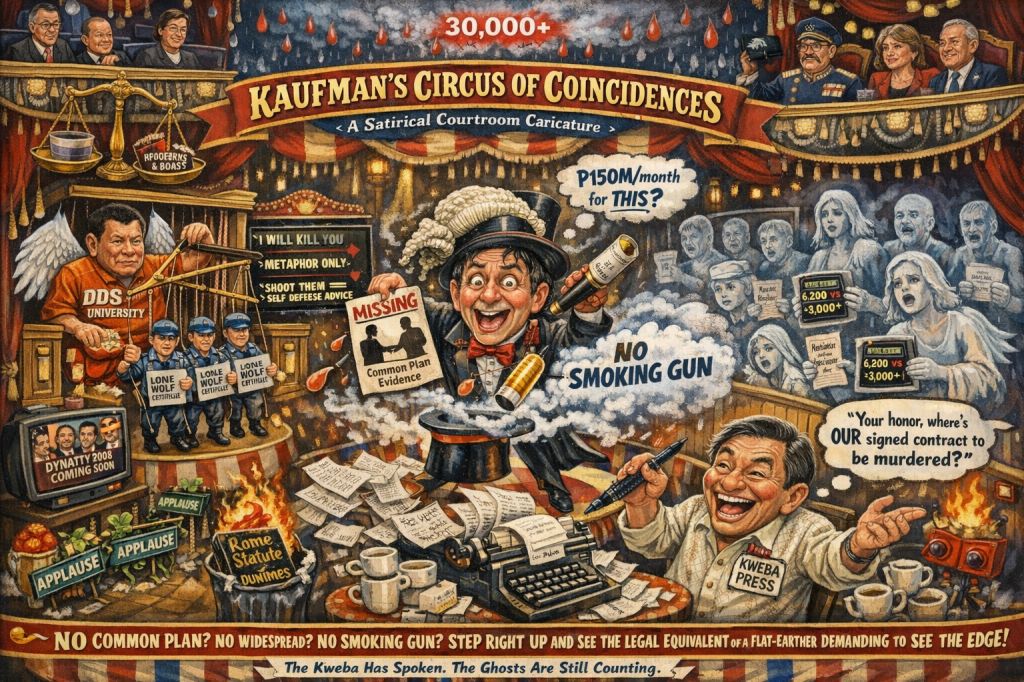
Defending the Indefensible: How to Turn a Killing Spree into a Series of Unfortunate Coincidences
By Louis ‘Barok‘ C. Biraogo — February 28, 2026
LADIES, gentlemen, and the ghosts of 30,000-plus drug-war dead, gather ‘round the virtual kweba. On February 26, 2026, Nicholas Kaufman — British-Israeli hired gun, former Jerusalem prosecutor turned ICC defense diva — strutted into the Pre-Trial Chamber like a magician pulling rabbits out of a hat that was never there. His client, the detained ex-president Rodrigo “Digong” Duterte, stands accused of crimes against humanity of murder under Article 7(1)(a) of the Rome Statute. Kaufman’s mission? Convince three judges that the entire Philippine drug war was just a series of unfortunate, unconnected oopsies with zero “common plan,” zero “widespread or systematic” character, and — cue the dramatic pause — zero smoking gun.
Oh, the suspense. You could hear the crickets in Davao applauding.
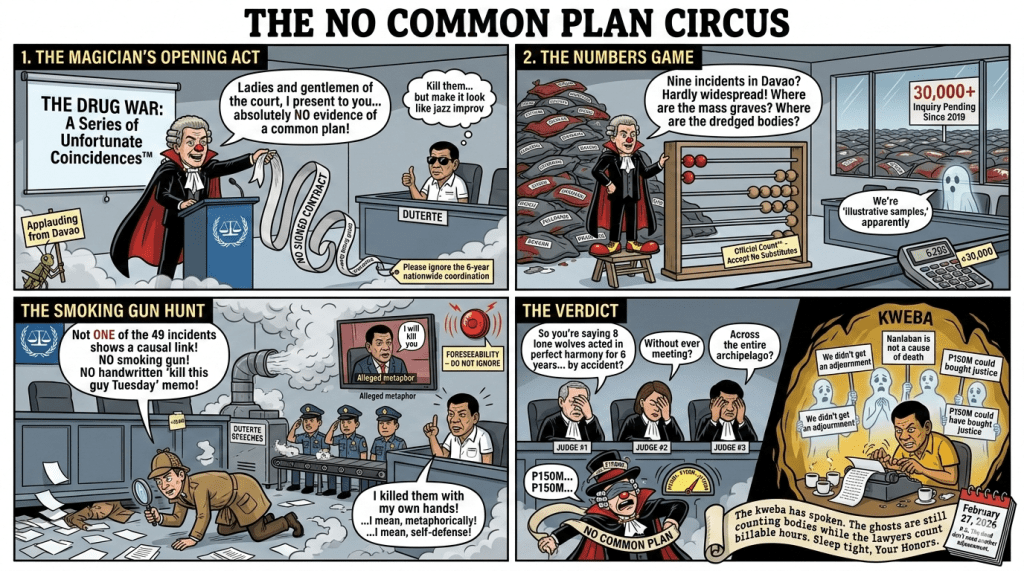
“Batteries, Conscience, and Common Plans Not Included”
1. The “Lack of a Common Plan” Canard — Or, “Where’s the Signed Contract, Your Honors?”
Kaufman’s opener, delivered with the gravity of a man who just discovered the wheel: “In order to prove criminal liability through indirect co-perpetration, there is a need to show a common plan upon which the suspect and his co-perpetrators must mutually agree, and that common plan must without exception, have a criminal element.” And — plot twist! — “the prosecution cannot point to any particular point in time where there is direct evidence indicating that even two of their so-called co-perpetrators actually met to agree to such a preposterous scheme.”
Cue the slow clap from the peanut gallery.
Article 25(3)(a) of the Rome Statute does not require a PowerPoint presentation or notarized minutes. The International Criminal Court (ICC) has never demanded a literal handshake in a smoke-filled room. In Prosecutor v. Thomas Lubanga Dyilo (Confirmation Decision, 2007, para. 343 et seq.), the Chamber made crystal clear: a “common plan” exists when there is a mutual agreement or common design, express or implied, that foreseeably leads to the crimes. No need for a smoking-gun meeting when the entire apparatus screams coordination.
Fast-forward to Prosecutor v. Bosco Ntaganda (Trial Judgment, 2019; Appeals affirmed the doctrine despite some grumbling on terminology). Indirect co-perpetration via control over an organizational apparatus — hello, Philippine National Police and the Davao Death Squad blueprint replicated nationwide. In the Kenya cases (Ruto et al. Confirmation, 2011), the Pre-Trial Chamber charged political leaders as indirect co-perpetrators based on inferred common plans from rallies, training camps, ethnic targeting, and foreseeable violence — without a single “we hereby agree to murder” email. Patterns, command structures, public incitement, reward systems (promotions for body counts, anyone?), and institutional replication. That’s the jurisprudence Kaufman is pretending doesn’t exist.
Kaufman wants you to believe the drug war was eight lone wolves acting in perfect, coincidental harmony for six years across the archipelago. Satire writes itself.
2. “Only Nine Incidents in Davao? Hardly Widespread!” — The Numbers Don’t Lie, But the Defense Does
Next act: “Count one contains nine incidents of murder in one city, Davao, [which] is hardly widespread.” And no mass graves or dredged bodies, so — poof! — no crime against humanity.
Article 7(1) requires the murders to be “part of a widespread or systematic attack directed against any civilian population.” Note the disjunctive “or.” The ICC Elements of Crimes and Kunarac jurisprudence (International Criminal Tribunal for the former Yugoslavia, adopted by ICC) define “widespread” as large-scale, numerous victims, geographic spread; “systematic” as organized policy or pattern, not random. The prosecution’s 49 incidents covering 78 named victims (plus the thousands more in the investigation’s scope from November 2011–March 2019) are not the entire case — they are illustrative samples of a national policy that Human Rights Watch, Amnesty International, and the ICC itself estimate killed between 6,200 (official, laughably low) and 30,000+.
Nine in Davao? That’s just the opening act, counselor. The nationwide symphony under Duterte’s presidency turned the entire country into one giant stage for state-sponsored slaughter of the poor, the suspected, the inconvenient — civilians all, because “drug personality” is not a get-out-of-Rome-Statute-free card. Katanga (Confirmation, 2008) and Ntaganda confirm: the attack’s scale is assessed holistically, not by cherry-picked snapshots. Forensic mass graves? Not required when you have body bags, police logs, eyewitnesses, and Duterte’s own televised boasts: “I will kill you,” “shoot them,” “I don’t care about human rights.”
3. “No Causal Nexus, No Smoking Gun” — The Desperate Search for a Literal Trigger Pull
And the pièce de résistance: “Not one of the 49 incidents manifests such a causal link between a speech, an order, and one of the charged incidents… There is no smoking gun.”
Under Article 25(3)(a), indirect co-perpetration requires an essential contribution to the common plan with knowledge and foresight that crimes will occur. Not a handwritten “kill this guy on Tuesday” memo. Duterte’s speeches created the policy atmosphere; quotas, bounties, promotions, and the replication of the Davao model supplied the machinery; the killings followed like clockwork. Foreseeability and control — that’s the nexus. Lubanga and Katanga both convicted on exactly this basis: leaders who set the wheels in motion without personally squeezing triggers.
Kaufman’s “no smoking gun” mantra is the legal equivalent of a flat-earther demanding to see the edge. The gun is smoking so hard it set off the fire alarms in The Hague.
The Actors, Their Motives, and the Blood on the Floor
- Kaufman? A polished international defense mercenary (P150 million a month, rumor has it) doing his job with theatrical flair — “I feel sorry for the weeping victim, but I have a job to do.” Noble. But this is performative spectacle for the domestic audience: keep the Dutertards frothing, muddy the waters, buy time for political resurrection.
- Duterte? Legacy salvage operation. The man who built his brand on “I killed them with my own hands” now claims it was all metaphor and self-defense. His political survival — and his family’s 2028 dreams — hinge on this not becoming the first Asian head-of-state ICC conviction.
- The ICC Prosecution? Institutional credibility on the line. After years of investigation, arrest, and hearing, they must prove the Rome Statute isn’t just for Africans. The stakes: affirm that no one — not even a populist strongman — can turn a nation into a killing field and hide behind “no signed contract.”
- Marcos Jr. government? The delicate tango of cooperation (arrest delivered) versus domestic backlash. Neutralize a rival dynasty while avoiding the optics of “handing over a hero.” House resolutions to rejoin the ICC? Pure theater.
- And the victims — the moral North Star. The mothers, the widows, the orphans of the urban poor slaughtered in the name of “cleaning” the streets. Their tears in the gallery are not props. They are the reason this court exists.
Witness credibility attacks? Classic. Self-confessed killers turned state witnesses are standard in every major ICC case (Katanga, Ongwen). Corroboration exists in spades: patterns, timelines, official data. Davao Death Squad (DDS) origins in Davao? Public record. Political fallout? Irrelevant to the law.
Possible Paths Forward and the Coming Reckoning
The Pre-Trial Chamber has options:
- Confirm all charges (most likely — substantial grounds threshold is low)
- Narrow them
- Adjourn for more evidence
- Or — miracle of miracles — dismiss
Dismissal would gut ICC jurisprudence on indirect liability and embolden every aspiring autocrat. Confirmation sends it to trial, where the full horror show plays out.
Impacts? In the Philippines: deeper polarization, possible reprisals, but also a long-overdue national reckoning with impunity. Globally: precedent that drug wars waged as extermination campaigns are crimes against humanity. Southeast Asia watches. The world watches.
My Verdict — And the Three Non-Negotiable Demands
This defense is not merely weak. It is an insult to the intelligence of the Chamber, to the Rome Statute, and to every grave in the Philippines that has no marker because the body was never found.
Call for Justice: The victims deserve their day. Every mother who buried a child labeled “nanlaban” demands accountability — not performative sorrow from the defense table.
Call for Supremacy of the Rule of Law: No former president, no matter how many votes he harvested on a platform of death, is above the law. The Rome Statute was written for exactly this moment.
Call for Humanity: Behind every “incident,” behind every legal argument, are thousands of human beings erased. Their lives mattered. Their deaths must not be sanitized by courtroom wordplay.
Bold Recommendations — Because Half-Measures Are for Cowards
To the Pre-Trial Chamber: Confirm the charges in full. Reject narrow literalism. Affirm that international criminal law sees patterns, not PowerPoints.
To the Prosecution: Hammer the institutional control evidence. Bring the full statistical horror — the 30,000 estimate, the child victims, the post-2019 continuation. No mercy on rebuttal.
To the world: Learn this lesson. When a leader says “I will kill them,” believe him. When the bodies pile up under state policy, call it what it is — a crime against humanity. And never, ever let a defense lawyer convince you that absence of a signed murder contract equals innocence.
The kweba has spoken. The ghosts are still counting bodies while the lawyers count billable hours. Sleep tight, Your Honors.
— Barok
P.S. The dead don’t need another adjournment.
Key Citations
A. Legal & Official Sources
- Rome Statute of the International Criminal Court. International Criminal Court, 17 July 1998.
- Decision on the confirmation of charges. ICC-01/04-01/06-803-tEN. International Criminal Court, 29 Jan. 2007.
- International Criminal Court. Judgment. Case No. ICC-01/04-02/06-2359, 8 July 2019.
- International Criminal Court. Decision on the Confirmation of Charges. Case No. ICC-01/04-01/07-717, 30 Sept. 2008.
- International Criminal Court. Decision on the Confirmation of Charges Pursuant to Article 61(7)(a) and (b) of the Rome Statute. Case No. ICC-01/09-01/11-373, 23 Jan. 2012.
B. News Reports
- Laqui, Ian. “Kaufman: Duterte not co-perpetrator in drug war due to lack of ‘common plan’.” Philstar.com, 26 Feb. 2026.

- ₱75 Million Heist: Cops Gone Full Bandit

- ₱6.7-Trillion Temptation: The Great Pork Zombie Revival and the “Collegial” Vote-Buying Circus

- ₱1.9 Billion for 382 Units and a Rooftop Pool: Poverty Solved, Next Problem Please

- ₱1.35 Trillion for Education: Bigger Budget, Same Old Thieves’ Banquet

- ₱1 Billion Congressional Seat? Sorry, Sold Out Na Raw — Si Bello Raw Ang Hindi Bumili

- “We Will Take Care of It”: Bersamin’s P52-Billion Love Letter to Corruption

- “Skewed Narrative”? More Like Skewered Taxpayers!

- “Scared to Sign Vouchers” Is Now Official GDP Policy – Welcome to the Philippines’ Permanent Paralysis Economy

- “Robbed by Restitution?” Curlee Discaya’s Tears Over Returning What He Never Earned

- “No Pressure” Luistro? The House Pork Bazaar Exposed
- “My Brother the President Is a Junkie”: A Marcos Family Reunion Special

- “Mapipilitan Akong Gawing Zero”: The Day Senator Rodante Marcoleta Confessed to Perjury on National Television and Thought We’d Clap for the Creativity

 KWEBA ni BAROK
Leave a comment