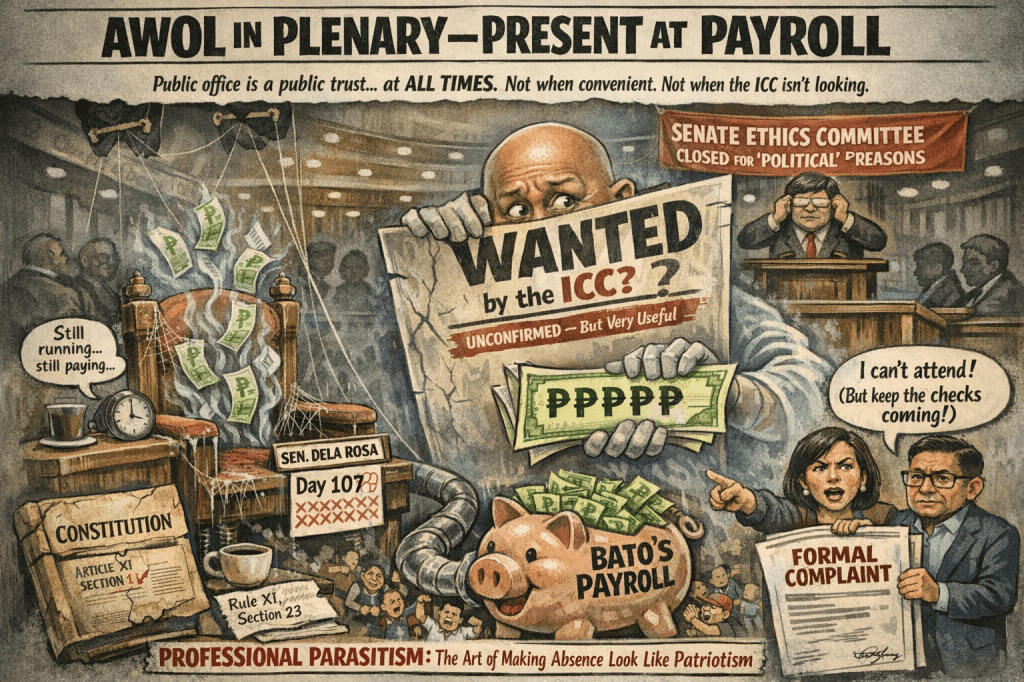
AWOL in Plenary, Present at Payroll
By Louis ‘Barok‘ C. Biraogo — February 28, 2028
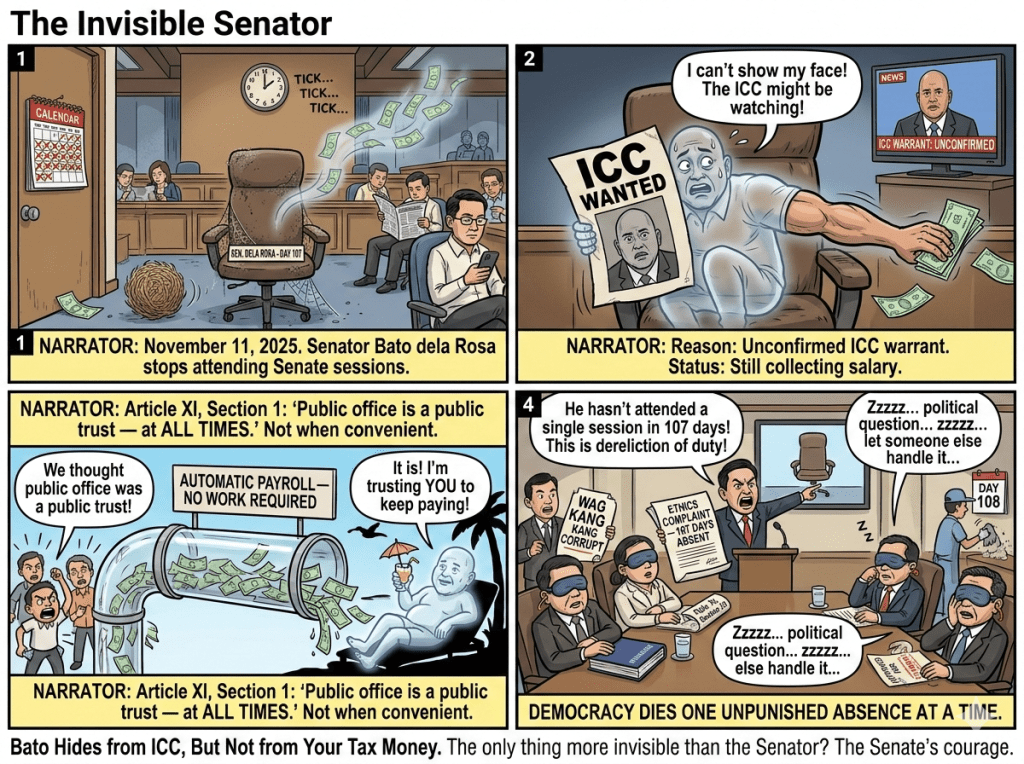
AN empty chair in the Senate plenary hall does not merely occupy space. It mocks the institution. Since November 11, 2025—107 days and counting as of this writing—Sen. Ronald “Bato” dela Rosa has transformed that chair into a symbol of entitled absenteeism wrapped in the convenient fog of an unconfirmed International Criminal Court (ICC) warrant. No sessions attended. No committee hearings chaired. No votes cast. Yet the salary, the staff, the franking privilege, the car plate—all flow uninterrupted from the public purse.
Enter Wag Kang Corrupt on February 25, 2026. The civil society outfit, fronted by Cielo Magno and Barry Gutierrez, marched into the Senate Committee on Ethics and Privileges and filed the only complaint that should have been filed months ago: prolonged, unjustified absence equals dereliction of duty and grave abuse of privilege. Their language was clinical, almost merciful. Mine will not be.
The Legal Baseline: Public Office Is a Public Trust
Article XI, Section 1 of the 1987 Constitution of the Republic of the Philippines is not decorative prose: “Public office is a public trust. Public officers and employees must, at all times, be accountable to the people, serve them with utmost responsibility, integrity, loyalty and efficiency, act with patriotism and justice, and lead modest lives.” Note the phrase “at all times.” Not “when convenient.” Not “when the ICC isn’t looking.” At all times.
Article VI, Section 16(3) grants each House the power to “punish its Members for disorderly behavior” and, with two-thirds concurrence, suspend or expel. Prolonged unexplained absence is textbook disorderly behavior. The Senate’s own Rules of Procedure vest the Ethics Committee with jurisdiction over the “conduct, rights, privileges, safety, dignity, integrity and reputation” of its members (Rule X, Section 13). Rule XI, Section 23 already did its quiet work: dela Rosa lost “almost all” committee memberships after five successive unexplained absences. The rules are not ambiguous; the Senate is simply choosing not to read them aloud when the absentee wears the right political color.
Republic Act No. 6713 (the Code of Conduct and Ethical Standards for Public Officials and Employees), Section 4(a) demands “Commitment to public interest” and “utmost responsibility, integrity, competence, and loyalty.” Section 4(b) requires “Professionalism.” Receiving full compensation while rendering zero plenary or oversight work is not professionalism; it is professional parasitism.
The Supreme Court has repeatedly told us these are political questions—Arroyo v. De Venecia (1997), Santiago v. Guingona (1998). Courts will not rescue the Senate from its own cowardice. The remedy is internal. Which is precisely why nothing will happen unless public outrage forces the hand.
The Defense: Fear, Due Process, and the ICC Shadow
Supporters of dela Rosa, including Imee Marcos, argue that the senator did not choose to be absent. They frame his disappearance as an act of self-preservation amid legal uncertainty, alleging inadequate state protection should an ICC arrest be attempted.
This defense rests on three pillars:
- Personal safety and due process—if an arrest warrant exists, appearing publicly could expose him to detention without sufficient guarantees.
- Legal ambiguity of ICC jurisdiction: The Philippines withdrew from the Rome Statute effective March 17, 2019, raising questions about ongoing jurisdiction over acts from 2011–2019.
- Functional representation: His office staff continues to operate, and legislation is allegedly pursued through proxies.
These arguments are not frivolous—but they are deeply flawed.
Why the Defense Fails
First, the warrant remains unconfirmed by the ICC itself, by the Department of Justice (DOJ), by Malacañang. Ombudsman Remulla’s November 2025 press conference was not a judicial finding; it was a press release. The Supreme Court already swatted down dela Rosa’s earlier “very urgent motion” for lack of basis. You do not get to treat rumor as exigent circumstance and then demand the Republic treat your fear as law.
Second, even if a warrant existed, fear does not suspend constitutional duty. Judges under death threats do not stop issuing decisions. Prosecutors do not vanish. Soldiers do not collect hazard pay from a foxhole in Boracay. The Constitution’s arrest privilege under Article VI, Section 11 covers only offenses punishable by six years or less. Crimes against humanity do not qualify. The privilege was never meant to become a get-out-of-Senate-free card.
Third, “My staff is still working.” Staff cannot interpellate. Staff cannot vote. Staff cannot be held politically accountable to 110 million Filipinos. A senator is not a franchise; he is the constitutional actor. This is not delegation; it is abdication.
The Civil Society Question: Accountability or Political Signaling?
The complaint’s timing, coinciding with the Marcos-Duterte rift that sharpened after Duterte’s March 2025 ICC surrender, invites the accusation of political weaponization. Yet even a politically motivated complaint can be legally meritorious. The facts—three-plus months of zero attendance, full pay—stand independent of the filers’ CVs.
Wag Kang Corrupt—launched in 2023 by vocal Duterte critics—carries the whiff of selective outrage. Where were they when other senators missed sessions for junkets or medical tourism? Civil society is allowed to be strategic; it is not required to be naïve. The real scandal is not that they filed—it is that the Senate needed them to.
The Politics Is Pure Theater
The Marcos-Duterte cold war simmers: one son’s administration delivered Duterte to The Hague; the other daughter’s uncle now defends the former police chief who ran the very campaign under scrutiny. The unconfirmed warrant is the perfect MacGuffin—useful for both sides. For Duterte loyalists, proof of “foreign interference.” For the administration, a convenient lever to keep troublesome allies on the sidelines without dirtying their own hands. Meanwhile the Senate, that great deliberative body, treats its own rules like optional suggestions.
Options on the Table, Stripped of Euphemism
For dela Rosa:
- Return immediately, demand protection in open session, and dare the ICC through legal channels.
- File a formal leave application and voluntarily forfeit salary pro-rata—put your money where your fear is.
- Resign. The honest exit. Trigger a special election. Stop collecting a paycheck for phantom representation.
For the Ethics Committee:
- Dismiss—coward’s choice, already telegraphed by Senate President Sotto’s “no work, no pay” disclaimer.
- Censure and dock pay for every absent day.
- Suspend (maximum 60 days under the Constitution)—symbolic, since he is already self-suspended.
- Expel—requires two-thirds, politically radioactive.
For Wag Kang Corrupt:
- Keep the pressure. Monitor the March 4 executive session. If whitewashed, go to the Ombudsman under Republic Act No. 6713.
- Parallel public campaign. Broaden the net—name every habitual absentee. Make selective enforcement impossible.
For the public:
Stop romanticizing “Bato the fearless.” Demand receipts. Every single peso drawn from the national treasury must be earned in the plenary or committee room. Delicadeza is not a slogan; it is the minimum wage of public service.
What must be done is brutally simple. The Senate must amend its rules tomorrow: mandatory attendance thresholds, automatic salary forfeiture after 30 cumulative unexcused absences in a year, public quarterly disclosure of attendance and committee participation. The Ombudsman should treat Republic Act No. 6713 violations by legislators as fair game, not political no-fly zones. Civil society must institutionalize this vigilance—file against the next ghost senator regardless of party. And the electorate must remember in 2028: an empty chair does not deserve another term.
This is not about one former police general’s personal peril. It is about whether the Republic still believes that sovereignty resides in the people, or has degenerated into a protection racket where the powerful can disappear when accountability knocks and still collect the rent.
Bato dela Rosa did not invent absentee privilege. He merely perfected the art of making it look like patriotism. The Senate, by its silence, is complicit. And the Filipino people, if they shrug, become accessories after the fact.
The chair is still empty. The clock is still running. The question is no longer whether Senator dela Rosa will return. The question is whether the Senate will remember what it was elected to do before the next empty chair becomes permanent.
Because in the end, democracy does not die with a bang or even a warrant. It dies one unpunished absence at a time.
Key Citations
A. Legal & Official Sources
- The 1987 Constitution of the Republic of the Philippines. Official Gazette of the Republic of the Philippines.
- Code of Conduct and Ethical Standards for Public Officials and Employees. Republic Act No. 6713, Official Gazette of the Republic of the Philippines, 20 Feb. 1989.
- Rules of the Senate. Senate of the Philippines.
- Arroyo v. De Venecia. Supreme Court of the Philippines, 14 Aug. 1997, G.R. No. 127255, The LawPhil Project.
- Santiago v. Guingona, Jr.. Supreme Court of the Philippines, 18 Nov. 1998, G.R. No. 134577, The LawPhil Project.
B. News Reports
- ₱75 Million Heist: Cops Gone Full Bandit

- ₱6.7-Trillion Temptation: The Great Pork Zombie Revival and the “Collegial” Vote-Buying Circus

- ₱1.9 Billion for 382 Units and a Rooftop Pool: Poverty Solved, Next Problem Please

- ₱1.35 Trillion for Education: Bigger Budget, Same Old Thieves’ Banquet

- ₱1 Billion Congressional Seat? Sorry, Sold Out Na Raw — Si Bello Raw Ang Hindi Bumili

- “We Will Take Care of It”: Bersamin’s P52-Billion Love Letter to Corruption
- “Skewed Narrative”? More Like Skewered Taxpayers!

- “Scared to Sign Vouchers” Is Now Official GDP Policy – Welcome to the Philippines’ Permanent Paralysis Economy
- “Robbed by Restitution?” Curlee Discaya’s Tears Over Returning What He Never Earned

- “No Pressure” Luistro? The House Pork Bazaar Exposed
- “My Brother the President Is a Junkie”: A Marcos Family Reunion Special

- “Mapipilitan Akong Gawing Zero”: The Day Senator Rodante Marcoleta Confessed to Perjury on National Television and Thought We’d Clap for the Creativity


 KWEBA ni BAROK
Leave a comment