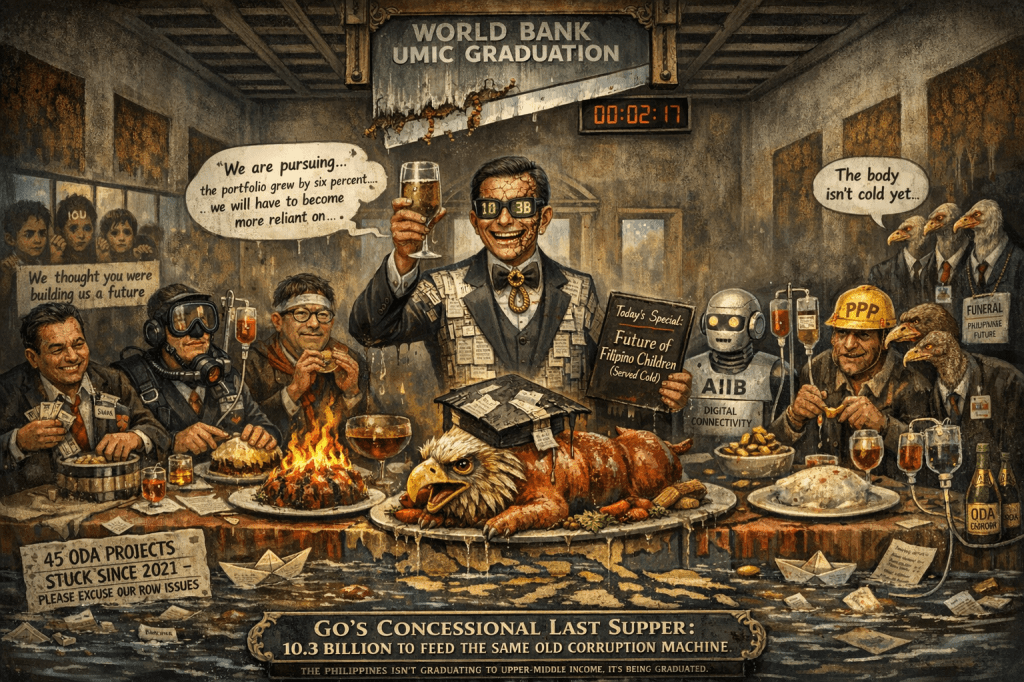
Before UMIC Graduation: One Final Feast on Concessional Crumbs
By Louis ‘Barok‘ C. Biraogo — March 1, 2026
Manila, February 27, 2026: while ordinary Filipinos still wade through last year’s ghost-flood muck, Finance Secretary Frederick Go steps to the podium like a maître d’ calling last orders at the all-you-can-borrow buffet. “Twenty-five new ODA loan agreements,” he beams. “$10.3 billion from Japan, South Korea, and France. Plus two shiny AIIB baubles: half a billion for Luzon Digital Connectivity and $150 million for a Metro Manila ‘sponge city’ to retain water.”
Retain water? Darling, the only thing this government has ever retained is the right to keep stealing it.
Let us pause and summon the righteous fury that any clear-eyed observer must feel when witnessing a nation mortgage its children’s future. Here, the refugees are the next generation of Filipinos, already born with a $10.3 billion IOU tattooed on their foreheads. This is not fiscal prudence. This is fiscal necromancy—raising dead money from the graves of concessional loans before the World Bank’s upper-middle-income country (UMIC) guillotine falls and the cheap-credit party ends forever.
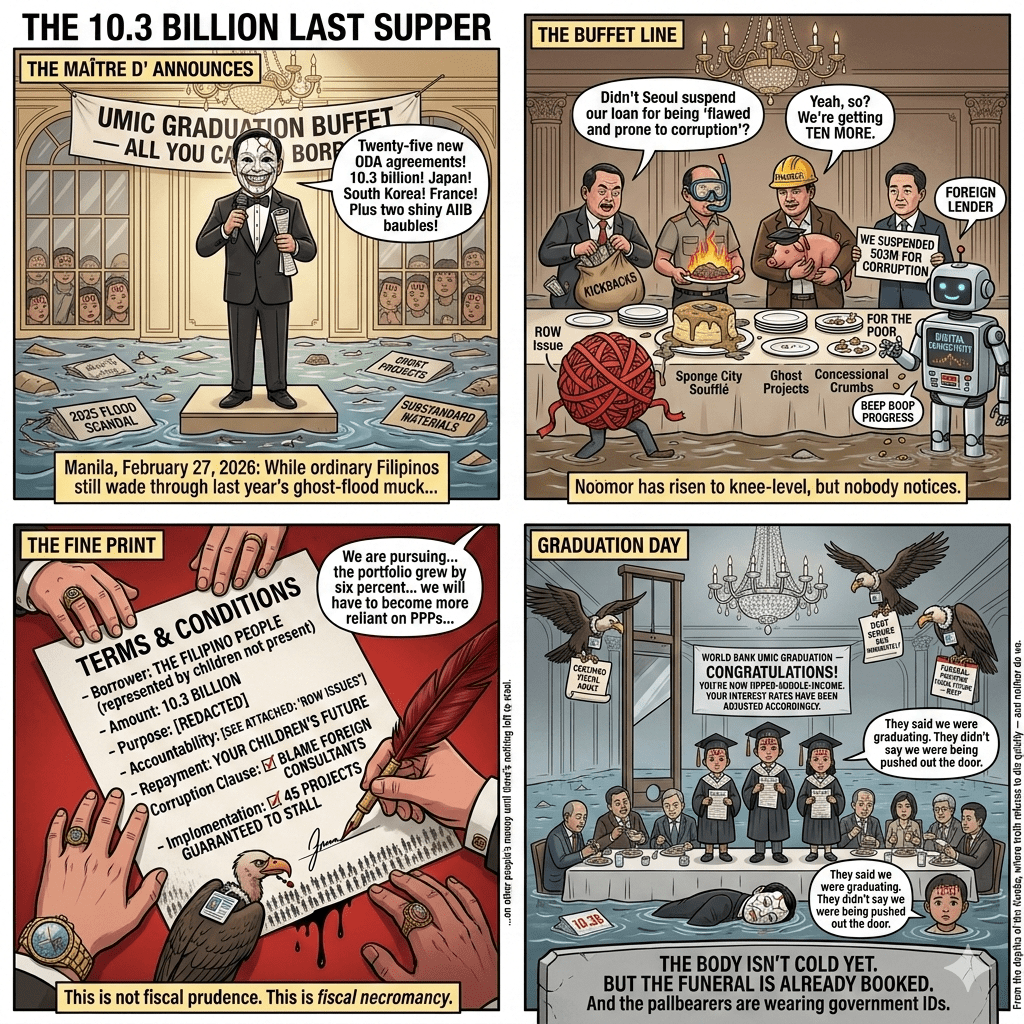
“Com0e for the concessional rates, stay for the generational debt”
Exhibit A: Frederick Go, the Polished Frontman
They call him the “safe, pro-business choice.” Of course they do. Appointed ad interim on November 17, 2025, right after the flood-control scandal detonated like a poorly built dike and swept away key figures’ credibility amid cabinet shake-ups. Go, former Robinsons Land CEO and Special Assistant to the President for Investment and Economic Affairs, arrived with the CV of a corporate suit and the timing of a getaway driver.
His defenders swoon: “Technocrat! Reformer! He’ll prosecute the flood crooks and recoup funds!” Sure. The same way he “vowed fiscal discipline” while announcing we’re about to sign ten more loans from the very South Korea that suspended a proposed $503 million (around ₱28.7 billion) infrastructure loan in September 2025 because the project was deemed “flawed and prone to corruption.”
Go’s public statements are masterpieces of passive voice. “We are pursuing…” “The portfolio grew by six percent…” “We will have to become more reliant on PPPs…” Never “I will smash the patronage networks that turned flood control into a multi-billion-peso ATM for congressmen and favored contractors.” Just spreadsheets and smiles.
Is he a reformer? Or the fresh coat of varnish slapped over the same termite-ridden mahogany of Philippine governance? History will decide, but the smart money — the money that isn’t being borrowed — says “convenient frontman.” A business guy to reassure investors while the ghosts of Malabon and Navotas still haunt the budget.
The Borrowing Strategy: Last Call at the Concessional Bar
The rationale is elegantly technocratic: “Lock in the cheap money before UMIC graduation.” Translation: the Philippines has been stuck in lower-middle-income purgatory since 1987 — longer than most millennials have been alive — and now, on the cusp of escaping, we’re doing what any self-respecting addict does: one last monster hit.
Compare us to our ASEAN neighbors, will you? Vietnam chases far less in foreign loans yet somehow builds high-speed rail and ports without the legendary right-of-way (ROW) alibis that have left 45 ODA projects moldering since 2021. Indonesia leans on domestic bonds and FDI, keeping debt-to-GDP prudently lower. Malaysia and Thailand have deeper capital markets; Singapore barely touches ODA at all. They learned the lesson we refuse: real development comes from internal strength, not from treating foreign lenders like sugar daddies who still haven’t noticed the missing jewelry.
Our ODA portfolio already sits at $39.6 billion as of 2024, with Japan alone committing $13.23 billion. And we want another $10.3 billion? This isn’t a “smart final harvest.” It’s a desperate raid on the cookie jar before the nutritionist (World Bank) bans sugar.
The Cancer: Corruption, Still Metastasizing
Here is the part no technocrat spreadsheet will ever capture: the 2025 flood-control scandal. Billions in “questionable insertions,” ghost projects, substandard materials that dissolved like wet tissue when typhoons arrived. Business groups — even the American Chamber — screamed for independent probes, blacklisting, prosecutions. South Korea listened. We didn’t.
And now we’re begging Seoul for ten more loans.
Approving $10.3 billion in new ODA without first jailing the flood-control plunderers is like handing the family silver to a known thief because “he promised to buy better locks next time.” ODA has become the perfect political shield: when the sponge city turns into a sponge for kickbacks, blame the foreign consultants. When digital connectivity becomes digital corruption, shrug and say “ROW issues.” The poor get flooded twice — once by typhoons, once by the loans that were supposed to save them.
The Tridemic of Doom
- Rising External Debt Burden
We’re not being strangled by success. We’re being slowly garroted by our own addiction to other people’s money. Debt service already crowds out health, education, and actual flood control. UMIC graduation won’t magically create fiscal adulthood; it will just make the interest rates higher. - Project Implementation Risks
Forty-five ODA projects stuck. The alibi? Right-of-way and procurement delays. Translation: politicians still treating public works as private ATMs. The “sponge city” will absorb public funds long before it absorbs floodwater. - The Corruption of ODA Itself
These loans come wrapped in “technical assistance” that too often becomes technical assistance in moving money offshore. Every suspended Korean loan, every halted deal — they’re warning flares we treat as fireworks.
The Utopian Demands (Because Someone Has To)
I demand — with the straight face of a man who knows it will never happen — that this government treat public money as if it belonged to the people who actually pay taxes.
Implement real risk-management tools that don’t live in Excel but in independent oversight boards with prosecutorial power. Transparency not as photo-op Senate “pledges of cooperation,” but as live-streamed bidding, published feasibility studies, and asset declarations updated hourly.
Demand genuine public service over ribbon-cutting culture. Build the damn flood gates before you cut the ribbon on the next “world-class” project that will leak like the last one.
Cynical Yet Practical Recommendations (Because Utopia Is Tired)
- Prosecute every named actor in the 2025 flood-control scandal — congressmen, contractors, DPWH officials — and recover every stolen peso before signing a single new loan. Non-negotiable. No prosecutions, no pesos.
- Amend the right-of-way laws so that “ROW issues” stop being the universal Get-Out-of-Jail-Free card for incompetence and collusion.
- Create an independent ODA Watchdog — outside DOF, outside Congress, with real teeth and foreign observers — that must certify every project as corruption-proof before a single centavo is released. Burden of proof on the proponents, not the public.
- Pivot now to genuine domestic revenue mobilization — stop the performative “war on tax evaders” that somehow never touches the big fish — and make PPPs actually competitive instead of crony playgrounds.
- Publish, in real time, the disbursement status of every existing ODA project. Let the sunlight disinfect what the floodwaters could not.
Mr. Go, your $10.3 billion press briefing was the sound of fiscal vultures circling the still-warm corpse of the country’s fiscal future. The Philippines isn’t graduating to upper-middle income. It’s being graduated — like a delinquent student being pushed out the door with a mountain of loans and a pat on the back.
The body isn’t cold yet. But the funeral is already booked.
And the pallbearers are wearing government IDs.
— Barok
From the depths of the Kweba, where truth refuses to die quietly—and neither do we.
Key Citations
- Inosante, Aubrey Rose. “Government seeks $10.3 billion ODA loan deals – Go.” The Philippine Star, 27 Feb. 2026.
- World Bank. “World Bank Country and Lending Groups.” World Bank Data Help Desk. Accessed 28 Feb. 2026.
- “Flood control projects scandal in the Philippines.” Wikipedia. Accessed 28 Feb. 2026.
- “South Korea suspends US$503 million loan to Philippines over corruption fears.” South China Morning Post, 12 Sept. 2025.
- “Philippine president names new finance minister in cabinet switch.” Reuters, 17 Nov. 2025.
- “Frederick Go.” Wikipedia. Accessed 28 Feb. 2026.
- Desiderio, Louella. “ODA-funded projects reach $39.6 billion in 2024.” The Philippine Star, 1 Aug. 2025.
- “Japan Remains PH Top Development Partner.” JICA, 8 Aug. 2025.

- “Forthwith” to Farce: How the Senate is Killing Impeachment—And Why Enrile’s Right (Even If You Can’t Trust Him)
- “HINDI AKO NAG-RESIGN!”

- “I’m calling you from my new Globe SIM. Send load!”

- “Mahiya Naman Kayo!” Marcos’ Anti-Corruption Vow Faces a Flood of Doubt

- “Meow, I’m calling you from my new Globe SIM!”

- “No Special Jail for Crooks!” Boying Remulla Slams VIP Perks for Flood Scammers
- “PLUNDER IS OVERRATED”? TRY AGAIN — IT’S A CALCULATED KILL SHOT

- “Several Lifetimes,” Said Fajardo — Translation: “I’m Not Spending Even One More Day on This Circus”

- “Shimenet”: The Term That Broke the Internet and the Budget

- “We Did Not Yield”: Marcos’s Stand and the Soul of Filipino Sovereignty

- “We Gather Light to Scatter”: A Tribute to Edgardo Bautista Espiritu

- $150M for Kaufman to Spin a Sinking Narrative

 KWEBA ni BAROK
Leave a comment